
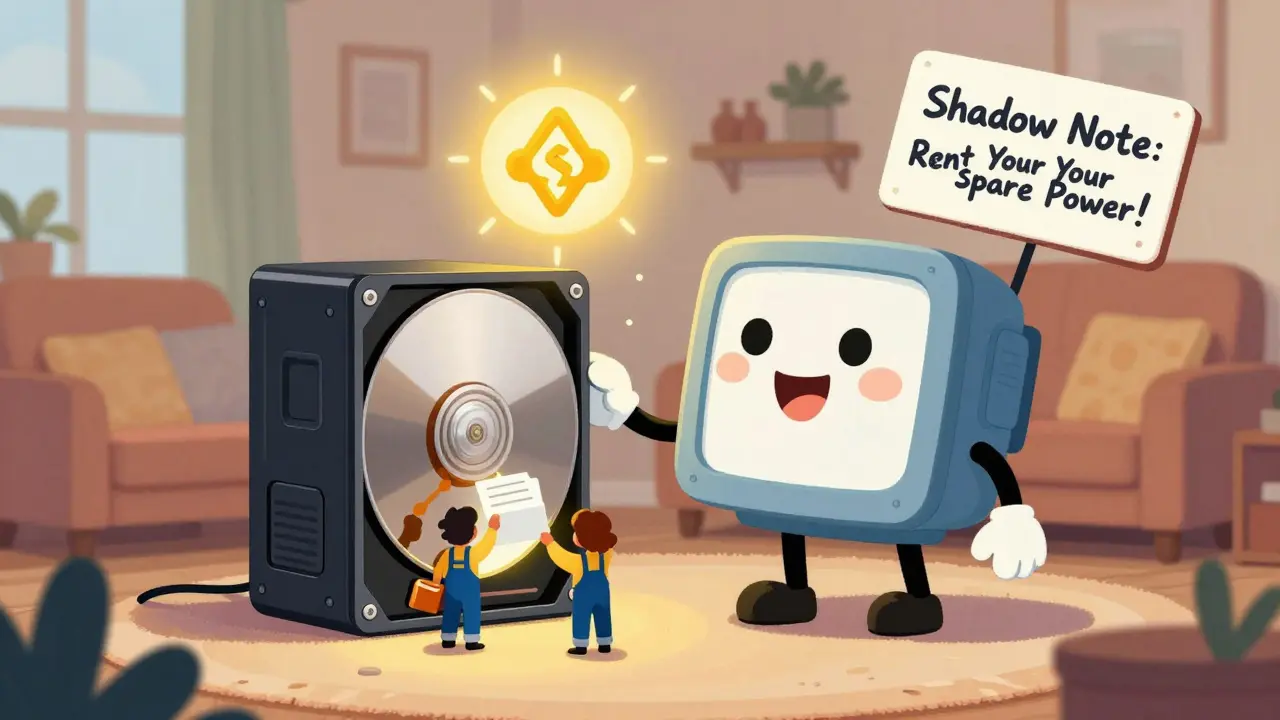
Shadow Token (SHDW) isn’t another meme coin or speculative gamble. It’s a utility token built to power a decentralized infrastructure network - think of it as Airbnb for cloud storage and computing, but run by thousands of ordinary people instead of a big tech company. If you’ve ever used Dropbox or AWS, Shadow Token is trying to replace those services with a system where you can rent out your spare hard drive space or unused CPU power and get paid in SHDW. It’s not about trading. It’s about using real hardware to build a new kind of internet.
How Shadow Token Actually Works
Shadow Token runs on the Solana blockchain, which means transactions are fast and cheap - crucial when you’re paying for tiny bits of storage or compute power every second. The core of the system is called DAGGER, a custom network layer designed to coordinate storage and computing resources across thousands of individual devices. Unlike Filecoin, which only handles storage, or Render Network, which only handles GPU power, Shadow Token combines both - plus network bandwidth - into one platform.
Here’s how it works in practice:
- You install the Shadow Node software on a computer with at least 32GB RAM, 1TB NVMe storage, and a 1Gbps internet connection.
- You stake 10,000 SHDW tokens to lock your node into the network.
- When someone else needs to store a file or run a small program, the DAGGER network assigns that task to your node.
- You earn SHDW tokens in return - proportional to how much you contribute.
This isn’t mining. There’s no energy-heavy proof-of-work. It’s more like renting out your garage to a neighbor. You’re not creating new tokens - you’re earning rewards for giving up your spare resources.
Market Data and Supply
As of January 2026, there are exactly 169,057,206 SHDW tokens in circulation. That’s the total supply - no more will ever be created. No tokens were reserved for founders, no team allocations, no private sales. All tokens were distributed through early network participation. This fixed supply model is rare in crypto and gives the token a deflationary structure by default.
Prices vary wildly depending on the exchange:
- Kraken: $0.046 (down 6% in 24 hours)
- Gate.com: $0.057
- CoinGecko: $0.107 (based on higher-volume trades)
Market cap ranges from $7.8M to $18.2M depending on the source - a sign of low liquidity. Daily trading volume hovers around $12K-$14K. That means if you try to sell more than $500 worth at once, you’ll likely see slippage of 5% or more. It’s not a liquid market. You can’t buy or sell large amounts without moving the price.
Why It’s Different From Filecoin or Render
Filecoin lets you rent storage. Render lets you rent GPU time. Shadow Token does both - and adds network orchestration. That means if you’re running a decentralized app that needs to store data, process it, and send it somewhere else, you can do it all on one network. No switching between platforms. No complex integrations.
But here’s the catch: Shadow Token is tied to Solana. If Solana goes down, Shadow goes down. Filecoin runs on IPFS and Ethereum, so it’s more resilient. Render works across multiple chains. Shadow doesn’t. That’s a major limitation. It’s fast and cheap today - but it’s also fragile.
Compare the numbers:
| Project | Market Cap | Primary Function | Multi-Chain? | Active Apps |
|---|---|---|---|---|
| Shadow Token (SHDW) | $7.8M-$18.2M | Storage + Compute + Network | No (Solana-only) | 47 |
| Filecoin (FIL) | $2.1B | Storage | Yes | 289 |
| Render Network (RNDR) | $1.3B | GPU Compute | Yes | 156 |
| Akash Network (AKT) | $480M | Compute | Yes | 121 |
Shadow Token’s biggest weakness isn’t the tech - it’s the ecosystem. Filecoin has 52,000+ Discord members. Shadow has 3,500. Render has 38,000. Shadow’s community is small, technical, and quiet. That’s not a good sign for long-term growth.

Who Uses Shadow Token?
Not retail investors. Not speculators. Real developers.
According to Solana blockchain analytics, 83% of SHDW transactions are directly tied to storage or compute services - not trading. That’s unusually high. Most crypto tokens see 90%+ speculative trading. Shadow is different. People are using it to run actual applications.
Examples:
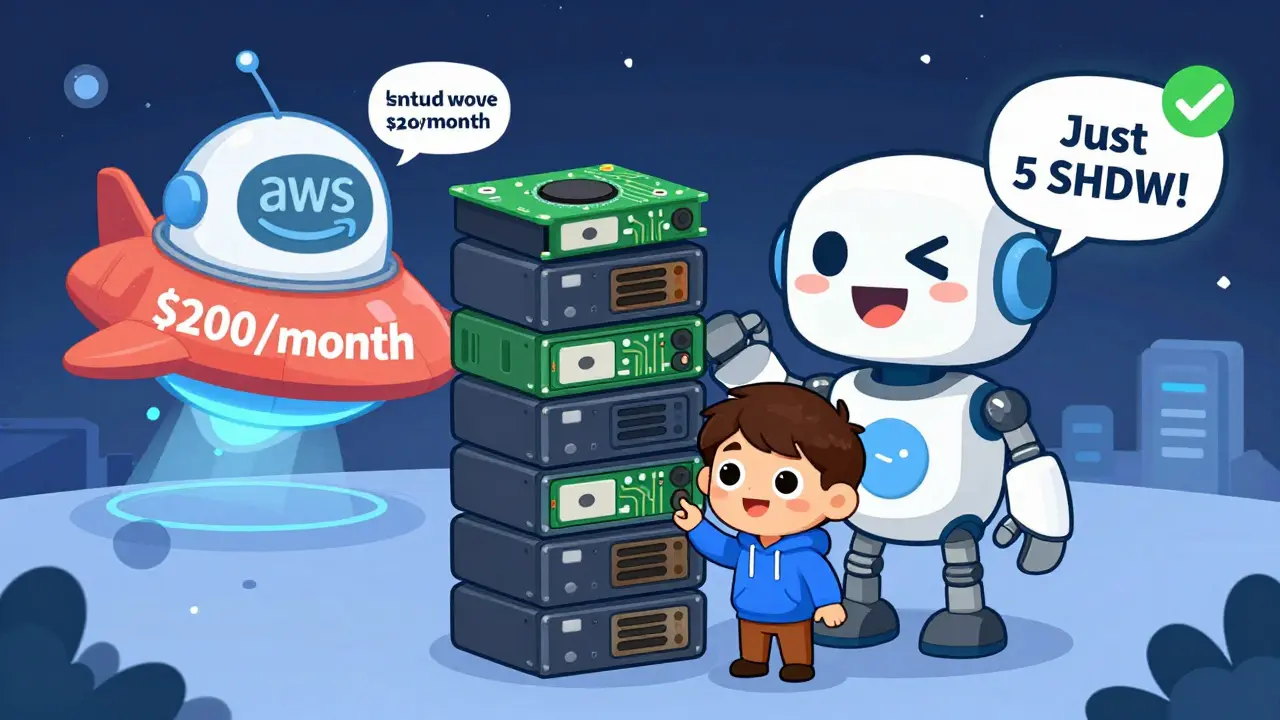
- A small AI startup uses Shadow Drive to store training data instead of paying AWS $200/month.
- A decentralized video platform runs video encoding on Shadow nodes, cutting costs by 40%.
- A researcher in Berlin uses the network to run simulations without relying on university servers.
One developer on Gate.com reported retrieval speeds 30% faster than competitors for files under 100MB. That’s meaningful for apps that need quick access to data.
The Risks
Shadow Token isn’t for everyone. Here’s what you’re getting into:
- Low liquidity: You can’t easily buy or sell large amounts without hurting the price.
- Solana dependency: If Solana has a network outage, Shadow stops working.
- Anonymous team: No one knows who built it. No LinkedIn profiles. No public faces. That’s common in crypto - but it raises red flags for enterprise users.
- High barrier to entry: You need $575+ in SHDW just to run a node. Most people can’t afford that.
- Poor documentation: Enterprise integration guides are sparse. Developers report 2-3 weeks just to get started.
Regulators haven’t cracked down yet - but the SEC’s 2025 guidance on dePIN tokens says any token that pays users for providing infrastructure could be classified as a security if the rewards look like an investment contract. Shadow’s model is borderline. If regulators decide to act, it could be a problem.
What’s Next for SHDW?
The roadmap is focused on survival - not hype.
- Q2 2026: Cross-chain support (Ethereum, Polygon)
- Q3 2026: Mobile node support (run a node from your phone)
- Q4 2026: Integration with Solana’s Firedancer validator client (faster, more stable network)
- Now: DAGGER Enterprise - a private version for corporations to run their own secure, internal Shadow networks
If they pull off cross-chain support, Shadow could grow fast. If they don’t, they’ll stay stuck in Solana’s tiny corner of crypto.
Should You Buy SHDW?
Only if:
- You’re a developer who needs cheap, decentralized storage and compute.
- You already hold Solana and want to support its ecosystem.
- You’re okay with holding a low-liquidity, high-risk token for years - not months.
Don’t buy it if:
- You’re looking for quick profits.
- You don’t understand how decentralized infrastructure works.
- You expect it to hit $1 or $10 anytime soon.
Shadow Token isn’t a get-rich-quick play. It’s a bet on the future of decentralized infrastructure. And that future is still being built - slowly, quietly, by a small group of developers.
Is Shadow Token (SHDW) a good investment?
It’s not an investment in the traditional sense. SHDW doesn’t pay dividends, doesn’t have a company behind it, and doesn’t promise returns. It’s a utility token used to pay for decentralized storage and compute. If you believe in the future of dePIN networks and think Shadow can grow beyond Solana, then holding SHDW makes sense. But if you’re hoping for a 10x return next year, you’re likely to be disappointed. The market is too small and illiquid for that kind of movement.
Can I mine Shadow Token?
No, you can’t mine SHDW. There’s no mining in this system. Instead, you earn SHDW by running a Shadow Node - contributing your computer’s storage, bandwidth, or processing power to the network. You need to stake 10,000 SHDW to qualify, and then you earn rewards based on how much you contribute. It’s more like renting out your hardware than mining.
Where can I buy SHDW tokens?
SHDW is available on a few exchanges: Kraken, Gate.com, and Bitrue. It’s not on Coinbase, Binance, or other major platforms. Because trading volume is low, prices vary significantly between exchanges. Always check multiple sources before buying. Use limit orders - market orders can lead to big losses due to slippage.
How do I run a Shadow Node?
To run a Shadow Node, you need: a computer with 32GB RAM, 1TB NVMe SSD, and a 1Gbps internet connection. You must stake 10,000 SHDW tokens. Then, download and install the official Shadow Node software from docs.shadow.io. The setup is technical - it’s not plug-and-play. Most users report needing 2-3 weeks to get everything working smoothly, especially if you’re new to Solana. Community support is limited, so expect to troubleshoot on your own.
Is Shadow Token safe?
The technology is secure - DAGGER uses a hierarchical data model to protect integrity. But safety isn’t just about code. The team is anonymous, which means no one is legally accountable if things go wrong. The network has never been hacked, but it’s also not widely audited. If you’re using SHDW for enterprise purposes, you’re taking on more risk than you would with a well-known provider like AWS or Filecoin. For personal use, the risk is manageable - but treat it like a beta product, not a finished service.
What’s the difference between SHDW and Filecoin?
Filecoin is purely a decentralized storage network. Shadow Token does storage, compute, and network orchestration - all in one. Filecoin works across multiple blockchains. Shadow is locked to Solana. Filecoin has a $2.1B market cap and 289 active apps. Shadow has under $20M and 47 apps. Filecoin is mature. Shadow is experimental. If you just need to store files, Filecoin is better. If you need to store AND process data on a fast, cheap network - and you’re okay with being on Solana - then Shadow might be worth trying.
Tammy Goodwin
I love how this project is quietly building something real instead of chasing hype. I run a node in my basement and honestly, it’s been a great way to make a little passive income while supporting decentralization. No drama, just tech.
Nadia Silva
This is the kind of project that makes me wonder why anyone still uses AWS. The fact that it’s Solana-only is a dealbreaker for enterprise, but for developers who care about efficiency over brand names? It’s brilliant.
Andy Marsland
Let’s be real - the entire dePIN space is a house of cards built on the assumption that people will voluntarily give up their bandwidth and storage for token rewards. The only reason this works is because gas fees on Solana are still cheap. Once they rise, or if Solana has another 3-day outage, this whole thing collapses. And don’t get me started on the anonymous team. No accountability. No legal recourse. This isn’t innovation - it’s a gamble dressed up as infrastructure.
Anna Topping
I think what’s beautiful here is how it flips the script. Instead of Big Tech hoarding resources, we’re all just… sharing. Like a digital potluck. I used to pay $150/month for cloud compute. Now I run a node, earn SHDW, and pay less than $30. It’s not about the money - it’s about feeling like part of something that actually works.
katie gibson
I’m not saying it’s a scam but… who *really* built this? No names, no faces, no LinkedIn profiles. And the docs are a mess. I spent 3 weeks trying to get my node running and ended up just giving up. This feels like a beta built by someone who hates users.
Ashok Sharma
For developers in developing countries, this is a game-changer. I run a small AI startup in India and Shadow Node lets me avoid paying in USD. The liquidity is low, yes, but the cost savings are real. This is practical tech, not speculation.
Margaret Roberts
You know who benefits most from this? The people who already have 10k SHDW. The rest of us are just renting out our hardware for pennies while the early adopters cash out. This isn’t decentralization - it’s a pyramid scheme with better hardware requirements.
Tselane Sebatane
I’ve been running a Shadow Node for 8 months now. I started with just a spare laptop and ended up upgrading to a proper rig because the rewards were too good to ignore. It’s not glamorous, but it’s real. I’ve paid for my daughter’s school supplies with SHDW earnings. This isn’t crypto fantasy - it’s real life, happening right now.
Jonny Lindva
I ran into some issues with my node and posted in the Discord - got a reply from someone who’d been doing it for a year. No corporate support, but the community is actually helpful. That’s rare. I’d rather have real people helping than a ticket system.
Harshal Parmar
Honestly, I was skeptical at first. But after I saw how fast my files loaded compared to AWS, I was sold. The 30% speed boost on small files? That’s huge for my app. And the fact that no one owns this? That’s the future. We don’t need Silicon Valley middlemen anymore.
Darrell Cole
You people are delusional. This is just another way to get people to give away their resources for free while a handful of insiders hold the keys. And you think the SEC won’t come after this? Please. They’re already watching. This isn’t innovation - it’s regulatory suicide.
Dave Ellender
I appreciate the depth of this breakdown. Most crypto posts are pure hype. This one actually lays out the tradeoffs. That’s rare and valuable.
Linda Prehn
I tried to run a node and the setup process made me cry. I’m not a dev. Why is everything in crypto so hostile to normal people? This isn’t empowering - it’s exclusionary.
Adam Lewkovitz
Solana-only? In 2026? That’s not innovation, that’s laziness. If you’re serious about decentralization, you don’t lock yourself into one chain. This is like building a house on a fault line and calling it ‘resilient’.
Clark Dilworth
The DAGGER protocol’s hierarchical data model is actually a brilliant abstraction layer for distributed compute. It’s not just storage - it’s a stateful orchestration layer that’s been underappreciated. Most competitors are still stuck in the ‘dumb storage’ paradigm.
Brenda Platt
Y’all are underestimating how powerful this is for indie devs 🌟 I used to pay $200/mo on AWS. Now I pay $25 in SHDW and I’m not even maxing out my node. This is the future of web3 infrastructure - quiet, real, and actually useful. Keep building!
Barbara Rousseau-Osborn
Anonymous team? No audits? Low liquidity? You’re all just chasing a fantasy. This isn’t a project - it’s a Ponzi dressed up in technical jargon. I’ve seen this movie before. It ends with a rug pull and a bunch of people crying on Twitter.
george haris
I’m just curious - how many people here are actually running nodes vs. just holding SHDW for speculation? The post says 83% of transactions are usage-based, but I wonder if that’s skewed by devs who use it daily.
David Zinger
You think Filecoin is mature? It’s bloated, slow, and overpriced. Shadow is the future. Solana’s speed makes this possible. You hate it because you’re stuck in the Ethereum mindset. Adapt or get left behind.
carol johnson
I’m not even going to try to run a node. It’s too much work. But I bought 500 SHDW because I believe in the vision. If this takes off, I win. If it dies? I lost $30. Worth the gamble.