
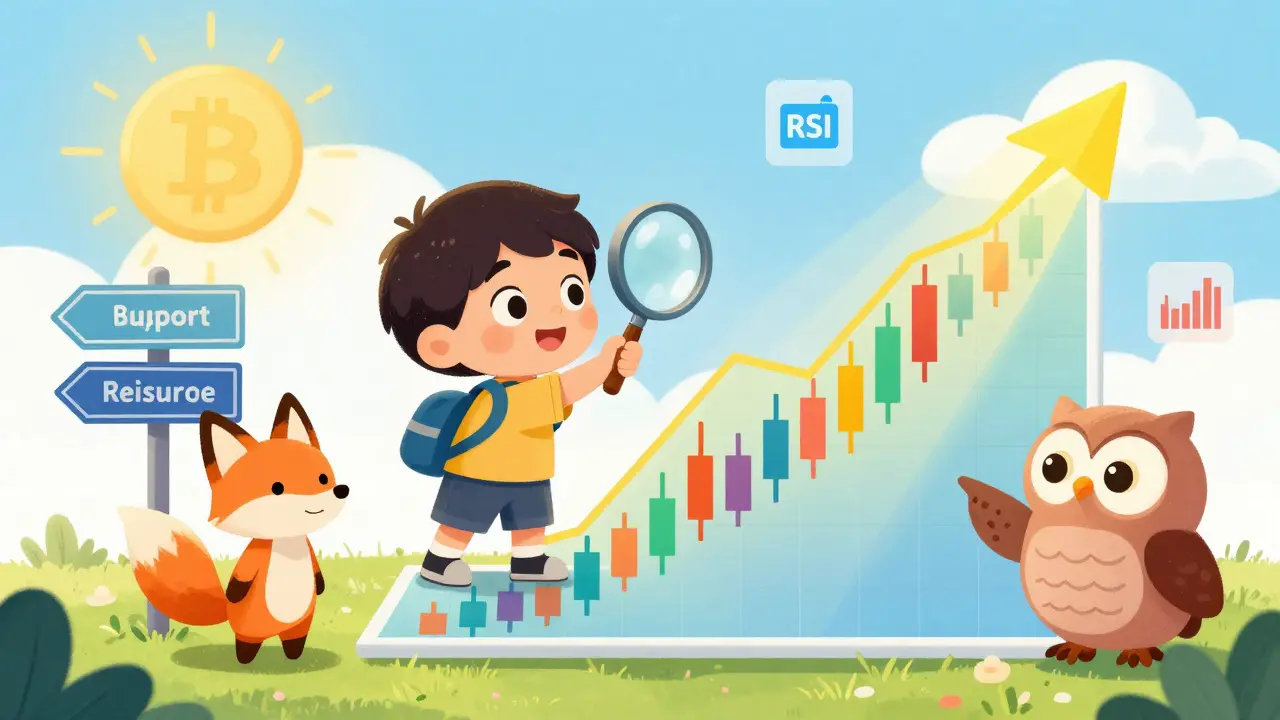
Technical analysis for cryptocurrency isn't magic. It's not about predicting the future with crystal balls or astrology. It's about reading what the market has already told you through price and volume - and using that to make smarter trading decisions. If you've ever looked at a Bitcoin chart and wondered why prices keep bouncing off a certain level, or why a sudden spike happens after a dip, you're already seeing technical analysis in action.
How Technical Analysis Works in Crypto
At its core, technical analysis (TA) is the study of historical price movements and trading volume to forecast future price trends. Unlike fundamental analysis - which asks, "What is this coin worth?" - technical analysis asks, "What is this coin doing right now?"
The idea is simple: markets move in trends, and those trends are shaped by human behavior. Fear and greed don't disappear just because the asset is digital. When thousands of traders see the same chart pattern, they tend to react the same way - buying at support, selling at resistance. That collective behavior creates repeatable patterns.
These patterns aren't guaranteed. But they're statistically useful. According to Kraken's 2024 backtesting data, when three technical indicators all point in the same direction - say, a Golden Cross, rising volume, and an RSI breakout - the signal is correct 82% of the time. That’s not perfect, but it’s better than flipping a coin.
Five Core Assumptions Behind Technical Analysis
Technical analysis rests on five key beliefs - not theories, but working assumptions that traders rely on daily:
- Market action discounts everything. All known information - news, rumors, regulations, even tweets from Elon Musk - is already reflected in the price.
- Prices move in trends. Whether up, down, or sideways, price doesn’t bounce randomly. It follows paths shaped by momentum.
- History repeats itself. Human psychology doesn’t change. Panic selling in 2018 looked a lot like panic selling in 2022. The same patterns show up again.
- Chart patterns have predictive value. Head and shoulders, double bottoms, cup and handle - these aren’t just shapes. They’re signals that traders recognize and act on.
- The market is always right. Even if you think a coin is overvalued, if the price keeps rising, the market says otherwise. Your job isn’t to argue with the chart - it’s to respond to it.
These assumptions aren’t taught in finance textbooks. They’re learned in the trenches - through losses, wins, and watching charts for hours.
Essential Tools Every Crypto Trader Needs
You don’t need fancy software to start. Most exchanges - Binance, Coinbase Pro, Kraken - give you free charting tools. But here are the five tools that matter most:
- Support and Resistance Levels - These are price zones where buying or selling has historically been strong. Support is the floor; resistance is the ceiling. When price breaks through resistance, it often becomes the next support level. Traders watch these like clockwork.
- Trend Lines - Draw a line connecting swing lows (for uptrends) or swing highs (for downtrends). If price keeps respecting the line, the trend is alive. Break the line? The trend might be reversing.
- Moving Averages (50-day and 200-day) - These smooth out price data to show the general direction. The 50-day crossing above the 200-day is called a Golden Cross - a bullish signal. The opposite - Death Cross - is bearish. In 2024, CoinGlass data showed these crossovers preceded 78% of major Bitcoin rallies.
- Relative Strength Index (RSI) - This oscillator runs from 0 to 100. Above 70? Overbought. Below 30? Oversold. But here’s the catch: in strong trends, RSI can stay overbought for weeks. It’s not a sell signal - it’s a warning.
- Bollinger Bands - Two lines around a moving average that expand and contract with volatility. When price hits the upper band, it’s often overextended. When it hugs the lower band, buyers may step in. The squeeze - when bands tighten - often precedes big moves.
These aren’t magic wands. They’re tools. Like a hammer. You don’t build a house with just a hammer - but you can’t build one without one.

Technical Analysis vs. Fundamental Analysis
Many new traders get stuck comparing TA to fundamental analysis. Here’s the difference:
| Aspect | Technical Analysis | Fundamental Analysis |
|---|---|---|
| Focus | Price action, volume, chart patterns | Team, technology, adoption, utility |
| Timeframe | Short-term (minutes to months) | Long-term (6+ months to years) |
| What it answers | "Is the price rising or falling?" | "Is this project worth holding?" |
| Best for | Day trading, swing trading | Long-term investing, HODLing |
| Weakness | Blind to news shocks (e.g., bans, regulations) | Too slow for volatile price swings |
Think of it this way: technical analysis tells you when to enter or exit. Fundamental analysis tells you what to buy. The best traders use both - but not at the same time.
Real-World Successes and Failures
Technical analysis isn’t just theory. People make real money with it - and lose real money too.
One trader on Reddit turned $1,000 into $15,000 in 2024 by combining Fibonacci retracements at the 61.8% level with volume spikes on 4-hour Bitcoin charts. He didn’t care about news. He watched price action. When volume surged as price pulled back to that level, he bought. When it broke above, he held. Simple. Effective.
But another trader lost $20,000 because he relied on the "head and shoulders" pattern after Ethereum announced a partnership with AWS. The chart looked perfect - shoulders formed, neckline broke. He sold. Then Ethereum jumped 40% in 48 hours. Why? Because the market didn’t care about his pattern - it cared about the partnership. Technical analysis missed the fundamental catalyst.
That’s the risk. TA works best when the market is driven by traders - not headlines. During Bitcoin’s 2021 bull run, TA was golden. During China’s 2021 ban, it failed. The market doesn’t care about your indicators when a government shuts down trading.

Common Mistakes and How to Avoid Them
Most beginners fail not because TA is flawed - but because they misuse it.
- Indicator overload. Using five oscillators at once? You’re not being thorough - you’re being confused. A 2025 CryptoQuant study found traders using more than 3 indicators had 34% lower profitability. Stick to 1-3. Master them.
- Wrong timeframe. Looking at a 5-minute chart to decide if you should hold Bitcoin for a year? That’s like checking the weather every hour to plan your vacation. Start with the weekly chart to see the big trend. Then drop to daily. Then 4-hour for entry.
- Ignoring context. An RSI over 70 doesn’t mean "sell." In a strong uptrend, it just means "hold." Always ask: "Is this a trend or a trap?"
- Trading without a plan. If you don’t know your entry, exit, and stop-loss before you click buy, you’re gambling. Not trading.
Pro tip: Use TradingView’s free tier. Watch 100 charts. Just watch. Don’t trade. See how patterns repeat. That’s how you build intuition.
The Future of Technical Analysis in Crypto
TA isn’t dying - it’s evolving.
Platforms like TradingView now offer crypto-specific tools: funding rate heatmaps, open interest trends, and perpetual futures data overlaid on price charts. Kraken’s 2025 update lets you see on-chain metrics like NUPL (Net Unrealized Profit/Loss) right on your candlestick chart. That’s not replacing TA - it’s enhancing it.
AI is entering too. TrendSpider, a platform funded with $22 million, uses machine learning to auto-detect chart patterns with 89% accuracy. But here’s the catch: AI finds patterns humans miss - but humans still decide what those patterns mean.
The future belongs to traders who combine technical signals with on-chain data. If RSI is overbought AND exchange outflows are rising? That’s a stronger signal than either alone.
Meanwhile, as institutional investors pour into crypto - thanks to Bitcoin ETFs approved in 2024 - price movements are becoming less chaotic. That makes TA more reliable. Less noise. More clarity.
Where to Start
If you’re new, here’s your 30-day plan:
- Week 1: Open TradingView. Learn to read candlesticks. What does a long wick mean? What’s a doji?
- Week 2: Draw support and resistance on Bitcoin’s weekly chart. Watch how price reacts. Don’t trade. Just observe.
- Week 3: Add the 50-day and 200-day moving averages. Look for Golden Crosses. Write down what happened next.
- Week 4: Add RSI. See how it behaves in uptrends vs. sideways markets.
By the end of 30 days, you’ll know more than 80% of new traders. You won’t be profitable yet - but you’ll stop guessing. And that’s half the battle.
Is technical analysis reliable for cryptocurrency?
Yes - but only if used correctly. Technical analysis works because crypto markets are driven by human psychology, which creates repeatable patterns. However, it fails during major news events like regulatory bans or exchange collapses. The most reliable signals come when multiple indicators align - like a Golden Cross with rising volume and a breakout above resistance. Single indicators have low accuracy. Combined signals improve success rates to over 80%.
Do I need to pay for tools to do technical analysis?
No. Most major exchanges - Binance, Coinbase Pro, Kraken - offer free charting tools with basic indicators like moving averages, RSI, and support/resistance lines. TradingView’s free tier is more than enough to start. Paid plans ($14.95/month) unlock advanced features like alerts and custom scripts, but you don’t need them to learn or make profitable trades. Many top traders use only free tools.
Can technical analysis predict Bitcoin’s next price movement?
No tool can predict the future with certainty. Technical analysis gives you probabilities - not certainties. For example, if Bitcoin forms a "cup and handle" pattern on the weekly chart and volume surges as it breaks out, historical data shows a high chance of a significant rally. But if a major regulatory announcement drops the same day, all technical signals can be overridden. TA helps you assess risk, not eliminate it.
Why do some experts say technical analysis is "astrology"?
Critics like economist Dr. Nouriel Roubini argue that past price patterns have no causal link to future moves - especially in unregulated, emotionally driven markets like crypto. Their point is valid: if a government bans trading, no chart pattern can save you. But this view ignores the behavioral side of markets. Human traders still react to the same patterns. Studies show that when thousands of traders see a "head and shoulders" formation, they often sell - making it self-fulfilling. It’s not magic. It’s psychology.
How long does it take to learn technical analysis?
Most beginners reach basic proficiency in 3-6 months with consistent practice. The first 4-6 weeks should focus on reading candlesticks, identifying support/resistance, and understanding moving averages. After that, adding RSI and volume analysis helps. The real learning happens when you start watching charts without trading - just observing how price behaves. Many traders say they didn’t truly understand TA until after their first major loss.
Should I use technical analysis for long-term investing?
Not as your main strategy. Long-term investing (HODLing) should be based on fundamentals: team, adoption, tokenomics, and real-world utility. Technical analysis can help you time your entry - like waiting for a major dip before buying - but it shouldn’t drive your decision to hold for years. If you’re holding Bitcoin for 5 years, you care more about its network growth than whether the 50-day MA crossed the 200-day.
Technical analysis won’t make you rich overnight. But it will give you a framework to stop guessing - and start seeing. In a market as wild as crypto, that’s worth more than any indicator.
Danny Kim
I've been watching charts for years and honestly? The best signal is when volume spikes on a pullback to a strong support level. No fancy indicators needed. Just watch how price reacts. It's like watching a crowd at a concert - you don't need a mic to know when the crowd's about to lose it.
Richard Cooper
I just buy when it goes up sell when it goes down thats it
Tanvi Atal
TA is just gambling with charts. Real traders use on-chain data. You're wasting time.
Sony Sebastian
You're missing the point entirely. TA without on-chain metrics is like driving blindfolded. Volume spikes mean nothing if the whale wallets aren't moving. Look at the Puell Multiple, the MVRV Z-Score, and the SOPR - those are the real indicators. Everything else is noise.
Brian Lemke
I love how this post breaks it down so clearly. I started with just candlesticks and support/resistance - no indicators. After three months of watching, not trading, I finally saw the rhythm. It’s like learning a language. You don’t memorize grammar first - you listen until it clicks. Now I use RSI and Bollinger Bands, but I still check the raw chart first. The market whispers before it shouts.
Mae Young
Oh, so now technical analysis is ‘psychology’? That’s just a fancy word for ‘I believe in magic because I lost money last time I didn’t.’ If patterns were real, why do they vanish the second a single tweet drops? Why does every ‘Golden Cross’ in 2022 get obliterated by a Fed announcement? This isn’t science - it’s astrology with a spreadsheet.
Cathy Sunshine
I used to be so obsessed with indicators. I’d have 7 open on my chart, each screaming at me in different colors. Then I had a breakdown - literally. Sat there for 3 hours staring at a 4-hour Bitcoin chart, crying because I’d lost $12k on a ‘perfect’ head and shoulders. The truth? The market doesn’t care about your feelings. It doesn’t care about your indicators. It only cares about your discipline. I stopped trading. I started observing. Now I only enter when I feel calm. Not excited. Not anxious. Calm. That’s the only indicator that matters.
Kenneth Genodiala
It's amusing how people treat TA like some sacred scripture when it's essentially just pattern recognition - a cognitive bias masquerading as strategy. The fact that 82% success rate is even cited as impressive speaks volumes about the intellectual bankruptcy of retail traders. In any real financial market, a 17% failure rate would get you fired. And yet here we are, celebrating a coin toss with candlesticks. The only thing more delusional than believing in support levels is believing that others believe in them.
Michael Teague
I tried TA. It didn't work. I lost money. Now I just buy when I see news. Simple. No charts. No stress.
Dee Resin
I love how people treat RSI like a god. Overbought? Sell. Oversold? Buy. Except when it’s not. Like when BTC goes from 70 to 90 and stays there for weeks. Then what? You just quit? Nah. You get out because you’re scared. Not because the indicator said so. The indicator didn’t fail. You did.
Cory Derby
It's important to remember that technical analysis isn't meant to predict - it's meant to inform. Think of it like a weather radar. It won't tell you if it's going to rain tomorrow, but it can show you where the storm clouds are gathering. If you're holding for years, you don't need the radar. But if you're navigating daily, it's invaluable. The key is knowing which tool to use - and when to step away.
kati simpson
I think a lot of people get caught up in the tools and forget that the real skill is in patience. I used to think I had to be in every trade. Now I wait. Sometimes for weeks. I look at the chart, I see the pattern, I wait for the volume to confirm, and then I move. Most of the time, I don’t even enter. And that’s okay. The market will be there tomorrow. It always is.
Michael Rozputniy
They say TA works because of human behavior... but what if the whole market is being manipulated by algos? What if the 'patterns' are just bait set by hedge funds to trap retail traders? I've seen too many 'Golden Crosses' that turned into traps right after I bought. I'm starting to think the whole thing is a psyop. The charts aren't reflecting truth - they're reflecting manipulation. And the more people believe in them... the easier it is to control them.
Cheryl Fenner Brown
I just use the 50 and 200 MA and RSI 🤷♀️✨ and boom i make money sometimes 😌📈
Shannon Black
In India, we’ve been trading commodity futures for centuries using similar principles. The markets may be digital now, but human nature hasn’t changed. The difference? We didn’t call it ‘technical analysis.’ We called it reading the market’s pulse. It’s not about tools - it’s about awareness. And awareness doesn’t come from software. It comes from watching.
Trenton White
I’ve watched 200+ charts on TradingView. No trades. Just watched. Saw the same patterns repeat. The same reactions. The same panic. The same euphoria. It’s not about predicting. It’s about recognizing. And recognition - that’s the edge.
Megan Lavery
I started with TA because I was scared of missing out. Now I use it because it gives me structure. I don’t need to be right every time. I just need to be consistent. Stop-loss. Take-profit. One trade at a time. It’s not about being a genius. It’s about showing up. And honestly? That’s the real secret.