

When you hear "xUSD," it might sound like just another crypto token. But it's not one coin-it's multiple different stablecoins using the same name. Each one works differently, lives on different blockchains, and serves unique purposes. If you're trying to understand what xUSD is and whether it’s useful for you, you're not alone. Many people get confused because there's no single xUSD. Let’s cut through the noise and break down exactly what xUSD means in practice today.
There’s No Single xUSD-Here’s Why
The term "xUSD" isn’t trademarked or owned by one company. Instead, several independent projects have adopted it to name their dollar-pegged stablecoins. That means if someone says "I bought xUSD," you need to ask: which one? Because CrossFi’s xUSD and StraitsX’s XUSD are completely different systems with different rules, risks, and use cases.
Think of it like "Bitcoin" and "Litecoin." Both are cryptocurrencies, but they’re not the same thing. Same with xUSD. There are at least three major versions in active use, each built for different reasons.
1. CrossFi’s xUSD: Algorithmic, Collateralized, and Built for DeFi
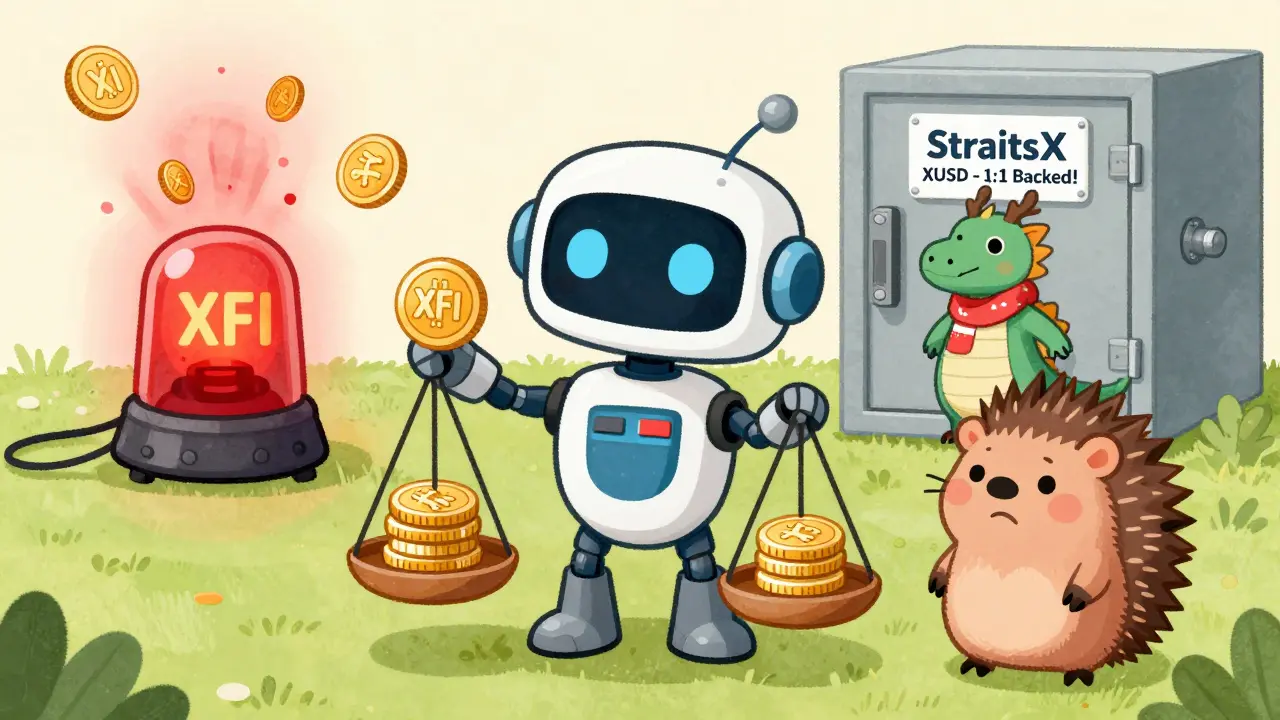
On the CrossFi Chain, xUSD is an algorithmic stablecoin that doesn’t hold real U.S. dollars in a bank. Instead, it’s backed by cryptocurrency-specifically, XFI tokens, the native coin of the CrossFi network.
To create xUSD, you lock up XFI as collateral. But here’s the catch: you need to deposit at least three times the value of the xUSD you want to mint. So if you want 100 xUSD, you must lock up $300 worth of XFI. This 300% ratio is way higher than most stablecoins, which often use 150% or even 110%. Why? To protect against price swings. If XFI’s value drops suddenly, the system still has enough cushion to stay solvent.
But if things go south, the system kicks in. If your collateral value falls below 200% of your xUSD debt, your position gets liquidated. That means part of your XFI is automatically sold to pay back the xUSD you borrowed. It’s not a penalty-it’s a safety feature. The whole design is meant to keep xUSD at $1, even if crypto markets crash.
This version of xUSD is built for DeFi users. You can use it to lend, borrow, stake, or add liquidity to trading pools on CrossFi. It’s also the only currency you can swap into xAssets (like xBTC or xETH) on the Haven Protocol, making it a bridge between crypto and tokenized assets.
2. StraitsX USD (XUSD): Regulated, Fiat-Backed, and Built for Payments
Now flip the script. StraitsX USD (written as XUSD) is a completely different beast. It’s not backed by crypto. It’s backed by real U.S. dollars held in regulated bank accounts in Singapore.
If you want XUSD, you deposit actual USD into StraitsX’s platform. Once confirmed, they issue you the same amount of XUSD tokens on the blockchain-either Ethereum (ERC-20) or BNB Smart Chain (BEP-20). To cash out, you send XUSD back, and they return your USD. It’s a 1:1 swap. No algorithm. No collateral. Just digital dollars on a blockchain.
This version is all about speed and cost. Traditional bank transfers, especially across borders, can take 3-5 days. With XUSD, you can send money to someone in Indonesia or the Philippines in under a minute, for pennies. It’s designed for Southeast Asian markets where remittances are huge, and traditional banking is slow and expensive.
Unlike many crypto projects, StraitsX follows Singapore’s financial laws. That means they’re audited, licensed, and compliant. If you’re tired of dealing with unregulated crypto, this version feels more like a digital bank account than a DeFi experiment.
3. Haven Protocol’s xUSD: The Gateway to Tokenized Assets
Then there’s Haven Protocol’s xUSD. It’s not meant for trading or payments. It’s meant for conversion. Haven’s entire system is built around tokenizing real-world assets-like gold, oil, or even stocks-into digital form. And xUSD is the only currency you can use to do that.
To create xUSD here, you burn XHV tokens (Haven’s native coin) equal to the USD value you want. So if you burn $100 worth of XHV, you get $100 in xUSD. You can then turn that xUSD into xAssets like xGOLD or xBTC. It’s a closed loop. xUSD doesn’t trade on exchanges. It doesn’t earn interest. It’s just a tool to move between crypto and tokenized assets.
How xUSD Compares to USDC and USDT
You’ve probably heard of USDC or USDT. They’re the giants of stablecoins. So how does xUSD stack up?
| Feature | CrossFi xUSD | StraitsX XUSD | USDC (Circle) |
|---|---|---|---|
| Backing | XFI crypto collateral (300% minimum) | Real U.S. dollars in Singapore banks | Real U.S. dollars held by regulated financial institutions |
| Blockchain | CrossFi Chain | Ethereum, BNB Smart Chain | Ethereum, Solana, Polygon |
| Regulation | None (decentralized) | Singapore FSA compliant | U.S. regulated (FinCEN, NYDFS) |
| Liquidation Risk | Yes-if collateral drops below 200% | No | No |
| Primary Use | DeFi lending, staking, asset conversion | Payments, remittances, trading | Trading, DeFi, transfers |
USDC is simpler: it’s a digital dollar backed by cash and short-term U.S. bonds. If you want safety and simplicity, it’s the go-to. But if you’re deep in DeFi and want to use stablecoins as a leveraged tool, CrossFi’s xUSD gives you more control. And if you’re sending money across Asia, StraitsX XUSD beats traditional banks hands down.
Why Use xUSD at All?
So why would anyone use xUSD instead of just holding USD or USDC?
- For DeFi traders: CrossFi’s xUSD lets you stay inside the ecosystem while avoiding crypto volatility. You can trade, lend, and stake without selling your Bitcoin.
- For remittance users: If you’re sending money to family in Vietnam or Thailand, XUSD cuts fees by 80% and cuts time from days to minutes.
- For asset tokenizers: Haven’s xUSD is the only way to convert XHV into tokenized gold, oil, or stocks.
- For privacy-focused users: Unlike USDC, which requires KYC on most platforms, CrossFi’s xUSD can be minted without identity checks.
Each version solves a different problem. There’s no "best" xUSD-only the right one for your use case.

Is xUSD Safe?
That depends on which one you’re using.
CrossFi’s xUSD is risky because it’s crypto-backed. If XFI crashes hard, even with 300% collateral, there’s no guarantee it can recover. Algorithmic stablecoins have failed before (see: TerraUSD). But CrossFi’s high ratio and liquidation system make it one of the more resilient ones.
StraitsX XUSD is safer because it’s backed by real dollars and audited. If the platform shuts down, you can still withdraw your USD. It’s not perfect, but it’s regulated-so there’s accountability.
Haven’s xUSD is low-risk because it’s not meant to be traded. It’s a utility token. As long as Haven Protocol exists, xUSD will work as intended.
Bottom line: If you want safety, go with StraitsX XUSD. If you want DeFi power, CrossFi’s xUSD is worth the risk. Just don’t treat them as the same thing.
Where Can You Get xUSD?
- CrossFi xUSD: Mint it directly through the CrossFi xApp by locking XFI tokens.
- StraitsX XUSD: Buy it on the StraitsX platform by depositing USD, or trade it on exchanges like Gate.io or KuCoin.
- Haven xUSD: Only available by burning XHV on the Haven Protocol app.
Most exchanges don’t list all versions. Always check which blockchain the xUSD is on before sending funds.
What’s Next for xUSD?
StraitsX plans to expand to more blockchains like Solana and Polygon. That could make it a serious competitor to USDC in Asia.
CrossFi is working on integrating xUSD with more DeFi protocols and adding automated collateral management tools to reduce liquidation risks.
Haven Protocol is exploring xUSD-backed loans and derivatives, which could turn it into a financial hub for tokenized assets.
None of these are going to replace USDC tomorrow. But they’re carving out real niches. If you’re into DeFi, payments, or tokenized assets, xUSD isn’t just another coin-it’s a tool you might need.
Is xUSD the same as USDC?
No. USDC is a centralized stablecoin backed by U.S. dollars held by regulated banks. xUSD refers to multiple different stablecoins-some crypto-backed (like CrossFi’s), some fiat-backed (like StraitsX’s), and some asset-gated (like Haven’s). USDC is simpler and more widely accepted, but xUSD versions offer unique features for specific use cases like DeFi or cross-border payments.
Can xUSD lose its $1 peg?
Yes, but only under extreme conditions. CrossFi’s xUSD has a 300% collateral ratio and liquidation system to prevent this, but if XFI crashes violently, the peg could break temporarily. StraitsX XUSD is much less likely to break its peg because it’s backed by real dollars and audited. Haven’s xUSD doesn’t trade, so it doesn’t have a market price to lose.
Do I need to know crypto to use xUSD?
It depends. If you’re using StraitsX XUSD, you just need to deposit USD and get tokens-like using a digital wallet. But if you’re minting CrossFi’s xUSD, you need to understand collateral ratios, liquidation risks, and DeFi mechanics. If you’re new, start with StraitsX. If you’re experienced, CrossFi’s xUSD offers more flexibility.
Is xUSD legal?
StraitsX XUSD is fully legal in Singapore and compliant with its financial regulations. CrossFi’s xUSD operates on a decentralized chain, so it falls into a gray area depending on your country. Always check local laws before using any stablecoin, especially algorithmic ones.
Can I earn interest on xUSD?
Yes, but only on certain platforms. CrossFi’s xUSD can be staked or lent on the CrossFi xApp to earn yield. StraitsX XUSD doesn’t currently offer interest-it’s designed for payments, not savings. Other DeFi platforms may accept XUSD for liquidity pools, but always check the risks before locking funds.
If you’re trying to use xUSD, don’t treat it like a single coin. Identify which version you’re dealing with, understand how it’s backed, and match it to your needs. Whether you’re sending money abroad, trading in DeFi, or tokenizing assets, there’s an xUSD that fits.
Austin King
This is actually one of the clearest breakdowns I've seen on xUSD. Finally someone gets it-there's no single xUSD, just a bunch of different stablecoins playing dress-up with the same name.
jack carr
I love how you laid this out like a roadmap. CrossFi’s xUSD? For the thrill-seekers. StraitsX? For the sensible folks. Haven? For the crypto alchemists. Perfect.
jay baravkar
Yessss! Finally a post that doesn’t just say "stablecoin" and call it a day 🙌 This is the kind of clarity the crypto space needs. Keep it coming!
Jane Darrah
I mean... I just wanted to send money to my cousin in Manila without paying $40 in fees and getting a 3-day delay, and now I’m deep in collateral ratios and algorithmic stability? I didn’t sign up for this. But... honestly? This is kind of fascinating.
Ian Thomas
You know what’s wild? We treat USDC like the Bible, but it’s literally just a bank account with a blockchain wrapper. Meanwhile, CrossFi’s xUSD is a full-blown financial experiment with 300% collateral and liquidation triggers. Who’s really the riskier one? I’m not sure anymore.
Denise Folituu
I just read this whole thing and now I feel like I’ve been lied to my entire crypto life. I thought xUSD was one thing. Turns out it’s like... three different people using the same alias. I need a nap. And maybe a therapist.
Eva Gupta
As someone from India, I can’t tell you how much this matters. Remittances here cost a fortune. StraitsX XUSD? Game-changer. I’ve been using it for months-no drama, no delays. Just clean, fast, cheap transfers. Why didn’t anyone tell me about this sooner?
Nancy Jewer
The structural asymmetry between fiat-backed and crypto-backed stablecoins is underappreciated. StraitsX XUSD operates within a fiduciary framework, whereas CrossFi’s xUSD introduces systemic risk via overcollateralized algorithmic mechanics. It’s not just about peg stability-it’s about governance architecture.
Leah Dallaire
I’m not saying it’s a government plot... but why do three different entities use the same ticker? Coincidence? Or is this how they prepare us for CBDC rollout? Just saying.
prasanna tripathy
This is actually beautiful. In India, we have so many local payment systems-UPI, Paytm, PhonePe. But none of them work internationally. StraitsX XUSD? It’s like UPI for the whole world. I’m telling my whole family about this.
James Burke
Honestly, I didn’t think I’d care about stablecoins this much. But now I get it. It’s not about the money. It’s about the system behind it. CrossFi’s 300% collateral? That’s not greed-that’s responsibility. Respect.
Bill Pommier
While the author presents a seemingly coherent taxonomy of xUSD variants, the underlying premise is fundamentally flawed. The very notion of multiple stablecoins sharing a non-trademarked symbol undermines the very concept of monetary integrity. This is not innovation. It is regulatory arbitrage masquerading as utility.
Megan Lutz
I appreciate the clarity, but let’s be real-USDC is still the gold standard. Why? Because it’s simple. You don’t need a finance degree to use it. CrossFi’s xUSD? Sounds like a 10-part Netflix documentary. Not for me.
Basil Bacor
i mean... xUSD? like... is it even a real coin? or just some guy on github with a name? 🤔
Ethan Grace
I used to think crypto was about freedom. Now I realize it’s about complexity. You have to be a lawyer, a programmer, and a risk analyst just to send $100 to your mom. And we call this progress?
Jamie Hoyle
Oh please. StraitsX XUSD is just USDC with a Singaporean flag. CrossFi’s xUSD? A death trap waiting for the next XFI dump. Haven? A glorified paperweight. This whole post is just a marketing brochure with footnotes.
Brian T
I read this and thought... why do I care? Then I remembered I lost $3k on TerraUSD. Now I’m terrified of algorithmic stablecoins. But I also can’t stop reading. It’s like watching a car crash in slow motion.
Nash Tree Service
While the article presents a compelling narrative, one must question the underlying assumptions regarding decentralization as a virtue. The assertion that CrossFi’s xUSD offers "more control" is a fallacy. Control implies responsibility-and responsibility implies accountability, which is absent in permissionless systems. The illusion of autonomy is the most dangerous commodity in crypto.
Ken Kemp
I’ve been using StraitsX XUSD for remittances to my sister in the Philippines. Took 47 seconds. Fee was $0.12. My bank took 5 days and $28. I’m never going back. If you’re sending money internationally, this is the future. No hype. Just results.
Jonathan Chretien
You’re all missing the point. This isn’t about stablecoins. It’s about the *philosophy* of money. USDC is the corporate state. StraitsX is the technocratic state. CrossFi? The anarchist commune. Haven? The alchemical temple. We’re not choosing coins-we’re choosing civilizations. 🌌💎
Bonnie Jenkins-Hodges
I don’t trust crypto. But I trust American dollars. So if StraitsX XUSD is backed by real USD in Singapore? Fine. But if it’s not? I’m not touching it. And if you’re using CrossFi’s version? You’re basically gambling with your life savings. 🇺🇸❌
Josh Moorcroft-Jones
I’ve read this entire post, cross-referenced the whitepapers, checked the contract addresses on Etherscan, verified StraitsX’s FSA license number against the official registry, reviewed CrossFi’s collateralization history since Q3 2022, and analyzed the liquidity depth of xUSD pools across DEXs on both CrossFi Chain and BNB Smart Chain-only to realize that the real takeaway is: nobody really knows what they’re doing, and everyone’s just hoping the market doesn’t crash before they cash out.