

Most people think of stablecoins as just a way to move between Bitcoin and Ethereum without losing value during market swings. But that’s only the tip of the iceberg. Stablecoins like USDC, USDT, and DAI are now quietly powering real financial systems - from small businesses in Nigeria paying suppliers to artists in Berlin getting paid in real time for every stream of their music.
Stablecoins Are Becoming Digital Cash
Imagine sending money across borders without waiting three days, paying 5% in fees, or dealing with middlemen. That’s what stablecoins do. In countries like Argentina, Nigeria, or Vietnam, where local currencies lose value fast, people are using USDC to save, pay bills, and buy groceries. They don’t need a bank account. Just a phone and a crypto wallet. This isn’t theoretical. In 2024, over $12 billion in stablecoin payments flowed into Latin America and Africa. That’s more than what Western Union sent in the same period. For migrant workers sending money home, stablecoins cut costs from 7% down to under 1%. And the transfer? Done in under a minute.How DeFi Relies on Stablecoins - Not Just for Trading
Decentralized Finance (DeFi) runs on stablecoins. Why? Because you can’t lend out Bitcoin if its price drops 20% overnight. Lenders need certainty. Borrowers need predictability. In protocols like Aave or Compound, people lock up stablecoins as collateral to borrow other assets. Others deposit stablecoins to earn interest - sometimes 4% to 8% APY, far higher than traditional savings accounts. This isn’t speculation. It’s savings. It’s lending. It’s borrowing - all without a bank. Stablecoins also power liquidity pools. When you add USDC and ETH to a pool on Uniswap, you’re not just trading. You’re helping others swap tokens, and you get paid for it. That’s how DeFi keeps moving. And it only works because stablecoins hold their value.Businesses Are Paying Employees and Suppliers in Stablecoins
A startup in Toronto hires developers in Ukraine and Colombia. Paying them in USD via PayPal or Wise means delays and fees. Paying in USDC? Instant. Zero chargebacks. No currency conversion. The employees get the exact amount they agreed on - no erosion from exchange rates. Companies like Bitwage and CryptoPayroll now specialize in payroll in stablecoins. They’re not just for crypto startups. A logistics firm in Mexico uses USDC to pay its truck drivers in Guatemala. A fashion brand in Italy pays its suppliers in Indonesia using DAI. These aren’t tech experiments. They’re operational choices. Why? Because traditional banking systems are slow. A wire transfer from the U.S. to Southeast Asia can take five days. With stablecoins? Two minutes. And the cost? Less than $0.10.Programmable Money: Paying as You Go
Here’s where it gets interesting. Stablecoins aren’t just digital cash. They’re programmable money. With smart contracts, you can set up payments that flow continuously - like water through a pipe. A musician on Audius gets paid in USDC every time someone listens to their song. A freelance designer gets paid per hour worked, not once a month. A SaaS company charges users per minute of usage, not per subscription. Superfluid and Streamr are building this. Instead of paying $100 a month for a tool, you pay 17 cents every time you open it. That’s not just convenient - it’s fair. You only pay for what you use. And the money moves in real time, with no middleman taking a cut. This changes how we think about work, income, and value. It turns payments from events into streams.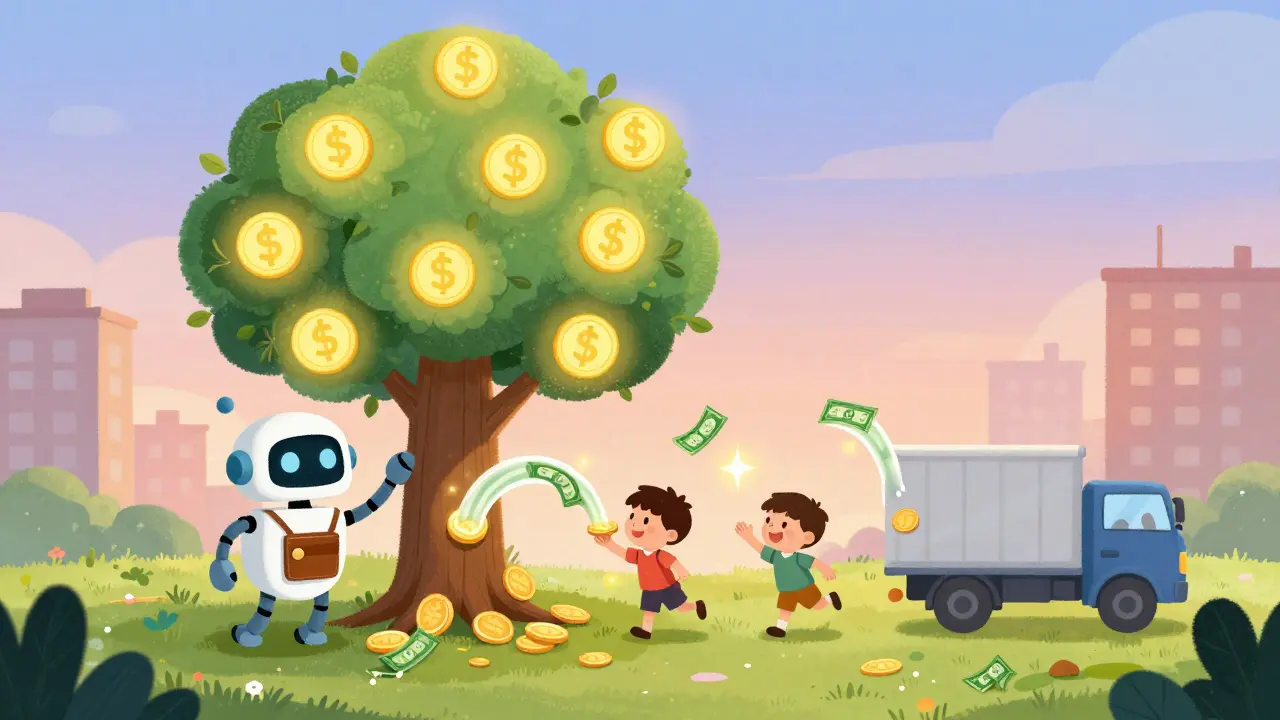
Stablecoins Are Fixing Supply Chains and SME Financing
Small businesses in emerging markets struggle to get loans. Banks don’t trust them. No credit history. No collateral. But with stablecoins, things change. A textile factory in Bangladesh can tokenize its future orders as NFTs. Investors buy those NFTs using USDC. The factory gets cash upfront. When the goods ship, the buyer pays the rest. Everything is tracked on-chain. No paperwork. No delays. This is supply chain finance - powered by stablecoins. It’s already happening on platforms like Centrifuge and Maple. SMEs that were locked out of credit now have access to capital in hours, not weeks. And it’s transparent. Every payment, every invoice, every delivery is recorded. No fraud. No disputes. Just trustless automation.Loyalty Programs That Actually Work
Your coffee shop gives you a stamp card. After ten coffees, you get one free. But you can’t use those stamps at the bookstore down the street. Stablecoins change that. Imagine a loyalty program where every purchase earns you USDC. You can spend it anywhere - at a local bakery, an online store, or even send it to a friend. No restrictions. No expiration. No hidden terms. Brands like Starbucks and Uber are testing this. They’re not replacing cash. They’re upgrading loyalty from a locked-in points system to real digital money. That’s powerful. It turns customers into participants in a wider economy.Corporate Treasury Management Is Going Onchain
Big companies aren’t ignoring this. Tesla, MicroStrategy, and even some banks are holding part of their cash reserves in stablecoins. Why? Because traditional banks lock your money. You can’t access it on weekends. You can’t move it instantly. Stablecoins let companies move billions 24/7. No bank holidays. No wire delays. No intermediary fees. PwC’s Global Digital Assets Lead calls stablecoins “a potential settlement currency for capital markets.” That’s not hype. It’s strategy. Companies are using them to manage cash flow, settle trades, and reduce counterparty risk. This isn’t crypto fantasy. It’s corporate finance, updated.
Peer-to-Peer Payments Without Banks
You don’t need a bank to send money with a stablecoin. Just a wallet. Just an internet connection. In the Philippines, people use USDC to send money to relatives in rural villages. No branch. No agent. No waiting. The recipient cashes out via a local exchange - often within minutes. This isn’t just for the unbanked. It’s for anyone tired of Venmo’s limits, PayPal’s holds, or Western Union’s fees. Stablecoins give people control. No gatekeepers. No delays. No surprises.Why This Isn’t Just a Crypto Thing Anymore
Five years ago, stablecoins were mostly traded between crypto wallets. Today, they’re used to pay rent, buy groceries, fund startups, and settle international contracts. The shift is clear: stablecoins aren’t about speculation anymore. They’re about utility. They’re faster than wires. Cheaper than cards. More reliable than local currencies in unstable economies. And they work without banks - which is exactly why they’re growing so fast. Governments are watching. The EU’s MiCA regulation, the U.S. Treasury’s stablecoin framework - they’re not trying to stop this. They’re trying to shape it. Stablecoins are becoming infrastructure. Like electricity. You don’t notice it until it’s gone.Are stablecoins safe to use for everyday payments?
Stablecoins tied to real assets like USDC and USDT are backed by reserves held in regulated banks. These reserves are audited regularly and publicly disclosed. While no system is 100% risk-free, they’re far more stable than Bitcoin or Ethereum. For everyday payments, they’re safer than carrying cash and more reliable than volatile cryptocurrencies.
Can I use stablecoins to pay my bills in the U.S.?
Yes. Services like BitPay, Coinbase Commerce, and Strike let you pay utility bills, rent, and even taxes using USDC. Many landlords and service providers now accept stablecoins directly. You can also convert stablecoins to fiat through ATMs or exchanges and deposit them into your bank account - making it easy to use them like regular money.
Do I need a bank account to use stablecoins?
No. You only need a crypto wallet - like MetaMask, Phantom, or Trust Wallet - and internet access. This is why stablecoins are so powerful in places where banks are scarce or expensive. A farmer in Kenya can receive payments from a buyer in Germany without ever opening a bank account.
How do stablecoins compare to traditional wire transfers?
Traditional wires take 1-5 days, cost $15-$50, and often involve multiple intermediaries. Stablecoin transfers take under a minute, cost less than $0.50, and go directly from sender to receiver. There’s no currency conversion lag, no weekend delays, and no hidden fees. For cross-border payments, stablecoins are faster, cheaper, and more transparent.
Are stablecoins regulated?
Yes, increasingly so. In the U.S., the Treasury and SEC are pushing for clear rules. The EU’s MiCA law requires stablecoin issuers to hold full reserves, disclose audits, and comply with anti-money laundering rules. Stablecoins like USDC are already regulated by the New York State Department of Financial Services. This isn’t the Wild West anymore - it’s evolving into a monitored financial system.
Can stablecoins replace the U.S. dollar?
Not replace - but complement. The U.S. dollar is still the world’s dominant currency. Stablecoins are digital versions of it, designed to move faster and cheaper. Think of them as the internet version of cash. They don’t replace banks or governments - they make financial systems more efficient. For global trade, remittances, and DeFi, they’re already doing what dollars can’t do as well.
Rajappa Manohar
This is huge. Stablecoins just saved my cousin in Kerala when his bank froze his account. No drama, just got paid in USDC.
Raja Oleholeh
India will never adopt this. Too much foreign control. Stick to UPI.
Alison Hall
I paid my rent in USDC last month. Landlord didn't even notice until his bank statement showed up. Perfect.
Brandon Woodard
The notion that stablecoins are merely a speculative tool is not only outdated-it is dangerously reductive. The infrastructure being built upon these digital assets represents a paradigm shift in global financial architecture, one that transcends traditional banking’s inherent inefficiencies and institutional inertia.
Bianca Martins
My friend in Nigeria uses USDC to buy groceries now. No more waiting for wire transfers. She just scans a QR code and boom-food on the table. 😊
Antonio Snoddy
You know what's funny? We're building a new financial system on blockchain, but we're still using the same old human impulses-greed, fear, control. We think we're escaping the bank, but we're just trading one gatekeeper for another. The real revolution isn't in the code-it's in whether we can stop treating money like a god and start treating it like a tool. And honestly? I'm not sure we're ready for that.
Prateek Chitransh
People in rural India are already doing this. My uncle in Bihar gets paid in DAI for his handloom work. He doesn't know what 'DeFi' means, but he knows his money doesn't vanish overnight. Smart.
alvin mislang
This is all a CIA psyop to replace the dollar. You think USDC is safe? It’s backed by JPMorgan. The same bank that froze your crypto last year. Wake up. 🤡
dayna prest
Stablecoins? More like stable-coin-tervention. They're the glitter on a dumpster fire. At least Bitcoin has chaos with integrity. This? It's Wall Street with a blockchain tattoo.
Mike Reynolds
I used to think this was all hype. Then I paid my freelance designer in USDC. She got paid in 47 seconds. No fees. No 'we're processing your payment'. Just... done. Mind blown.
Jackson Storm
I’ve been using USDC to pay my dog walker since last year. She lives in Guatemala. Before this, she’d wait 3 weeks for a wire. Now she gets paid same-day. She calls it 'digital cash'. I call it common sense.
Michelle Slayden
The regulatory frameworks emerging globally-particularly under MiCA and the U.S. Treasury’s proposed guidelines-demonstrate a maturing ecosystem. The convergence of compliance, transparency, and technological efficiency renders stablecoins not merely an alternative, but a necessary evolution in monetary transmission.
Vernon Hughes
The fact that you need to explain this to people in 2024 is proof that finance is still stuck in the 1980s
christopher charles
I’ve been telling my boss for months: let’s pay the remote devs in USDC. He said 'but what if it drops?' I said 'it’s stable, bro.' He still doesn’t get it. 😅
Johnny Delirious
The institutional adoption of stablecoins as treasury assets is not merely a trend-it is a foundational reorientation of corporate liquidity management. The implications for global capital markets are profound, irreversible, and underappreciated.
Monty Burn
Money is just a story we all agree on and stablecoins are the new fairy tale where the dragon is a bank and the princess is your wallet and the knight is a smart contract and nobody knows who wrote the ending
Amy Garrett
I just used DAI to buy a coffee at this cafe in Austin. They had a QR code. I thought it was a joke. It wasn't. Best coffee ever. 😍
Alexandra Wright
You think this is about efficiency? It’s about control. The same people who ran the banks are now running the blockchains. They just changed the logo.
Jack and Christine Smith
my mom just sent me $200 in USDC for my birthday. she used the coinbase app. she didn't know what a wallet was. she just typed my email. i got it in 22 sec. she cried. i cried. we're not tech people. this just... worked.
Haritha Kusal
this is so cool!! my cousin in the philippines uses this to send money to her mom. no more middlemen. just love in digital form. 🌸
Kenneth Mclaren
They’re not replacing the dollar. They’re replacing YOU. Soon your salary, your rent, your groceries-all tracked, taxed, and controlled by a central authority with a blockchain logo. You think you’re free? You’re just a node in their network.
Ryan Husain
The integration of stablecoins into SME financing represents not merely an innovation, but a democratization of capital access. This is not crypto. This is commerce. And it is long overdue.
Mike Reynolds
I just used USDC to pay my landlord. He said 'you're not joking?' I said 'nope, here's the transaction ID.' He's now asking how to get his own wallet.