
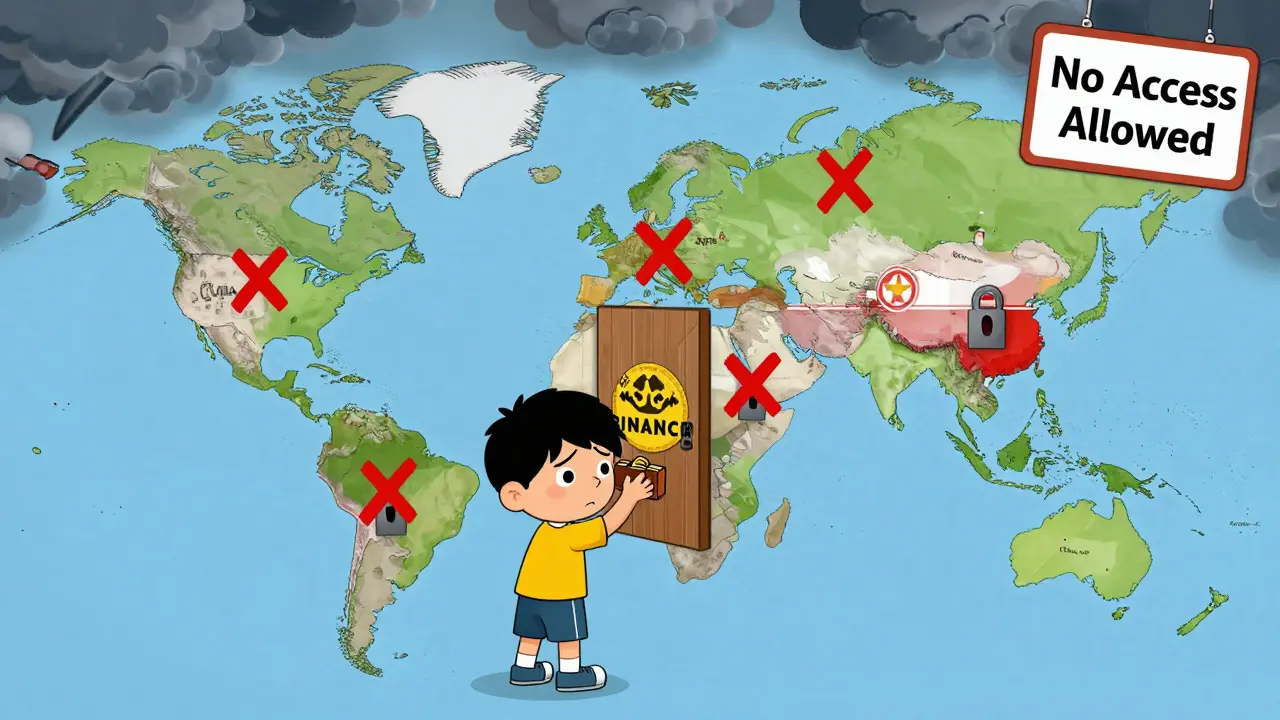
If you're trying to trade crypto on Binance and suddenly can't access your account, you're not alone. Thousands of users around the world hit walls every month-not because they did anything wrong, but because Binance has blocked access in their country. This isn't random. It’s a direct result of governments tightening rules around cryptocurrency, and Binance’s response has been to pull out, lock features, or completely shut down services in dozens of places. Understanding which countries are restricted, why, and what’s still available can save you from frozen funds, lost trades, or worse.
Complete Ban: Six Countries Where Binance Doesn’t Operate at All
These six countries face total restrictions. No trading, no deposits, no withdrawals-nothing. Binance blocks access at the network level, so even using a VPN won’t get you in. These bans aren’t arbitrary. They’re tied to international sanctions or extreme crypto prohibitions.
- Cuba: Banned since day one in 2017 due to U.S. sanctions.
- Iran: Added in 2018 after OFAC sanctions tightened.
- Syria: Also under OFAC restrictions since 2018.
- North Korea (DPRK): Banned due to state-linked hacking and money laundering.
- Crimea (Ukraine): Restricted since 2019 to comply with EU and U.S. sanctions.
- Non-government-controlled areas of Ukraine: Blocked since 2022 after Russia’s invasion.
If you live in any of these, Binance’s servers won’t even let you log in. There’s no appeal. No workaround. Your account will be permanently locked if detected.
Total Crypto Ban: Twelve Countries Where All Exchanges Are Illegal
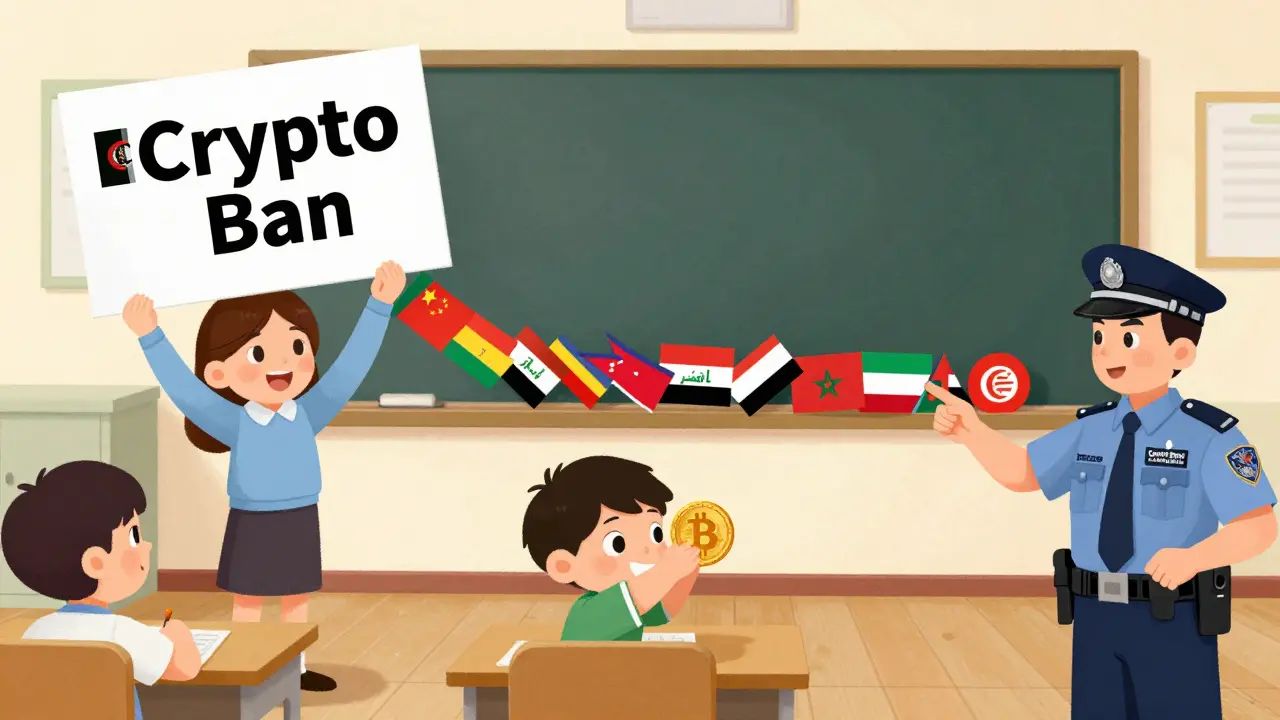
These aren’t just Binance restrictions-they’re national bans on all crypto trading. Even if you try another exchange, you’re breaking the law. These rules come from central banks or government decrees, not just Binance’s policy.
- Afghanistan: Taliban ban since 2022.
- Algeria: Finance Law 18-04 since 2018.
- Bangladesh: Digital Security Act 2018.
- Bolivia: Central Bank Circular 001-2014.
- China: Full ban on trading and mining since September 2021. (Hong Kong and Taiwan are separate.)
- Egypt: Central Bank ruling in 2020.
- Iraq: Central Bank warning in 2022.
- Kuwait: Central Bank Circular 7/2022.
- Morocco: Foreign Exchange Regulations 2017.
- Nepal: Nepal Rastra Bank directive in 2017.
- North Macedonia: Full ban since 2023.
- Tunisia: Ban enacted in 2018.
In these countries, even holding crypto can be risky. Some users report police raids on crypto holders. If you’re in one of these, your safest bet is to move assets before restrictions hit-or avoid crypto altogether.
Partial Restrictions: Where Binance Still Exists-But With Limits
This is where things get messy. Binance still operates in these 52 countries, but major features are gone. You might be able to buy Bitcoin, but not trade futures. You can deposit, but not withdraw in local currency. Or your account gets flagged every time you log in from a new device.
Here are the big ones:
- United States: Binance.com shut down in September 2019. Now you must use Binance.US, which only works in 51 states. New York residents are completely blocked. Withdrawal times can take 72 hours in some states.
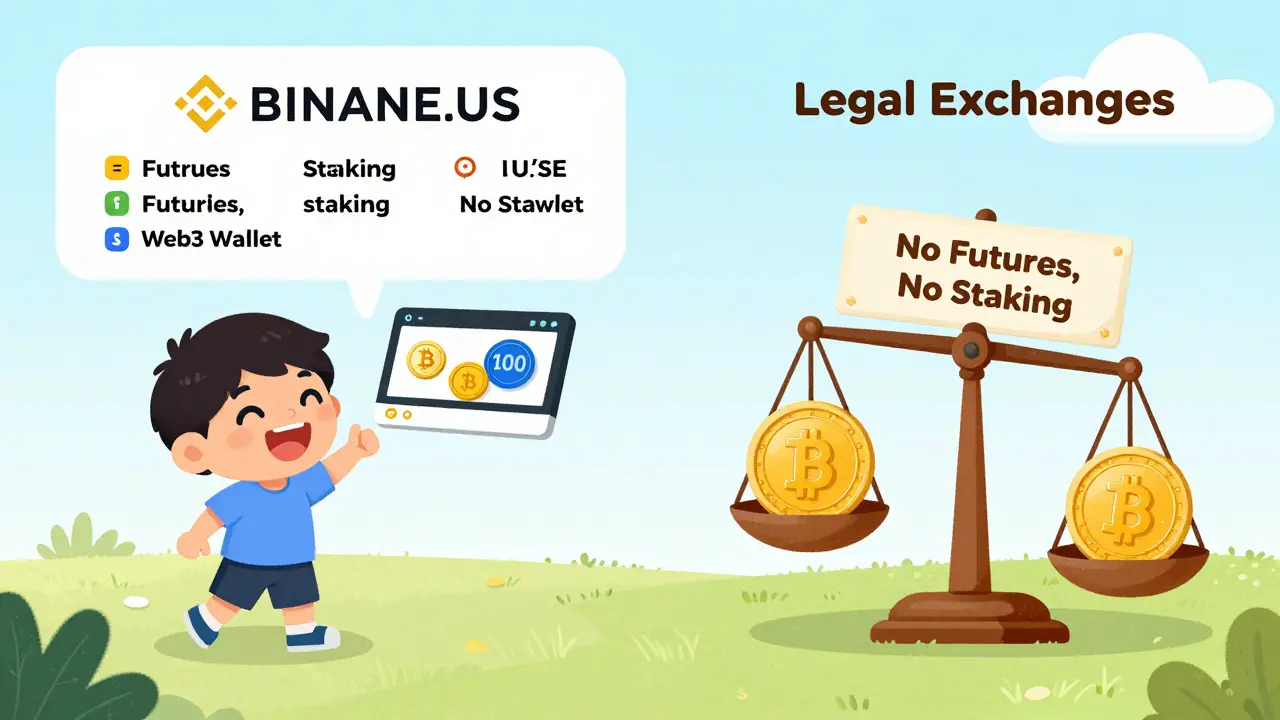
- United Kingdom: FCA revoked Binance’s license in February 2023. You can still log in, but no futures, no staking, no lending. Deposits are limited to GBP via bank transfer only.
- Netherlands: Binance fully exited in July 2023 after a €3.3 million fine. Accounts were frozen, and users were forced to withdraw funds or lose them.
- Canada: Exited in October 2023. Users lost access to CAD deposits. Fined CAD$6 million in March 2024 for poor KYC.
- Nigeria: Operations suspended in February 2024 after the SEC declared Binance illegal. Naira deposits blocked. Over 2 million users affected.
- Belgium: FSMA ordered service halt in June 2023. No trading, no deposits.
- Australia: Futures trading suspended in July 2024. Spot trading still allowed, but with strict limits.
- Japan: Registered but severely limited. No leverage, no derivatives, no fiat on-ramps.
- India: No outright ban, but 30% tax on crypto trades since 2022. Binance removed INR deposits, forcing users to use third-party P2P platforms.
These restrictions aren’t static. A country can go from "partial" to "total" overnight. Nigeria went from active to blocked in under 48 hours after a government notice. Users who didn’t withdraw in time lost access permanently.
Service-Specific Blocks: What You Can’t Do Even If You’re in a "Allowed" Country
Just because you can log in doesn’t mean you can trade everything. Binance splits features by region, not country. Here’s what’s commonly blocked:
- Binance Futures: Unavailable in 44 countries, including all EU members, UK, Switzerland, Canada, Australia, New Zealand, and the U.S. This affects over 80% of global users.
- Staking & Lending: Blocked in the UK, Canada, Australia, and Japan. You can’t earn interest on your crypto there.
- Web3 Wallet: Restricted in New Zealand, Malaysia, Singapore, and Thailand since late 2024. You can’t connect your MetaMask or claim airdrops.
- Fiat Deposits: CAD, NGN, EUR, and GBP deposits are gone in many regions. You’re forced to use P2P or third-party gateways.
One user in Germany told me he could still buy Bitcoin on Binance, but when he tried to stake ETH, the option vanished. He called support-no explanation. That’s normal. Binance doesn’t notify users before removing features. You just wake up one day and it’s gone.
Why Binance Restricts So Many Countries
It’s not about politics. It’s about money. Binance has paid over $8.7 billion in fines and settlements since 2021. The biggest hit? A $4.3 billion settlement with the U.S. SEC in July 2024 for operating without a license. That’s why they pulled out of Canada, the UK, and the Netherlands-they couldn’t afford to fight.
The EU’s MiCA regulation, which took effect in December 2024, forced Binance to build separate systems for each country. That’s expensive. They got licenses in only seven places: Hong Kong, UAE, Bahrain, Switzerland, Singapore, Japan, and Malta. Everywhere else? They cut features or left.
It’s also about KYC. Binance was fined $4.32 million in Canada alone for failing to verify 98.7% of high-risk users. Now, if you’re in Turkey, Vietnam, or Nigeria, you’ll need a video call with a compliance officer just to open an account. That takes 3.2 days. In the U.S., it’s 15 minutes.
What Happens When You’re in a Restricted Country?
Most users think they can just use a VPN. That’s a mistake.
- Your account gets flagged immediately.
- Withdrawals are frozen.
- You can’t access customer support.
- You risk permanent account closure.
Reddit threads are full of stories like this: "I used a VPN from Serbia. My $18,000 portfolio vanished. No reply from support. No appeal." Over 2,800 users reported similar issues in May 2025. Binance’s Terms of Service say they can shut you down "at their sole discretion." No warning. No explanation.
Trustpilot ratings tell the story: 2.1 stars from users in restricted countries. 4.3 stars from those who aren’t. The difference? Access. Control. Predictability.
What Are Your Alternatives?
If you’re locked out of Binance, you’re not out of options. But you’ll need to switch.
- U.S. users: Use Binance.US or Coinbase.
- UK/EU users: Kraken, Bitstamp, or eToro.
- Nigeria/Africa: Paxful, Luno, or Yellow Card.
- India: CoinDCX, WazirX, or ZebPay.
- China: Use OTC desks or decentralized exchanges like Uniswap (but know the legal risks).
Each has its own limits. But they’re legal. They won’t freeze your funds. And they’ll let you withdraw.
How to Check If Your Country Is Restricted
Don’t guess. Don’t rely on forums. Go straight to the source.
- Visit Binance’s official support page (search "restricted countries").
- Look for the "Restricted Jurisdictions" list under "Legal & Compliance".
- Check your account dashboard-if you see "Service Not Available" or "Restricted Region", you’re blocked.
- Try to deposit your local currency. If the option disappears, it’s gone.
There’s no official downloadable list. Binance updates this silently. So check every 3 months.
What’s Coming in 2026?
Binance is building regional hubs. They’ve set up legal entities in Mauritius, Dubai, and Singapore to serve Africa, the Middle East, and Asia. But these won’t fix restrictions-they’ll just create new ones.
Analysts expect 15 more countries to be restricted by 2026. Countries like Jordan, Uganda, and Peru are under pressure from the FATF to crack down on crypto. Binance won’t fight them. They’ll leave.
Meanwhile, the global crypto market is splitting. Binance’s market share dropped from 63% in 2021 to 41% in 2025. Coinbase, Kraken, and regional players are gaining. If you’re in a restricted country, your best move is to get off Binance before it’s too late.
Is it illegal to use Binance if my country is restricted?
It depends. In countries like Nigeria or Algeria, using Binance violates national law. In others, like the U.S. or UK, you’re not breaking the law-but you’re violating Binance’s Terms of Service. That means your account can be frozen, funds seized, and no refund given. Using a VPN doesn’t make it legal-it just makes you harder to trace. The risk isn’t just losing money. It’s losing access permanently.
Can I still access my funds if my country gets restricted?
Maybe-but only if you act fast. When Binance announces a restriction, users usually get 30-60 days to withdraw funds. After that, deposits are blocked. Withdrawals may still work, but customer support stops responding. In Nigeria and Canada, users reported delays of 3-6 months to get money out. Don’t wait. If your country is on the edge, withdraw everything now.
Why does Binance block futures trading in so many places?
Because derivatives trading is heavily regulated. The EU’s MiCA rules require exchanges to get specific licenses for futures, options, and leverage products. Binance only got those licenses in 7 countries. Everywhere else, they removed the feature to avoid fines. The U.S. SEC also treats crypto futures as unregistered securities. So Binance pulled it globally to stay out of court.
What’s the difference between Binance and Binance.US?
They’re completely separate companies. Binance.US is a U.S.-based entity with its own servers, compliance team, and license. It only supports 51 states, has fewer coins (about 100 vs. 500+), and doesn’t offer futures, staking, or lending. Withdrawals take longer. But it’s legal. If you’re in the U.S., Binance.com is not an option. Using it risks account closure and asset loss.
Are there any countries where Binance is fully unrestricted?
Yes. In places like Singapore, Hong Kong, UAE, and Switzerland, Binance operates with full access: spot trading, futures, staking, lending, Web3 Wallet, and fiat deposits. These countries have clear crypto regulations that Binance complied with. If you’re looking for full access, these are your best bets. But you need to be physically located there-or have legal residency.
Final Advice: Don’t Wait for the Warning
Binance doesn’t send emails when they restrict a country. They don’t call. They don’t give you time. One day, your account works. The next, it’s gone. If you’re in a gray-zone country-like Serbia, Bosnia, or Myanmar-you’re already at risk. Check your access now. Withdraw what you can. Move to a compliant exchange. The longer you wait, the more you stand to lose.
Holly Perkins
lol i just tried to deposit and it said service not available 🤡
Peggi shabaaz
i've been using binance for years and never thought i'd get locked out. honestly, it's scary how fast they pull the plug. one day you're trading, next day you're stuck. no warning, no help. just silent. i'm moving everything to coinbase now. peace of mind is worth the fee difference.
Ben Pintilie
vpn? lol nope. tried it. got flagged in 2 hours. funds frozen. support ghosted me. 🤦♂️
Ekaterina Sergeevna
oh wow. another crypto platform that 'complies'. how revolutionary. next you'll tell me they're not secretly mining your biometrics while you 'trade'. the irony of a 'decentralized' exchange being a corporate puppet is almost poetic. 🤡
Christopher Wardle
the real question isn't which countries are blocked. it's why we let a private corporation dictate our financial access. regulation isn't the enemy. dependency is.
Andrea Atzori
I just found out my sister in Melbourne lost access to her staking rewards overnight. It's devastating. Crypto was supposed to be freedom. Now it's a minefield of corporate red tape. We need better options. Urgently.
Joe Osowski
bunch of commie regulations. usa should've never let these foreign exchanges in. if you can't trust your own government to protect your assets, you deserve to lose them. we don't need binance. we need american crypto. period.
Gaurav Mathur
this whole thing is a psyop. binance didn't get forced out. they were paid off. the feds and the big banks are behind this. they don't want you owning crypto. they want you dependent. check the shareholders. look at the board. it's all connected. the veil is thin.
Jeremy Lim
i just... i don't even know anymore. i spent 3 years building my portfolio. now i can't withdraw. support won't answer. i feel so helpless. 😔
Elizabeth Choe
you think this is bad? wait till you see what happens when they shut down p2p in nigeria. it's like watching a dam break. people are selling gold for usdt just to feed their kids. crypto isn't just money. it's survival. and binance just threw away a lifeline.
Beth Trittschuh
we're all just pawns in a game we didn't choose. 🌌✨
Donna Patters
It's simply irresponsible to allow such a centralized entity to hold so much power. This is not innovation. This is a regulatory failure masquerading as disruption.
Michelle Cochran
i can't believe people still use binance. you're basically trusting a company that got fined billions for laundering money from terrorists and drug cartels. if you're not using a non-custodial wallet, you're not a crypto user. you're a bank customer with extra steps.
monique mannino
if you're in india, try coinbase or wazirx. p2p is messy but it works. i've sent 12k in usdt to my mom via phonepe and she got rupees in 10 mins. binance is a ghost ship. don't wait for the lifeboats to vanish.
Sanchita Nahar
bhaiya usa uk canada all blocked but binance still runs in dubai. why? because they paid. same thing in nigeria. they took money and left. now people are crying. i told them this would happen. no one listened.
Sakshi Arora
i tried to log in from india after the ban and it said 'service not available' but i was on my home wifi. then i tried a different network and it worked. so its not even consistent. what even is this system
bala murali
the regulatory landscape is a labyrinth. the absence of clear jurisdictional boundaries creates systemic vulnerability. institutional compliance mandates are inherently exclusionary. one must consider the ethical implications of platform sovereignty versus user autonomy.