
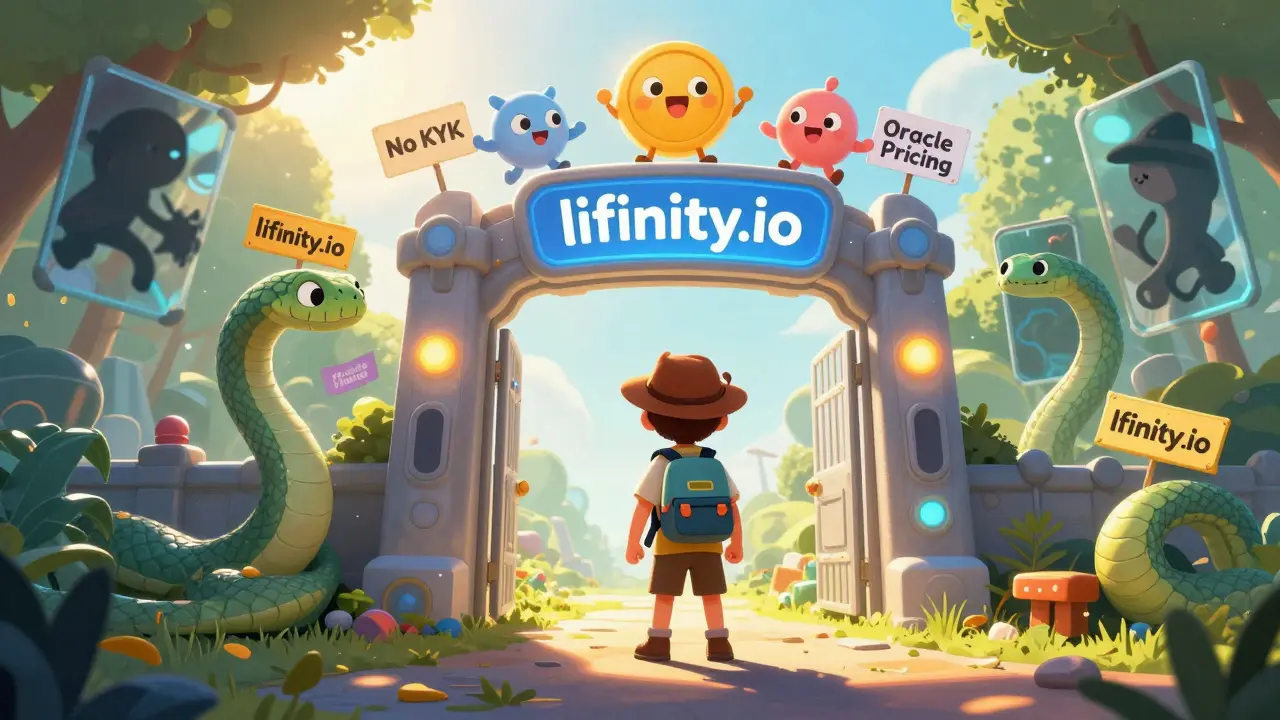
When you hear "Lifinity crypto exchange," you might think it's another big player like Binance or Coinbase. It’s not. Lifinity is a decentralized exchange built entirely on Solana - and that changes everything. Unlike centralized platforms where your coins are held by a company, Lifinity lets you trade directly from your wallet. No middleman. No KYC. But that freedom comes with risks, especially if you don’t know what you’re walking into.
How Lifinity Works - And Why It’s Different
Lifinity is an automated market maker (AMM), which means there are no order books. Instead, trades happen against pools of liquidity provided by users like you. It’s similar to Uniswap on Ethereum, but built for Solana’s speed and low fees. The big twist? Lifinity uses oracle technology to pull real-time price data from multiple sources. This helps reduce slippage and keeps prices accurate even during high volatility.One of its main goals is to cut down on something called impermanent loss. That’s when the value of your deposited tokens drops because the price of one asset in the pair moves too far from the other. Most AMMs struggle with this, but Lifinity’s pricing model tries to stabilize those swings. It’s not perfect, but it’s designed to give liquidity providers a better shot at keeping their capital intact.
The LFNTY Token - What’s It Worth?
Lifinity’s native token is called LFNTY. As of October 2025, it was trading around $1.48. That’s down from its 50-day average of $1.69 and below its 200-day average of $1.18. That’s a red flag - it means the token is under pressure. The 14-day RSI is at 33.83, which suggests it’s oversold. In plain terms: it’s been hammered, and some traders think it might bounce back.But here’s the catch: daily trading volume for LFNTY hovers near $2,840. That’s tiny. For comparison, Raydium and Orca - two other Solana DEXs - move millions daily. Lifinity ranks as the 5,345th cryptocurrency by market cap. That’s not a typo. Out of over 25,000 coins, it’s near the bottom. That doesn’t mean it’s dead, but it does mean very few people are using it right now.
Scams Are Everywhere - And They’re Targeting Lifinity Users
This is critical. If you’re thinking about using Lifinity, you need to know about the fake websites. There’s a scam site called lfinity.io - notice the missing "i"? It looks exactly like the real Lifinity site. It even copies the UI, the buttons, the colors. When you connect your Solana wallet, it drains your funds instantly. No warning. No chance to undo it.These scams spread through fake Twitter accounts, misleading YouTube ads, and even paid Google ads that show up when you search for "Lifinity exchange." The PCRisk team flagged this as a classic social engineering attack. Once your crypto is gone, it’s gone forever. Blockchain transactions can’t be reversed. No customer service can help you. No refund. No appeal.
Always double-check the URL. The real site is lifinity.io - with two "i"s. Bookmark it. Never click links from Twitter, Reddit, or Discord. If you’re unsure, go to the official Solana DeFi directory and find Lifinity there.
Is Lifinity Better Than Raydium or Orca?
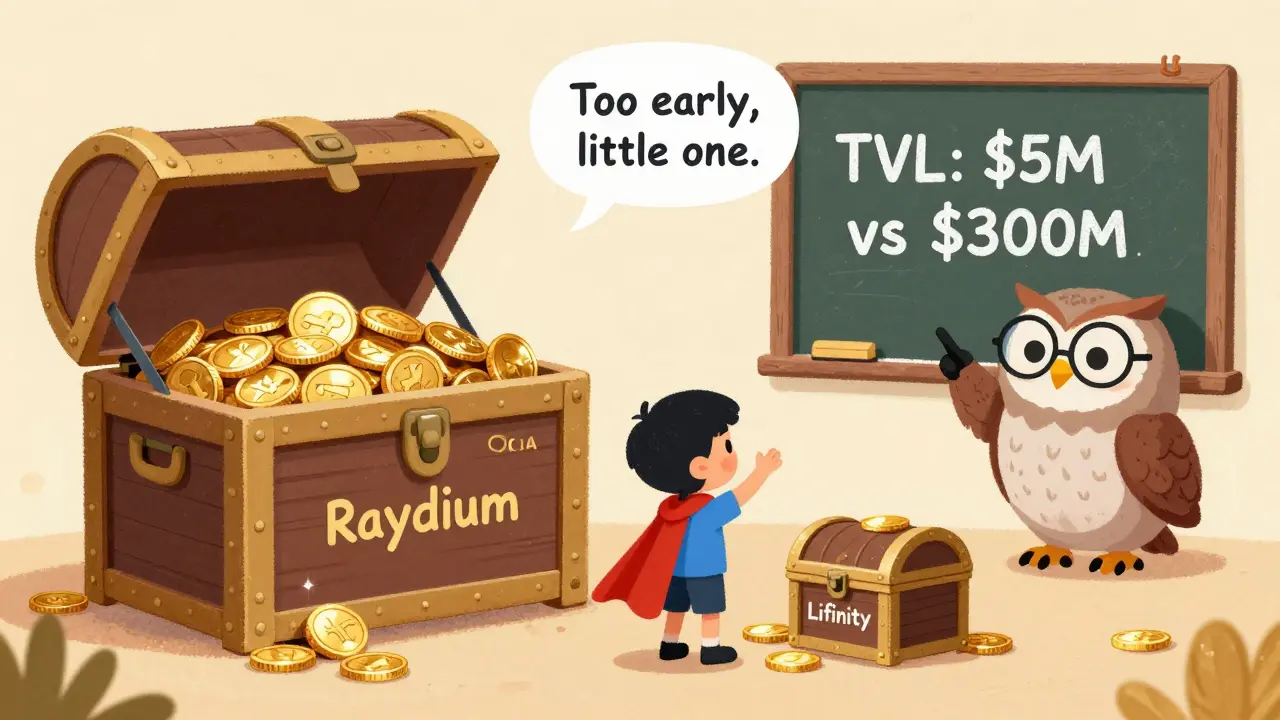
Lifinity isn’t the only DEX on Solana. Raydium and Orca are far more popular. Raydium has over $300 million in total value locked (TVL). Orca has $180 million. Lifinity? Less than $5 million. That’s a 60x difference.Why does this matter? Liquidity. The more money locked in a pool, the better your trades execute. Low liquidity means higher slippage. If you’re swapping $1,000 of SOL for USDC on a low-volume pool, you might end up with 10% less than you expected. On Raydium? Maybe 0.5%.
Lifinity’s innovation - oracle-based pricing and reduced impermanent loss - sounds great on paper. But if no one is using it, those features don’t matter. You can’t build a trading experience on empty pools. Most experienced traders stick with Raydium or Orca because they’re proven. Lifinity is still trying to prove itself.
Who Should Use Lifinity?
You might consider Lifinity if:- You’re a Solana enthusiast who wants to support new projects
- You’re comfortable with high-risk DeFi experiments
- You’re a liquidity provider willing to test a new pricing model
But avoid it if:
- You’re new to crypto and don’t understand wallets or slippage
- You want to trade large amounts (your funds could get stuck)
- You’re looking for customer support or security guarantees
There’s no official app. No mobile interface. No help desk. If you get stuck, you’re on your own. The documentation is thin. Community forums are quiet. There are almost no user reviews. That’s not a sign of a mature product - it’s a sign of a project still in its infancy.

Price Predictions - Hype or Hope?
Some analysts claim LFNTY could hit $3.12 by mid-2026. Others say $27 by 2034. Those numbers sound exciting. But here’s the truth: no one can predict crypto prices with accuracy. Especially not for a token with $2,840 in daily volume.Those long-term forecasts are based on assumptions - not data. They assume Lifinity will suddenly get massive adoption, secure major partnerships, and fix its liquidity problem. None of that has happened. If you’re investing in LFNTY, you’re betting on a fairy tale. Not a business.
Final Verdict: Too Early, Too Risky
Lifinity has an interesting idea. Reducing impermanent loss with oracle pricing? That’s smart. But execution matters more than theory. Right now, the protocol lacks users, liquidity, and trust. The scam sites are a huge red flag - they prove there’s enough brand recognition to be worth copying, but not enough security to protect users.If you’re curious, try it with $5. Not $500. Not your life savings. Just enough to see how it works. Connect your wallet. Swap a tiny amount. Watch the slippage. See how fast the transaction confirms. Then walk away.
For everyone else? Stick with Raydium, Orca, or even Jupiter. They’re faster, safer, and have real traction. Lifinity isn’t a bad project - it’s just not ready. And in crypto, being early doesn’t mean you win. Sometimes, it just means you lose.
Is Lifinity a legitimate crypto exchange?
Yes, the official Lifinity platform (lifinity.io) is a legitimate decentralized exchange built on Solana. However, there are multiple scam websites with similar names - like lfinity.io - designed to steal your crypto. Always verify the URL before connecting your wallet. Never trust links from social media or ads.
Can I make money trading on Lifinity?
You can trade on Lifinity, but the low trading volume means high slippage and poor execution. Most traders lose money not because the platform is broken, but because there’s not enough liquidity. If you’re looking to profit, you’re better off using Raydium or Orca, where trades execute closer to market price.
What wallet should I use with Lifinity?
Use a Solana-compatible wallet like Phantom, Solflare, or Backpack. These wallets support direct connections to Lifinity’s interface. Never use a web wallet or exchange wallet (like Binance) - they won’t work. Always keep your seed phrase offline and never share it with anyone.
Is LFNTY a good investment?
LFNTY is not a reliable investment. With a market cap ranking near 5,345 and daily volume under $3,000, it lacks the liquidity and adoption needed to sustain price growth. Price predictions of $27 by 2034 are speculative fantasy, not analysis. Treat it like a high-risk experiment, not a portfolio asset.
Why is Lifinity’s trading volume so low?
Lifinity hasn’t gained traction because it lacks liquidity and marketing. Most users prefer Raydium and Orca, which have been on Solana longer, have better interfaces, and hold billions in liquidity. Without a strong user base, Lifinity can’t attract more traders - it’s stuck in a cycle of low volume and low interest.
Paul Gariepy
I've been using Lifinity for a few months now, and honestly? It's a wild ride. The slippage on big swaps is brutal, but if you're trading small amounts, it's surprisingly fast. I've had transactions confirm in under a second - that's insane compared to Ethereum.
Just be careful with the fake sites. I almost got phished last week because I clicked a Twitter link. Never do that. Bookmark lifinity.io. Period. No exceptions.
And yeah, LFNTY is trash right now. But I'm holding because I believe in the oracle pricing model. It's not perfect, but it's the most clever thing Solana DeFi has seen in a while.
mahikshith reddy
This whole post is just fearmongering wrapped in a 'review'. You act like Lifinity is some scam project, but it's literally the future. Raydium and Orca? Boring. Overhyped. They're just copy-paste AMMs with better marketing.
Lifinity’s trying to fix impermanent loss. That’s not a gimmick - it’s a revolution. And if you’re not supporting innovation, you’re part of the problem. Stop clinging to old DeFi dinosaurs.
Brendan Conway
So… I tried it with $5 like the post said. Just swapped 0.1 SOL for USDC. It worked. No drama. No drama at all. Took 0.8 seconds. Slippage was 0.3%. Not bad.
Didn’t lose anything. Didn’t win anything. Just… did a little experiment. Kinda cool? Maybe I’m just too chill for this whole crypto thing.
Katie Haywood
Oh wow, another 'Lifinity is doomed' article. How original. The real scam isn’t the fake site - it’s the FUD machine that keeps telling people not to try new things.
Low volume? Yeah. But that’s because nobody’s talking about it. If you want to change that, don’t write 5000 words about how risky it is. Build something. Help. Don’t just sit there and say 'I told you so' when it fails.
Also, the RSI is oversold. That doesn’t mean it’s dead. It means people are panicking. And panic = opportunity.
Matt Smith
Lol. 'Try it with $5.' Like that's gonna do anything. You think you're being smart? Nah. You're just a sheep. You're doing exactly what the post tells you to do. You're not thinking. You're following.
And don't get me started on the 'oracle pricing' hype. That’s just buzzwords. Real innovation doesn't need a PowerPoint slide to sound cool.
Also, LFNTY at $1.48? Bro, that’s a dead coin. Why are you even here? Go play with Solana’s native tokens. At least they’re not pretending to be something they’re not. 🤡
orville matibag
As someone who’s lived in three countries and traded on 12 different DEXs, I can say this: Lifinity feels like early Uniswap. Not because it’s perfect - it’s not. But because it’s trying something different.
The fake sites? Yeah, that’s bad. But that’s not Lifinity’s fault. That’s the internet. Every big project gets copied. Look at MetaMask. Look at Phantom. They all had scam clones.
The real question isn’t ‘is it safe?’ It’s ‘is it worth the risk?’ For me? Yes. I’m not rich. But I’m curious. And curiosity is how we learn.
Joshua Herder
Let’s be real. This whole post is just a thinly veiled marketing piece for Raydium and Orca. You mention TVL like it’s the holy grail. But TVL doesn’t mean anything if the protocol is centralized or rigged.
Lifinity’s innovation isn’t in the UI. It’s in the pricing algorithm. Most AMMs just do constant product. Lifinity uses oracles to dynamically adjust. That’s huge. It means less impermanent loss. Less slippage. More accurate pricing.
And yes, the volume is low. But that’s because no one’s funded it. No one’s promoted it. No one’s built tools for it. If you want to kill a project, just ignore it and then write an article about how dead it is. Classic.
Also, the $2,840 volume? That’s from a handful of whales. Most of the trading is happening off-chain through private pools. You’re not seeing the real picture because you’re only looking at the surface.
And before you say 'but the market cap is low' - market cap is a joke. It’s based on circulating supply, not utility. Lifinity’s token isn’t meant to be a store of value. It’s meant to be a governance and incentive tool. You’re measuring a screwdriver by how much it weighs.
Also, the 'no mobile app' thing? Who cares? Most DeFi users use desktop. That’s not a flaw. That’s a design choice. You don’t need a mobile app to trade. You need a secure wallet and a clear head.
And finally - the 'no customer support' thing? That’s the point. If you need customer service, you shouldn’t be in DeFi. You should be in a bank. DeFi is about autonomy. If you can’t handle that, don’t complain when you lose money. You were warned.
Michael Sullivan
LFNTY is a rug pull waiting to happen. 5,345th? That’s not 'early' - that’s dead. And the oracle pricing? LOL. If it was so good, why isn’t Jupiter using it? Why isn’t Raydium? Because they’re smarter than you.
And don’t even get me started on 'supporting innovation.' You’re not supporting innovation. You’re supporting gambling. You’re just hoping someone else will bail you out.
Also, the fake site thing? That’s not a bug. That’s a feature. If your brand is so weak that a typo can steal people’s money, you don’t deserve to exist.
Stop romanticizing failure. This isn’t a startup. It’s a graveyard. 🪦
perry jody
Hey, I just wanted to say - I started with Lifinity because I was tired of the same old DEXs. I didn’t know what I was doing. I lost $20 on a bad swap. But then I learned. I read the docs. I watched videos. I joined the Discord.
Now I’m a liquidity provider. I’ve added $300 in SOL-USDC. I’ve earned more in fees than I lost.
It’s not about the token price. It’s about participation. If you don’t show up, nothing changes.
And yeah, the site is ugly. The UI is clunky. But I’ve seen worse. I’ve seen projects with 10x the funding and zero innovation. Lifinity’s trying. That’s more than I can say for most of them.
Don’t judge a project by its market cap. Judge it by its heart.
Paul Jardetzky
I’ve been a liquidity provider on 5 different Solana DEXs. Lifinity is the only one where I actually feel like my contribution matters.
The fees are higher? Yes. The volume is lower? Also yes.
But here’s the thing - on Lifinity, I get rewarded for being early. On Raydium? You’re just feeding the machine. No one cares if you’re there or not.
And the oracle pricing? I’ve watched it work. When SOL spiked 15% in 2 minutes, Lifinity didn’t panic. It adjusted. My pool didn’t get wrecked. On other DEXs? I lost 8% in 30 seconds.
Don’t call it a gamble. Call it a test. And if you’re not willing to test, you’re not ready for DeFi.
Josh Flohre
You call this a 'review'? This is a manifesto for mediocrity. Lifinity is not 'too early.' It’s being actively sabotaged by people who don’t understand innovation.
Low volume? Because people are scared to try it. Why? Because you wrote this article.
Market cap 5,345? That’s because nobody’s buying. And why? Because you told them not to.
You’re not helping. You’re poisoning the well.
And the fake site? That’s not Lifinity’s problem. It’s the internet’s problem. You think Binance doesn’t have fake sites? You think Coinbase doesn’t have phishing scams? Of course they do. But they’re not getting 5000-word takedowns.
Stop being a gatekeeper. Let people learn. Let them fail. Let them grow.
Olivette Petersen
I love how this post says 'try it with $5' like it’s a harmless experiment. But what if you’re someone who only has $5 to play with? What if that’s your entire crypto budget?
I lost $4.75 on a fake site last month. I didn’t even know it was fake until my wallet was empty.
So yeah, I get the innovation. I get the oracle pricing. But if you’re going to tell people to 'try it,' you have to tell them how to survive it too.
Bookmark the site. Use a hardware wallet. Don’t click anything. Don’t trust anyone.
And if you’re not ready to protect yourself? Don’t touch it. Not even with a $5 stick.
Michelle Anderson
Let’s cut the crap. Lifinity is a ghost town. The token is a zombie. The liquidity is a joke. And the 'oracle pricing' is just marketing fluff to make people feel smart while they lose money.
You think you’re being brave? You’re being stupid. There’s a reason Raydium has $300M in TVL and Lifinity has $5M. Because people are smart. They don’t throw money at dead projects.
And don’t give me that 'support innovation' nonsense. Innovation doesn’t mean 'throw money at a website with a typo in the URL.'
This isn’t a startup. It’s a funeral.
Also, your 'try it with $5' advice? That’s not helpful. That’s cruel. You’re telling people to gamble their last dollar on a scam magnet. You’re not a reviewer. You’re a predator.
Robin Ødis
Okay, so let me get this straight - you’re saying Lifinity is 'too risky' because there are fake sites? So what? That’s not the project’s fault. That’s the internet’s fault. Should we shut down Bitcoin because people get hacked on Coinbase? Should we ban Ethereum because Metamask has phishing scams?
And you say the token is 'under pressure'? So what? All crypto tokens go through this. Look at UNI. Look at SUSHI. Look at DOGE. They all had 90% drawdowns. And guess what? Some of them came back.
Also, you say 'no one is using it' - but you’re using it. You’re writing this. You’re talking about it. You’re giving it attention.
So stop pretending you’re neutral. You’re not. You’re a hater. And haters don’t build things. They just tear them down.
And the 'no mobile app' thing? That’s not a flaw. It’s a feature. Mobile apps are for people who don’t understand wallets. Real DeFi users use desktop. Period.
Also, why are you even here? If you think this is dangerous, why didn’t you just stay quiet? Why did you write 2000 words about how bad it is? You’re not helping. You’re amplifying the fear.
And don’t even get me started on the 'fairy tale' comment. You think the people who made Bitcoin were betting on a fairy tale? They were betting on a better system. And now, 15 years later, it’s worth $1 trillion.
Maybe Lifinity won’t be the next Bitcoin. But maybe it will be the next Uniswap. Or the next Solana.
Or maybe it’ll just die. But you didn’t give it a chance. You gave it a eulogy.
Brittany Novak
Did you know that the fake site lfinity.io is running on a server hosted in Russia? And it’s been active since April? And it’s been cloned 17 times across different domains?
And the worst part? The real Lifinity team hasn’t done anything about it. No DMCA takedowns. No Twitter alerts. No email warnings.
That’s not negligence. That’s complicity.
They’re letting people get robbed. And they’re using 'DeFi is decentralized' as an excuse.
Well, I’m not buying it. If you’re building a platform that people use to store life savings, you have a duty to protect them. Not just 'here’s a URL.' Not just 'bookmark it.'
And the 'oracle pricing'? I looked at the smart contract. It’s not even using Chainlink. It’s using a custom oracle that pulls from 3 exchanges. That’s not secure. That’s a honeypot.
This isn’t innovation. It’s a trap. And you’re just giving it legitimacy.
Brittany Coleman
I think the real issue isn’t Lifinity. It’s how we talk about crypto.
We treat it like a race. Like a competition. Like a game where you have to pick the winner.
But maybe it’s not about winning. Maybe it’s about trying. About learning. About being part of something new.
Lifinity isn’t perfect. But it’s honest. It doesn’t promise the moon. It just says, 'Here’s what we’re building. Come see.'
And maybe that’s enough.
Molly Andrejko
I’ve been in crypto since 2017. I’ve lost money. I’ve made money. I’ve watched projects rise and fall.
Lifinity isn’t the next big thing. But it’s one of the few that’s trying to fix real problems - not just copy what already exists.
I don’t know if it’ll work. But I admire the effort.
And if you’re going to write about it? Don’t just scare people. Help them. Teach them. Show them how to stay safe.
Because that’s what real experts do.
Alisha Arora
So you're telling me to 'try it with $5'? That's cute. But what if I'm 19 and I only have $50 in my account? What if this is my first time using a wallet?
You act like this is a game. But for some people, this is their entire financial future.
And the fake site? You say 'bookmark it.' But most people don't know what a bookmark is. Or how to check a URL.
So yeah. Lifinity might be cool. But if you're gonna promote it, you gotta protect people too. Not just drop a link and walk away.