

When you buy Bitcoin at $50,000, you own it. If it drops to $40,000, you lose $10,000. But what if you could bet on Bitcoin going up - or down - without ever holding it? That’s where crypto options come in. They let you profit from price swings without owning the coin, and they cap your worst-case loss at the price you pay upfront. It’s not magic. It’s finance, adapted for digital assets.
What Exactly Are Crypto Options?
A crypto option is a contract. Not a promise to buy or sell. A right to do it - but only if you want to. You pay a fee, called a premium, for that right. In return, you get to decide later whether to buy or sell a specific cryptocurrency at a set price before a set date.
Think of it like a reservation for a future price. If the market moves your way, you use it. If it doesn’t, you walk away. Your loss? Just the premium. No more, no less.
Unlike spot trading - where you buy Bitcoin and store it in a wallet - options let you trade price movements without touching the actual coin. The exchange holds the contract. You don’t need custody. You don’t need to worry about hacks or private keys. Just the numbers on your screen.
The Four Key Parts of Every Option
Every crypto option has four core pieces:
- Premium: The price you pay to buy the option. This is your maximum loss.
- Strike price: The price at which you can buy (call) or sell (put) the crypto.
- Expiration date: When the contract ends. After this, it’s worthless.
- Underlying asset: The crypto you’re betting on - Bitcoin, Ethereum, Solana, etc.
For example: You buy a Bitcoin call option with a $52,000 strike price, expiring in 30 days, for a $1,000 premium. Bitcoin is trading at $50,000 now. You think it’ll hit $58,000. If it does, you can buy it at $52,000 and sell it at $58,000. Profit? $6,000 minus your $1,000 premium = $5,000 net.
If Bitcoin stays below $52,000? You let it expire. You lose $1,000. That’s it. No margin call. No forced sell-off. Just a small, known cost.
Call Options vs. Put Options
There are two basic types:
- Call options: The right to buy crypto at the strike price. You buy calls when you think prices will rise.
- Put options: The right to sell crypto at the strike price. You buy puts when you think prices will fall.
Let’s say Ethereum is at $3,000. You’re nervous about a market dip. You buy a put option with a $2,800 strike price for $200. If Ethereum crashes to $2,200, you can sell it at $2,800. You make $600 per ETH - minus your $200 premium. Net profit: $400.
But here’s the twist: You don’t even need to own Ethereum to use a put option. You can short the market without borrowing coins. That’s something spot trading can’t do easily.
U.S. vs. European Options: When Can You Act?
Not all options work the same. Two styles exist:
- U.S.-style: You can exercise the option anytime before expiration. More flexibility. More common on crypto exchanges.
- European-style: You can only exercise on the expiration date. Less flexible. Often used in institutional settings.
Most retail traders on platforms like Deribit, OKX, or Binance trade U.S.-style options. It gives you room to react. If Bitcoin surges early, you don’t have to wait until the last day to cash in.

Why Use Options Instead of Just Buying Crypto?
Spot trading is simple. But options give you superpowers:
- Limited risk: Your loss is capped at the premium. No surprises.
- Profit in any market: You can make money if prices go up, down, or even stay flat - if you use the right strategy.
- No custody needed: You avoid wallet risks, exchange hacks, and private key management.
- Leverage without margin: You control a large position with a small upfront cost. No liquidation risk like with futures.
Imagine you have $5,000. You could buy 0.1 Bitcoin at $50,000. If Bitcoin drops 20%, you lose $1,000. But if you use $5,000 to buy call options with a $55,000 strike, you’re betting on a big move. If Bitcoin jumps to $65,000, your options might be worth $15,000. If it doesn’t? You lose $5,000 - same as spot - but you didn’t have to hold it.
Options as Insurance: Hedging Your Crypto Holdings
Many traders use options like car insurance. You hope you never need it. But if something goes wrong, you’re covered.
Let’s say you own 2 Ethereum at $3,500 each. You believe in the long-term, but fear a 30% pullback next week. You buy two put options with a $3,200 strike price. Each costs $150. Total cost: $300.
If Ethereum drops to $2,800? You exercise the puts. Sell your ETH at $3,200. You protect $800 per coin. Your net loss? $400 (from $3,500 to $3,200) plus $300 premium = $700 total. Without puts, you’d have lost $1,400.
That’s the power of hedging. You pay a small fee to avoid a big loss.
Realistic Risks: You Can Still Lose Everything
Options aren’t risk-free. They’re just predictably risky.
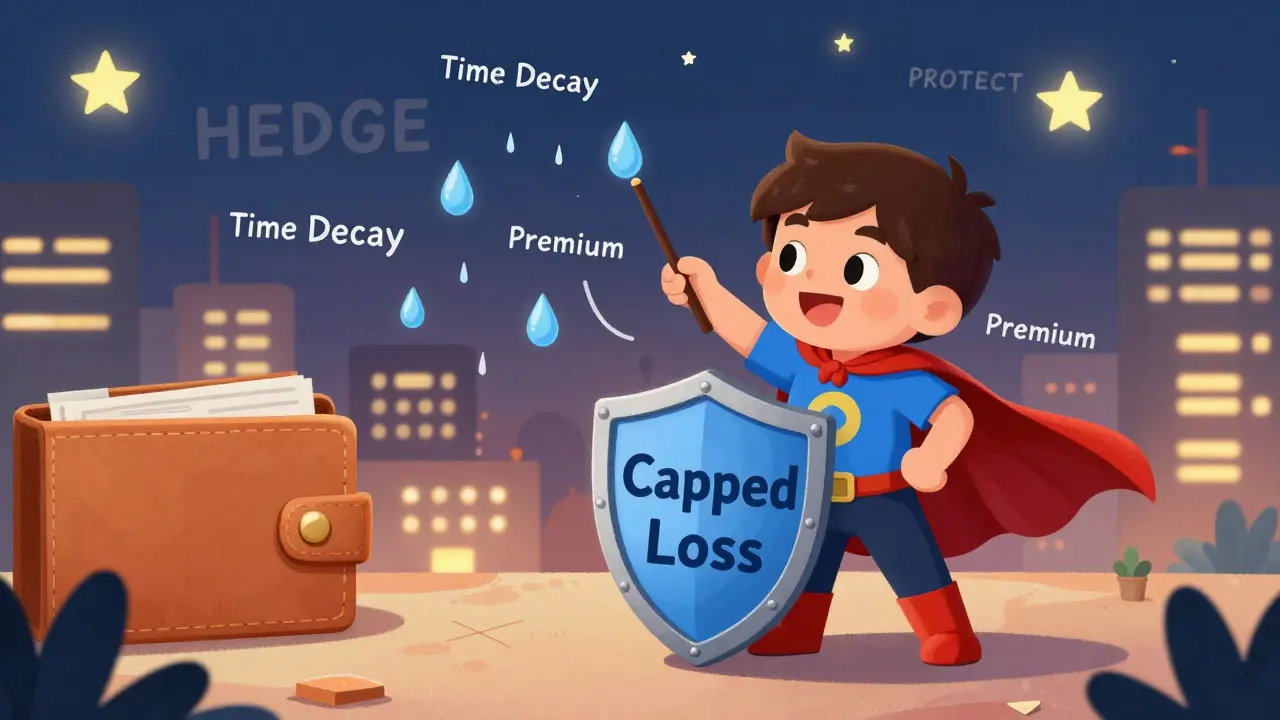
The biggest danger? Time decay. Every day, the value of your option erodes. Even if Bitcoin stays flat, your option loses value. This is called theta decay. It’s why many options expire worthless.
Another risk: Implied volatility. If markets get calm, option premiums drop - even if the price doesn’t move. You might buy a $500 option that becomes $200 in a week, even if Bitcoin is unchanged.
And then there’s assignment risk. If you sell options (write them), you might be forced to buy or sell crypto at the strike price. That’s not for beginners.
Most new traders lose money because they think options are “easy money.” They’re not. They’re a tool. Use them wrong? You’ll lose. Use them right? You’ll protect or profit.
How to Start Trading Crypto Options
You don’t need a PhD. But you do need to learn step by step:
- Choose a platform: Deribit, OKX, Binance, and Bybit offer crypto options. Start with one that supports your coin.
- Use a demo account: All major exchanges have paper trading. Practice for 2 weeks. No real money.
- Start simple: Buy one call or one put. Don’t touch spreads, straddles, or butterflies yet.
- Limit your exposure: Never risk more than 5% of your portfolio on options.
- Set a clear exit: Decide before you buy: “I’ll sell if I make 2x,” or “I’ll cut at 50% loss.”
Most traders lose because they don’t have a plan. They chase big wins. Options reward patience, not greed.
What’s Next for Crypto Options?
The crypto derivatives market hit over $1 trillion in annual trading volume in 2025. Options make up a big chunk. Why? Because institutions are using them. Hedge funds, family offices, even pension funds are allocating to crypto options for diversification and hedging.
Exchanges are adding more strike prices, shorter expirations (even hourly options), and new assets like Solana, XRP, and Dogecoin options. Decentralized options protocols are also growing - think Uniswap-style trading for options, without a central exchange.
Regulation is still messy. The U.S. hasn’t approved crypto options ETFs yet. But in Europe and Asia, they’re already trading. That’s why platforms based in the UK, Singapore, and Dubai are leading the way.
One thing’s clear: Options aren’t going away. They’re becoming part of the standard toolkit - like moving from cash to credit cards.
Final Thought: It’s Not About Guessing - It’s About Planning
Crypto options aren’t a get-rich-quick scheme. They’re a way to manage risk and express market views with precision. You can profit from fear. You can profit from calm. You can protect what you own. But only if you understand how they work.
Start small. Learn the language. Watch how premiums change with time and volatility. Paper trade until it feels natural. Then, trade with real money - but always with a plan.
Because in crypto, the market doesn’t care if you’re right. It only cares if you’re prepared.
Can you lose more than your premium in crypto options trading?
No. If you buy an option (call or put), your maximum loss is the premium you paid. That’s the whole point. Even if Bitcoin crashes to $1,000, you don’t owe more than what you spent on the contract. The only exception is if you sell options (write them). Then, you could face unlimited losses - which is why most beginners should never sell options.
Do you need to own Bitcoin to trade Bitcoin options?
No. You don’t need to own any cryptocurrency to trade crypto options. The exchange holds the contract. You’re betting on price movement, not ownership. You can buy a Bitcoin call option even if you’ve never held a single BTC. That’s why options are so accessible - no wallet, no custody, no keys.
Are crypto options more risky than spot trading?
It depends. If you’re buying options, they’re less risky than spot trading because your loss is capped. But if you’re selling options or using complex strategies, they can be far riskier. For beginners, buying options is actually safer than buying crypto outright - because you can’t lose more than your premium. But if you don’t understand time decay or volatility, you’ll lose money faster than in spot trading.
Can you trade crypto options on weekends?
Yes. Crypto markets never sleep, and neither do options exchanges. You can trade Bitcoin options 24/7, including weekends and holidays. That’s different from traditional stock options, which only trade during market hours. This round-the-clock access is one reason crypto options are so popular.
What’s the best strategy for beginners in crypto options?
The best strategy for beginners is buying single calls or puts. Pick one asset you understand well - like Bitcoin or Ethereum. Set a clear goal: “I’m buying this call because I think it’ll hit $60,000 in 3 weeks.” Keep it simple. Don’t try to hedge or spread until you’ve made at least 10 profitable trades. Mastery comes from repetition, not complexity.
Elijah Young
Options are a smart way to play crypto without the headache of custody. I’ve been using Deribit for months now, and the ability to hedge my ETH holdings with puts has saved me twice already. No sleepless nights when the market dips.
Desiree Foo
I appreciate how this breaks it down, but let’s be real - most people treat options like lottery tickets. Buying calls because ‘Bitcoin might moon’ is not a strategy. It’s gambling with a fancy name. If you don’t understand theta decay, you shouldn’t be near this market. Discipline isn’t optional.
bala murali
As someone who’s been trading derivatives in traditional markets for over a decade, the parallels between crypto options and equity options are striking. The real differentiator here is liquidity and 24/7 access. That’s not a minor advantage - it’s transformative. But the volatility clustering and gamma squeezes? Those are where retail traders get wrecked. Understand the Greeks before you trade.
Ekaterina Sergeevna
Oh wow, another ‘options are safe’ fairy tale. Let me guess - you also think NFTs are ‘digital art’ and DeFi is ‘decentralized finance.’ The fact that 90% of options expire worthless is buried under flowery language. This post reads like a marketing brochure for Deribit. Thanks for the laugh.
Kaz Selbie
Bro, you’re not ‘hedging’ if you’re just buying one put. That’s a band-aid. Real hedging is a collar strategy - long spot, short call, long put. And if you’re not monitoring implied volatility skew, you’re flying blind. I’ve seen traders lose 80% of their premium in 48 hours because they ignored the vol crush. Stop treating this like a video game.
Robbi Hess
Let me tell you something - options are not for the faint of heart. I watched a guy turn $2,000 into $40,000 on a single Bitcoin call… then lose $180,000 on a leveraged straddle three weeks later. The market doesn’t care if you’re ‘prepared.’ It cares if you’re lucky. And luck runs out.
Keturah Hudson
Coming from India, where options trading is still seen as ‘gambling,’ it’s refreshing to see this level of clarity. The fact that you can hedge without owning the asset is revolutionary - especially in emerging markets where access to traditional hedging tools is limited. This isn’t just finance - it’s financial inclusion.
Ace Crystal
Stop overthinking it. Buy one call. Watch it. Learn. Then buy another. Do that 10 times. That’s how you build intuition. You don’t need a PhD. You need repetition. I went from losing $500 a week to making $3k consistently in 6 months. Just. Keep. Trading.
Brittany Meadows
…and of course, the government will ban this next week. 🤡💸 They already know what’s coming - decentralized options on the blockchain? No way they let retail win. Mark my words - the SEC will shut this down before 2026. They’re scared. 💀
SAKTHIVEL A
It is imperative to underscore that the structural asymmetry inherent in the pricing mechanism of American-style options introduces a non-linear risk exposure profile that is often mischaracterized by neophyte participants. The phenomenon of time decay, quantified via the theta metric, operates with exponential decay characteristics, thereby necessitating a sophisticated temporal arbitrage framework for sustainable profitability. One must not conflate speculative exposure with strategic capital allocation.
blake blackner
bro i just bought 10 calls on solana for $20 each. if it goes up 20% im rich. if not? oh well. 🤷♂️
Andrea Atzori
This is the most balanced explanation I’ve seen on crypto options. The comparison to car insurance is spot-on. I’ve used puts to protect my portfolio during every major correction since 2022. It’s not about making a killing - it’s about not getting wiped out. That’s the real win.
Joe Osowski
Yeah right. ‘Options are safer than spot.’ Tell that to the 10,000 Americans who lost their life savings on crypto derivatives last year. This isn’t finance - it’s a casino with a website. And you’re just the guy selling the chips. Stick to Bitcoin. Save yourself.