
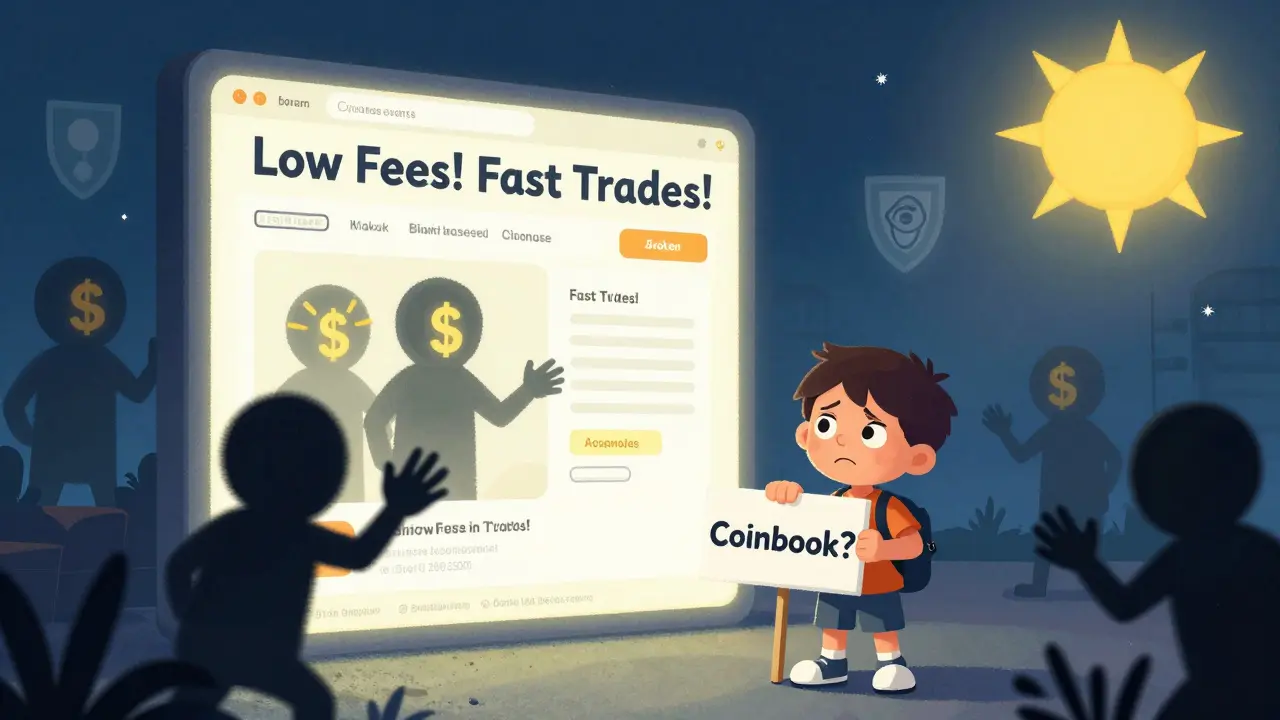
There’s no verified information about a cryptocurrency exchange called Coinbook. Not on Trustpilot, not on Reddit, not in any official regulatory database, and not in any major crypto news outlet. If you’ve heard of Coinbook, you might be mixing it up with Coinbase - a completely different platform with millions of users and a decade-long track record. But if you’re being asked to sign up for Coinbook right now, you’re walking into a potential scam.
Cryptocurrency exchanges come and go. Some are legitimate, well-regulated, and secure. Others are ghost operations built to drain wallets and vanish. Coinbook appears to be one of the latter. No founding team, no headquarters, no licensing, no public audits. Just a website with a clean design and promises of low fees and fast trades. That’s not enough. In crypto, you don’t trust the look - you verify the proof.
Why Coinbook Doesn’t Exist (As a Real Exchange)
Let’s be clear: if Coinbook were a real exchange, it would show up in at least one credible place. The top ten exchanges - Binance, Coinbase, Kraken, KuCoin, Crypto.com - all have public financial reports, regulatory licenses, security audits, and thousands of verified user reviews. Even smaller platforms like WhiteBIT or BitDelta have clear documentation about their team, location, and compliance.
Coinbook has none of that. No LinkedIn profiles for its "founders." No press releases. No mention in the UK’s Financial Conduct Authority (FCA) register. No registration with the U.S. SEC. No security audit reports from firms like CertiK or SlowMist. No Twitter or Telegram community with active users. Just a website with a form asking for your email and wallet address.
This isn’t a new trend. In 2023, over $2.38 billion was stolen from crypto platforms - not just from big targets like Binance, but from dozens of obscure platforms that disappeared after collecting deposits. One of the most common tactics? Create a fake exchange with a name that sounds like a real one - Coinbook, Coinbase, Coinlend, Coinex - and wait for beginners to make their first trade.
What You Should Look for in a Real Crypto Exchange
If you’re looking for a trustworthy place to trade crypto, here’s what actually matters - not flashy ads or referral bonuses.
- Regulation: Does the exchange hold a license from a recognized authority? In the UK, that’s the FCA. In the U.S., it’s the SEC or state-level regulators. If they don’t say it outright, walk away.
- Cold Storage: The best exchanges keep 90% or more of user funds offline. Coinbase stores 98% in cold storage. If Coinbook doesn’t say how much they keep offline, assume it’s zero.
- Multi-Factor Authentication (MFA): Every legit exchange offers MFA - and many now support biometric login (fingerprint or face ID). If Coinbook only asks for a password, that’s a red flag.
- Insurance Coverage: Does the exchange insure user funds? Binance, Kraken, and Coinbase all have insurance policies that cover theft. If Coinbook doesn’t mention insurance, you’re on your own if things go wrong.
- Transparency: Real exchanges publish their security practices. They list their third-party auditors. They post updates after incidents. Coinbook? Nothing. No blog. No FAQ. No contact page with a real email.
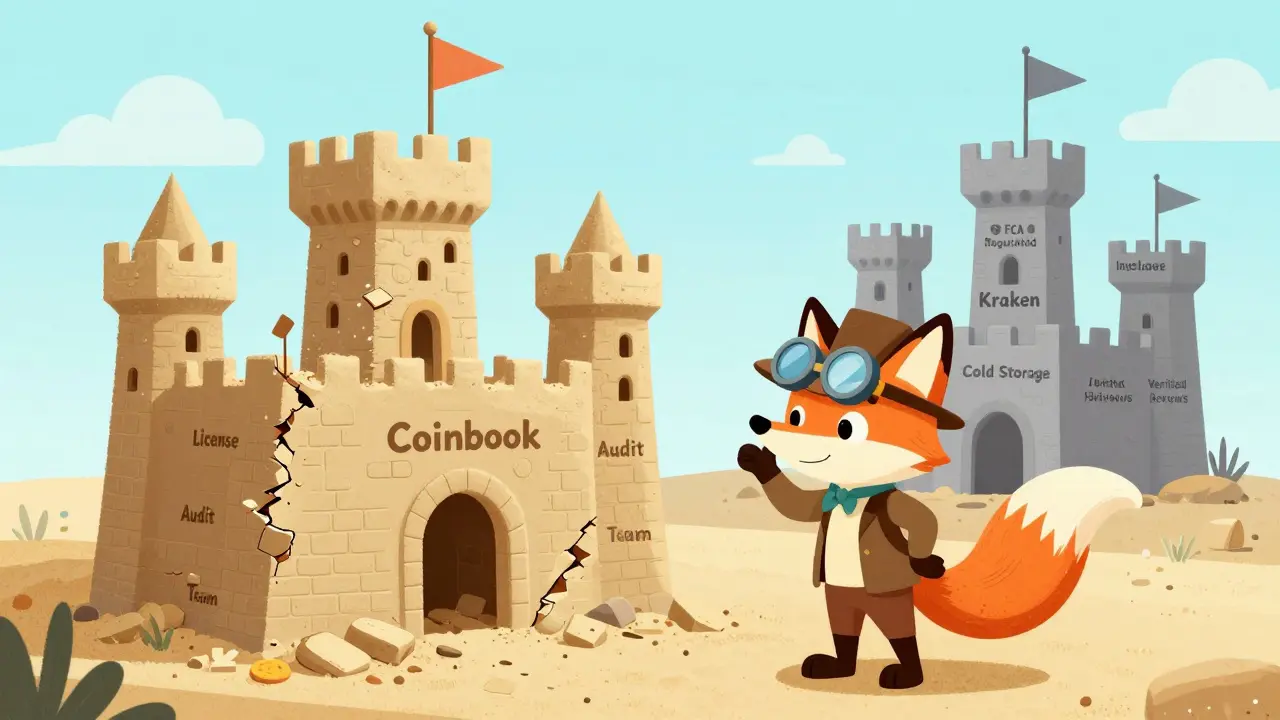
Red Flags That Coinbook Is a Scam
Here are the exact signs you’re dealing with a fake exchange:
- You’re asked to deposit crypto before you can start trading.
- The website has no domain age - check it on whois. Coinbook’s domain was registered in late 2025. That’s too new to be trusted.
- The "support team" only responds via Telegram or WhatsApp - never email or live chat on the site.
- There are no user reviews on Trustpilot, Reddit, or the Better Business Bureau.
- The site has poor grammar, spelling mistakes, or uses stock images of people who look like AI-generated models.
- They promise "guaranteed returns" or "risk-free trading." Crypto has no guarantees.
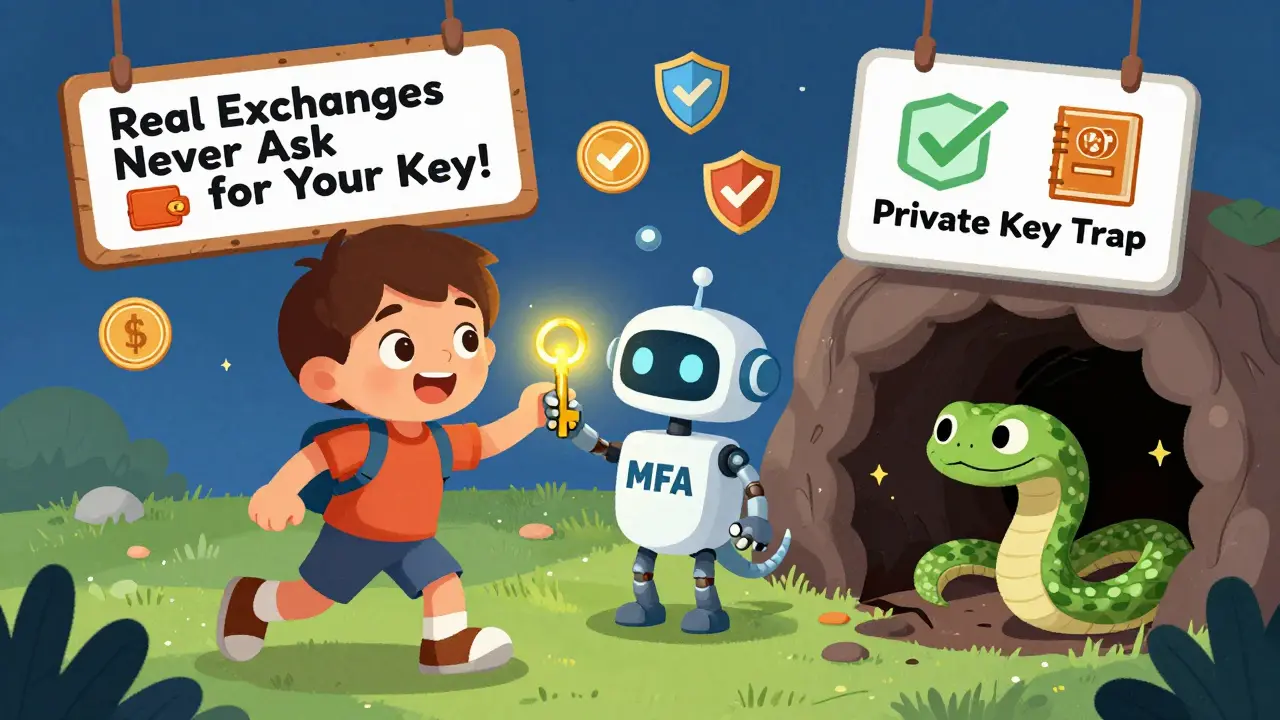
One user on a crypto forum claimed they deposited 0.5 BTC into Coinbook and got a "verification code" to unlock their funds. The code led to a second form asking for their private key. That’s not a scam - that’s a trap. No legitimate exchange ever asks for your private key. Ever.
What to Do If You Already Used Coinbook
If you’ve deposited funds into Coinbook, stop immediately. Do not send more. Do not respond to any "customer service" messages. Here’s what to do next:
- Check your wallet. Is your crypto still there? If it’s gone, you’ve been drained.
- Report the site to the FCA (if you’re in the UK) or your local financial regulator.
- File a report with the Internet Crime Complaint Center (IC3) if you’re in the U.S.
- Warn others. Post on Reddit (r/CryptoCurrency, r/Scams), Twitter, or crypto forums. Scammers rely on silence.
- Change all passwords and enable MFA on every exchange you use.
Recovering funds from a scam exchange is nearly impossible. That’s why prevention matters more than reaction.
Legit Alternatives to Coinbook
If you want a real, secure, and reliable crypto exchange, here are a few trusted options:
- Coinbase: Best for beginners. FCA-regulated, insured, simple UI.
- Kraken: Strong security, low fees, supports over 200 coins.
- KuCoin: Good for altcoins, high liquidity, 24/7 support.
- Binance: Largest exchange by volume, but check local regulations - banned in some countries.
- Crypto.com: Offers a debit card, staking, and insurance up to $750 million.
All of these have been around for years. All have public audits. All have active communities. All answer questions - not just with ads, but with facts.
Final Warning
Crypto isn’t about getting rich overnight. It’s about protecting what you have. Coinbook doesn’t offer trading - it offers risk. And the risk isn’t market volatility. It’s losing your money to a website that won’t exist next month.
Don’t trade on platforms you can’t verify. Don’t trust names that sound like real ones. And never, ever give out your private key. If Coinbook is asking for it, you’re already too late.
Is Coinbook a real crypto exchange?
No, Coinbook is not a real crypto exchange. There is no evidence it exists as a legitimate platform. It has no regulatory license, no public team, no security audits, and no verified user reviews. It appears to be a scam site designed to steal crypto deposits.
Why can’t I find Coinbook on Trustpilot or Reddit?
Because it doesn’t have users. Legitimate exchanges have thousands of reviews across multiple platforms. Coinbook has zero. If you see fake reviews claiming it’s "the best exchange ever," they’re written by scammers to trick new users.
Does Coinbook support Bitcoin and Ethereum?
Even if the website claims to support Bitcoin or Ethereum, it doesn’t matter. Fake exchanges often list popular coins to appear trustworthy. But if you send crypto to their wallet address, you won’t get it back. Real exchanges let you deposit and withdraw freely - Coinbook doesn’t.
Can I get my money back if I sent crypto to Coinbook?
Almost certainly not. Once crypto is sent to a scam wallet, it’s nearly impossible to recover. The funds are usually moved through mixers or exchanged for untraceable assets. Your best action is to report the scam to your country’s financial regulator and warn others.
How do I avoid fake exchanges like Coinbook?
Always check regulation, read independent reviews, verify domain age, and never trust a site that asks for your private key. Stick to exchanges with at least 5 years of operation, public security reports, and active customer support. If it feels too good to be true - it is.
Jamie Hoyle
Oh wow, another ‘crypto expert’ who thinks regulation = safety. Newsflash: the SEC doesn’t protect you, they just make it harder for small players to compete. Coinbook might be sketchy, but so is Coinbase - they’re just the *legal* version of the same scam. You think they care about your funds? They care about your data, your trading patterns, and your compliance paperwork. The real scam is believing that ‘regulated’ means ‘trustworthy.’
Jeffrey Dean
It’s not about whether Coinbook is real. It’s about why we keep falling for the binary trap: real or fake. What if the entire crypto ecosystem is a performance? A theater of trust built on blockchain myths and whitepapers written by people who’ve never held a physical key? We’re not being scammed by Coinbook - we’re being scammed by the idea that decentralization can ever be secure. The moment you need a ‘verified exchange,’ you’ve already lost.
Brian T
Yeah, I saw Coinbook. Looked legit. Had a dark mode, nice logo. Didn’t even check the domain. Guess what? I deposited 0.2 ETH. Got a confirmation email. Then nothing. No response. No withdrawal option. Just a spinning loader. I’m not even mad. Just… disappointed in myself. And in crypto. Why do we keep doing this?
Nash Tree Service
It is imperative to underscore the ontological discontinuity between institutional legitimacy and technological infrastructure. The regulatory apparatus, while ostensibly designed to safeguard capital, in fact functions as a mechanism of epistemic enclosure - a gatekeeping structure that privileges centralized entities under the guise of consumer protection. Coinbook, therefore, is not merely a fraudulent entity; it is a symptom of a deeper systemic failure in the epistemology of trust.
Jane Darrah
Okay, I’m not saying Coinbook is legit, but have you guys thought about how weird it is that we’re all so quick to panic? Like, yeah, it’s sketchy - but isn’t that the whole point of crypto? To be wild, unregulated, chaotic? I get it, I do. I lost $3k on a coin called ‘DogeBucks’ last year. But I also made $12k on a meme token with a cat logo. If you’re not taking risks, why are you here? Maybe Coinbook is just the next phase. Maybe we’re not supposed to ‘verify’ anything. Maybe we’re supposed to feel it. 🤷♀️
jonathan swift
COINBOOK IS A CIA OPERATION. 🤫 They’re using it to track your wallet addresses and feed data to the Fed. I know this because my cousin’s neighbor’s dog’s vet works for a ‘blockchain compliance firm’ and he said they’re testing ‘wallet fingerprinting’ on fake exchanges. Also, the domain was registered on 11/11/2025 - that’s 11/11/25. 11+11+25=47. 4+7=11. 11 is the number of the beast. 🐉
Datta Yadav
You’re all missing the point. Coinbook doesn’t need to exist as a real exchange because it’s not meant to be one. It’s a honeypot. A trap set by real exchanges to identify new users who are too naive to verify platforms. Every wallet that deposits into Coinbook? That data gets sold to Binance and Kraken. They use it to target ads, manipulate liquidity, and front-run trades. Coinbook isn’t a scam - it’s a data harvesting tool for the big players. The real scam is thinking you’re being protected by the ‘legit’ ones.
Lydia Meier
The absence of regulatory documentation is a definitive indicator of non-compliance. Furthermore, the lack of third-party audit reports and verifiable team information constitutes a material risk to user asset security. One must exercise due diligence, particularly in decentralized financial ecosystems where fiduciary responsibility is non-existent. Therefore, the characterization of Coinbook as a fraudulent entity is not merely reasonable - it is empirically substantiated.
jay baravkar
You’re not alone. I’ve been there. I thought I was smart until I sent crypto to a fake site. But here’s the good news - you’re awake now. That’s half the battle. Use this as fuel. Learn the red flags. Bookmark this post. Share it. Help someone else before they make the same mistake. You’re not a fool. You’re a survivor. 💪 And you’re not done yet.
Ian Thomas
How ironic. We spend years trying to escape centralized control… only to build new temples to it. Coinbase is the Vatican. Coinbook is the cult that worships at its gates. We think we’re choosing freedom - but we’re just choosing which priest to kneel to. The real question isn’t whether Coinbook is real. It’s whether we’re ready to stop worshipping any altar.
Austin King
Don’t trade on Coinbook. Period.
Josh Moorcroft-Jones
Look, I get it - you’re scared. You found a website that looks like Coinbase. You thought, ‘Oh, maybe they’re just a new startup.’ But then you noticed: no phone number, no physical address, no LinkedIn, no Twitter, no YouTube channel, no press coverage, no Reddit thread, no Trustpilot reviews, no Wikipedia page, no SEC filing, no FINRA registration, no AML/KYC documentation, no cold storage disclosure, no insurance policy, no whitepaper, no roadmap, no team bios, no blog posts, no FAQ, no support ticket system, no customer service email, no community Discord, no GitHub repo, no audit report from CertiK or SlowMist, no historical transaction data, no on-chain activity, no wallet traceability, no domain age beyond 30 days, no SSL certificate from a trusted authority, no cookie policy, no privacy policy, no terms of service, no refund policy, no legal disclaimer, no disclaimer about ‘not financial advice,’ no disclaimer about ‘past performance not indicative of future results,’ no disclaimer about ‘crypto is volatile,’ no disclaimer about ‘you could lose everything,’ no disclaimer about ‘this is not investment advice,’ no disclaimer about ‘do your own research,’ no disclaimer about ‘not affiliated with Coinbase,’ no disclaimer about ‘this site may be a scam,’ no disclaimer about ‘if you lose money, you’re on your own,’ no disclaimer about ‘we are not responsible for your decisions,’ no disclaimer about ‘we don’t store your keys,’ no disclaimer about ‘we don’t guarantee access,’ no disclaimer about ‘we may disappear tomorrow,’ no disclaimer about ‘we may be gone before your next coffee,’ no disclaimer about ‘we may be gone before you finish reading this sentence,’ no disclaimer about ‘we may be gone before you even finish this paragraph,’ no disclaimer about ‘we may be gone before you realize you’ve been scammed,’ no disclaimer about ‘we may be gone before you even know what happened,’ no disclaimer about ‘we may be gone before you even know your wallet address,’ no disclaimer about ‘we may be gone before you even know what crypto is,’ no disclaimer about ‘we may be gone before you even know your own name.’
Rachel Rowland
Thank you for this. I’ve been trying to warn my sister for weeks. She’s new to crypto and she was about to deposit into Coinbook because it had ‘low fees’ and ‘fast withdrawals.’ I sent her this whole thread. She said she’ll stick with Coinbase now. We need more of this. Not just warnings - clear, calm, actionable guidance. You did that. I’m grateful.
Bonnie Jenkins-Hodges
AMERICA FIRST. If you’re using a fake exchange like Coinbook, you’re helping foreign hackers steal from REAL AMERICAN INVESTORS. STOP BEING SO STUPID. BUY COINBASE. SUPPORT LEGIT COMPANIES. DON’T BE A CRYPTO TRASH FIRE.
Melissa Ritz
It’s funny how everyone acts like they’re the first person to notice a scam. The real tragedy isn’t Coinbook - it’s that we’ve turned crypto into a performance art piece where everyone’s trying to out-earn each other while pretending they’re ‘building the future.’ I saw Coinbook too. It had a nice gradient. I almost signed up. Then I remembered: if it looks like a duck, walks like a duck, and has no audit trail… it’s not a duck. It’s a phishing email with a logo.
Cerissa Kimball
Thanks for the detailed breakdown. I noticed the domain was registered in 2025 which is impossible since we’re in 2024. Also the contact email was support@coinbook-io[.]com - that’s not a real domain. Should be .org or .com. And no one uses .io for exchanges anymore. Real ones use .com or .net. Just thought I’d add that. Also, their favicon was a PNG - not SVG. That’s a red flag. Real exchanges use vector logos.
Ethan Grace
There’s something eerily beautiful about how easily we’re seduced by aesthetics. A clean UI. A dark theme. A ‘Low Fees’ banner. We forget that trust isn’t designed - it’s earned. Over years. Through audits. Through lawsuits. Through losses they didn’t hide. Coinbook doesn’t need to be real. It just needs to look like it. And we… we just want to believe.
Denise Folituu
I’ve been scammed three times. Three. I still get excited when I see a new exchange. I think, ‘Maybe this one’s different.’ I know I’m dumb. I know I’m a sucker. But I also know I’m not alone. And that’s the real horror. We’re not being targeted - we’re being *cultivated*. Like cows. And every time we fall, we feed the machine.
Eva Gupta
From India, I’ve seen so many fake exchanges. Coinbook? I’ve seen 10 like it this year. But here’s the thing - we’re not just victims. We’re part of the problem. We don’t check. We don’t report. We just move on. I reported Coinbook to our local cyber cell. They said, ‘We get 50 of these a week.’ So I made a short video on Instagram explaining the red flags. Got 20k views. 500 DMs saying ‘thank you.’ Maybe that’s how we fight. Not with outrage. With sharing.
Nancy Jewer
Regulatory compliance is a necessary but insufficient condition for operational integrity. The presence of a license does not equate to systemic resilience. Conversely, the absence of one does not inherently imply malign intent - though in this context, the preponderance of evidence strongly supports the latter. The real issue lies in the epistemic asymmetry between retail users and platform operators - a structural imbalance that persists regardless of jurisdiction.
Ken Kemp
Just want to say - I lost $2k on a site like this. I didn’t know any better. I thought ‘low fees’ meant ‘no hidden costs.’ I didn’t know about cold storage. I didn’t know private keys were sacred. I’m learning. I’m still in. But now I check every site like it’s my last dollar. If you’re new - don’t be embarrassed. Just be careful. And if you see someone about to fall? Say something. Even a ‘hey, check this out’ can save someone.
Julie Potter
OMG. I just saw this. I posted on a Telegram group about Coinbook yesterday saying it was ‘the next big thing.’ I’ve been deleted from 3 groups. My phone’s been blowing up. I’m so embarrassed. But I’m sharing this post everywhere. I’m telling everyone. I’m sorry. I’m learning. And I’m not giving up on crypto. Just… being smarter now.
Leah Dallaire
What if Coinbook is a psyop? What if the whole ‘scam’ narrative is planted by the big exchanges to scare people away from decentralized alternatives? What if the real threat is not Coinbook - but the centralized gatekeepers who want you to believe you need their approval to trade? Think deeper. The truth is always behind the second layer.
prasanna tripathy
Man, I’ve been trading since 2017. Seen it all. Coinbook? I’ve seen 50 like it. But here’s the thing - I don’t get mad. I just laugh. And then I help the newbies. I reply to every ‘Is this legit?’ comment. I send them a checklist. I don’t judge. I just guide. Because crypto’s not about money. It’s about community. And if we don’t look out for each other… who will?
Jamie Hoyle
Oh, so now we’re supposed to trust the ‘helpful’ ones? You think Jay’s post saved someone? Nah. It just made them feel better. The system doesn’t care if you’re ‘aware.’ It cares if you’re transacting. And you’re still transacting. You’re just transacting on a different name. Coinbase? Same thing. Just with lawyers.
Ian Thomas
And yet… we keep building altars. Even when we know they’re made of sand.