

HashKey Exchange isn’t another flashy crypto platform chasing hype. It’s a licensed, compliance-first exchange built for users who care more about safety than speed. If you’re in Hong Kong or need to trade in HKD or USD with a regulator-approved platform, HashKey might be your best bet. But if you want 300+ coins, 100x leverage, or automated trading bots, you’ll be disappointed. Here’s what actually matters in 2025.
It’s One of the Few Licensed Crypto Exchanges in Hong Kong
HashKey Exchange is one of the first platforms in Hong Kong to get a full trading license from the Securities and Futures Commission (SFC). That’s not just a badge-it’s a legal requirement to operate. As of March 2025, they’re the largest licensed virtual asset exchange in the region. This matters because Hong Kong is pushing hard to become a global crypto hub, and only exchanges that pass strict audits, keep user funds separate, and submit to regular inspections can stay open.For comparison, most global exchanges like Binance or Bybit don’t have this license. That’s why HashKey made it to #14 on Forbes’ 2025 list of most trustworthy crypto exchanges-out of 200+ evaluated. Their score? 4.9 out of 5. The main reason? Regulatory compliance, transparency, and asset security. No other exchange in Asia has this level of official recognition.
What You Can Trade (And What You Can’t)
HashKey offers 107 spot trading pairs and 53 futures pairs. Sounds solid? Not really. The big problem? Only 26 cryptocurrencies are supported. That’s less than 10% of what Kraken or OKX offer. You’ll find Bitcoin, Ethereum, Solana, and a few others-but no meme coins, no new DeFi tokens, and no NFT marketplace. If you’re into trading lesser-known altcoins, you’ll need another platform.What they do have? HKD and USD as fiat on-ramps. That’s rare. Most exchanges only support EUR, USD, or GBP. If you’re in Hong Kong and want to deposit Hong Kong dollars directly, HashKey is one of the only places that lets you do it without going through a third-party payment processor.
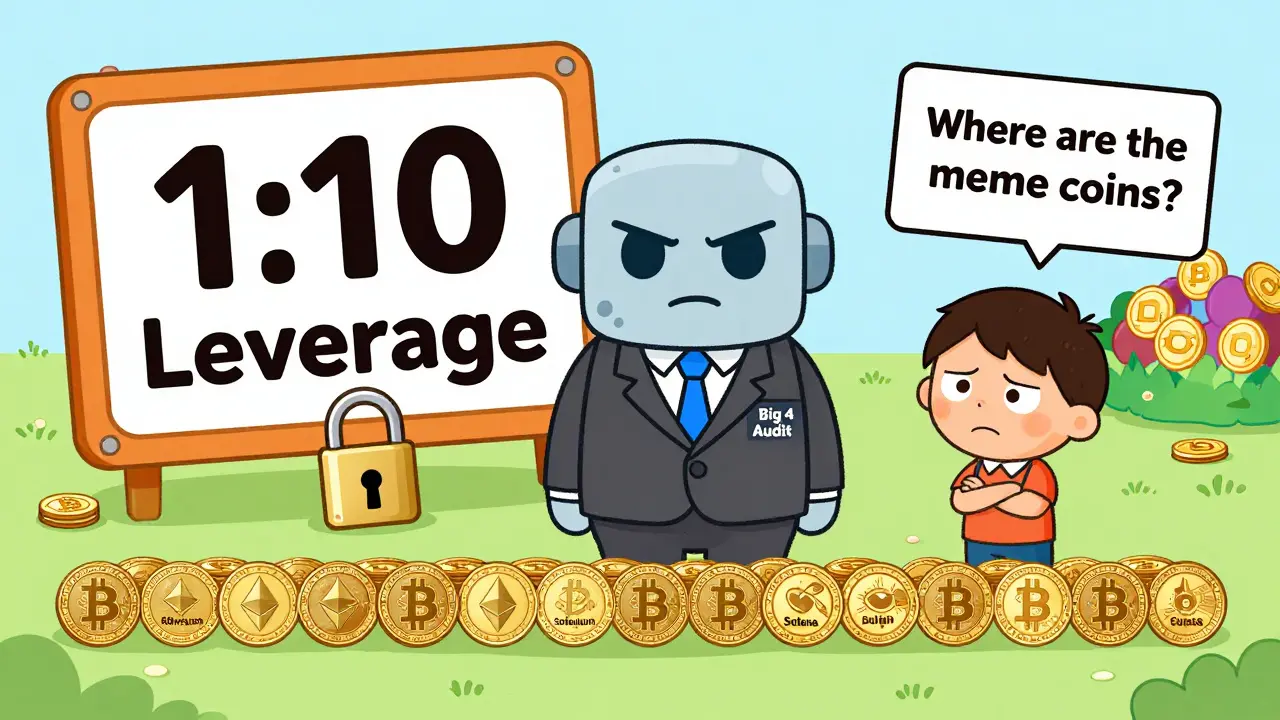
Leverage is capped at 1:10. That’s low. On Binance or Bybit, you can go up to 125x. HashKey’s limit makes sense for safety, but it’s a dealbreaker for day traders or those trying to amplify small moves. If you’re a long-term holder or institutional investor, this won’t bother you. If you’re trying to make quick profits, you’ll hit a wall.
Fees Are Transparent, But Not Always Low
Deposits and withdrawals for crypto are free. That’s good. Transactions clear in under 10 minutes. No surprises there.Trading fees? They’re tiered based on your VIP level, not flat. Maker fees start at 0.08%, taker fees at 0.1%. Higher volume traders get discounts. But here’s the catch: fiat withdrawals cost money. You’ll pay a fee to pull out HKD or USD to your bank account. That’s unusual. Most exchanges waive fiat withdrawal fees. HashKey doesn’t. One user reported being charged $362 to withdraw their own funds after being accused of money laundering. They never got a clear answer.
HashKey’s native token, HSK, gives you small discounts on trading fees and rewards for referring others. It’s not a game-changer, but it’s better than nothing.
Security Is Strong-But Not Perfect
HashKey uses cold storage for 95% of assets. User funds are segregated. All traffic is encrypted with SSL. They’ve never had a breach. That’s rare in crypto.They also get audited by Big 4 accounting firms. That’s the same level of scrutiny banks get. Forbes highlighted this as a key reason for their high trust score.
But here’s the gap: no facial recognition, no biometric login, and no two-factor authentication (2FA) via authenticator apps like Google Authenticator. Some reports say 2FA is supported-others say it’s not. That inconsistency is worrying. If you’re serious about security, you want multiple layers, not guesswork.
Trading Tools Feel Outdated
The web and mobile apps work. But they’re slow. Users report being logged out randomly-even when they check “remember me.” The interface is clean, but clunky. Charts load slowly. Orders take longer to fill than on bigger exchanges.You won’t find copy trading, trading bots, or advanced order types like iceberg or OCO. No API for algorithmic trading beyond basic access. That’s fine if you’re a beginner. If you’re a pro, you’ll feel like you’re using a 2018 platform. TradersUnion gave their trading tools a 5.25/10. That’s below average.
Customer support is available 24/7 via live chat, but ticket responses take over a month. Trustpilot reviews are split 50/50. Half say it’s reliable. Half say it’s a scam. The worst complaints? Frozen funds, unresponsive support, and being asked to pay fees to withdraw your own money.

Who Is This Exchange Really For?
HashKey isn’t for everyone. It’s not for meme coin traders. Not for high-leverage speculators. Not for users who want 500+ coins.It’s for three types of people:
- Hong Kong residents who need to trade in HKD with a legal platform.
- Institutional investors who need compliance, audits, and dedicated account managers.
- Risk-averse retail traders who value regulation over features.
If you’re outside Hong Kong, the benefits shrink. You still get the license, but you lose the HKD pairing. You’re left with a limited coin list and slower tools than global giants.
The Bigger Picture: Compliance Is the New Crypto Currency
The crypto world is changing. Governments are cracking down. The U.S. is suing exchanges. Europe is tightening rules. Even Dubai and Singapore are demanding licenses.HashKey’s strategy isn’t flashy-it’s smart. They’re betting that in 5 years, the only exchanges that survive will be the ones with real licenses. They’re already ahead of the curve. Their Crypto-as-a-Service platform, launched in early 2025, helps banks and funds get into crypto without breaking regulations.
They’re not trying to beat Binance. They’re trying to be the Swiss bank of crypto. Slow. Secure. Regulated. That’s their niche.
If you’re in Hong Kong or need a compliant gateway to digital assets, HashKey Exchange is one of the safest choices you have. But if you’re looking for speed, variety, or advanced tools, you’ll need to look elsewhere.
Is HashKey Exchange safe to use?
Yes, for users who prioritize regulation over features. HashKey is one of the few crypto exchanges in Hong Kong licensed by the SFC. It uses cold storage, has never been hacked, and undergoes audits by Big 4 firms. But it lacks advanced security like facial recognition or authenticator app 2FA, which some competitors offer. It’s safe for long-term holding and regulated trading, but not the most secure platform overall.
Does HashKey Exchange support fiat deposits and withdrawals?
Yes, but only for USD and HKD. You can deposit fiat directly via bank transfer. Crypto deposits and withdrawals are free and fast (under 10 minutes). However, fiat withdrawals cost a fee-unlike many other exchanges. This makes it less attractive for users who frequently move money in and out of the platform.
How many cryptocurrencies does HashKey support?
HashKey supports 26 cryptocurrencies as of 2025. That includes Bitcoin, Ethereum, Solana, Chainlink, and a few others. It’s far fewer than major exchanges like Kraken (278) or OKX (329). If you trade altcoins or new tokens, you’ll need another platform. HashKey focuses on major, regulated assets-not speculative coins.
What are the trading fees on HashKey Exchange?
Trading fees are tiered based on your trading volume and VIP level. Maker fees start at 0.08%, taker fees at 0.1%. Higher volumes reduce these fees. Crypto deposits and withdrawals are free. But fiat withdrawals have a fee-sometimes significant. There’s no flat 0% fee structure, contrary to some misleading reports.
Can I use HashKey Exchange if I’m not in Hong Kong?
Yes, but with limits. HashKey is available to users outside Hong Kong, but the main advantage-HKD trading pairs-is lost. You still get the licensed security and compliance, but you’re stuck with fewer coins and slower tools than global exchanges. For most international users, platforms like Kraken or Coinbase offer more features and better liquidity.
Does HashKey Exchange offer leverage or futures trading?
Yes, but with strict limits. HashKey offers futures trading with a maximum leverage of 1:10. That’s much lower than competitors like Binance or Bybit, which allow up to 125x. This makes it unsuitable for aggressive traders but safer for those who want to hedge positions without extreme risk. It doesn’t offer options or perpetual contracts with high leverage.
Why do some users call HashKey a scam?
Some users report being asked to pay large fees to withdraw funds, claiming they’re under investigation for money laundering. Others complain about slow customer service, forced logouts, and a poor mobile interface. While HashKey is a licensed exchange, its customer service is inconsistent, and its platform lacks polish. These experiences don’t mean it’s a scam-but they do mean you should proceed with caution, especially if you’re new to crypto.
Megan O'Brien
HashKey’s compliance-first approach is basically the crypto equivalent of using a fax machine in 2025. Sure, it’s legal, but who the hell still uses fax? The 26 coins? The 1:10 leverage? It’s not a platform-it’s a regulatory museum piece. If I wanted to trade like it’s 2018, I’d just buy a time machine.
Tyler Porter
Look, I get it-security matters. But if your exchange doesn’t have bots, or decent charts, or even decent 2FA, then you’re not helping people-you’re just making them wait. I’m not saying go wild, but come on. A little innovation wouldn’t kill you.
Luke Steven
There’s something beautiful about an exchange that doesn’t try to be everything to everyone. The crypto world is drowning in noise-meme coins, 100x leverage, influencer pumps. HashKey is the quiet guy in the corner who actually shows up to work. It’s not sexy, but it’s honest. And in a space where 90% of platforms are just glorified casinos, maybe that’s the real innovation.
Regulation isn’t the enemy-it’s the foundation. The fact that they’re audited by Big 4 firms? That’s more than most can say. The UI is clunky? Fine. But at least my money isn’t getting stolen while I’m scrolling TikTok.
Ellen Sales
so like… hashkey is basically the crypto version of a library? quiet, boring, no memes, but you know the books aren’t on fire? 🤷♀️ i’m lowkey here for it. i don’t need 300 coins, i just need to not get hacked while i hold eth. also, hkD support? yes please. why do all the other exchanges act like usd is the only currency that exists??
Sheila Ayu
Wait-so you’re telling me this exchange doesn’t even have 2FA via Google Authenticator?? And you call this secure?? You’re literally trusting your life savings to a platform that can’t even get basic security right. And don’t even get me started on the $362 withdrawal fee-sounds like a ransomware attack with a compliance certificate.
Janet Combs
Okay but… I just want to deposit HKD and not get my account frozen for 6 weeks. That’s it. That’s all I ask. If the app logs me out every 2 minutes and the support takes a month to reply, fine-I’ll deal. I just want to know my money’s safe. And honestly? That’s more than I can say for half the exchanges out there. I’m not here to trade Solana memecoins-I’m here to sleep at night.
Rachel McDonald
They’re not a scam. They’re just… painfully slow. Like, if you’re waiting for your order to fill, you could’ve brewed a pot of coffee, read a chapter of War and Peace, and still be waiting. And the fee for withdrawing your own money? That’s not a fee-that’s a punishment. You’re not a bank. You’re not a government. You’re a crypto exchange. Stop acting like you’re charging me for oxygen.
Vijay n
HashKey is controlled by the chinese government to monitor all crypto transactions in hong kong and then report to beijing this is not about security its about surveillance the sfc license is just a cover for data harvesting
Jayakanth Kesan
I live in India and I use HashKey for my USD holdings. Yeah, the interface is slow, yeah, no bots-but I’ve never had a single issue with withdrawals. No freezes, no weird fees, no drama. I don’t need flashy features. I need reliability. And honestly? That’s rarer than you think.
Aaron Heaps
Let’s be real: if you’re using HashKey, you’re not a trader-you’re a retiree with a crypto portfolio. You want safety? Fine. But don’t pretend this is for serious investors. The lack of API, the clunky UI, the 1:10 leverage-it’s a retirement home for crypto, not a trading floor.
Tristan Bertles
People are acting like HashKey is broken because it doesn’t have 300 coins. But if you’re trading meme coins, you’re already playing with fire. HashKey is the guy who says, ‘Hey, maybe don’t put your life savings into Dogecoin.’ It’s not about what they offer-it’s about what they don’t let you do. And honestly? That’s the most responsible thing in crypto right now.
Amit Kumar
Bro, I’m from India and I’ve used Binance, OKX, even KuCoin-but I switched to HashKey because I needed to move USD out without getting flagged. The fees are annoying, yeah, but at least I didn’t get my account suspended for ‘suspicious activity’ after depositing $5k. The UI is trash, but my money is safe. That’s worth more than 100x leverage.
Cathy Bounchareune
HashKey is the crypto equivalent of a cashmere sweater: expensive, warm, and you’ll never wear it to a party-but you’ll feel guilty if you don’t own one. It’s not for the hype, it’s for the quiet confidence that your money won’t vanish because some dev forgot to patch a vulnerability. And honestly? That’s worth more than a 10x return on Shiba Inu.
Dan Dellechiaie
Let’s stop pretending this is about safety. It’s about control. The SFC license? That’s not protection-it’s gatekeeping. They’re not letting anyone in unless you’re already rich enough to need a compliance officer. And the fact that they charge you to withdraw your own money? That’s not a fee-it’s a tax on trust. This isn’t crypto-it’s banking with extra steps.
Rishav Ranjan
26 coins. 1:10 leverage. No API. That’s it. Done. No need to overthink it.
Rebecca F
They’re not safe. They’re just slow. And slow is just another word for dead. If you’re still using this in 2025, you’re not a trader-you’re a relic. And your portfolio? It’s fossilized.
Jordan Renaud
There’s a quiet dignity in being the last one standing when everyone else is burning down. HashKey isn’t trying to win the race-it’s trying to make sure the race doesn’t burn the whole track. Maybe that’s not exciting. But in a world where exchanges vanish overnight, maybe that’s the most revolutionary thing you can do.
Radha Reddy
As someone from India who uses HashKey for USD deposits, I appreciate the compliance. Yes, the interface is outdated. Yes, support is slow. But I’ve never lost funds. I’ve never been asked for KYC twice. I’ve never had a withdrawal delayed for weeks. In crypto, that’s luxury.
Shubham Singh
HashKey is a regulatory puppet. SFC license does not equal security. It equals bureaucratic compliance. The audit reports are performative. The cold storage? Maybe. But the 2FA inconsistency? That’s negligence dressed in a suit.
Charles Freitas
You’re all acting like this is some kind of moral victory. It’s not. It’s just a slow, overpriced, underpowered platform with a fancy license. You’re not being responsible-you’re being lazy. If you don’t want to learn how to use a real exchange, that’s your problem. Don’t call this safety. Call it convenience for people who don’t want to grow up.
Earlene Dollie
Imagine your crypto portfolio is a pet. Most people treat it like a wild raccoon-feed it junk, let it run wild, hope it doesn’t break the couch. HashKey treats it like a goldfish. Small bowl. No toys. But it’s alive. And somehow… that’s enough.
Steve B
Regulation isn’t a feature. It’s a compromise. And HashKey is the exchange that chose compromise over chaos. That’s not weakness-it’s wisdom. The world is collapsing into speculation. Maybe the real revolution isn’t in leverage or coins-it’s in restraint.