
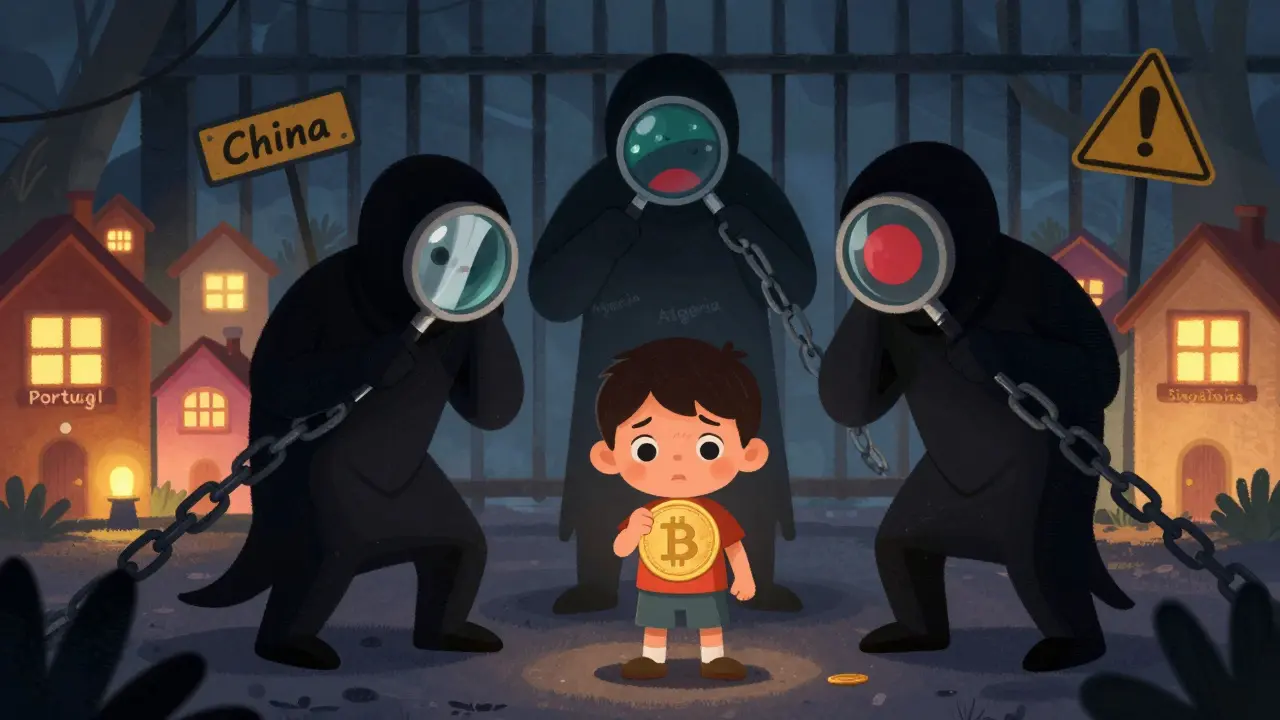
When you hold Bitcoin or Ethereum, you might think your activity is private. But in some countries, just owning crypto can land you in legal trouble. While places like Portugal and Singapore treat crypto like any other asset, others treat it like a crime. If you're a crypto user, your risk isn't just about price swings - it's about where you live. So which countries are actually prosecuting regular people for using cryptocurrency? The answer isn't what most assume.
China: The Harsh Reality of a Total Ban
China doesn't just discourage crypto - it bans it. Since 2017, the government has outlawed all crypto exchanges, ICOs, and mining operations. By 2021, even peer-to-peer trading was targeted. Authorities don't just shut down businesses; they go after individuals. In 2024, Chinese courts convicted over 1,200 people for running crypto mining rigs or facilitating trades through unofficial channels. Fines reached up to 500,000 RMB ($70,000), and prison sentences of up to five years were handed out. There are no gray areas. If you're mining Bitcoin in a basement in Guangdong or using a P2P app to buy USDT, you're breaking the law. China’s enforcement is relentless because it sees crypto as a threat to its digital currency, the e-CNY, and to capital controls.
Algeria and Bolivia: Complete Prohibitions with Real Consequences
Outside of Asia, Algeria and Bolivia stand out as the only two countries with absolute bans on cryptocurrency. In Algeria, the central bank declared all crypto transactions illegal in 2018. The law doesn’t just target exchanges - it criminalizes holding, sending, or receiving digital assets. In 2023, Algerian authorities raided homes and confiscated devices after tracking crypto wallet addresses linked to foreign transfers. At least 87 people were prosecuted that year, with charges under anti-money laundering and foreign exchange violation laws.
Bolivia took a similar route. The Central Bank of Bolivia issued a resolution in 2014 banning all cryptocurrencies, calling them a “threat to financial stability.” In 2024, Bolivian prosecutors filed charges against 43 individuals for using Bitcoin to pay for imported goods. One man received a two-year sentence for buying Ethereum to send money abroad. These aren’t rare cases. The government monitors bank transfers and flags any suspicious activity linked to crypto wallets. If you’re a Bolivian citizen holding crypto, you’re already on the radar.
Bangladesh: Taxation? No. Criminal Charges? Yes.
Bangladesh doesn’t tax crypto - it prosecutes it. The country’s Anti-Money Laundering Act classifies cryptocurrency as an illegal financial instrument. In 2023, Bangladesh’s Financial Intelligence Unit tracked over 1,100 transactions involving local wallets linked to overseas exchanges. Authorities arrested 62 people for using Binance or Kraken accounts to send money abroad. Many were charged under Section 5 of the Money Laundering Prevention Act, which carries penalties of up to seven years in prison. Unlike India, where you pay taxes on gains, in Bangladesh, even owning crypto without reporting it is enough to trigger criminal proceedings. There’s no legal path to compliance - only avoidance or punishment.
India: Heavy Taxes, No Jail - But Still High Risk
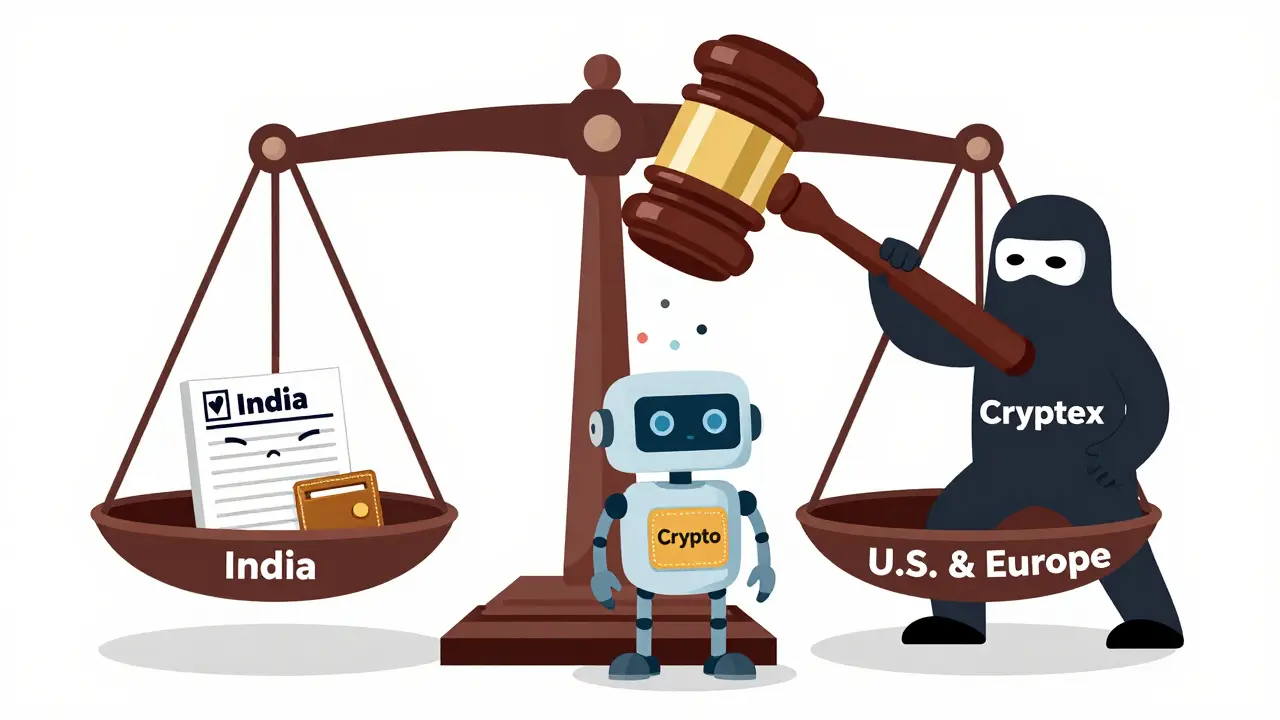
India walks a fine line. You can legally buy, sell, and hold crypto. But the government slapped on a 30% tax on all profits and a 1% tax deducted at source (TDS) on every transaction. That means every trade gets reported to the tax authorities. In 2024, over 1.7 million crypto transactions were flagged for audit. While no one has been jailed for owning Bitcoin, the tax system acts as a surveillance tool. If you don’t file, you risk penalties, asset seizure, or even criminal fraud charges under the Income Tax Act. The government doesn’t need to ban crypto - it just needs to track it. For users, the risk isn’t prison - it’s being audited, fined, or having your bank account frozen.
United States: Targeting Criminals, Not Users
In the U.S., you won’t get arrested for buying Solana. But if you’re laundering money, running a darknet market, or helping ransomware gangs - you’re in deep trouble. The September 2024 takedown of Cryptex, a Russia-linked exchange that processed $5.88 billion in illicit funds, shows how the U.S. operates. The Treasury’s OFAC sanctioned the platform and its operator, Sergey Sergeevich Ivanov. The State Department offered a $10 million reward for his capture. This wasn’t about Joe Schmoe trading Dogecoin. It was about dismantling a criminal pipeline. The U.S. focuses on institutions, not individuals. As long as you’re not moving money for hackers or drug cartels, your risk is near zero. Even with shifting political winds, enforcement remains laser-focused on large-scale abuse.
Europe: A New Enforcement Machine
Europe didn’t just update its rules - it built a new enforcement body. In July 2025, the Anti-Money Laundering Authority (AMLA) launched with 30 staff. By 2028, it’ll have over 400. AMLA now monitors every crypto transaction above €1,000 across the EU. Exchanges must report suspicious activity, and failure to comply can lead to fines up to 5% of annual revenue. The Netherlands, Germany, and France have already seized millions in crypto linked to fraud. Operation Endgame in 2024, which took down a $97 million payment processor funneling cash to Cryptex, showed how coordinated these efforts are. But here’s the key: AMLA targets exchanges, not users. If you’re a regular investor, you’re not being hunted. You’re just caught in a system that’s now watching every move your exchange makes.

Singapore and South Korea: Compliance Over Prosecution
Singapore and South Korea are the opposite of China and Algeria. Both have clear, detailed rules - but they don’t jail people for using crypto. Singapore’s Monetary Authority (MAS) requires stablecoin issuers to hold 100% reserves in regulated banks. Exchanges must be licensed, and customer funds must be segregated. In 2023, MAS fined two platforms for failing to verify users - but never prosecuted a single retail investor.
South Korea’s VAUPA law, effective since July 2024, forces exchanges to insure client assets, report suspicious activity, and keep transaction records for five years. The Financial Services Commission doesn’t go after users - it goes after bad exchanges. In 2025, two Korean platforms were shut down for fake trading volumes, but thousands of individual traders weren’t touched. These countries want crypto to thrive - just under strict rules. Prosecution? Not happening. Regulation? Absolutely.
Portugal: The Crypto Safe Haven
Portugal remains one of the few countries where crypto users face zero prosecution risk. There’s no capital gains tax on crypto profits. No mandatory reporting. No licensing requirements for individuals. The government doesn’t track your wallet. In 2025, a Portuguese court ruled that using Bitcoin to pay for a car was perfectly legal. Even when the EU pushed for stricter AML rules, Portugal exempted personal crypto use. If you’re holding Ethereum in Lisbon, you’re not breaking any law. You’re not even on a radar. Portugal’s approach isn’t accidental - it’s intentional. The country wants to attract crypto entrepreneurs. And so far, it’s working.
What This Means for You
If you’re a crypto user, your biggest risk isn’t the market. It’s geography. In China, Algeria, Bolivia, and Bangladesh, simply owning crypto can lead to fines, asset seizure, or jail. In India, you’re being watched - and taxed - but not jailed. In the U.S. and Europe, you’re safe unless you’re involved in crime. In Singapore, South Korea, and Portugal, you’re not just safe - you’re protected.
There’s no global standard. There’s no international treaty. What you can do in one country might be a felony in another. If you travel, move, or send crypto across borders, you’re playing with legal fire. The best advice? Know where you stand. If you’re in a country with a ban, don’t assume you’re invisible. Authorities are getting better at tracking wallets. If you’re in a crypto-friendly place, don’t assume you’re immune - rules can change overnight. But right now, the countries that prosecute users most are clear: China, Algeria, Bolivia, and Bangladesh. Everyone else? They’re focused on the big players.
Can I go to jail for owning Bitcoin in China?
Yes. China bans all cryptocurrency activities, including holding, trading, and mining. Individuals have been prosecuted and sentenced to prison for running mining operations or using P2P apps to buy crypto. Fines and asset seizures are common, and prison terms of up to five years have been handed down.
Is crypto illegal in India?
No, crypto isn’t illegal in India - but it’s heavily taxed. The government imposes a 30% tax on all crypto profits and a 1% tax deducted at source on every transaction. While owning crypto is legal, failure to report earnings can lead to audits, fines, or criminal fraud charges under tax laws.
Why does the U.S. prosecute crypto users?
The U.S. doesn’t prosecute regular users. It targets major criminal enterprises - like exchanges that launder money for ransomware or darknet markets. The 2024 takedown of Cryptex and the $10 million reward for its operator show the focus is on large-scale crime, not personal wallets.
Are crypto exchanges being shut down in Europe?
Yes - but not because users are trading. The new Anti-Money Laundering Authority (AMLA), launched in 2025, monitors transactions and shuts down exchanges that fail to comply with reporting rules. Individual users aren’t targeted - the focus is on institutions that enable fraud or money laundering.
Which countries are safest for crypto users in 2026?
Portugal, Singapore, and South Korea are among the safest. Portugal has no crypto taxes or reporting rules for individuals. Singapore and South Korea have strict rules for exchanges, but protect users from prosecution. As long as you’re not involved in crime, your risk is extremely low in these countries.
Scott McCrossan
China bans crypto? Big surprise. The entire system is a dictatorship with a digital veneer. They fear decentralized money because it exposes how fragile their control really is. Meanwhile, the US lets you mine Bitcoin in your garage while they bomb countries for oil. Double standards don't get more obvious than this.
Beth Erickson
India's 30% tax is just a surveillance tool disguised as revenue. They don't care if you profit they just want to track every move. It's not regulation it's digital policing with receipts.
Ruby Ababio-Fernandez
Portugal wins. No taxes no rules no drama. Just chill.
Jeremy Fisher
Look I get why China cracks down. They've spent decades building a financial firewall around their economy. Crypto isn't just about money it's about ideology. If people start using Bitcoin to bypass capital controls that undermines their entire model of state-led development. It's not about fear of innovation it's about fear of losing control. The e-CNY isn't just a currency it's the centerpiece of a new digital authoritarianism. And yeah maybe that's scary for some but for them it's survival.
Compare that to the US where the government spends billions on crypto enforcement but only targets the big fish. That's not because they're liberal it's because they're pragmatic. They know prosecuting Joe Schmoe who bought 0.2 BTC isn't worth the PR hit. But when a Russian exchange moves $5 billion in ransomware cash? That's a national security threat. The difference isn't moral it's strategic.
And Europe? AMLA is the most dangerous thing to happen to crypto since Mt. Gox. Not because it's evil but because it's efficient. Every transaction over €1000 gets logged. No more anonymity. No more gray zones. It's not about stopping crime it's about eliminating privacy. And the worst part? Most users don't even notice. They just think 'oh cool more compliance' while their wallet history gets fed into a database that could be used against them in 2030.
Andrew Edmark
It's wild how much this depends on where you live. I grew up thinking money was money but now it's clear your rights as a crypto user are tied to your passport. Someone in Bangladesh could go to jail just for sending a few hundred dollars in crypto to their sister abroad. Meanwhile I can trade Dogecoin on my phone while eating breakfast and no one cares. That's not freedom that's privilege.
I think we need to stop acting like crypto is some neutral tech. It's a political tool. And the countries that ban it aren't anti-innovation they're anti-liberty. The ones that tax it are trying to control it. The ones that ignore it? They're either naive or really confident in their systems. Portugal isn't lucky it's intentional. They know if you want to attract talent you stop treating people like suspects.
Dominica Anderson
Let's be real the US is just playing 4D chess while everyone else is stuck in checkers. They don't need to ban crypto because they've already weaponized the tax code. You think you're free? You're just a data point in a Bloomberg terminal.
sruthi magesh
India's 30% tax is the ultimate trap. They want your money but they don't want you to have power. It's neoliberalism with blockchain. They'll tax your gains but won't protect your rights. The real crime isn't holding crypto it's trusting the state to be fair.
Lisa Parker
I just bought my first ETH last week and now I'm terrified. What if I move to another country? What if they freeze my account? I didn't sign up for this stress.
Geet Kulkarni
Wow such deep insights! I love how Portugal allows freedom without regulation. Truly the land of crypto zen 🌿✨
Paul David Rillorta
China bans crypto? LMAO they banned it in 2017 and now they're building 5000 new mining rigs in secret. They hate crypto but they want the hashpower. Hypocrites.
andy donnachie
Interesting breakdown. I'd add that Ireland's stance is quietly pro-crypto too. No specific tax on gains and the Central Bank doesn't monitor personal wallets. Not as clean as Portugal but way better than the UK.
Lauren Brookes
I think the real takeaway isn't which countries ban crypto but which ones treat people like adults. China sees users as threats. India sees them as tax sources. The US sees them as potential criminals. But Portugal Singapore and South Korea? They treat crypto users like responsible adults with rights. That's not policy that's philosophy.
James Breithaupt
AMLA in Europe is the quiet monster nobody talks about. They're not shutting down exchanges because they're evil they're shutting them down because they're non-compliant. But compliance means KYC everywhere. That means your wallet is no longer yours it's the state's ledger. And the scary part? Most people are fine with it. They'd rather feel safe than be free. That's not progress that's surrender.
Alex Williams
For anyone thinking of moving countries because of crypto laws here's the real advice: don't focus on where you are focus on where you can go. Portugal is great but if you're a developer or entrepreneur you might be better off in Singapore or even Estonia. The key isn't just legality it's ecosystem. Can you open a bank account? Can you hire talent? Can you get legal clarity? That's what matters more than tax rates.
And if you're in a banned country? Use a hardware wallet. Don't tell anyone. Don't post about it. And don't assume you're safe just because you haven't been caught yet. They're getting better at tracing on-chain activity every year.
Sarah Shergold
Umm yeah but what about Australia? We tax it but we don't jail people. And we're not as bad as the US. Chill out.
Ian Plunkett
US is the most dangerous because it's the most deceptive. They say 'we don't ban it' but then they force every exchange to report everything. You're not free you're just watched by a different set of eyes.
And the $10M reward? That's theater. They don't want Ivanov caught they want everyone to believe they're hunting criminals. Meanwhile your neighbor's crypto holdings are flagged for AML checks because he sent 500 bucks to a friend. That's not enforcement that's intimidation.
jennifer jean
Love how Portugal just says 'do your thing' 🤗💎
george chehwane
China's ban isn't about crypto it's about the e-CNY. They're not scared of Bitcoin they're scared of competition. And that's the real story: authoritarian regimes fear decentralized systems not because they're dangerous but because they're honest.
Anandaraj Br
India's tax is a trap and you know it. They want your money but they don't want you to be rich. They want you to be dependent on their system. Crypto should be freedom but in India it's just another cage with a tax receipt.
Chris Thomas
Let's not romanticize Portugal. They're not a utopia they're a tax haven with a pretty coastline. The moment the EU tightens rules they'll cave. Same with Singapore. These aren't free societies they're corporate havens with good PR. Crypto freedom is an illusion. The real power lies with the banks and the regulators. You're just a customer.