
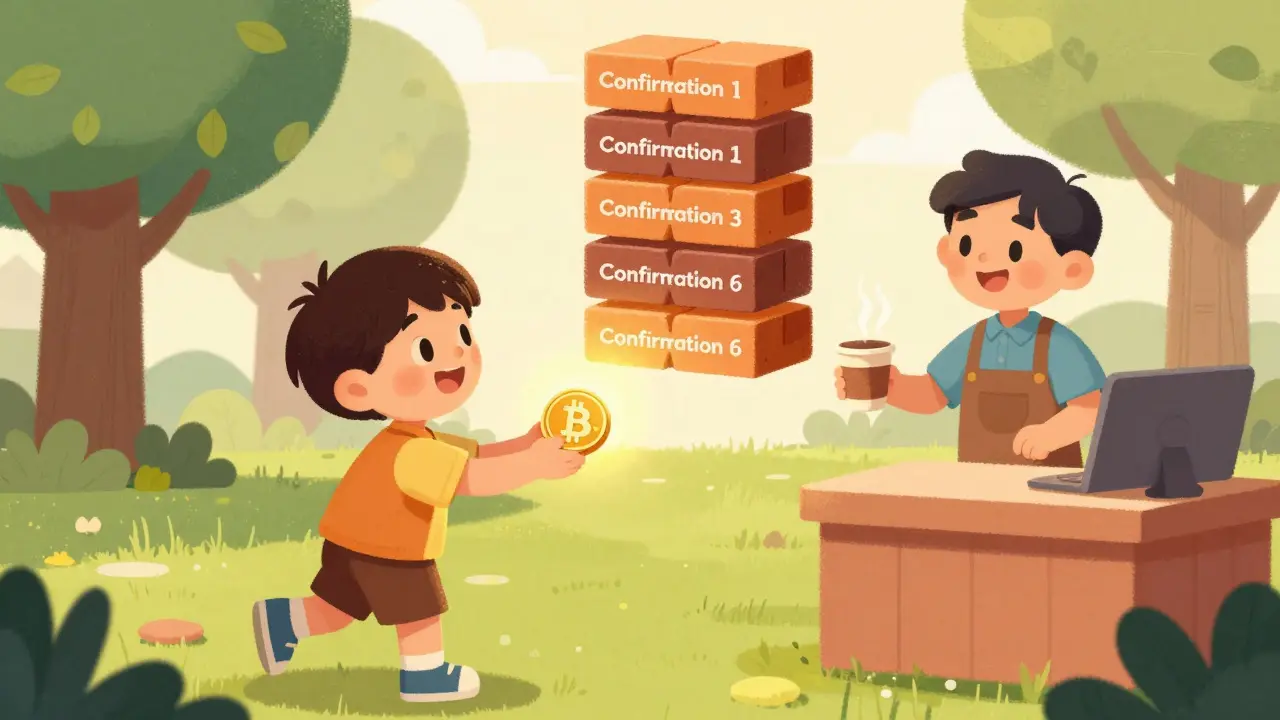
When you send Bitcoin or Ethereum to someone, you expect it to stick. No going back. No disputes. No frozen funds. That certainty? That’s finality-and it’s what makes blockchain trustworthy for real money, not just tech talk.
Finality isn’t just about a transaction showing up in your wallet. It’s about knowing, beyond any reasonable doubt, that it can’t be undone. Imagine paying for coffee with crypto, and the next day, the seller says, "Wait, that payment vanished." That’s what happens without finality. But with it? The coffee is yours. The money is gone from their account. Done.
What Finality Actually Means
Finality means a transaction is permanent. Once it’s finalized, no one-not even the sender, a hacker, or a rogue validator-can reverse it. This is different from just being "confirmed." A transaction can be confirmed but still vulnerable if the network hasn’t locked it in for good.
Think of it like signing a contract. Once both parties sign, notarize, and file it, you know it’s legally binding. Finality is the blockchain’s version of that notary stamp. It doesn’t just say "this happened." It says, "this happened, and it will always have happened."
Without finality, blockchain would be useless for payments. Why would a store accept crypto if the buyer could undo the transaction five minutes later? Finality turns digital coins into real value.
How Finality Is Achieved
Finality doesn’t happen by magic. It’s built into the blockchain’s consensus mechanism-the system that lets thousands of computers agree on what’s true. Different blockchains use different ways to reach this agreement, and each gives you a different kind of finality.
Probabilistic Finality: The Bitcoin Way
Bitcoin doesn’t promise instant finality. Instead, it says: "The more blocks added after your transaction, the safer it gets." This is called probabilistic finality. It’s not "yes or no." It’s "how likely is it to be reversed?"
When you send Bitcoin, it gets included in a block. That’s one confirmation. But it’s not final yet. If someone controls more than half the network’s mining power (a 51% attack), they could theoretically rewrite history and undo your transaction. But the more blocks get built on top of yours, the harder that becomes.
After six confirmations, Bitcoin considers a transaction practically final. That takes about an hour. Why six? Because the chance of a chain reorganization succeeding drops to less than 0.000001%. It’s not zero-but for all practical purposes, it’s gone.
Physical Finality: Ethereum Classic’s Hard Guarantee
Ethereum Classic (ETC) takes a different approach. It uses proof-of-work like Bitcoin, but with one key difference: it treats finality as physically impossible to reverse. Why? Because reversing a transaction means redoing all the computational work that went into every block after it.
Imagine building a tower of Legos. You add 100 layers. Now someone wants to remove the 50th block. They’d have to knock down the whole tower, rebuild it, and do it faster than the network keeps adding new blocks. The energy cost? Astronomical. The time? Impossible.
This is physical finality. It’s not about probability. It’s about physics. You can’t undo it without spending more than the value of the transaction itself. That’s a real economic barrier.
Instant Finality: The Private Chain Shortcut
Private blockchains-like those used by banks or supply chain companies-don’t need thousands of anonymous nodes. They use a small group of trusted validators. When one of them approves a transaction, it’s instantly final.
This is why companies like JPMorgan use private blockchains for cross-border payments. They don’t care about decentralization. They care about speed and certainty. Instant finality lets them settle trades in seconds, not hours.
But here’s the catch: you have to trust the validators. If they collude, they can reverse transactions. That’s fine for corporate use, but it’s not how public blockchains work.
Absolute Finality: The Theoretical Ideal
Absolute finality means zero chance of reversal. No reorgs. No attacks. No exceptions. It’s the gold standard-but very few public blockchains achieve it.
Some newer consensus algorithms, like Tendermint (used by Cosmos) or HotStuff (used by Diem), aim for absolute finality. They use Byzantine Fault Tolerance (BFT), where validators vote on blocks. Once two-thirds agree, the block is final. No waiting. No confirmations. Just locked-in.
The trade-off? These systems are faster but less permissionless. They need known validators. You can’t just join and start validating. That makes them less decentralized, but more predictable.

Why Finality Speed Matters
Not all finality is created equal. Some blockchains take 10 minutes. Others take 10 seconds. That difference changes everything.
Take Binance Smart Chain (BSC). It uses Proof-of-Stake Authority (PoSA), combining fast block times with BFT consensus. Finality hits in about 15 seconds. That’s why you can buy NFTs or swap tokens on BSC and immediately use them-no waiting.
Polygon PoS, which secures its transactions on Ethereum, waits for L1 checkpoints. Those happen every 30 minutes. So even if your transaction is on Polygon, you’re still tied to Ethereum’s slower pace.
Speed isn’t just about convenience. It’s about security. Slow finality means longer windows for attacks. Fast finality means less time for fraudsters to exploit.
Finality vs. Immutability: Don’t Confuse Them
People often mix up finality and immutability. They’re related-but not the same.
Immutability means data can’t be changed. Once a block is written, you can’t edit it. That’s true for all blockchains. But immutability doesn’t mean finality.
Here’s the difference: Imagine you write "I paid $100" on a whiteboard. You can’t erase it-that’s immutability. But if someone comes along and paints over it with a new message, the original is gone. That’s not finality.
Finality is about the chain’s history being permanently settled. Immutability just says the data won’t change. Finality says no one can rewrite the whole history.
That’s why Bitcoin waits for six confirmations. Even though each block is immutable, the chain itself can still be rewritten-until enough blocks are built on top to make it economically impossible.

Real-World Impact
Finality isn’t a technical footnote. It’s what lets blockchain be used in the real world.
- **Online stores** need to know a payment is final before shipping goods. If a transaction reverses, they lose money.
- **Decentralized finance (DeFi)** apps rely on finality to lock loans, pay interest, or settle trades. If finality fails, users lose funds.
- **Gaming and NFTs** need finality to prove ownership. If your rare item disappears because of a chain reorg, the whole system breaks.
- **Cross-border payments** depend on fast finality. If it takes hours, it’s not better than SWIFT.
Without finality, blockchain is just a slow, expensive database. With it? It becomes a global settlement layer.
What You Should Do
If you’re sending crypto:
- For Bitcoin: Wait for at least 6 confirmations before considering funds final.
- For Ethereum: 12-30 confirmations are common for high-value transfers.
- For BSC or Polygon: 10-20 blocks usually suffice.
- For private chains: Check the provider’s documentation-they’ll tell you how many rounds are needed.
If you’re running a business:
- Don’t accept crypto until finality is reached.
- Use wallets or APIs that auto-confirm finality (like Blockchair, Etherscan, or Chainlink).
- For high-value transactions, wait longer. Don’t assume 1 confirmation is safe.
Is finality the same as confirmation?
No. A confirmation means a transaction was included in a block. Finality means it’s permanently settled and can’t be reversed. One confirmation doesn’t mean finality. Six confirmations might.
Can finality be reversed?
Technically, yes-but only under extreme conditions. In Bitcoin, a 51% attack could rewrite history. In Ethereum Classic, it’s practically impossible due to the cost of redoing all the work. In BFT-based chains, finality is absolute once agreed upon. The higher the security, the harder it is to reverse.
Which blockchain has the fastest finality?
Private blockchains like those using BFT consensus (e.g., Hyperledger Fabric, Cosmos) achieve finality in under a second. Among public chains, Binance Smart Chain and Solana are among the fastest, with finality in 1-5 seconds. Bitcoin and Ethereum Classic take minutes.
Why does Ethereum take longer to finalize than BSC?
Ethereum’s proof-of-stake system still waits for multiple layers of attestations before finalizing. BSC uses fewer validators and combines PoSA with BFT, letting them agree faster. Ethereum prioritizes security and decentralization over speed; BSC prioritizes speed for users.
Do I need to wait for finality when buying NFTs?
Yes. If you buy an NFT and the transaction isn’t final, the seller could reverse it, and you’d lose both your money and the asset. Always wait for the number of confirmations recommended by the marketplace.
Andrew Edmark
Finality is what makes crypto actually usable, not just a gambling game. I remember when I sent ETH to a friend and panicked because it was only confirmed once. Turned out, it was fine, but I didn’t know the difference between confirmation and finality back then. Learned the hard way. Now I wait for 30+ on Ethereum for anything over $500. No regrets.
Also, the Lego tower analogy? Chef’s kiss. Perfect way to explain physical finality.
Dominica Anderson
Bitcoin’s 6-confirmations myth is a joke. It’s not finality-it’s a gamble with math. Real money doesn’t wait. If your settlement layer needs an hour, you’re already obsolete.
sruthi magesh
Of course they say BFT is 'absolute'-they’re just hiding the fact that validators are all connected to the same VC firms. Finality? More like controlled finality. You think this is decentralized? Lol. Wake up.
Lisa Parker
okay but like… what if i just really need my nft right now?? i dont wanna wait 15 seconds. is there a way to just… skip it??
Nova Meristiana
Anyone who thinks probabilistic finality is 'good enough' is just settling for mediocrity. You wouldn’t accept a 99.9% success rate in heart surgery. Why accept it in money? 😒
Aileen Rothstein
This is one of the clearest explanations I’ve read. The contract vs. notary analogy? Genius. I’ve been trying to explain this to my cousin for months-he thought ‘confirmed’ meant ‘done.’ Now I’m sending him this link.
Also, the part about private chains? Spot on. Banks love speed, but they don’t care about trustlessness. That’s fine-but don’t call it blockchain if you’re not embracing decentralization.
JJ White
YOU DIDN’T EVEN MENTION THE TRUTH ABOUT FINALITY. IT’S A LIE. EVERY BLOCKCHAIN IS CONTROLLED BY A FEW ENTITIES. EVEN COSMOS. EVEN SOLANA. EVEN BITCOIN-MINERS ARE ALL IN CHINA OR KAZAKHSTAN. FINALITY IS A MARKETING TERM FOR ‘WE’LL LET YOU THINK YOU’RE SAFE UNTIL WE’RE READY TO REORG.’
THEY’RE ALL PONZIS. I’M NOT SCARED. I’M JUST SAD.
Nicole Stewart
Finality confirmation speed matters. End of story.
Alan Enfield
Really appreciate how you broke this down. The difference between probabilistic and physical finality was something I’d never fully grasped. Now it makes sense why ETC is still alive-it’s not about ideology, it’s about economics. Smart.
Jennifer Riddalls
Thanks for writing this. I’m new to crypto and was so confused about why some chains take forever to settle. This helped me understand why I should wait even if my wallet says ‘confirmed.’ I’m gonna bookmark this.
Kyle Tully
So you’re telling me I can’t just send crypto and assume it’s done? That’s wild. I thought the blockchain was magic. Now I feel like I’ve been scammed by tech bros. Why didn’t anyone tell me this before? I just lost $200 on a NFT because I didn’t wait. I’m so mad.
kieron reid
The entire post is an exercise in obfuscation. Finality doesn’t exist. It’s just a delay between when you think you’re safe and when someone else decides you’re not. The real finality is when the price drops and you realize you were never in control.
Ian Plunkett
Let’s be real-the only blockchain with true finality is one that doesn’t exist. Every system has a backdoor. The ‘absolute’ ones? They’re just centralized with better PR. And don’t get me started on BSC. It’s a honeypot with a fancy UI. 😅
Avantika Mann
This was so helpful! I’m a teacher in India and I’ve been explaining blockchain to my students using simple analogies. The Lego tower and notary stamp? Perfect. I’m using this in my next class. Thank you for making something complex feel so human.
yogesh negi
Wow, this is such a beautiful breakdown! I love how you connected the dots between economics, physics, and trust. It’s not just code-it’s a social contract written in math! And the fact that Bitcoin waits for six confirmations? That’s patience as a virtue. We need more of that in this fast-paced world. Thank you for writing this with heart!
Andrew Edmark
Agreed with @1914-this is the kind of clarity we need more of. Also, @1913, you’re not wrong about BSC being a honeypot… but if you’re just swapping tokens and not holding long-term, does it matter? Sometimes utility > purity.