
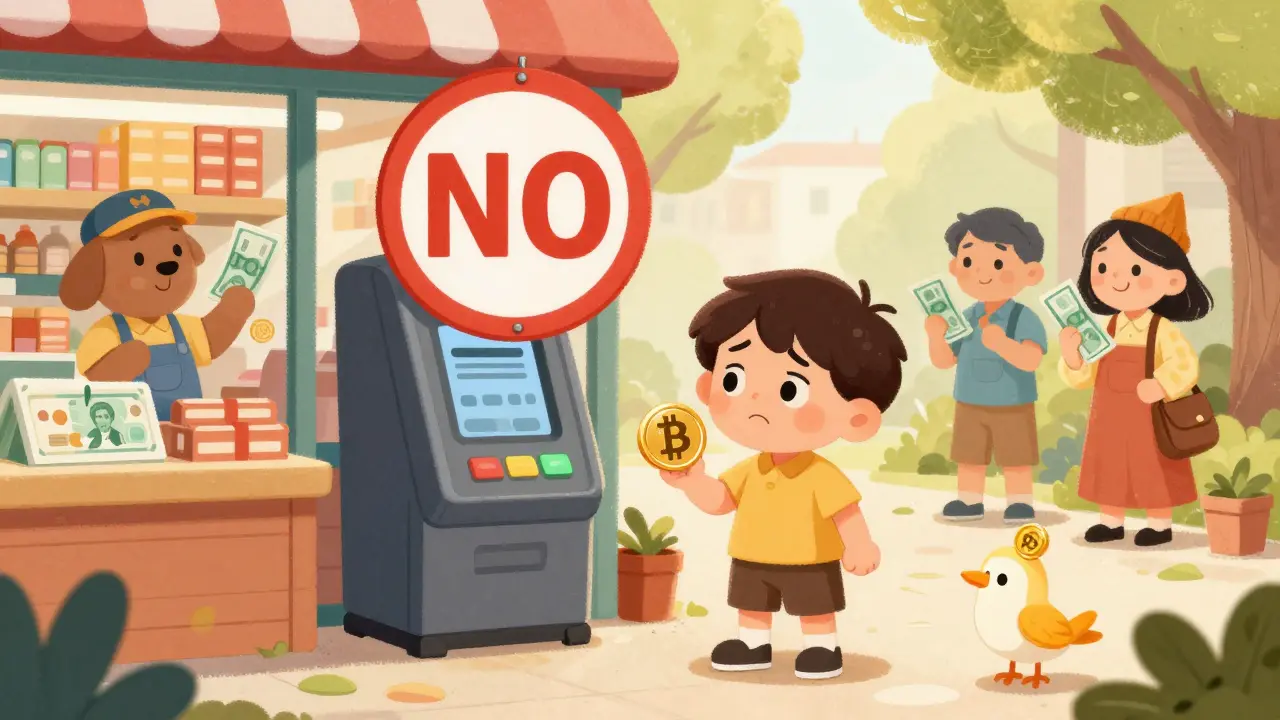
Can you use Bitcoin or Ethereum to pay for groceries, rent, or a coffee in Russia? The short answer is no - and using crypto for everyday purchases there could cost you serious money. As of 2026, Russia has made it crystal clear: cryptocurrency is not legal tender, and using it to pay for goods or services within the country is illegal.
This isn’t just a rule on paper. Russian authorities are cracking down hard. Starting in 2026, individuals caught using crypto for payments face fines between 100,000 and 200,000 rubles (roughly $1,100-$2,200 USD). For businesses? The penalty jumps to 700,000-1 million rubles (about $7,700-$11,000 USD). And here’s the kicker: any crypto used in those transactions gets seized by the state. No warnings. No second chances.
Ownership vs. Usage: Two Different Rules
Here’s where things get confusing for many people: owning crypto in Russia is perfectly legal. You can buy Bitcoin on a foreign exchange, hold it in a wallet, and even sell it later for rubles. But as soon as you try to use it to pay your landlord or buy a phone online from a Russian seller? That’s where the trouble starts.
The government treats cryptocurrency like gold or stocks - something you can own and trade, but not spend. The Central Bank of Russia has been vocal about this. They don’t want crypto competing with the ruble. Their fear? A shadow economy where people bypass banking controls, evade taxes, and sidestep sanctions. So while you’re free to hold crypto, you’re not allowed to use it like money.
The One Exception: International Trade
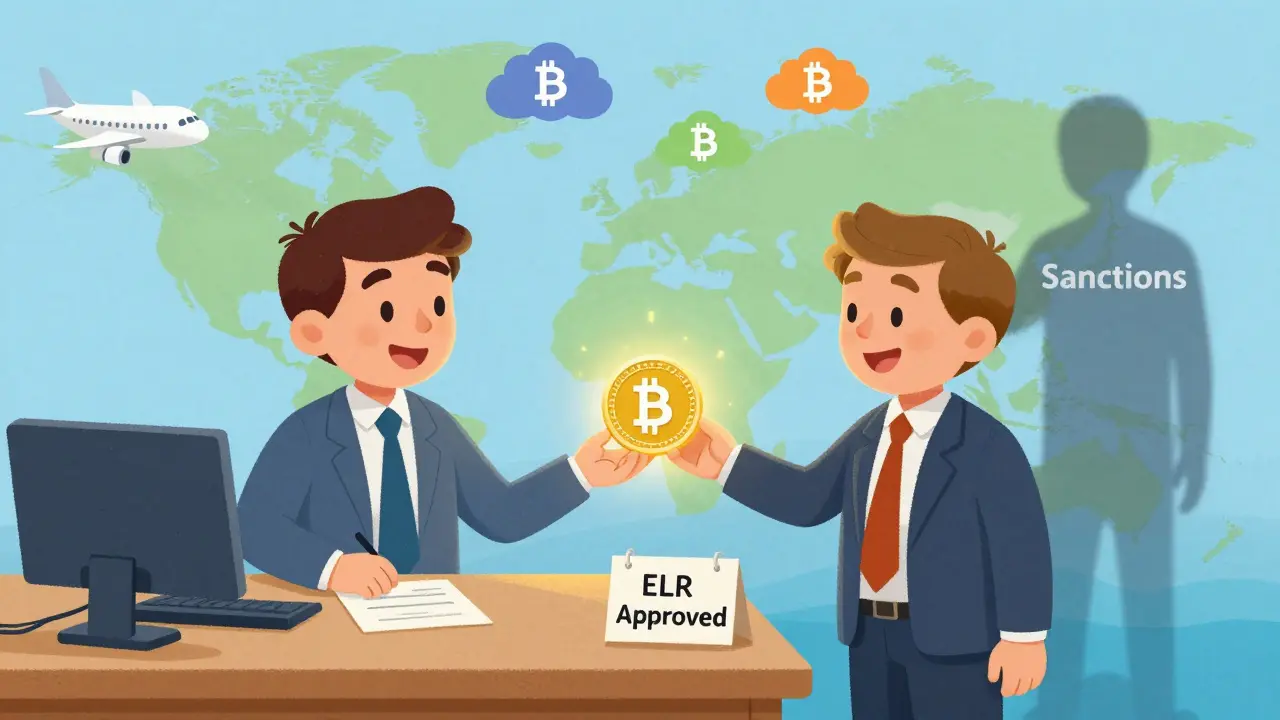
There’s one big loophole - and it’s not for regular people. Russia created an Experimental Legal Regime (ELR) specifically for international business. Under this system, Russian companies can legally use cryptocurrency to pay foreign suppliers, partners, or customers. It’s not a free-for-all, though. Only approved entities can use it, and all transactions must go through strict reporting channels.
Why does this exist? Simple: sanctions. After 2022, Western financial systems cut Russia off from SWIFT, Visa, Mastercard, and major banks. Companies needed a way to keep trading. Crypto became a workaround. In 2025, crypto-facilitated trade between Russia and other countries hit 1 trillion rubles - roughly $11 billion USD. That’s not small change. It’s a lifeline for exporters, importers, and tech firms trying to survive under sanctions.
But again - this doesn’t help you buy a new laptop from a Russian online store. This rule only applies to cross-border deals between businesses. Regular consumers? Not eligible.
Taxes Don’t Care About Your Wallet
Even if you’re just holding crypto, the Russian tax authorities are watching. The law requires every citizen to report all crypto income by April 30 each year - that includes mining rewards, staking interest, airdrops, NFT sales, and even profits from trading Bitcoin for Ethereum.
You have to convert everything to rubles using the official exchange rate on the day of the transaction. No estimates. No approximations. The system checks this automatically. If you fail to report $500,000 worth of crypto gains over two years? You could face fines up to 2 million rubles ($22,000 USD), forced labor, or even prison time. Smaller mistakes still cost you - a missed report can mean a 50,000 ruble fine plus 40% of the unpaid tax.
And yes, the government has tools to catch you. They track blockchain activity, cross-reference bank records, and work with foreign exchanges to identify Russian users. If you’ve been trading on Binance or Kraken without declaring it - you’re already on their radar.
Why Is Russia So Strict?
Russia’s approach isn’t random. It’s a balancing act. On one side, they need to control capital flight and prevent money laundering. On the other, they see crypto’s value in bypassing global financial isolation. The Central Bank wants total control over the ruble. The Finance Ministry, however, has started pushing for more openness - especially for international trade.
There’s tension between these two goals. The Central Bank pushes for total bans. The Treasury wants to use crypto as a tool for economic survival. That’s why the ELR exists - it’s a compromise. But for everyday citizens? The message is loud and clear: don’t use crypto to pay for anything inside Russia.
What Happens If You Try Anyway?
Some Russians still try. You’ll find underground markets, Telegram groups, and peer-to-peer deals where people trade crypto for rubles. But those are high-risk. If you’re caught, you don’t just lose your crypto - you lose money, freedom, or both.
Enforcement is ramping up. In 2025, Russian authorities seized over 12,000 crypto wallets linked to unreported transactions. Most were tied to small-scale traders trying to pay rent or buy electronics. The fines aren’t just penalties - they’re deterrents. The government wants people to think twice before even trying.
There’s also a chilling effect on innovation. Russia used to rank 7th in global crypto adoption in 2024. By 2025, it dropped out of the top 10 entirely, according to Chainalysis. Why? Because the fear of punishment outweighed the convenience of using crypto. People still hold it - but they’re not spending it.

What About Mining and Trading?
Here’s a twist: mining crypto is still legal. So is trading it on foreign platforms. You can mine Bitcoin in your basement, sell it on Binance, and withdraw the rubles to your bank account - as long as you report the profit. No VAT applies to mining or trading. But the income tax? That’s mandatory.
Many Russians use this route. They buy hardware, mine crypto, then convert it to rubles and pay taxes. It’s a gray-area hustle, but it’s legal - if you’re honest with the tax office. The problem? Most aren’t. And that’s why the crackdown is getting worse.
The Future: Will Russia Change Its Mind?
Some lawmakers are pushing for change. In late 2025, a group of deputies asked the Central Bank to license domestic crypto exchanges. The Finance Ministry has floated ideas to expand access to crypto derivatives for qualified investors. But none of that affects the ban on domestic payments.
Experts think the real shift will come from economic pressure. If Russia’s trade with non-Western countries keeps growing - and crypto keeps enabling it - the government may eventually loosen restrictions. But not for personal use. More likely, they’ll expand the ELR to include more industries, not more consumers.
For now, the message is simple: crypto is an investment, not a currency - in Russia.
Can I buy Bitcoin in Russia?
Yes, you can buy Bitcoin and other cryptocurrencies in Russia, but only through foreign exchanges like Binance, Kraken, or Bybit. There are no licensed domestic exchanges yet. You can’t use Russian banks to directly buy crypto, and local platforms are banned. Buying is legal - using it to pay for goods or services inside Russia is not.
Can I use crypto to pay for rent or utilities in Russia?
No. Paying rent, utilities, or any domestic service with cryptocurrency is illegal. The law requires all payments within Russia to be made in rubles. If you try to pay your landlord in Bitcoin, you risk fines, asset seizure, and potential legal action - even if they agree to accept it.
What happens if I don’t report my crypto earnings?
Failing to report crypto income can lead to serious consequences. For undeclared income over 45 million rubles in two of the last three years, you could face fines up to 2 million rubles, forced labor for up to five years, or imprisonment for 18 months to five years. Smaller omissions still trigger 50,000 ruble fines and 40% penalties on unpaid taxes. The tax service uses automated systems to detect unreported transactions.
Can Russian companies use crypto for international payments?
Yes, under the Experimental Legal Regime (ELR). Approved Russian companies can use cryptocurrency to pay foreign suppliers, partners, or clients. This is designed to help businesses bypass sanctions. The ELR requires strict reporting to Russian authorities, and only certain entities qualify. It’s not available to individuals or small businesses.
Is mining cryptocurrency legal in Russia?
Yes, mining crypto is legal in Russia. You can run mining rigs at home or in industrial facilities. However, any income you earn from mining - whether in crypto or rubles - must be reported as taxable income. You must convert your mining rewards to rubles using official exchange rates and pay income tax by July 15 each year.
Will Russia ever allow crypto payments domestically?
It’s unlikely in the near term. The Central Bank remains firmly opposed to crypto as a payment method, fearing it undermines the ruble. While the Finance Ministry supports expanding crypto for international trade, there’s no political will to let citizens use it for everyday purchases. Any future change would likely be limited to specific sectors, not broad consumer use.
Can I be arrested for using crypto in Russia?
Yes - but only in extreme cases. Simple use of crypto for payments won’t land you in jail. But if you’re involved in large-scale, repeated violations - especially if linked to sanctions evasion or tax fraud - you could face criminal charges. Fines are the most common outcome, but imprisonment is possible for repeat offenders or those hiding over 45 million rubles in crypto income.
Ace Crystal
So let me get this straight - you can mine Bitcoin in your garage, trade it on Binance, and cash out to rubles, but if you try to use it to pay for your kid’s soccer cleats? You’re looking at a fine bigger than your annual salary. That’s not regulation. That’s performance art.
krista muzer
i mean… i get why they dont want crypto as payment. ruble’s already shaky. but like… if you can mine it and sell it, why not spend it? its the same coin. the gov just wants control. and control is such a boring drug.
SAKTHIVEL A
It is imperative to underscore that the Russian Federation’s regulatory architecture vis-à-vis cryptographic assets is not merely a fiscal policy - it is a sovereign strategic imperative. The Central Bank’s aversion to decentralized mediums of exchange stems from an existential imperative to preserve the ruble’s monetary hegemony in an era of hyper-financial fragmentation. The ELR, while ostensibly a sanctions workaround, is in fact a calibrated instrument of economic resilience - a digital trench against Western financial encirclement.
Moreover, the taxation regime’s rigor is not punitive, but prophylactic. To permit unreported crypto income is to invite capital flight, illicit arbitrage, and systemic instability. The state’s surveillance mechanisms - blockchain forensics, cross-border bank reconciliation, and exchange data subpoenas - are not overreach. They are the necessary scaffolding of a post-sanctions economy.
Those who decry this as authoritarianism misunderstand the nature of the game. This is not about suppressing innovation. It is about channeling it. The future belongs to nations that can harness crypto’s utility without surrendering monetary sovereignty. Russia is playing 4D chess while the West is still figuring out checkers.
Robbi Hess
Let’s be clear: this is not about crypto. This is about control. The Russian government doesn’t want people transacting outside their system - not because it’s dangerous, but because it’s unpredictable. And unpredictability is the one thing a totalitarian regime can’t tolerate.
They’ll let you mine, trade, and even convert - as long as every keystroke is logged, every ruble accounted for. It’s not a ban on crypto. It’s a ban on autonomy.
And yet, somehow, people still try. That’s the real story here.
Grace Mugambi
I think what’s fascinating is how Russia is creating this weird duality - crypto as investment, not currency. It’s like they’re saying, ‘You can own it, but you can’t live with it.’ That’s a psychological boundary more than a legal one.
It reminds me of how some cultures treat alcohol: you can have it at home, but you can’t drink it on the street. The message isn’t ‘don’t do it’ - it’s ‘don’t do it in public.’
Maybe the real goal is to keep crypto as a private asset, not a public tool. That way, it’s a wealth reserve for the elite, not a tool for the masses.
And honestly? That’s kind of terrifying.
Claire Sannen
The ELR loophole is the most fascinating part. It’s not that crypto is banned - it’s that it’s weaponized. Russia isn’t rejecting crypto; it’s repurposing it as a geopolitical tool. That’s cold, calculated, and oddly brilliant.
Regular people can’t use it to pay rent? Fine. But if a factory in Ural can pay for German machinery with Ethereum? That’s not evasion - that’s adaptation.
It’s a two-tier system: crypto for the state, rubles for the citizen. And in that hierarchy, the individual loses. Always.
monique mannino
so like… if you mine bitcoin and sell it on binance and get rubles? totally legal. but if you send a friend 0.05 btc to cover your share of the electricity bill? instant fine. that’s wild. it’s like saying you can own a car but can’t drive it. why even let you have it??
Lindsey Elliott
People act like this is some new thing. Nah. It’s just China 2.0. You can own crypto, but you can’t use it. You can trade it, but not spend it. You can mine it, but if you don’t report it, you’re a criminal.
The only difference? China has a digital yuan. Russia just has fear.
And fear doesn’t scale.
Sakshi Arora
i think its funny how people say russia is anti crypto but they use it for trade. its not anti crypto its anti uncontrolled crypto. if you cant track it they hate it. if you can track it and tax it? its fine. its all about control not ideology
Ben Pintilie
lmao imagine getting fined $2k for buying a coffee with btc. like bro, i just wanted my espresso. now i’m a criminal? this is why america still wins.
Joe Osowski
This is what happens when you let a bunch of bureaucrats think they’re smarter than market forces. They don’t want crypto because they can’t control it. They want to control the ruble because they can’t control the people.
And now? They’re turning their own citizens into criminals just to prove a point. Pathetic.
Meanwhile, the rest of the world is moving on. Russia’s just stuck in a 2016 blockchain panic.
Donna Patters
It is evident that the Russian state’s posture toward cryptocurrency reflects a profound misunderstanding of the nature of decentralized systems. To treat crypto as a fungible asset for taxation while prohibiting its use as a medium of exchange is to confuse a tool with a token.
The ELR is not a compromise - it is a contradiction. If crypto is valuable enough to facilitate $11 billion in international trade, then it is valuable enough to facilitate a $10 grocery run.
By restricting domestic usage, the state not only undermines its own economic logic - it exposes its own fragility.
And yet, the Central Bank clings to its doctrine like a religious relic. How quaint.
Brittany Meadows
Let’s be real - this whole thing is a distraction. The government doesn’t care about crypto. They care about tracking you. Every transaction, every wallet, every miner - it’s all feeding into a surveillance state that’s building a digital prison.
They let you mine? Great. Now they know your IP. They let you sell? Perfect. Now they know your bank. They don’t want to stop crypto - they want to own it.
And if you think you’re safe because you didn’t pay with it? You’re already on their list.
Kaz Selbie
Oh wow. So Russia’s solution to sanctions is to become the world’s largest crypto tax collector? Brilliant. Absolutely brilliant.
Let’s take a nation already isolated, then tell its people they can’t spend their own money - but hey, we’ll audit you for it! What a way to build trust.
This isn’t innovation. This is economic self-sabotage dressed up as strategy.
And the worst part? It’s working. People are scared. And scared people don’t innovate. They just hide.
Elizabeth Choe
Can we talk about how wild it is that you can mine a whole rig of Bitcoin in your basement, cash out, and pay your taxes… but if you use that same Bitcoin to buy a new TV from a Russian seller? You’re basically signing a confession on national TV?
It’s like they’re saying, ‘We don’t care what you do in private - just don’t make it public.’
That’s not a policy. That’s a psychological trap.
Christopher Wardle
The irony is that Russia’s stance makes crypto more valuable as a store of value than as a currency. If you can’t spend it locally, you hold it. If you hold it, you trust it less as money and more as a hedge.
So the ban isn’t killing crypto - it’s turning it into gold.
And gold? That’s something even the state can’t fully control.
Peggi shabaaz
i dont even get why they care so much. like if someone pays rent in btc, they still get rubles from the exchange. the landlord still gets paid. the system still works. its just… less control. and control is the real enemy here
Santosh kumar
It’s easy to criticize from afar, but imagine being in Russia right now - sanctions, inflation, banks frozen. Crypto isn’t about rebellion. For many, it’s survival.
They can’t use it to pay rent? Fine. But they can mine it, sell it, and buy medicine. That’s not a loophole - that’s a lifeline.
The state doesn’t see that. They see risk. But for millions? It’s hope.
Elijah Young
The real story isn’t the ban. It’s the hypocrisy.
They allow crypto for international trade - because they need it. But they ban it domestically - because they fear it.
That’s not policy. That’s panic.
And panic doesn’t last. It just creates black markets.
Crystal McCoun
I just want to say - I’m so glad I live in a country where I can use crypto to pay for coffee, rent, and groceries. Seriously. It’s not about freedom. It’s about dignity.
When the state tells you what you can and can’t do with your own money - even if it’s digital - you’re not a citizen. You’re a subject.
And that’s not progress. That’s regression.
And yes, I report my taxes. I’m not a criminal. But I’m not a slave either.
Desiree Foo
Let me be very clear: anyone who uses crypto to pay for goods in Russia is not just breaking the law - they are betraying their country’s economic sovereignty. The ruble is the foundation of our national identity. To replace it with decentralized, untraceable tokens is to invite chaos, inflation, and moral decay.
These fines? They’re not punishment. They’re protection.
And if you think otherwise? You’re not just wrong - you’re dangerous.
Keturah Hudson
It’s wild how Russia is the only country that treats crypto like a drug - you can possess it, but you can’t use it. It’s like saying you can own a guitar but can’t play it.
And yet… the ELR? That’s the guitar solo. That’s the part they actually want you to hear.
They’re not banning crypto. They’re curating it.
Michelle Cochran
Let’s not pretend this is about economics. This is about power. The Russian state doesn’t want you to have financial autonomy. Period.
They don’t care if you’re mining, trading, or holding. They care if you’re doing it without their permission.
And if you think they’re going to change their mind? You’re not living in reality. You’re living in a dream.
Their goal isn’t to regulate crypto. It’s to erase the idea that you can have money they can’t track.
Holly Perkins
So… if I mine Bitcoin, sell it on Binance, and use the rubles to buy a car - is that legal?
Yes.
But if I send 0.1 BTC to the seller directly - even if it’s the same value - I go to jail?
That’s not a law. That’s a glitch.
And glitches get fixed… eventually.
Andrea Atzori
They’re not banning crypto. They’re banning trust.
Because if people start trusting Bitcoin more than the ruble? That’s the real threat.
And that’s why they’ll keep cracking down - not because it’s illegal.
But because it’s working.