

What You Need to Know About AUSTRAC Registration for Crypto Exchanges in Australia
If you're running or planning to launch a crypto exchange in Australia, you must register with AUSTRAC. There's no gray area. Starting in 2025, operating without this registration is a criminal offense. It doesn't matter if you're a small crypto ATM operator or a full-scale online platform - if you exchange Australian dollars for Bitcoin, Ethereum, or any other digital currency, you're legally required to register.
AUSTRAC, the Australian Transaction Reports and Analysis Centre, isn't just another government office. It's the country's financial intelligence unit, responsible for stopping money laundering and terrorist financing. And since 2018, digital currency exchanges have been under its watch. But things are changing fast. By March 31, 2026, the rules will get even tighter. If you're not ready, you could face fines, suspension, or even criminal charges.
Who Exactly Needs to Register?
Not every crypto business needs to register - only those that handle fiat-to-crypto or crypto-to-fiat trades. That means:
- Online exchanges like Binance or CoinSpot (if they serve Australian users)
- Crypto ATMs that let you buy Bitcoin with cash or withdraw AUD
- Peer-to-peer platforms that match buyers and sellers for fiat-crypto trades
- Any business that converts AUD to Dogecoin or sells USDT for Australian dollars
Here's what doesn't require registration - yet:
- Exchanging Bitcoin for Ethereum (crypto-to-crypto)
- Storing crypto in a wallet you control (self-custody)
- Tokenized asset platforms that don't trade fiat
- Non-custodial DeFi protocols
But don't get comfortable. Starting March 31, 2026, that list will shrink. AUSTRAC will start requiring registration for crypto-to-crypto exchanges, custody services, and even platforms that help issue new tokens or run ICOs. If you're thinking of expanding into those areas, you need to plan now.
The Registration Process: What Documents You Need
You can't just fill out a form and click submit. AUSTRAC requires two core documents before you even apply:
- AML/CTF Program - This isn't a template. It's a custom-built compliance plan that explains how your business detects, prevents, and reports suspicious activity. You must outline staff training, transaction monitoring tools, and escalation procedures.
- ML/TF Risk Assessment - You have to prove you understand your risks. Are you dealing with high-risk customers? Do you accept cash deposits? Do you serve customers from sanctioned countries? Your assessment must be detailed, updated annually, and signed off by a senior officer.
Once you have those, you submit your application through AUSTRAC's online portal. The system asks for:
- Business structure and ownership details
- Names and IDs of directors and key personnel
- Descriptions of your technology stack and transaction systems
- Proof of physical address and contact information
AUSTRAC doesn't give you a deadline. They give you a checklist. If you miss one item, they'll pause your application and ask for more. There's no rush fee. There's no fast-track. And if your documents are vague or incomplete, they can reject you outright.
What Happens After You Register?
Registration isn't a one-time event. It's the start of ongoing obligations.
Every registered exchange must:
- Verify every customer - You need to collect government-issued ID, proof of address, and sometimes proof of income. Face-to-face verification isn't always required, but you must be able to prove identity reliably.
- Monitor all transactions - Any transfer over $10,000 AUD must be reported within 10 business days. Suspicious activity - even under $10,000 - must be flagged immediately.
- Keep records for 7 years - Every transaction, every ID copy, every internal alert. AUSTRAC can demand these at any time.
- Submit annual compliance reports - You must confirm your AML/CTF program is still working and list any changes to your business.
Failure to meet these obligations can lead to penalties of up to $21 million AUD or 3 times the value of the transaction - whichever is greater. In extreme cases, directors can face jail time.
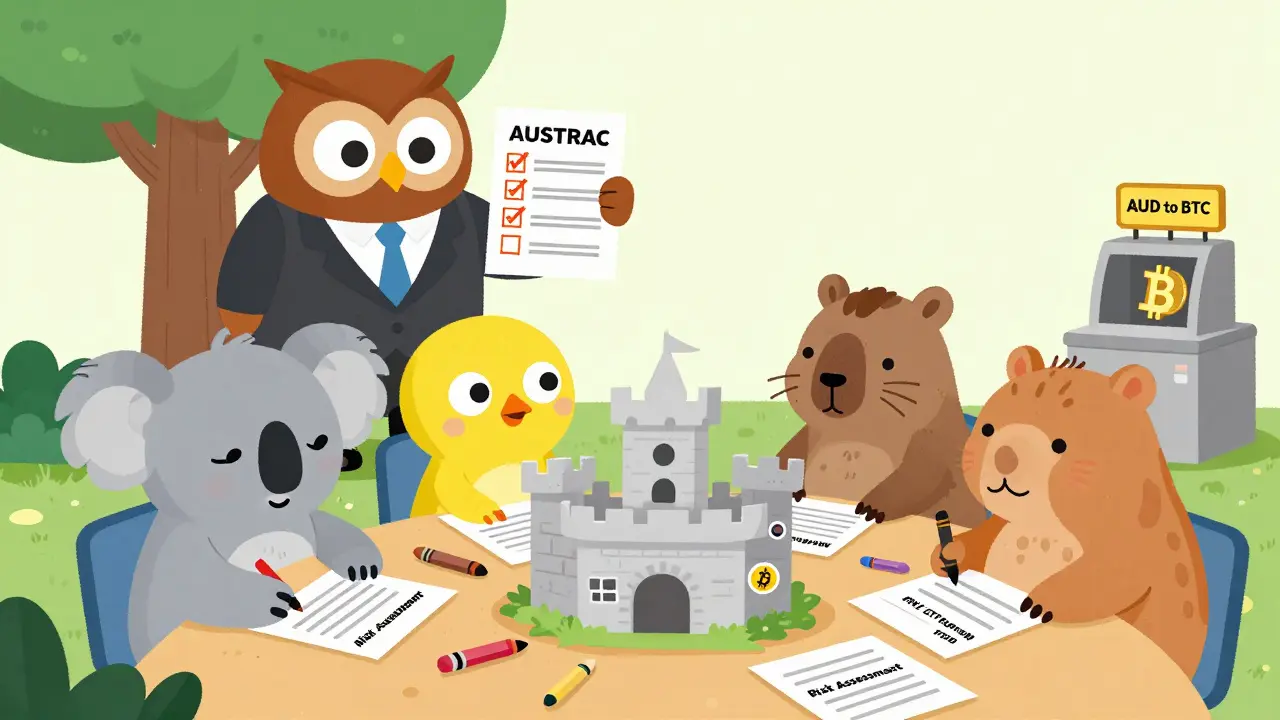
AUSTRAC vs ASIC: Know the Difference
Many people confuse AUSTRAC with ASIC (the Australian Securities and Investments Commission). They’re not the same.
AUSTRAC handles anti-money laundering. That’s your baseline. Every crypto exchange must register here.
ASIC handles financial products. If you're trading tokenized shares, derivatives, or security tokens - things that represent ownership or debt - you need an Australian Financial Services License (AFSL) from ASIC too.
For example:
- If you sell Bitcoin as a currency - only AUSTRAC.
- If you sell a token that gives holders dividends or voting rights - you need both AUSTRAC and ASIC.
As of June 2025, ASIC has started cracking down on exchanges that misclassify security tokens as utility tokens. If you're offering anything that looks like an investment, expect scrutiny. Don't assume you're safe just because you're registered with AUSTRAC.
What’s Changing in March 2026
The biggest shift isn’t happening now - it’s coming in March 2026. That’s when AUSTRAC will expand its scope to cover:
- Crypto-to-crypto exchanges (e.g., ETH for SOL)
- Digital asset custody services (holding crypto for clients)
- Platforms that facilitate token sales or ICOs
- Financial services tied to digital asset issuance
This change brings Australia in line with the Financial Action Task Force (FATF) global standards. It also means more businesses will need to register. Even decentralized platforms that act as intermediaries may fall under the rules.
If you're a small exchange that only does fiat-to-crypto today, you might think this doesn’t affect you. But if you plan to add ETH-to-LTC trading next year, you’ll need to reapply. And if you’re not prepared, you’ll have to shut down that feature.
Common Mistakes That Get Applications Rejected
Most rejections aren’t about fraud. They’re about sloppy paperwork.
Here are the top five reasons applications get turned down:
- Generic AML/CTF programs - Copy-pasting from another company’s template. AUSTRAC knows. They want your business’s specific risks, not boilerplate.
- Missing ownership details - If you have offshore investors or anonymous shareholders, you must disclose them. Hiding beneficial owners = automatic rejection.
- Unclear transaction monitoring - Saying you use "software to detect suspicious activity" isn’t enough. Name the tool. Explain the rules. Show sample alerts.
- No staff training records - You need proof that employees were trained on AML procedures. A PowerPoint deck isn’t enough - you need signed attendance logs.
- Ignoring the risk assessment - If your risk assessment says "low risk" but you accept cash deposits from anonymous users, AUSTRAC will call you out.
Many businesses spend months preparing, only to get rejected because they didn’t read the official AUSTRAC guidance documents. Don’t be one of them.

How to Prepare for the Future
You don’t need to be a lawyer to comply. But you do need to treat compliance like a core part of your business - not an afterthought.
Here’s what successful operators do:
- Start your AML/CTF program now - even if you’re not ready to launch.
- Hire a compliance consultant familiar with AUSTRAC’s 2025 standards - don’t rely on generic legal firms.
- Build your KYC system to handle future requirements - like crypto-to-crypto verification.
- Keep internal audit logs - you’ll need them if AUSTRAC asks for proof.
- Train your team monthly - compliance isn’t a one-time event.
Companies like Zitadelle AG and Xenia Compliance specialize in helping crypto businesses navigate this. They don’t guarantee approval - but they know what AUSTRAC looks for. And in a space where mistakes cost millions, that’s worth paying for.
Consumer Protection Isn’t Optional
Even if you’re not selling financial products, you still have to follow Australian Consumer Law. That means:
- No misleading claims like "guaranteed returns" or "10x profit"
- Clear disclosures about fees, volatility, and risks
- Accurate descriptions of what your service actually does
One exchange got fined $2 million AUD in 2024 for advertising a "crypto savings account" that promised fixed interest - but didn’t disclose the funds were used in high-risk DeFi protocols. The customer wasn’t told the risk. That’s not just bad marketing - it’s illegal.
Transparency isn’t just good practice. It’s the law.
Final Reality Check
Australia isn’t trying to ban crypto. It’s trying to bring it into the financial system - safely. The goal is to stop criminals from using exchanges to move dirty money, while letting legitimate businesses grow.
But the window for casual operators is closing. If you’re running a crypto exchange without AUSTRAC registration, you’re already breaking the law. If you’re planning to start one, waiting until March 2026 to prepare means you’ll be behind before you even launch.
There’s no shortcut. There’s no loophole. The rules are clear. The penalties are real. And AUSTRAC has the power to shut you down - fast.
Register now. Document everything. Train your team. And don’t assume you’ll be grandfathered in. The system doesn’t work that way.
Do I need AUSTRAC registration if I only trade crypto-to-crypto right now?
As of December 2025, no - you don’t need to register if you only exchange one digital currency for another. But that changes on March 31, 2026. After that date, crypto-to-crypto exchanges will require AUSTRAC registration. If you plan to offer this service in 2026, start preparing your AML/CTF program now.
Can I operate without registration if I don’t serve Australian customers?
If you don’t target Australian users - meaning you don’t market to them, accept AUD, or have an Australian business address - you may not need registration. But if an Australian customer signs up and trades, you’re now operating in Australia. AUSTRAC can track IP addresses, payment methods, and customer addresses. Ignorance isn’t a defense.
How long does AUSTRAC registration take?
There’s no official timeline. Applications can take anywhere from 4 to 12 months, depending on completeness and complexity. Many businesses get stuck for months because they submit incomplete documents. The faster you prepare your AML/CTF program and risk assessment, the quicker you’ll move through the process.
What happens if I get rejected?
If your application is rejected, you can appeal or resubmit after fixing the issues. But you cannot operate legally until you’re registered. Continuing to trade after rejection is a criminal offense. Some businesses have been fined over $5 million AUD for operating without registration after being denied.
Do I need an ASIC license too?
Only if you’re dealing with financial products - like tokenized stocks, bonds, or derivatives. If you’re just trading Bitcoin or Ethereum as currencies, you only need AUSTRAC. But if your tokens represent ownership, dividends, or profit-sharing, you need both. ASIC has been actively prosecuting exchanges that misclassify security tokens.
Can I use a third-party KYC provider?
Yes - many exchanges use providers like Jumio, Onfido, or Trulioo for identity verification. But you’re still legally responsible. AUSTRAC holds the exchange accountable, not the provider. Make sure your third-party system meets Australian standards and keeps records for 7 years.
What’s the penalty for operating without registration?
Operating without AUSTRAC registration is a criminal offense. Penalties include fines up to $21 million AUD or 3 times the value of the transaction - whichever is greater. Directors can also face up to 5 years in prison. In 2024, a crypto ATM operator was sentenced to 18 months for unregistered operations.
Scott Sơn
Bro. This is insane. AUSTRAC is turning Australia into the Silicon Valley of bureaucratic nightmares. You need a lawyer just to buy a damn Bitcoin now. 🤯
Frank Cronin
Of course they’re coming for crypto. First it was cash, then wire transfers, now your digital wallet. Next they’ll demand your private key before you can buy coffee. Welcome to the surveillance economy, folks.
Stanley Wong
I get why they’re doing this but it’s so heavy handed. Like yeah money laundering is bad but now every small guy trying to build something legitimate has to jump through 17 hoops just to exist. It’s not regulation it’s obstruction with a badge. And the worst part? The people who actually want to cheat will just move offshore and laugh while we’re filling out forms.
miriam gionfriddo
I just submitted my AML/CTF doc and they sent back a 12 page list of corrections. I wrote ‘transaction monitoring’ and they wanted the exact version of Chainalysis I used. I’m not a fucking auditor I’m a dev who built a bot!
Kenneth Ljungström
If you’re building something legit, just do it right from the start. KYC, AML, training logs, risk assessments - treat it like your product. It’s not a cost, it’s your reputation. And yes, third-party KYC providers are fine, but you’re still on the hook. Don’t outsource responsibility. 🤝
Cristal Consulting
Start now. Seriously. Even if you’re not ready to launch. Your AML program doesn’t need to be perfect - it just needs to exist. One small step a day beats a panic sprint in March 2026.
Tom Van bergen
They say no loopholes but there’s always a loophole. Just don’t serve Australians. IP blocking. No AUD. No marketing. Simple. Problem solved. The state doesn’t own your server.
Sandra Lee Beagan
In Canada we’ve got FINTRAC and it’s not perfect but it’s functional. Australia’s system feels like it was designed by someone who’s never met a startup. The documentation burden is absurd. You’d think they want compliance or they want to kill innovation.
Ben VanDyk
The post is accurate. But the tone? It’s like a government pamphlet written by a lawyer who hates people. No one reads this. They skim. And then they ignore. That’s the problem.
michael cuevas
You think this is bad wait till they start requiring your crypto wallet addresses to be registered too. Next thing you know your wallet is on a government spreadsheet with a red flag next to it
Nina Meretoile
I used to think crypto was about freedom. Now it’s about paperwork. But honestly? If we want to be taken seriously by banks and regulators, we have to play the game. It’s not ideal but it’s the path to legitimacy. 🌱
Barb Pooley
This is all just a cover. They’re not stopping money laundering. They’re stopping YOU. Once they control the exchanges, they control the money. And then what? Tax everything. Track every transaction. This isn’t regulation. It’s control.
Shane Budge
Does AUSTRAC actually have the staff to review all these applications? Or are they just rejecting everyone to scare people off?
sonia sifflet
You think Australia is bad? Try India. We have to register with RBI, SEBI, and now crypto rules. And they don’t even have clear guidelines. You’re just guessing. At least Australia has a checklist.
jonathan dunlow
Look I’ve been through this with 3 different startups. The key is not to wait. Start building your AML program like you’re building your product. Document everything. Train your team like they’re your most important users. And don’t try to cut corners - AUSTRAC doesn’t care about your hustle. They care about your paper trail. You want to scale? You need compliance as your foundation.
rita linda
This is why Americans should never trust foreign regulators. Australia is turning into a digital police state. They’ll fingerprint your crypto wallet next. This isn’t finance - it’s fascism with a compliance checklist.
Chris Mitchell
The real win here is clarity. For years, crypto operators were in the gray. Now there’s a path. It’s hard, it’s slow, it’s expensive - but it’s real. If you’re building something that lasts, this is the price of entry. Stop complaining. Start building.
Regina Jestrow
I just got rejected for using the word ‘likely’ in my risk assessment. They said it was ‘non-committal’. I’m not a lawyer. I’m a founder. Why does this feel like a trap?
Brooke Schmalbach
They say crypto-to-crypto will be regulated in 2026. That’s not regulation. That’s the end of decentralized finance. If you need to register to swap ETH for SOL, then DeFi is dead. And they’ll call it ‘compliance’.
Mariam Almatrook
The fact that you can be fined $21 million or face prison for operating without registration - for a digital currency exchange - is a grotesque overreach. This is not a banking system. It’s a digital marketplace. The state has no business criminalizing innovation.
Lore Vanvliet
I’m a US citizen. I don’t care about Australia. But if they’re this aggressive, imagine what the US will do next. This is the blueprint. They’re testing it here. We’re next. 🇺🇸🔥
Martin Hansen
You think this is bad? Try getting a license in Singapore. They make AUSTRAC look like a weekend garage sale. If you want to be a real player, you need to be in jurisdictions that don’t treat you like a criminal. Australia is just the first domino.
Cristal Consulting
One sentence: Start today. Your future self will thank you.