
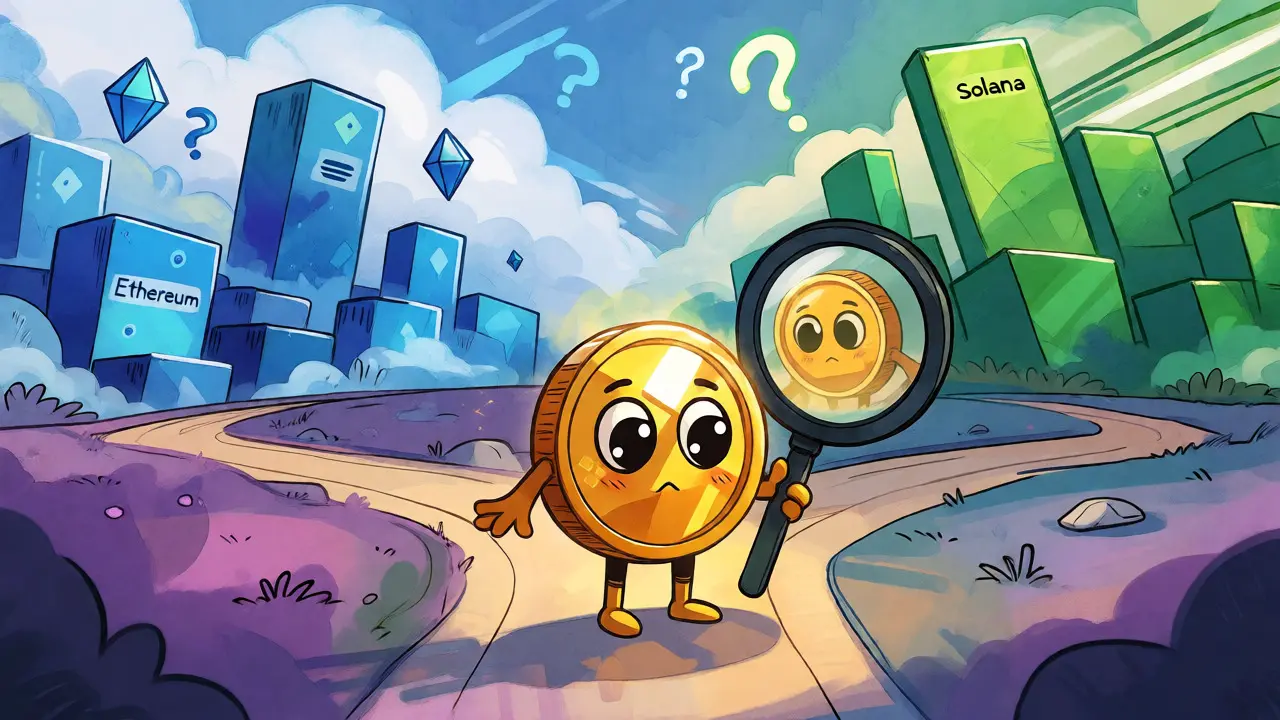
Imagine finding a cryptocurrency with a market cap of roughly $40,000. That’s less than the cost of a used Honda Civic in Bristol. Now imagine that same coin claims to be an AI-powered bot utility token, yet no one can agree on which blockchain it actually lives on. This is the confusing reality of Rita Elite Order, commonly known as RITA. It’s a classic example of how the ultra-low-cap corners of the crypto world operate: high hype, minimal data, and significant risk.
If you’re seeing RITA pop up in your wallet or on a decentralized exchange dashboard, you might be wondering if this is the next big thing or just noise. The honest answer leans heavily toward the latter. But before you dismiss it entirely, let’s break down what we actually know about this token, where the conflicting information comes from, and why most professional analysts ignore it completely.
The Identity Crisis: Is RITA on Ethereum or Solana?
The first red flag for any investor looking at Rita Elite Order (RITA) isn’t its price-it’s its location. Data aggregators are fighting over which network hosts this token. LiveCoinWatch lists it as an Ethereum-based token trading on Uniswap v2. Meanwhile, CoinSwitch explicitly states it is "built on the fast and scalable Solana blockchain.
This discrepancy matters because gas fees, transaction speed, and security models differ wildly between these two networks. If it’s on Ethereum, you’re paying higher fees for slower transactions. If it’s on Solana, you expect near-instant settlement. When major platforms disagree on the fundamental infrastructure of a project, it usually points to one of two things: either there are multiple tokens with similar names causing confusion, or the project lacks basic technical transparency.
| Source | Claimed Blockchain | Reported Price (USD) | 24h Volume (USD) |
|---|---|---|---|
| LiveCoinWatch | Ethereum (Uniswap v2) | $0.006912 | $588.28K |
| CoinGecko | Unspecified | $0.0004014 | $1,127.42 |
| CoinSwitch | Solana | N/A | N/A |
| DexTools | Unspecified | N/A | $1.07K |
Notice the price difference? One source says fractions of a cent; another says nearly a full cent. In crypto, a 1,000% variance in reported price across reputable trackers is not a minor typo. It suggests liquidity fragmentation or outdated listings. For a beginner, this makes tracking performance nearly impossible.
Utility Claims vs. Technical Reality
LiveCoinWatch categorizes RITA under three distinct labels: Artificial Intelligence, Bots, and Meme. These categories are rarely seen together in serious projects. Usually, a token is either a utility tool (like AI infrastructure) or a community-driven asset (like a meme). Claiming both often signals a marketing strategy rather than a technical roadmap.
Where is the whitepaper? Where is the GitHub repository? Searches through authoritative sources yield no verifiable technical documentation. There are no published smart contract audits, which is standard practice for even mid-tier DeFi projects. Without an audit, you don’t know if the code contains hidden mint functions that allow developers to dump unlimited supply onto holders. You also lack proof of concept for the claimed "AI bot" functionality. Does the token pay for API access? Does it govern a specific algorithm? Currently, these questions remain unanswered.
Compare this to established AI-crypto hybrids like Fetch.ai or SingularityNET. Those projects have clear developer teams, active GitHub commits, and documented use cases. RITA offers none of that. Its primary differentiator appears to be its extremely low price point, attracting speculative retail investors hoping for a "pump and dump" scenario.

Market Cap and Liquidity Risks
Let’s look at the numbers. With a market capitalization hovering around $38,000 to $44,000, RITA is microscopic. To put this in perspective, Dogecoin has a market cap exceeding $11 billion. RITA is roughly 260,000 times smaller. Even compared to other meme coins like Shiba Inu ($3.2 billion) or Floki Inu ($450 million), RITA is negligible.
Low market cap sounds appealing because it implies room for growth. If the price doubles, you double your money. But the flip side is extreme volatility and liquidity risk. DexTools reports daily trading volumes as low as $1,000. On some days, CoinMarketCap has recorded zero volume. What does this mean for you? It means if you buy $500 worth of RITA, you might struggle to sell it without crashing the price yourself. There simply aren’t enough buyers on the other side of the trade.
- Slippage Danger: With thin order books, a single large sell order can drop the price by 10-20% instantly.
- Exchange Availability: Major centralized exchanges like Binance list RITA as "Not Listed." You are restricted to decentralized exchanges (DEXs) like Uniswap or wallets like Phantom.
- Concentration Risk: Tokens in this tier often have highly concentrated ownership. A small group of early whales likely holds the majority of the supply.
How to Buy and Store RITA
Since RITA isn’t on Binance or Coinbase, buying it requires navigating the decentralized finance (DeFi) ecosystem. The process varies depending on which blockchain narrative you believe.
- Identify the Network: Check the contract address on Etherscan (for Ethereum) or Solscan (for Solana). Do not rely solely on aggregator prices. Verify the token exists on the chain you intend to use.
- Get a Wallet: Use MetaMask for Ethereum-based assets or Phantom for Solana-based assets. Never send funds to the wrong network; they will be lost.
- Fund Your Wallet: Deposit ETH or SOL into your wallet.
- Connect to a DEX: Go to Uniswap (if Ethereum) or Raydium/Jupiter (if Solana). Paste the verified contract address.
- Swap: Exchange your base currency for RITA. Be mindful of slippage settings-set them higher (e.g., 5-10%) to ensure the transaction goes through in low-volume markets.
Binance’s Web3 Wallet also provides a pathway for users who prefer staying within the Binance ecosystem, but it still routes you through decentralized protocols. Always double-check the contract address before confirming any swap.

User Experience and Community Sentiment
Search Reddit, Trustpilot, or Twitter for genuine user reviews of Rita Elite Order. You’ll find silence. Legitimate projects, even controversial ones, generate chatter. Users complain about bugs, praise features, or debate roadmaps. RITA has virtually no organic community discussion. This absence is telling. It suggests the holder base is small, passive, or composed entirely of bots and speculators waiting for a pump.
Phantom promotes buying RITA via their mobile app, indicating some retail interest. However, without testimonials or case studies showing real-world usage, it’s hard to gauge long-term viability. Most successful crypto investments have a visible tribe-a Discord server buzzing with activity, a Telegram group discussing updates, or a YouTube channel explaining new features. RITA lacks this social proof.
Final Verdict: Speculation or Scam?
Is Rita Elite Order a scam? Not necessarily in the traditional sense of a rug pull where developers disappear overnight. It may simply be a forgotten experiment. However, it exhibits multiple characteristics of high-risk speculative assets:
- No verifiable team or roadmap.
- Conflicting blockchain data.
- Extremely low liquidity.
- Generic "AI/Meme" categorization without technical backing.
If you decide to invest, treat it like lottery tickets. Only allocate money you can afford to lose completely. Don’t expect dividends, staking rewards, or functional utility. The primary value proposition here is hope-the hope that a viral tweet or a sudden listing on a larger exchange triggers a spike. For now, RITA remains a ghost in the machine, present on charts but absent in substance.
Is Rita Elite Order (RITA) listed on Binance?
No, Rita Elite Order is not listed on the main Binance spot exchange. Binance directs users to their Web3 Wallet to purchase it via decentralized exchanges. You cannot buy it directly with fiat currency on Binance.com.
Which blockchain does RITA actually run on?
Data is conflicting. Some sources list it as an ERC-20 token on Ethereum, while others claim it is on Solana. You must verify the contract address on the respective block explorer (Etherscan or Solscan) before sending funds.
Does RITA have a working AI feature?
There is no verifiable evidence of a functioning AI product tied to RITA. While categorized under AI and Bots by some trackers, no whitepaper or technical documentation demonstrates how the token interacts with artificial intelligence services.
Is RITA safe to hold?
It carries high risk due to low liquidity and lack of smart contract audits. The absence of public development activity and team information increases the uncertainty regarding its long-term survival.
Why do price sources show different values for RITA?
Discrepancies arise from fragmented liquidity across different decentralized exchanges and potentially outdated data feeds. Low trading volume means prices can vary significantly between platforms at any given moment.