

You stare at your screen. The chart is green, the news is buzzing, and everyone on Twitter seems to be getting rich. You feel a pull in your gut-a mix of excitement and panic that you’re missing out. Then, three months later, the chart turns red. Your stomach drops. You sell everything just as the price hits rock bottom, only to watch it rebound without you. Sound familiar?
This isn’t bad luck. It’s human wiring. Market psychology is the study of how emotions like fear, greed, and hope drive financial decisions, often overriding logic. In the world of blockchain and traditional finance alike, understanding this psychological cycle is more critical than analyzing any single candlestick pattern. While technical analysis tells you what happened, psychology explains why it happened-and more importantly, what might happen next.
The Emotional Lifecycle of Market Cycles
Markets don’t move in straight lines; they move in emotional waves. As noted by Davis Funds, bull markets are "born on pessimism, grow on skepticism, mature on optimism, and die in euphoria." This isn’t just poetic; it’s a predictable roadmap of collective human behavior.
During a Bull Market, defined as a sustained increase of 20% or more from recent lows, the initial phase is quiet. Most people are still scared from the previous crash. They ignore the rising prices because they expect another drop. This is where the smart money enters. As prices climb, skepticism fades into cautious optimism. By the time mainstream media declares a new era of wealth, euphoria has set in. Retail investors jump in, driven by the belief that prices can only go up. This is often the top.
Bear Markets operate on the inverse spectrum, characterized by declines of 20% or more from recent highs. They begin with denial. Investors tell themselves the dip is a buying opportunity. When losses deepen, denial turns into anger and bargaining. Finally, capitulation sets in-the point where pain becomes too great, and investors sell regardless of price. This mass selling creates the self-fulfilling prophecy of further decline.
Cognitive Biases That Sabotage Returns
Your brain is wired for survival, not for stock picking. Several cognitive biases consistently trap traders in both bull and bear phases.
Herd Mentality is perhaps the most powerful force in markets. Humans are social creatures. If everyone else is buying Bitcoin or tech stocks, our brains assume they know something we don’t. We abandon our own research to follow the crowd. During the 2007 crash, fear spread faster than facts, causing panic selling that accelerated the downturn long after fundamentals had stabilized.
Then there is Loss Aversion. Psychologists have proven that the pain of losing $100 is roughly twice as intense as the pleasure of gaining $100. This leads to a common mistake: holding onto losing positions too long (hoping they bounce back) while selling winning positions too early (fearing the profit will vanish). In a bull market, this manifests as anchoring bias. If you bought an asset at $10 and it rises to $50, you might refuse to buy more because you anchor your perception to the $10 price, thinking $50 is "too expensive," even if the fundamental value supports $100.
Overconfidence also plays a huge role, especially during booms. After a few successful trades, many investors believe they have cracked the code. They take excessive risks, over-leverage their portfolios, and ignore warning signs. Day traders often suffer here, mistaking short-term luck for skill until a correction wipes them out.
Greed, Envy, and FOMO in Bull Markets
In a strong uptrend, two emotions dominate: greed and envy. These are the "emotional twin terrors" of investing. Greed distorts judgment by creating an allure for quick riches. It blinds you to risk. You start thinking, "Why settle for 10% returns when I could get 100%?" This leads to overexposure in volatile sectors.
Envy is equally destructive. When you see a friend or a random person online claiming massive gains, you feel left behind. This triggers FOMO (Fear Of Missing Out). FOMO pushes you to enter markets at peak prices, precisely when the risk-reward ratio is worst. You aren’t buying because the asset is undervalued; you’re buying because you hate the feeling of watching others succeed while you sit on cash.
These emotions create feedback loops. Rising prices attract buyers, which drives prices higher, which attracts more buyers. This momentum continues until the pool of new buyers dries up. Once the flow of fresh capital stops, the bubble bursts.
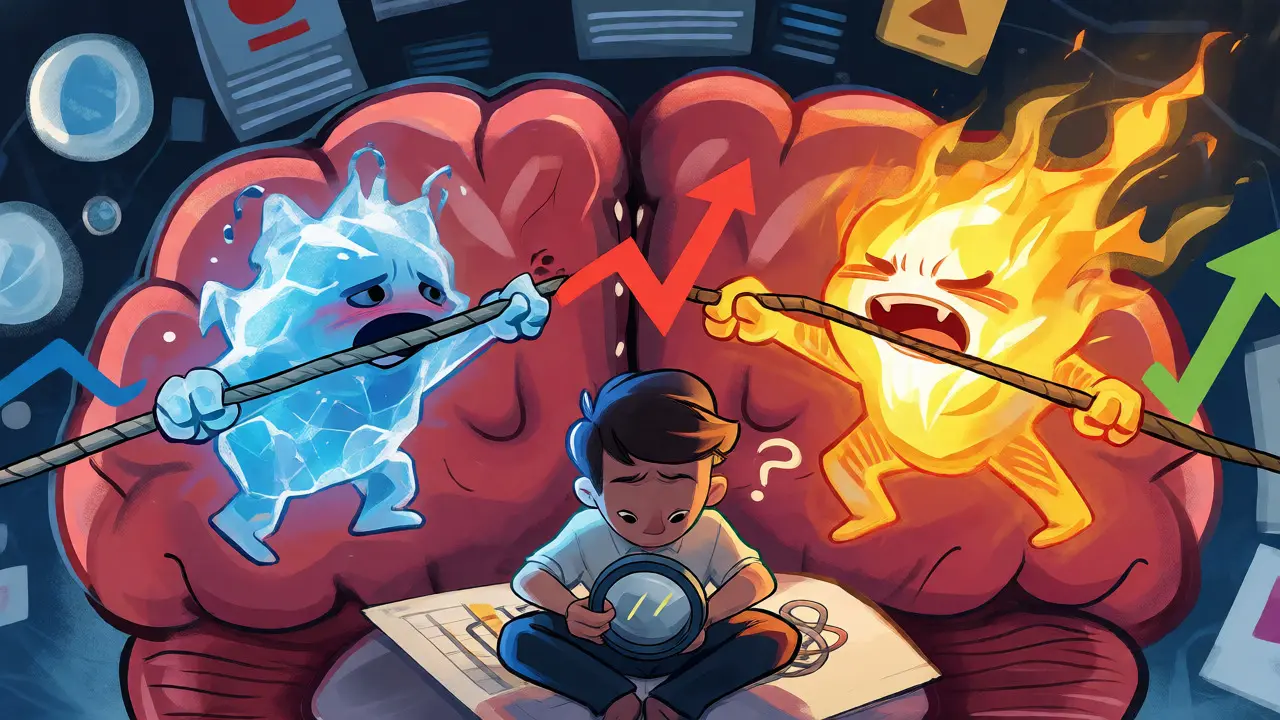
Fear and Capitulation in Bear Markets
Bear markets are fueled by a different set of fears. Charles Schwab identifies three primary drivers: weakening economies, significant liquidation of securities, and negative sentiment. While economic data matters, sentiment often moves first.
When prices fall, the narrative shifts from "this is a temporary dip" to "the system is broken." Investors flee to safety. In traditional markets, this means moving to bonds or utilities. In crypto, it might mean stablecoins or simply exiting to fiat currency. This flight to safety reduces liquidity, causing prices to drop further, which triggers more fear. It’s a vicious cycle.
A key psychological shift occurs here: from growth-seeking to capital preservation. In a bull market, you ask, "How much can I make?" In a bear market, you ask, "How much can I lose?" This change in question changes your entire strategy. You become hyper-sensitive to bad news and dismissive of good news. Even positive earnings reports or network upgrades are ignored because the prevailing mood is negative.
Comparing Psychological Drivers: Bull vs. Bear
Understanding the distinct emotional landscapes helps you anticipate market moves. Here’s how the psychology differs across major dimensions:
| Dimension | Bull Market Psychology | Bear Market Psychology |
|---|---|---|
| Dominant Emotion | Euphoria, Greed, Optimism | Fear, Anxiety, Despair |
| Decision Making | Rationality overridden by excitement; high risk tolerance | Rationality overridden by panic; low risk tolerance |
| Media Narrative | "New Era," "This Time Is Different," "To the Moon" | "Crash Imminent," "End of Cycle," "Dead Money" |
| Investor Action | Buying dips aggressively, increasing leverage | Selling rallies, hoarding cash/stablecoins |
| Perception of Risk | Risk is underestimated; volatility seen as opportunity | Risk is overestimated; volatility seen as threat |

Strategies to Beat Your Brain
If emotions drive markets, how do you avoid becoming a victim of them? You need systems that bypass your limbic system.
- Automate Your Investments: Dollar-cost averaging (DCA) removes emotion from the equation. You buy a fixed amount regardless of price. This prevents you from trying to time the market based on feelings.
- Set Pre-Defined Exit Rules: Decide your take-profit and stop-loss levels before you enter a trade. When the moment comes, execute mechanically. Don’t negotiate with yourself in real-time.
- Limit Media Consumption: Financial news is designed to trigger emotional responses. During extreme volatility, turn off the TV. Check your portfolio weekly, not hourly.
- Keep a Trading Journal: Write down *why* you made a trade. Was it based on analysis, or did you feel FOMO? Reviewing these entries helps you recognize your personal bias patterns.
Remember, the goal isn’t to eliminate emotion-that’s impossible. The goal is to ensure emotion doesn’t drive the bus. Successful investors acknowledge their fear and greed but let their strategy hold the steering wheel.
FAQ: Common Questions on Market Psychology
Can market psychology predict exact tops and bottoms?
No, it cannot predict exact dates or prices. However, it helps identify extreme conditions. When euphoria is universal (e.g., taxi drivers giving stock tips), a top is likely near. When despair is universal (e.g., headlines declaring stocks dead forever), a bottom is often forming. It signals probability, not certainty.
Is loss aversion really stronger than the desire for gain?
Yes, behavioral economics studies, notably by Kahneman and Tversky, show that losses hurt psychologically about twice as much as equivalent gains please us. This asymmetry causes investors to hold losers too long (avoiding the pain of realizing a loss) and sell winners too soon (locking in relief).
How does herd mentality affect crypto markets specifically?
Crypto markets are highly sensitive to social sentiment due to their 24/7 nature and reliance on community narratives. Herd mentality can cause extreme volatility, as seen in meme coin cycles. Unlike traditional stocks, crypto assets often lack tangible cash flows, making them purely dependent on collective belief and momentum, which amplifies herd effects.
Should I ignore all news during a bear market?
Not entirely, but filter it carefully. Focus on structural changes (like regulatory shifts or technological upgrades) rather than daily price fluctuations. Sensationalist headlines often exaggerate minor issues to drive engagement, triggering unnecessary panic.
What is the "anchoring bias" in investing?
Anchoring bias is the tendency to rely too heavily on the first piece of information offered (the "anchor"). For example, if you saw a token at $1, you might think $10 is expensive, even if its utility justifies $50. This prevents you from recognizing fair value when prices rise significantly from your entry point.