
Asvoria (ASV) sounds like the next big thing in Web3 - a coin that promises to give you a share of ad revenue, let you launch NFTs across blockchains, and even pay you just for browsing. But here’s the problem: Asvoria might not be real. At least, not in the way you think.
What Asvoria Claims to Be
Asvoria (ASV) is marketed as a cryptocurrency built on the Solana blockchain. Its creators say it’s more than just a token - it’s a full Web3 ecosystem. They promise a job marketplace where you get paid in ASV, an NFT launchpad that works on both Solana and Ethereum’s Base layer, and a revenue-sharing model where 50% of all advertising and data sales go straight back to token holders.
On paper, that’s compelling. Most crypto projects ask you to buy in and hope for the best. Asvoria says: ‘We’ll pay you back.’ That’s a rare pitch. And if it worked, it could challenge platforms like Brave Browser’s BAT token, which already rewards users for attention.
The Price Chaos
But look at the numbers - and you’ll see red flags.
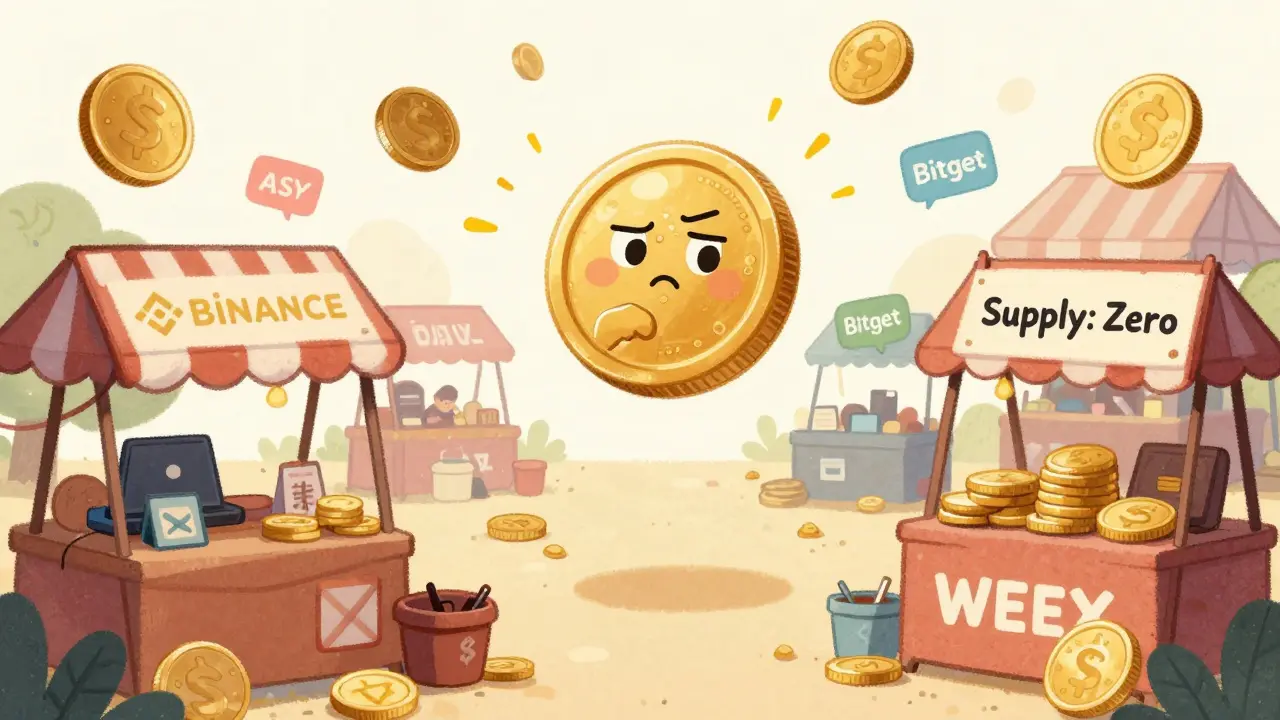
On CoinMarketCap, ASV trades at $0.00845. On Binance, it’s $0.021. On Bitget, it’s $0.0125. On WEEX, it’s $0.0081. That’s a 2.5x difference between the lowest and highest prices on major platforms. No legitimate coin behaves like this. Real assets have consistent pricing because exchanges reflect real supply and demand. When prices jump like this, it usually means one thing: the market is manipulated, or the token isn’t actually circulating.
And that’s where it gets weirder.
Zero Circulating Supply? How?
Multiple exchanges - including Binance and Bitget - report ASV’s circulating supply as zero. That means no tokens are out in the hands of users. But then, how is it trading? How is there a $21,828 daily volume on Binance if nobody owns it? How is Solflare reporting a $5.7 million market cap when no tokens are circulating?
This contradiction breaks every rule of cryptocurrency economics. You can’t have trading volume without supply. You can’t have market cap without holders. This isn’t a glitch - it’s a red flag. Either the data is wrong, or the project is a shell.
Market Cap vs. Fully Diluted Cap: The Illusion of Value
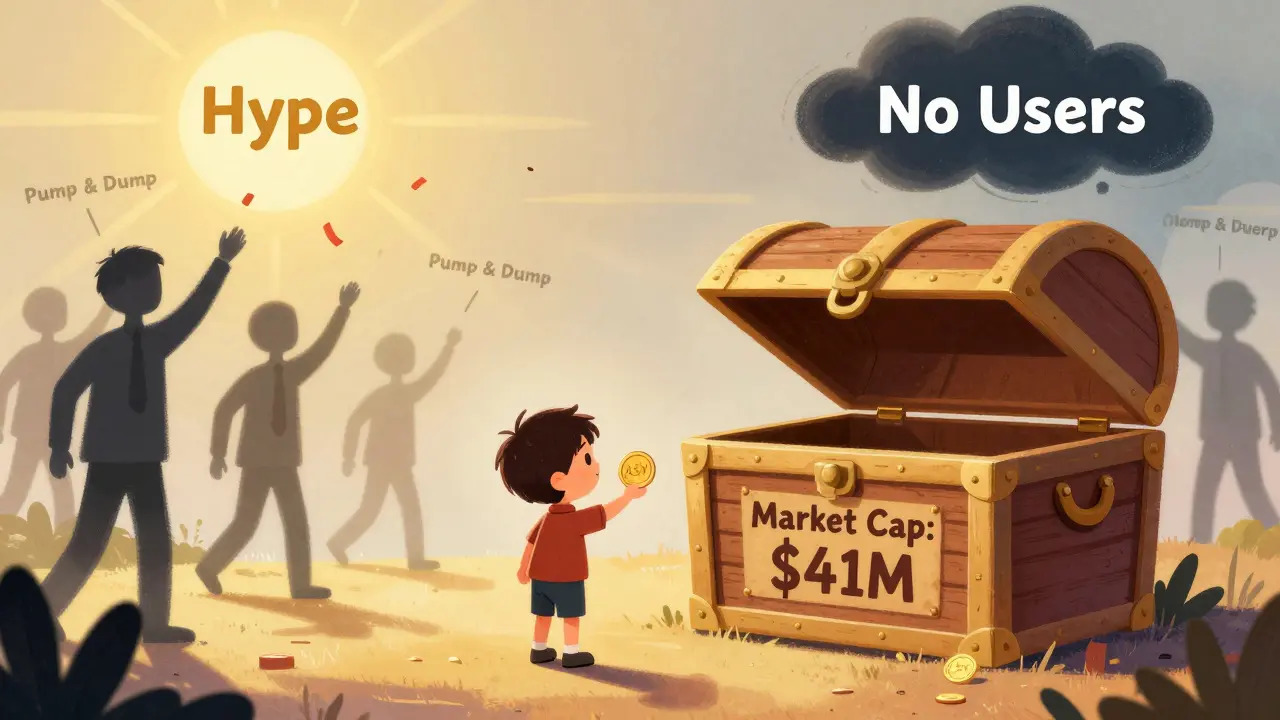
Bitget says Asvoria’s fully diluted market cap is $41.4 million. That’s based on the total supply of 1.2 billion ASV tokens. But fully diluted cap is just a theoretical number - it assumes every token is in circulation, which isn’t true. It’s like saying a startup is worth $1 billion because it has 10 million shares - even if only 100 are issued.
Real value comes from what’s actually out there. If zero tokens are circulating, the $41 million figure is meaningless. It’s a number on a screen, not a reflection of real economic activity.
Where It’s Listed - And Where It’s Not
Binance lists Asvoria as ‘Not listed.’ That’s huge. Binance doesn’t list coins without due diligence. If they say ‘not listed,’ it means they’ve checked the project and decided it doesn’t meet their standards. That’s a strong signal.
Meanwhile, Bitget and WEEX list it. Bitget is known for listing newer, riskier tokens. It’s not a bad exchange, but it’s not Binance or Coinbase either. The fact that Asvoria is only on smaller exchanges raises questions about its legitimacy.
Why the Price Hit $0.65 and Dropped to $0.01
ASV’s all-time high was $0.6543. That’s over 80 times its current price. That kind of crash doesn’t happen because of market corrections. It happens when hype dies.
Think of it like a pump-and-dump. Someone buys a large chunk of ASV, spreads the word on social media, gets early buyers in, then sells their holdings. The price spikes - then crashes. The low of $0.01295 confirms this pattern. The coin isn’t building value - it’s riding waves of speculation.
Is There Any Real Use?
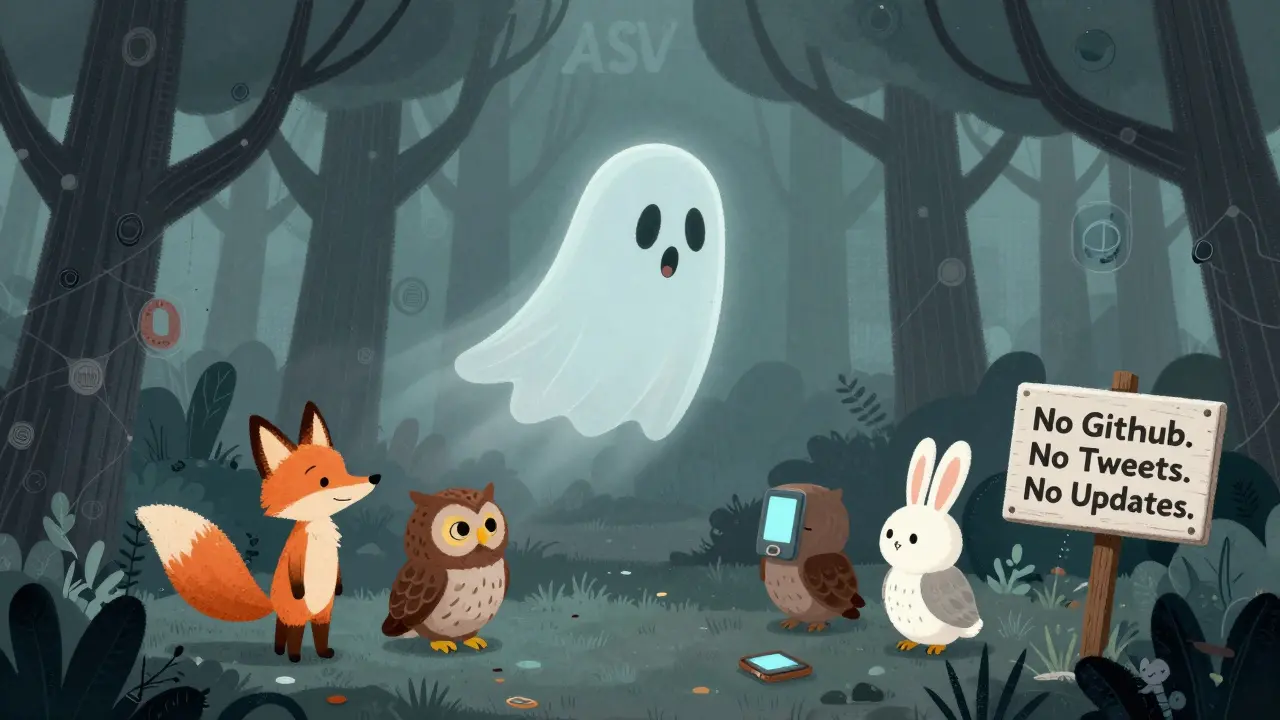
Asvoria says it supports multi-chain NFT launches. That’s useful. But does anyone actually use it? Are creators launching NFTs on Asvoria’s platform? Are developers building on it? Is there a single public case study, a tweet from a real user, a GitHub repo with active commits?
No.
Reddit has zero threads about ASV. Twitter has almost no organic conversation. Trustpilot has no reviews. Binance’s sentiment tool shows zero votes. That’s not ‘early stage.’ That’s ‘no one cares.’
Compare that to The Sandbox (SAND) or Decentraland (MANA). Even their low points had active communities. Asvoria has silence.
Can You Buy ASV? Should You?
Yes, you can buy ASV on Bitget, WEEX, and a few others. They’ll let you use a credit card or bank transfer. The process is simple.
But should you?
If you’re looking for a long-term investment - no. The tokenomics are broken. The supply data is inconsistent. The exchanges don’t trust it. There’s no community. There’s no transparency.
If you’re looking to gamble on a low-cap token with high volatility - maybe. But treat it like a lottery ticket, not an asset. The chance of it recovering is slim. The chance of it vanishing entirely? High.
What Happens Next?
There’s no roadmap. No team updates. No blog posts. No GitHub activity. No press releases.
Projects that die quietly often start like this - with big promises, confusing data, and no proof of use. Asvoria might be one of them.
It’s possible the team is still working on it. But if they were, they’d fix the supply data. They’d list on Binance. They’d show users using the platform. They’d have a public team. They wouldn’t let their token trade with zero supply.
Right now, Asvoria isn’t a coin. It’s a mystery.
Final Verdict
Asvoria (ASV) isn’t a scam - not yet. But it’s not a real project either. It’s a ghost in the machine. A token with no users, no supply, no trust, and no clear path forward.
If you’re curious, you can buy a few ASV tokens for $0.01. But don’t expect returns. Don’t expect support. Don’t expect it to grow.
It’s a warning sign wrapped in a pitch. And if you’re smart, you’ll walk away.
prashant choudhari
ASV has zero circulating supply but trades on multiple exchanges? That’s not a bug, it’s a feature of a rug pull waiting to happen. If no one holds it, who’s buying? The bots? The dev wallet? Either way, this isn’t crypto-it’s accounting theater.
Jordan Fowles
Reminds me of the old ICO days. Big promises, no code, no team, no community. Just a whitepaper and a hype tweet. People forget that crypto isn’t about price charts-it’s about utility and trust. This has neither.
Daniel Verreault
Bro this is peak pump n dump energy. 0.65 to 0.01? That’s not volatility thats a corpse being dragged across the chart. Binance says 'not listed' for a reason. Bitget and WEEX are the crypto equivalent of sketchy gas stations with no price tags. Buy ASV if you wanna fund someone’s vacation in Bali.
Jake West
Someone actually wrote a 2000-word essay on a coin that doesn’t exist? LMAO. You’re giving this thing more thought than the devs did. If you’re this invested in ASV, maybe try investing in therapy instead.
Mandy McDonald Hodge
im so confused why anyone would even look at this lmao 😅 like… if the supply is zero… how is it even a thing? this feels like a dream i had after eating expired ramen
Jackson Storm
Wait, if the circulating supply is zero but market cap is $41M, then technically the entire value is imaginary. Like, if I say my pet rock is worth $10 million because I *could* sell it… does that make it true? No. That’s just delusion with a spreadsheet.
Andrew Prince
Let’s be precise here: this isn’t merely a red flag-it’s a full-blown neon sign screaming ‘FRAUD’ in Comic Sans. The fact that multiple exchanges report conflicting prices while simultaneously claiming zero supply is not incompetence-it’s malice. The entire structure violates the fundamental axiom of market liquidity: no supply, no market. This isn’t Web3-it’s Web3.0.1: The Phantom Token Protocol. The team likely has a burner wallet, a fake Twitter account, and a $200 domain. They’ve already cashed out. You’re just the last sucker holding the bag.
Willis Shane
While I appreciate the thorough analysis, I must emphasize that the absence of verified on-chain activity, combined with inconsistent exchange data and zero community engagement, constitutes a material risk that exceeds speculative tolerance. This asset demonstrates none of the attributes necessary for fiduciary consideration, and its continued listing on minor exchanges raises serious questions regarding regulatory oversight-or lack thereof.
Jacky Baltes
It’s fascinating how we treat financial instruments like they’re narrative-driven art pieces. We assign value to symbols without substance because we’re desperate to believe in something bigger than ourselves. ASV isn’t a token-it’s a mirror. It reflects our collective hunger for easy wealth. The real question isn’t whether ASV is real. It’s why we keep believing in ghosts.
Bruce Morrison
People keep saying 'don't invest' but the real danger is the people who think they're smart for buying low. This isn't a dip-it's a black hole. If you're still holding ASV after reading this, you're not a degenerate investor-you're a cautionary tale waiting to be told.
nayan keshari
Why are Americans so obsessed with fake coins? In India we know better. If it looks too good to be true, it is. ASV is just another Western scam dressed in blockchain clothes.
Raja Oleholeh
ASV = AI Scam Verified 🚩💸
Steve Williams
Thank you for this clear breakdown. I’ve seen similar patterns in emerging markets where fake tokens are used to lure unsuspecting investors. The silence from the team speaks louder than any whitepaper. Walk away. Protect your capital. Real innovation doesn’t need hype-it needs transparency.