
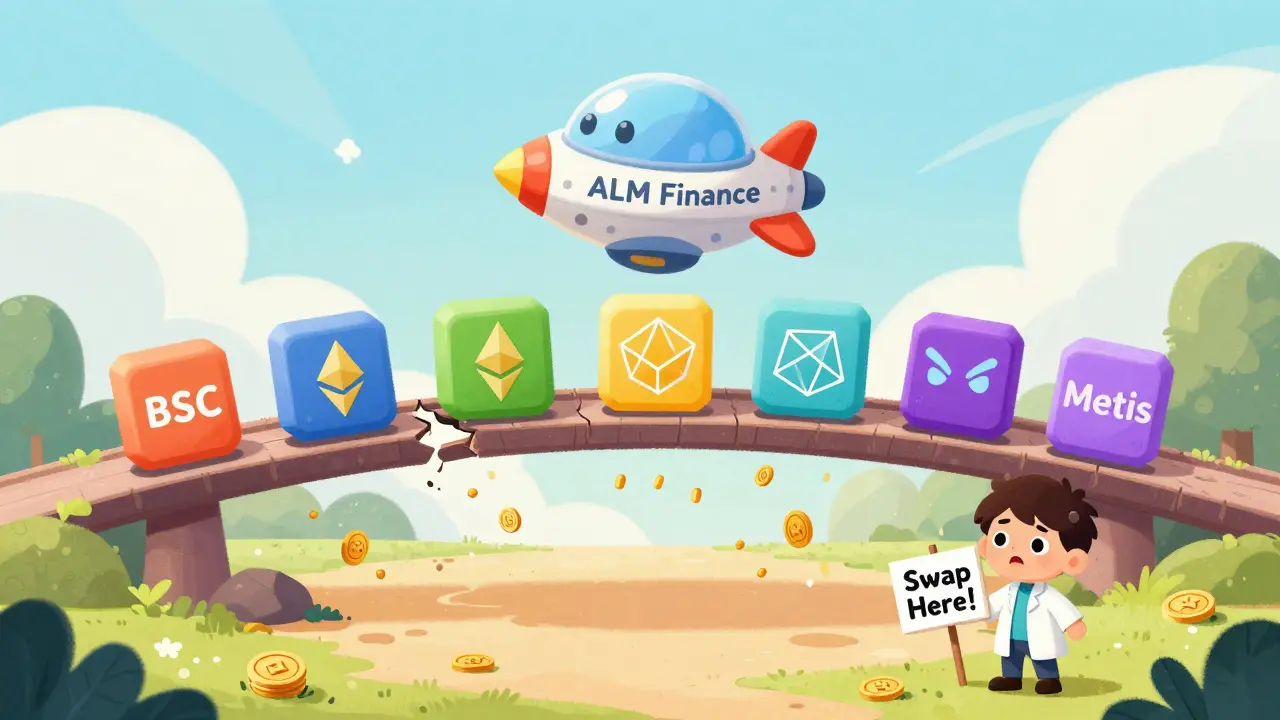
Alium Finance (ALM) is a cryptocurrency built to power a multi-chain decentralized finance (DeFi) ecosystem. Launched in May 2021, it promised to solve cross-chain liquidity problems by letting users swap tokens across Binance Smart Chain, Ethereum, Polygon, Fantom, and others without relying on traditional liquidity pools. But today, its reality looks very different from its original pitch.
What ALM Actually Does
Alium Finance’s main product is Alium Swap, a decentralized exchange that claims to connect multiple blockchains using hybrid liquidity. Unlike Uniswap or PancakeSwap, which lock up huge amounts of capital in each pair, Alium says it only needs a few key liquidity pairs to enable swaps across chains. The idea sounds smart-less capital needed, lower fees, faster trades. But in practice, it hasn’t worked. The ALM token is meant to do two things: let holders vote on platform changes (governance) and pay for services within the ecosystem (utility). That’s standard for DeFi projects. But here’s the catch: no one’s using it. Trading volume on Alium Swap rarely hits $100 in a day. For comparison, Uniswap moves over $1 billion daily. Alium Swap barely registers.Tokenomics: Infinite Supply, No Value
ALM runs on the Binance Smart Chain as a BEP20 token with the contract address0x7c38870e93a1f959cb6c533eb10bbc3e438aac11. It has 18 decimals, like most tokens. But its biggest red flag? No supply cap. The maximum supply is infinite.
Most successful crypto projects limit how many tokens exist to create scarcity. Bitcoin has 21 million. Ethereum’s supply is controlled by burns and issuance. Even newer DeFi tokens like AAVE or MKR have hard caps. ALM doesn’t. That means the team could theoretically mint billions more tokens at any time. No one knows who controls that minting function-or if it’s even locked. That’s a huge risk.
Price History: From $0.40 to $0.0015
ALM peaked at $0.4003 in June 2021, right after the DeFi hype wave. That was the top. Since then, it’s lost 99.5% of its value. By June 2025, it hit a new all-time low of $0.001534. As of early December 2025, it’s trading around $0.0018-$0.0021. That’s barely a penny. The 24-hour trading volume? Around $50. That’s less than what some people spend on coffee. With such low liquidity, even small buys or sells can swing the price wildly. You can’t trade ALM without risking slippage. Most exchanges won’t even list it because no one’s buying.
Price Predictions: One Says Price Predictions: One Says $0, Another Says $189,370
, Another Says 9,370
The forecasts for ALM are insane. One site, SwapSpace, says it’ll hit $0 by 2030. Another, CoinCodex, says it’ll hit $189,370-over 88 billion percent higher than today’s price.
That’s not a mistake. Those numbers are real. But they’re both meaningless.
$189,370 would make ALM worth more than Bitcoin. That’s not a prediction. It’s fantasy. And $0? That’s not a prediction either. That’s what happens when a project dies quietly. Neither forecast is based on real usage, revenue, or adoption. They’re just math models fed with wishful thinking.
Why No One Cares
There’s no community. No Reddit threads. No active Twitter account. No Telegram group with more than a few hundred people. No developer updates. No blog posts. No partnerships announced since 2022. Compare that to a project like Curve or Aave. They have thousands of contributors, regular code releases, public governance votes, and active forums. ALM’s website hasn’t changed in years. The whitepaper is still the same as 2021. The roadmap? Dead. Even the technical side is questionable. Alium Swap claims to have bridges between BSC, Polygon, Fantom, and Metis. But if you try to use it, you’ll find no real trades happening. No TVL (Total Value Locked) data exists on DeFiLlama. That’s the industry standard for measuring DeFi activity. If a project isn’t on DeFiLlama, it’s not real.How It Compares to Other Cross-Chain Tools
Alium Finance isn’t the only player trying to solve cross-chain swaps. Projects like Thorchain, Multichain (formerly Anyswap), and Synapse have been doing this for years. They’ve got millions in TVL, thousands of daily users, and working bridges. Alium’s advantage? None. It doesn’t offer anything new. It doesn’t have better security. It doesn’t have lower fees. It doesn’t have better UX. It just has a website and a token.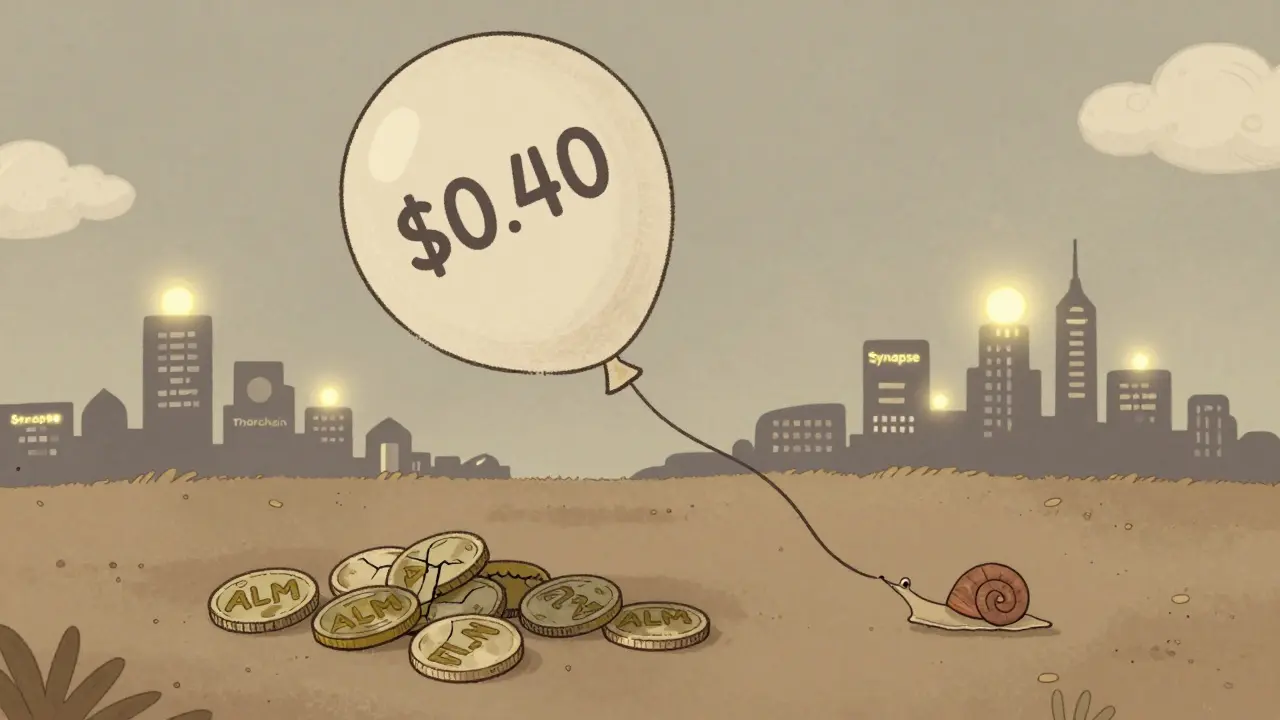
Is ALM Worth Buying?
No. If you’re looking for a DeFi investment, ALM is not it. The token has no utility, no liquidity, no community, and no roadmap. The infinite supply means value can be diluted at any moment. The price is stuck in a death spiral because no one wants to hold it. Some people buy it because they think it’s “undervalued.” But you can’t be undervalued if no one believes you have value. ALM is not a crypto. It’s a graveyard.What Happens Next?
Unless the team suddenly releases a major update, partners with a big exchange, or burns half the supply to create scarcity, ALM will keep drifting toward $0. The 21.1% rebound from its June 2025 low? That’s just noise. A few speculators dumping their bags and someone else buying out of hope. The real story here isn’t ALM. It’s how easily new crypto projects can launch with big promises-and vanish without a trace. If you’re curious about cross-chain DeFi, look at projects with real volume, real users, and real code updates. Not ones with $50 daily trading volume and a 99.5% price drop.Technical Snapshot (as of December 2025)
- Price: $0.0018-$0.0021
- 24h Volume: $11-$50
- Market Cap: $0 (effectively)
- All-Time High: $0.4003 (June 10, 2021)
- All-Time Low: $0.001534 (June 22, 2025)
- Supply: Infinite
- Chain: Binance Smart Chain (BEP20)
- Contract: 0x7c38870e93a1f959cb6c533eb10bbc3e438aac11
- RSI (14-day): 53.03 (Neutral)
- 50-Day SMA: $0.001932
- 200-Day SMA: $0.001869
- Market Rank: #6750 on CoinMarketCap
These numbers aren’t just low-they’re inactive. This isn’t a market. It’s a placeholder.
Is Alium Finance (ALM) a good investment?
No. ALM has no real use case, zero liquidity, and an infinite supply that can be inflated anytime. The price has dropped 99.5% since its peak, and trading volume is under $100 a day. There’s no community, no development updates, and no reason to believe it will recover. Buying ALM is gambling on a dead project.
Can I trade ALM on major exchanges like Binance or Coinbase?
No. ALM is not listed on any major exchange. It only trades on a few tiny decentralized exchanges like PancakeSwap or Alium Swap itself. Even there, liquidity is so low that buying or selling more than a few dollars’ worth will cause massive price swings. It’s not safe or practical to trade.
Why does ALM have an infinite supply?
An infinite supply means the project team can create more ALM tokens at any time. This removes scarcity, which is a core driver of value in crypto. Most successful tokens have hard caps to protect value. ALM’s infinite supply suggests either poor design or a lack of commitment to long-term value. It’s a major red flag.
Is Alium Swap actually working?
Technically, yes-the bridges exist. But practically, no. There are almost no trades happening. No one is locking funds into its pools. No one is using it for daily swaps. Without users and liquidity, the technology is useless. It’s like having a car with no gas, no roads, and no drivers.
What happened to Alium Finance’s roadmap?
It disappeared. The original roadmap promised NFT integration, mobile apps, and more chains. None of those were delivered. The website hasn’t been updated since 2022. No team members have posted updates. No GitHub commits. No blog posts. The project is inactive. The roadmap is dead.
Should I hold ALM as a long-term asset?
Absolutely not. Holding ALM is like holding cash in a failing bank. There’s no growth, no demand, and no safety net. Even if the price rises slightly, it’s just a temporary bounce. Without real adoption, the value will keep falling. Don’t treat it as an investment. Treat it as a warning.
Is ALM a scam?
It’s not clearly a scam in the legal sense-there’s no evidence of theft or fraud. But it’s a failed project that misled early investors with big promises. It raised awareness, then vanished. That’s not illegal, but it’s unethical. Many people lost money believing in a project that never delivered. That’s the real danger.
Can I stake ALM to earn rewards?
There is no staking mechanism for ALM. The project never launched staking pools, liquidity mining, or yield farming. Even if you hold ALM, you earn nothing. No passive income. No rewards. Just a token with no function.
Where can I find official updates about ALM?
There are no official updates. The website (aliumpay.finance) hasn’t changed in years. The Twitter account has no recent posts. The Telegram group is inactive. The Discord server is empty. The team has gone silent. If you’re looking for news, there isn’t any.
Is ALM listed on CoinMarketCap or CoinGecko?
Yes, ALM is listed on CoinMarketCap at #6750, but only because it’s tracked by automated bots. The data is outdated, the volume is fake, and the market cap is meaningless. CoinGecko does not list it at all. Its presence on CoinMarketCap is a technical artifact, not a sign of legitimacy.
If you’re interested in cross-chain DeFi, look at projects with real activity-like Thorchain or Synapse. ALM is a relic of 2021’s hype. Don’t waste your time or money on it.
Shane Budge
This is the exact kind of post that saves people from losing money. ALM isn't a coin, it's a ghost town with a website.
Adam Bosworth
LMAO the $189k prediction. Someone’s still holding ALM and thinks they’re gonna be a billionaire? Bro, your portfolio’s a graveyard and you’re out here planting flowers on it 💀
Renelle Wilson
It’s important to recognize that while ALM may appear to be a failed project, it also serves as a cautionary tale about the broader DeFi landscape. Many projects launch with ambitious visions, but without sustainable governance, community engagement, and transparent development, even the most technically sound ideas can collapse under the weight of neglect. This is not unique to ALM-it’s systemic. We must educate new entrants not just on how to analyze tokens, but on how to assess the integrity of the teams behind them.
Elizabeth Miranda
I remember when I first saw ALM on CoinMarketCap. Thought it was some new cross-chain darling. Turned out it was just a placeholder. Like buying a house with no doors.
Chloe Hayslett
USA built empires. ALM built a spreadsheet. And people still think this is investing? You're not a crypto investor. You're a data entry clerk for a failed startup.
Thomas Downey
The moral failure here is not the token. It is the ecosystem that allows such projects to exist without accountability. There is no regulatory oversight. No liability. No consequences. And yet, individuals are expected to navigate this minefield with nothing but a whitepaper and a prayer.
Annette LeRoux
ALM is like that friend who says they’re gonna start a band… then never picks up the guitar. 🎸💔 Still waiting for the debut album… 4 years later.
Jerry Perisho
Infinite supply = no scarcity = no value. That’s crypto 101. If you don’t get that, don’t touch anything with a token contract
Manish Yadav
This is why people in India don't trust crypto. All these fake projects. No one cares. Just take money and run.
Krista Hewes
i just checked alms price again and i swear it went up .0001… maybe its coming back? or am i just delusional 😅
Madison Agado
There’s a quiet tragedy in projects like ALM. They’re not malicious-they’re just abandoned. The team likely ran out of funds, got distracted, or realized the idea was hollow. But the people who bought in? They’re left holding a digital ghost. It’s not greed that kills here. It’s silence.
Scott Sơn
ALM didn't die. It was assassinated by reality. The whitepaper was a Shakespearean tragedy. The roadmap? A funeral program. And the price chart? A downward spiral in Helvetica.
miriam gionfriddo
i cant believe i still have 12k alm tokens… i thought i was smart buying at $0.03… now im just sad and broke and my dog is judging me
Nicole Parker
I think the saddest part isn’t the price drop-it’s that no one even talks about it anymore. No drama, no updates, no memes. Just… nothing. It’s like watching a house get abandoned and the neighbors just ignore it. No one even turns off the lights.
Cristal Consulting
You don’t need to be a genius to see this is dead. But you do need to be brave enough to walk away. Good job posting this. Someone needed to say it out loud.
Tom Van bergen
You say ALM is dead but what about all the other coins that died and came back? Maybe this is just the calm before the storm. Maybe the team is working in secret. Maybe they’re waiting for the right moment. Maybe you’re just too narrow-minded to see the potential
Sandra Lee Beagan
The silence speaks louder than any whitepaper. No GitHub commits. No Discord activity. No blog. That’s not a project on pause-it’s a project in hospice. 🕯️
Ben VanDyk
I didn’t even know ALM still existed until I saw this post. Honestly? Good riddance.
michael cuevas
you know what’s wild? people still buy this. like, i get wanting to gamble. but this is like betting on a flat tire to win the race
Nina Meretoile
Every crypto graveyard has a flower… ALM is just the one with the most overgrown weeds. 🌱💔 But hey, at least it’s not a rug pull. Just a slow fade. Still sad though.
Barb Pooley
I’ve been watching ALM since 2021. I know for a fact the devs are all working for a crypto hedge fund now. They drained the liquidity, sold their bags, and vanished. This was a honeypot from day one.
Uzoma Jenfrancis
In Nigeria we call this 'Naira to nothing'. You invest, you wait, you cry. Then you learn. ALM is just another lesson.