
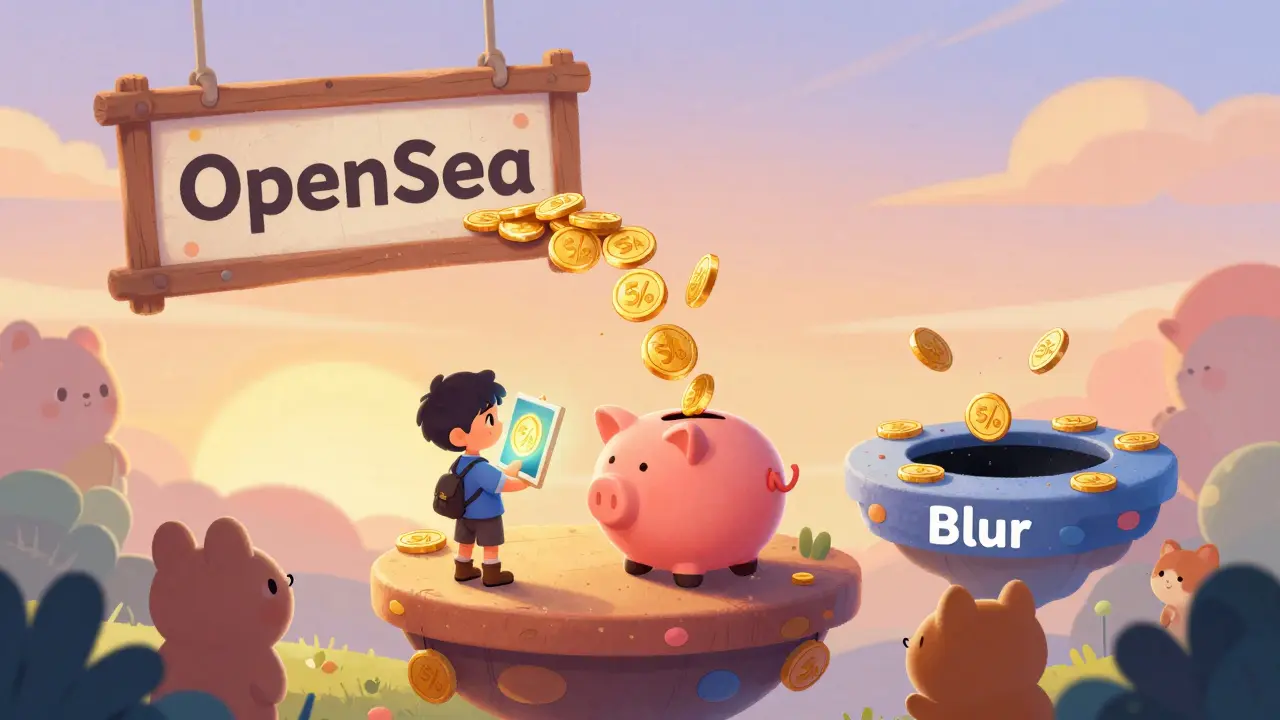
When you buy an NFT, you’re not just buying a digital image. You’re entering a contract - one that’s supposed to pay the original creator every time it changes hands. But here’s the problem: NFT royalties aren’t guaranteed. They’re optional. And that’s turning the whole system into a mess.
How NFT Royalties Actually Work
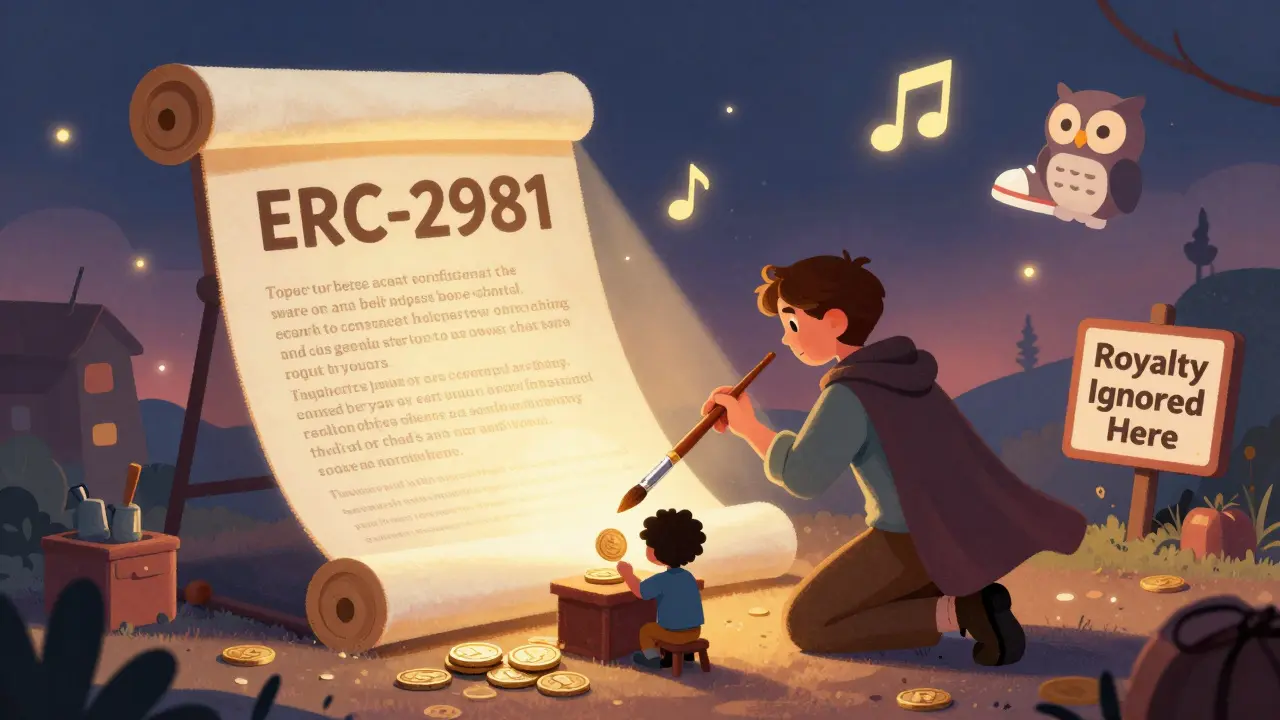
Think of NFT royalties like a 5% tip that automatically goes to the artist every time their artwork is resold. It sounds simple. But unlike physical art, where the artist gets nothing after the first sale, NFTs were built to fix that. The tech behind it? ERC-2981. It’s a smart contract standard that tells any marketplace: "Here’s who gets paid and how much."
ERC-2981 doesn’t force anyone to pay. It just gives the info. If a marketplace wants to honor it, they read the contract. If they don’t, they ignore it. That’s why two people can buy the same NFT on two different platforms - and one pays the creator, while the other doesn’t.
Here’s how it works under the hood:
- When an NFT is minted, the creator sets a royalty percentage - say, 5% (or 500 basis points).
- The smart contract stores two things: the address that should receive the payment, and the percentage.
- When the NFT sells, any marketplace that follows ERC-2981 calls the
royaltyInfo()function to get those details. - The marketplace then sends the calculated amount (e.g., 0.05 ETH on a 1 ETH sale) to the creator’s wallet.
It’s clean. It’s transparent. And it’s completely optional.
Why Some Marketplaces Ignore Royalties
In 2023, Blur changed everything. They let buyers skip royalty payments entirely. Why? Because collectors hate fees. And Blur saw an opportunity: more volume, more users, more trading.
The result? Within months, nearly 40% of all NFT trading moved to royalty-free platforms. Creators lost millions. OpenSea and Rarible, which still honor royalties, saw drops in volume. But here’s the twist: high-value sales - the ones that matter most to serious artists - kept flowing to platforms that paid. In Q1 2025, 68% of transactions over 1 ETH happened on royalty-compliant marketplaces.
Why? Because collectors who buy expensive NFTs aren’t just flipping. They’re investing. And they know: if the artist doesn’t get paid, the project dies. No royalties = no incentive to create. No creation = no future value.
The Regulatory Wild West
Who’s supposed to fix this? Governments are trying.
In the EU, MiCA (Markets in Crypto-Assets) went live in June 2024. It forces crypto platforms to be transparent about fees - but it doesn’t say anything about royalties. It’s a loophole. Meanwhile, the UK’s Financial Conduct Authority (FCA) is digging deeper. Their October 2024 paper called NFT royalties a "priority area" for regulation. They’re asking: Should creators have the same rights as musicians or painters? If so, should platforms be legally required to pay?
At the same time, WIPO - the UN’s intellectual property agency - is pushing for mandatory authenticity checks. Their idea? If you can’t prove you’re the real artist, you can’t mint. That would cut down on scams and make royalty payments more reliable.
Who’s Getting It Right?
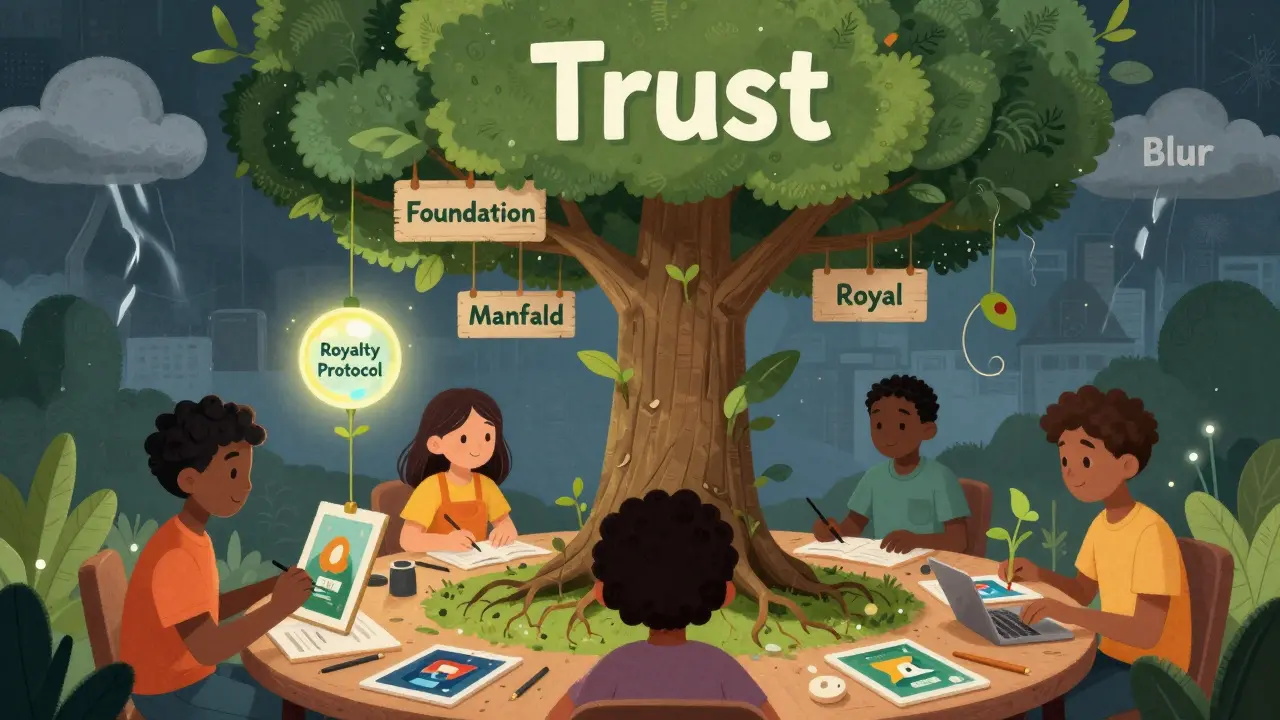
Not all marketplaces are the same. Here’s who’s still honoring creators:
- Foundation: Requires 10% royalties on all sales. No exceptions.
- Manifold: Lets creators set custom rates, from 0% to 25%. All enforced.
- Royal: Focuses on music NFTs. Pays royalties like streaming - every time the track is resold.
- Gucci: Even luxury brands are using it. Their digital sneakers include 5% perpetual royalties. In 2024, that brought in $18.7 million from resales.
These platforms aren’t just being nice. They’re building trust. And trust = long-term value.
The Tech That’s Trying to Fix It
Some teams are building tools to force compliance - not through laws, but through tech.
One project, the NFT Royalty Protocol, lets creators register their royalty rules on a public, decentralized ledger. Any marketplace that wants to list the NFT has to check that ledger first. If they ignore it, they’re flagged. Buyers see a warning: "This marketplace doesn’t pay royalties. Proceed at your own risk."
Another idea? Royalty-aware order books. Imagine bidding on an NFT - but before your bid is accepted, you have to agree to pay the creator’s royalty. No agreement? No sale. It’s like a contract you can’t skip.
And then there’s Layer 2. Platforms using Optimism and Arbitrum are cutting royalty processing costs by 60%. That means even tiny sales - $10 NFTs - can now pay out $0.50 to creators. Before, it wasn’t worth the gas fee. Now, it is.
What This Means for Creators
If you’re an artist, here’s your reality:
- Use ERC-2981. Always. Even if a marketplace ignores it now, the data is on-chain. Future platforms might honor it.
- Set your royalty early. Don’t wait. Once your NFT is out, you can’t change it on most platforms.
- Only list on platforms that visibly honor royalties. Check their FAQ. Look for the "creator fee" label on listings.
- Use multisig wallets for payouts. A single wallet? One hack, and your royalties vanish. Two or more signatures? Much safer.
And if you’re a collector? Pay royalties. Not because you have to - but because you want to. The next great artist? They’re minting today. If you don’t pay them now, they’ll quit. And the whole ecosystem collapses.
What’s Next?
Gartner predicts that by 2026, 75% of enterprise NFTs - think luxury goods, music, and digital fashion - will have standardized royalties. That’s up from 42% in 2024. Why? Because brands realized: royalties aren’t a cost. They’re revenue.
Meanwhile, the Ethereum Foundation is quietly exploring protocol-level changes. Could we see mandatory royalties built into Ethereum itself? It’s controversial. But if collectors keep fleeing to royalty-free zones, the pressure will grow.
The truth? NFT royalties were never about technology. They were about fairness. And fairness doesn’t die just because one platform decides to ignore it.
Do all NFT marketplaces pay royalties?
No. Some platforms like OpenSea and Foundation honor creator-set royalties using ERC-2981, but others like Blur and LooksRare allow buyers to skip payments entirely. Whether you pay depends on which marketplace you use - not the NFT itself.
Can creators change their royalty rate after minting?
Usually not. Most NFTs lock in royalty rates at mint time. Some advanced collections use upgradeable contracts that let creators change the percentage later - but this requires complex smart contract design and is rare. Always assume your royalty rate is permanent.
Is there a legal way to force marketplaces to pay royalties?
Not yet. Current laws like the EU’s MiCA require transparency but don’t mandate royalty payments. The UK’s FCA is exploring whether existing intellectual property laws could apply to NFTs, but no binding rules exist. Right now, enforcement is up to marketplaces - not courts.
Why do some collectors hate paying royalties?
Because they see royalties as a tax on flipping. If you bought an NFT to resell quickly, a 5-10% cut feels like a penalty. But collectors who hold long-term realize: without royalties, artists can’t survive. No new art = no future value. It’s a short-term vs long-term trade-off.
Can I use NFT royalties for music or other media?
Yes. Platforms like Royal and AnotherBlock are built specifically for music NFTs. Each time the NFT is resold, the artist gets a percentage - just like streaming royalties. In Q2 2025, music NFTs made up 12% of all marketplace volume, proving this model works beyond art.
Mara Alves Mariano
So let me get this straight - we’re treating NFT royalties like some sacred cow now? LOL. You think artists deserve a cut every time their JPEG flips? What about the guy who bought it for 0.1 ETH and sold it for 10 ETH? He did the work. The artist? They minted it once and vanished. This isn’t music. It’s digital graffiti. Stop pretending this is art. It’s gambling with a side of ego.
Adam Ashworth
I get why Blur did what they did. Buyers don’t want to pay extra fees just because some artist thinks they’re owed. But here’s the thing - if you want sustainable creative ecosystems, you can’t just cut out the creators. It’s not about fairness. It’s about incentives. No royalties = no new talent. No new talent = no future market. It’s simple economics. The platforms that ignore this? They’re building on sand.
Allison Davis
ERC-2981 is the standard for a reason. It’s not magic - it’s metadata. But marketplaces have a choice. If they choose to ignore it, they’re not just breaking a norm - they’re breaking trust. Artists aren’t asking for handouts. They’re asking for the system they were promised. Foundation, Manifold, Royal - they’re proving it’s possible. The others? They’re just playing the short game. And history always punishes short-term thinking.
Tom Jewell
There’s a deeper question here, buried under all the noise: What does ownership really mean in the digital age? If I buy a painting, I own the canvas. But if I buy an NFT, I own a pointer to a file. The original is still everywhere. So why should the artist get paid every time that pointer changes hands? Is it because we’re trying to recreate scarcity where none exists? Or is it because we’re trying to give artists dignity in a system that treats them as disposable? I don’t have the answer. But I think we’re all just trying to figure out how to value something that can’t be held.
karan narware
In India, we call this ‘royalty colonialism’ - Western artists demanding cut from every resale like they’re royalty themselves. Meanwhile, a 19-year-old in Jaipur draws a doodle, mints it for 0.001 ETH, and no one pays her. Who gets the system? The ones with branding. Not the ones with talent. The whole thing is a performance. And we’re all just clapping for the wrong person.
Michael Suttle
This is all a CIA-backed blockchain psyop to control the creative class. Mark my words - the moment you start paying royalties, they’ll track your wallet, tax your gains, and then ban your NFTs for ‘non-compliance’. They’ve already started. Look at how many platforms are now requiring KYC. It’s not about royalties. It’s about control. The elite want you to think this is about fairness. It’s not. It’s about power. And they’re using artists as pawns.
Zephora Zonum
I mean if you really think an artist deserves 5% of every resale then why not 50%? Why not 100%? The market is the only judge of value. If someone pays 10 ETH for a JPEG then that’s what it’s worth. The artist got paid upfront. They got their 1 ETH. The rest is profit. If you want to keep getting paid forever then maybe don’t mint 10,000 copies of your cat in a hat. Stop being greedy. This isn’t a welfare program for digital illustrators.
vasantharaj Rajagopal
The technical architecture of ERC-2981 is elegant but operationally fragile. The issue isn’t moral - it’s economic. Gas costs, interoperability gaps, and the lack of standardized fee routing across L2s create friction. Platforms like Blur optimized for liquidity density, not creator equity. Until we have a unified protocol layer - not just a metadata standard - royalties will remain a suggestion. The real fix? On-chain fee routing with atomic settlement. We’re 18 months away from that.
ann neumann
They took everything from us. First our jobs. Then our privacy. Now they want to take our dreams too. They say ‘royalties are optional’ - but what does that mean? It means they’re erasing our legacy. Every time a platform ignores a royalty, they’re deleting a piece of a creator’s soul. I’ve watched my best friend cry because her 2021 NFT sold for 8 ETH and she got $0. She spent two years on that piece. Two years. And now? She’s working at Starbucks. They didn’t just ignore the payment. They ignored her. And if you’re okay with that? Then you’re part of the problem.
William Montgomery
You don’t get to decide what’s fair. The market does. If collectors stop buying on royalty-paying platforms, that’s a signal. Not a tragedy. Stop romanticizing artists. They’re not saints. They’re entrepreneurs. And if their product isn’t worth the fee, maybe they should pivot. Or improve. Or stop minting 10,000 copies of a dog with sunglasses.
Jenni James
I find it profoundly troubling that we have conflated contractual obligation with moral virtue. The ERC-2981 standard is neither a covenant nor a social contract. It is a technical specification. To treat it as anything more is to engage in performative ethics. Furthermore, the notion that creators are entitled to perpetual remuneration is anathema to capitalist principles. One does not receive royalties for a painting sold at Sotheby’s. Why should a JPEG be any different? The entire premise is a conceptual fallacy.
Chelsea Boonstra
I get why Blur won. Buyers want freedom. But here’s what no one’s saying - if you remove royalties, you’re not just removing a fee. You’re removing the reason artists create. Look at the numbers. Top 1% of creators still earn 80% of royalties. That’s the real story. The rest? They’re barely scraping by. If we kill royalties, we kill the middle class of digital art. And then what? Only billionaires can afford to make art? That’s not progress. That’s collapse.
Alex Thorn
I see so many people talking about this like it’s a war between buyers and creators. But it’s not. It’s a system that’s still finding its feet. The real heroes? The platforms that are building tools to make royalties automatic - not forced. Layer 2s cutting gas fees. Decentralized royalty registries. Royalty-aware order books. These aren’t fixes. They’re evolution. And evolution takes time. Don’t panic. Don’t rage. Just keep building. The market will find balance.
Howard Headlee
LET’S GET REAL. ROYALTIES AREN’T A TAX - THEY’RE A TREAT. EVERY TIME YOU BUY AN NFT AND PAY THE ARTIST, YOU’RE SAYING ‘I BELIEVE IN YOU.’ THAT’S POWERFUL. THAT’S WHY GUCCI’S DIGITAL SNEAKERS MADE $18.7M. BECAUSE PEOPLE WANT TO SUPPORT CREATORS WHO MAKE THEM FEEL SOMETHING. IF YOU’RE ONLY BUYING TO FLIP, YOU’RE NOT A COLLECTOR. YOU’RE A SPECULATOR. AND SPECULATORS DON’T BUILD LEGACIES. THEY BURN THEM.
Julie Tomek
The institutional adoption curve is clear. By 2026, 75% of enterprise NFTs will have standardized royalties. This is not speculation - it is data-driven projection from Gartner’s 2025 report. The reason? Brand integrity. Luxury, music, and fashion rely on provenance and authenticity. Royalties are not a cost center - they are a brand equity amplifier. When Gucci pays royalties, they’re not just paying an artist. They’re reinforcing their legacy. This is not altruism. It is strategic value creation. The market is already moving. The question is whether individual collectors will align.
Brandon Kaufman
I used to think royalties were just about money. Then I talked to a painter who made her first $200 from a resale. She said, ‘I bought my daughter new shoes.’ That’s the real story. It’s not about the 5%. It’s about dignity. The people screaming ‘it’s optional’? They’ve never had to live off their art. The ones who do? They’re not asking for a mansion. Just enough to keep painting.
Craig Gregory
The entire NFT royalty model is a trap. It’s designed to make you feel guilty. To make you think you’re a bad person if you don’t pay. But here’s the truth: the blockchain is neutral. The smart contract is code. The marketplace is a business. The artist is a vendor. And you? You’re the customer. You don’t owe anyone anything beyond what you agreed to. If the contract doesn’t enforce it, you’re not stealing. You’re exercising consumer sovereignty. Stop letting emotional manipulation dictate your wallet.
Anshita Koul
I live in a country where artists make $5 a month. And here you are, arguing over 5% of 1 ETH? The real issue isn’t royalties - it’s access. Who gets to mint? Who gets to be seen? Who gets to be paid? The system isn’t broken because some platforms ignore fees. It’s broken because 99% of creators can’t even get to the starting line. Fix the gatekeepers first. Then we can talk about the tip jar.
PIYUSH KOTANGALE
I think we’re overcomplicating this. If you love the art, pay the artist. If you don’t, move on. Simple. No guilt. No drama. No regulation needed. The market will sort it. The good platforms will thrive. The bad ones? They’ll vanish. Let it happen. We don’t need laws. We need conscience. And some people just don’t have it - and that’s okay. The art will survive without them.
vishnu mr
i think royaltys are cool but like why do we even need a platform to pay them? cant the artist just get paid directly? like if the buyer sends eth to the artist and then the nft is transfered? idk im just confused why we need all this smart contract stuff just to send 0.05 eth
Grace van Gent-Korver
I just want to say - if you’re an artist reading this: keep going. Even if no one pays you today, your work matters. Someone out there is saving your art. Someone is printing it on their wall. Someone is showing it to their kid. That’s worth more than ETH.
Anthony Marshall
This is the moment. This is where we choose what kind of world we want. Do we want art that dies with its first sale? Or art that keeps growing because the people who made it can keep making more? I choose growth. I choose artists. I choose legacy. If you don’t? That’s fine. But don’t pretend you’re not choosing. You are. And your choice matters.
Lindsay Girvan
Royalties are dead. Long live the market.
Mara Alves Mariano
Oh wow, Adam, you think ‘incentives’ matter? That’s cute. Let me guess - you also believe in Santa and the Tooth Fairy. The artists who made the first 10k NFTs? They’re broke. The ones who made the 100k? They’re on yachts. The system doesn’t reward talent. It rewards luck and hype. You’re not building a future. You’re just cleaning up the mess someone else made.
ann neumann
I saw a comment from someone who said ‘artists are vendors.’ I want to scream. That’s not a vendor. That’s my sister. She’s 22. She draws monsters. She eats ramen. She hasn’t slept in 72 hours because she’s trying to finish a piece for her mom’s birthday. You think she’s a ‘vendor’? No. She’s a person. And you’re not just ignoring a payment. You’re ignoring her humanity.
Alex Thorn
To the person who said ‘the market will sort it’ - yes. But markets don’t fix inequality. They amplify it. The platforms that pay royalties now? They’re not doing it because they’re nice. They’re doing it because they know: the next generation of artists will only build on platforms that respect them. This isn’t charity. It’s survival. And the ones who ignore it? They’ll be the ones left behind.