
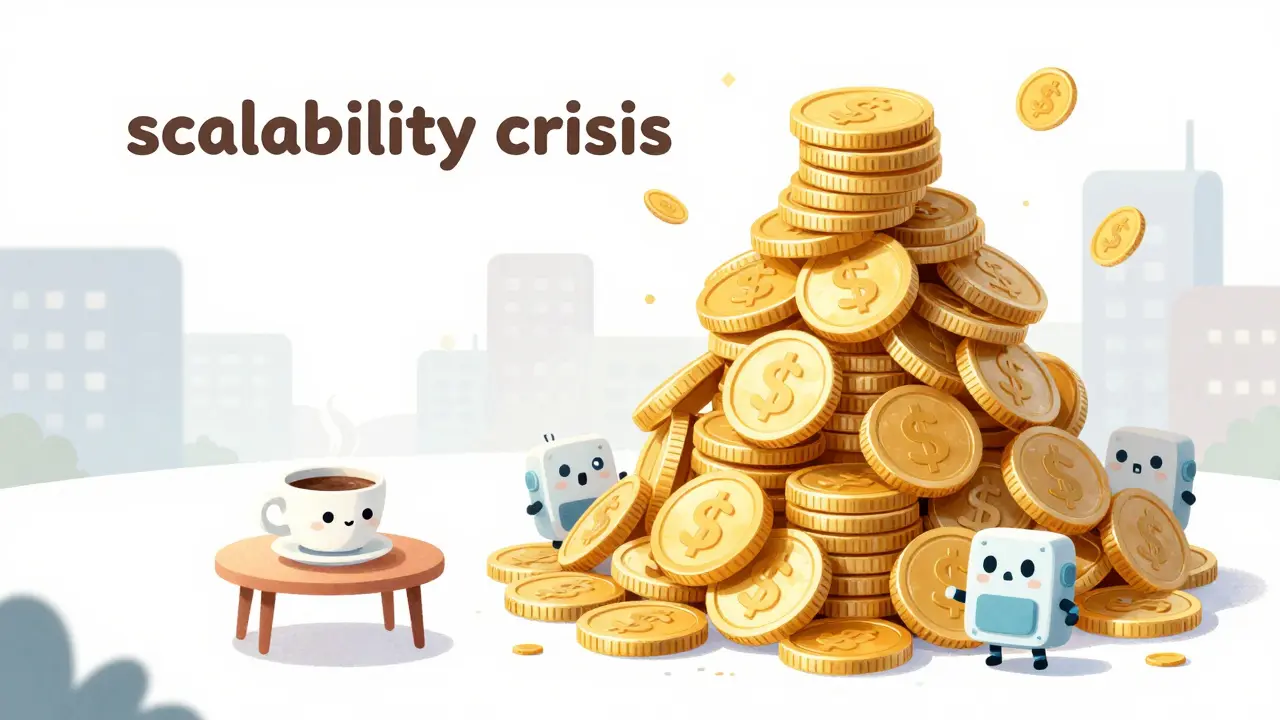
Imagine trying to use a digital currency to buy a coffee, but the fee to send the payment is higher than the price of the drink itself. This is the "scalability crisis" that has plagued major networks for years. When too many people try to use a blockchain at once, the competition for limited space drives prices through the roof. But there is a fix that doesn't involve compromising security: Blockchain Rollups is a Layer 2 scaling solution that processes multiple transactions off-chain and bundles them into a single batch before submitting them to the main network. By changing how data is handled, rollups make blockchain interactions affordable for everyone, not just whales.
The Logic Behind the Savings
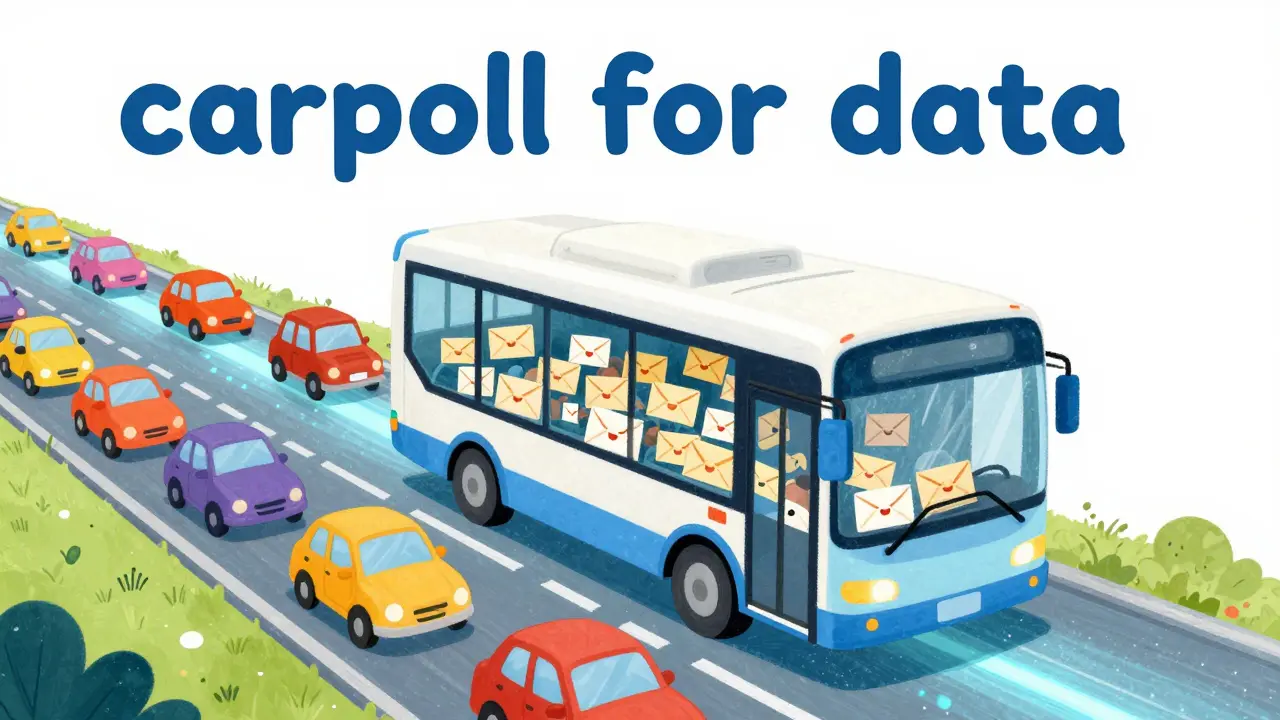
To understand how rollups lower costs, think of them like a carpool for data. On a standard Layer 1 network, every single transaction is like a person driving their own car to the same destination. This clogs the highway and makes tolls expensive. Rollups act as a bus; they gather hundreds of transactions, pack them into one vehicle, and pay a single "toll" to the main chain.
The technical magic happens through computational load redistribution. Instead of the main blockchain executing every single trade or transfer, the Layer 2 handles the heavy lifting. Once the work is done, the rollup creates a compressed cryptographic proof. This proof is a tiny piece of data that tells the main chain, "I've processed 1,000 transactions, and here is the proof that they are all valid." Because the main chain only needs to verify a small proof rather than 1,000 individual entries, the cost reduction is massive.
| Feature | Standard Layer 1 (On-Chain) | Rollup Solution (Layer 2) |
|---|---|---|
| Processing Location | Directly on the main chain | Off-chain (bundled) |
| Data Load | Full transaction details | Compressed proofs / batches |
| Cost Trend | Increases with congestion | Decreases as usage grows (shared costs) |
| Example Cost (Bitcoin) | ~5,000 satoshis | ~50 satoshis (up to 99% less) |
ZK-Rollups: The Efficiency Powerhouse
Not all rollups work the same way. ZK-rollups (Zero-Knowledge rollups) are particularly effective at cutting costs. They use complex mathematics to prove a transaction is valid without revealing all the data. This creates a fixed-cost proof verification model.
Here is the wild part: in a traditional blockchain, more users usually mean higher fees. With ZK-rollups, the relationship is inverted. Since the cost of verifying a proof is relatively stable regardless of how many transactions are inside the batch, adding more users actually spreads that cost thinner. The more people use the network, the cheaper it gets for each individual. This creates a positive feedback loop that makes micropayments-things like tipping a content creator a few cents-actually viable.
Optimistic and Based Rollups
While ZK-rollups use math, Optimistic Rollups take a "guilty until proven innocent" approach. They assume transactions are valid and only run a check if someone challenges a batch. This is often easier to implement for complex smart contracts, though it can have slower withdrawal times.
Then there are Based Rollups. These are a newer breed that rely on Layer 1 sequencers. By using the existing infrastructure of the main chain to order transactions while still processing the bundles off-chain, they remove the need for a separate, centralized operator. This further streamlines the process and can drive fees even lower by eliminating middleman overhead.
Where the Savings Actually Matter
Lowering fees isn't just about saving money; it's about unlocking new things we can actually build. High gas fees have long been the "death valley" for several industries. When costs drop, the landscape changes:
- Decentralized Finance (DeFi): You can now swap small amounts of tokens or provide liquidity without the transaction fee eating 20% of your investment.
- Blockchain Gaming: Imagine a game where every item picked up is an NFT. Doing this on a main chain would cost a fortune. Rollups allow thousands of tiny in-game actions to happen cheaply.
- Supply Chain: Companies can track individual parts of a product across a global journey. Instead of one expensive update per shipment, they can log every single movement in real-time.
- NFTs: Minting a collection no longer requires a massive upfront budget, making digital art accessible to hobbyists, not just wealthy studios.

The Trade-offs: Is it Always Better?
If rollups are so cheap, why isn't everything on one? There are a few catches. First, there is liquidity fragmentation. If your money is on one rollup and the app you want to use is on another, moving those funds can be a chore. It's like having money in two different banks that don't talk to each other.
Second, rollups are still tied to the base layer's blockspace. If the main chain (like Ethereum) becomes incredibly congested, even the compressed proofs will eventually cost more to post. This is why developments like danksharding are so important-they create dedicated space for rollup data, which will likely trigger another massive drop in fees.
From a security perspective, rollups are a huge win over sidechains. If a sidechain crashes, your funds might be gone forever. Because rollups store their data on the main chain, you can almost always get your money back through a forced withdrawal, even if the rollup operator disappears.
Do rollups make the main blockchain slower?
Actually, the opposite. By moving the bulk of the transaction processing off-chain, rollups reduce the congestion on the main network. This means that even people who don't use rollups might see slightly lower fees because there is less competition for blockspace.
Which is cheaper: Optimistic or ZK-Rollups?
Generally, ZK-rollups have a higher theoretical ceiling for cost reduction because their proof verification costs are shared among more users as the network grows. Optimistic rollups are often cheaper for developers to launch, but ZK-rollups offer better long-term scaling for high volumes.
Can I lose my money if a rollup fails?
Unlike sidechains, most rollups provide a security guarantee via the main chain. Because the transaction data (or a proof of it) is stored on Layer 1, users can typically trigger a withdrawal process to recover their assets even if the rollup network goes offline.
Are rollups a permanent solution for fees?
They are the most practical current solution, but they still rely on the base layer. As the base layer evolves (through things like sharding), rollups will become even more efficient. They aren't a "set and forget" fix, but a foundation for continuous scaling.
What is the 'blockchain trilemma' mentioned in scaling?
The trilemma is the idea that you can only have two of three properties: security, scalability, and decentralization. Rollups attempt to solve this by keeping security and decentralization on Layer 1 while pushing scalability to Layer 2.
Next Steps for Users and Developers
If you are a user, the best way to start is by bridging a small amount of assets to a reputable Layer 2. Experiment with a DeFi protocol on a rollup to see the speed and cost difference compared to a main net. You'll likely notice that transactions finish in seconds and cost pennies.
For developers, the choice depends on your app's needs. If you need high compatibility with the Ethereum Virtual Machine (EVM) and a faster launch, Optimistic rollups are a great start. However, if you are building a high-frequency app (like a game or a payment processor) where instant finality and lowest-possible costs are key, investing the time into ZK-rollup integration is the way to go.
Jason Davis
L2s are definitely the way forward but a lot of people forget about the bridge risk. I've seen way too many folks lose funds just tryin to move assets between chains because the bridge got hacked. Its a huge bottle neck for adoptoin and needs more work before the average person just jumps in without thinking.
Samson Selleck
The reduction in computational overhead is a superficial metric if one fails to account for the systemic fragility introduced by sequencer centralization. We are essentially substituting a robust, monolithic consensus mechanism for a fragmented ecosystem of precarious intermediaries. The heuristic of 'cost-saving' is merely a palliative for the underlying architectural inefficiencies of the base layer. Until we achieve genuine data availability sampling, these rollups are just sophisticated band-aids on a bleeding arterial wound of a network. Furthermore, the liquidity fragmentation is not a 'chore'-it is a fundamental failure of interoperability that renders the user experience fragmented and cognitively taxing for any serious actor in the space.
Artavius Edmond
Totally agree with the point about gaming. Imagine actually playing a game where you aren't paying a dollar every time you open a chest! That's where the real mass adoption happens.
Alan Seiden
Utterly rubbish. These so-called solutions are just convoluted ways to hide the fact that the original premise of blockchain was flawed. Only a fool would trust a 'compressed proof' over a transparent ledger. We don't need 'buses' for data; we need a system that actually works without needing ten different layers of abstraction to hide the cost.
Surender Kumar
this is realy cool stuff. imagine a future where we dont even notice we are using a blockhain because the fees are so low it just works like a normal app. very optimistc about this!
Amanda Faust
everyone knows zk rollups are better because the finality is instant unlike optimistic ones where you gotta wait like a week to get your money back if you want to be safe
Akshay Gorad
The comparison table is quite helpful for understanding the cost difference. It is interesting to see how ZK-rollups invert the cost relationship as more people join.
Kelly Cantrell
Of course they want us to use 'Layer 2'. It's just another way to move our assets into a black box where the operators can manipulate the order of transactions behind the scenes. Once you bridge your money away from the main chain, you're basically trusting a small group of people and hoping they don't decide to 'update' the rules of the game while your funds are locked up.
jennelle williams
small steps make a big change
Jessie Tayaban
OMG yes!! I tried bridging to an L2 last week and I literally almost cried when I saw the gas fee was like 10 cents instead of 50 bucks!! It is actually life changing lol!!
My only issue is that some of my favorite apps still arent there yet but im manifesting it!!
Chidinma Sandra okafor
Oh sure, just bundle the transactions and everything will be magical. I love how the 'solution' to a crowded highway is just to put everyone in a bus they didn't ask to be on. Truly revolutionary stuff here.
Rima Dinar
I truly believe that as more people start to educate themselves on the nuances of Zero-Knowledge proofs and the way these bundles are constructed, we will see a massive wave of developers who feel empowered to create tools for the underserved populations in the global south who simply cannot afford the current L1 fees, which is why these developments are so vital for financial inclusion.
logan bates
As long as it keeps the US competitive in the tech space, I'm all for it. We can't let other countries dominate the scaling game.
EDOZIEM MICHAEL
money is just a flow of energy and rollups are like better pipes for that energy to move through without friction
7stargee Emmanuel Obani
this whole thing is just a way to pump l2 tokens 🙄 nothing is actually changing for the regular user who just wants a wallet that works
Lauren Abrams
I wonder if the liquidity issue gets solved by some kind of universal bridge that just happens in the background without us seeing it.