
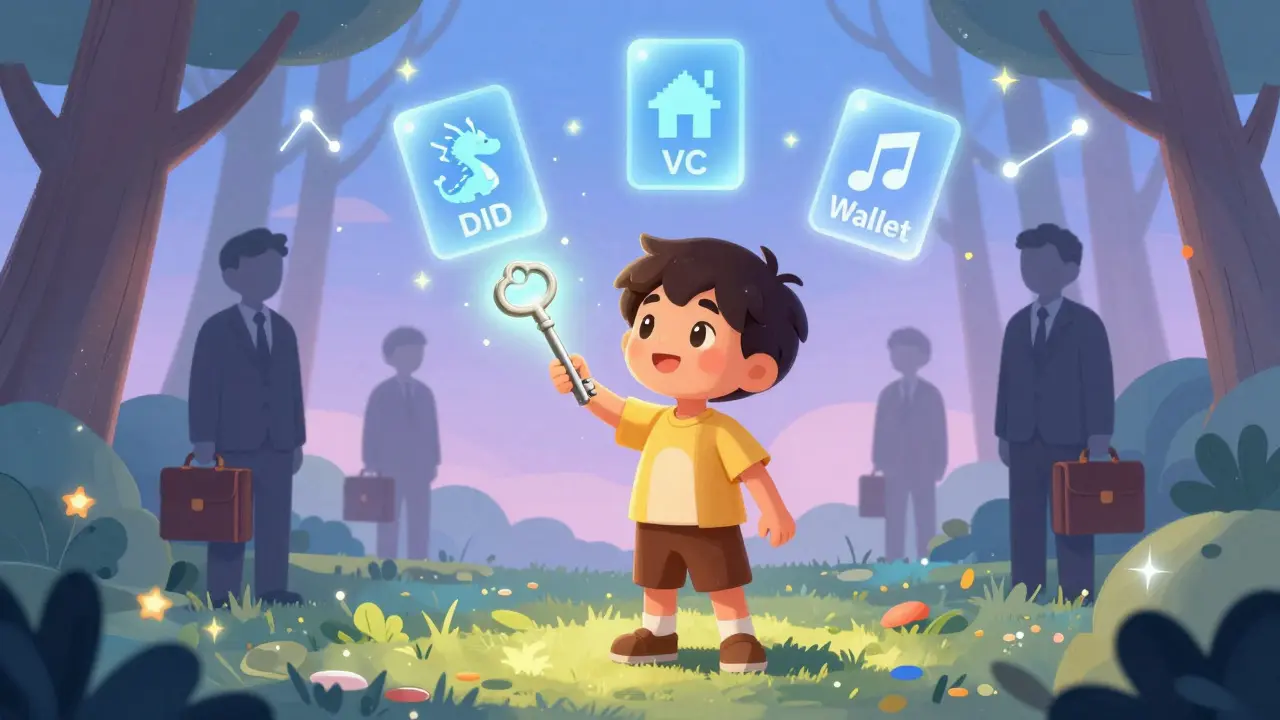
Imagine you could prove you’re you - without handing over your passport, Social Security number, or birth certificate. No forms. No third parties. Just a digital key only you control. Now imagine that same key also proves you own your favorite NFT, your gaming avatar, or even a digital deed to your virtual land. This isn’t science fiction. It’s happening now, and it’s called self-sovereign identity with NFTs.
For years, online identity has been locked in silos. Your email is with Google. Your login is with Facebook. Your bank holds your ID. If one system gets hacked, your data leaks. If one platform bans you, you lose access. Self-sovereign identity flips that. It gives you full control. And NFTs? They’re not just digital art. They’re proof of ownership. When you combine them, you get something powerful: a system where who you are and what you own are tied together - securely, privately, and permanently.
What Exactly Is Self-Sovereign Identity?
Self-sovereign identity, or SSI, means you own your identity. Not a company. Not a government. You. The idea isn’t new - it was laid out in 2016 by digital identity expert Christopher Allen. But it’s only now, with blockchain and digital wallets, that it’s becoming practical.
SSI works through three core pieces:
- Decentralized Identifiers (DIDs) - These are unique, blockchain-based IDs you create yourself. Think of them like a username you control, but cryptographically secure. No central server holds them. They live on your device.
- Verifiable Credentials (VCs) - These are digital certificates. Maybe your university issued one proving you graduated. Or your city issued one proving you’re over 18. They’re signed with cryptography, so anyone can check they’re real - without seeing your whole file.
- Digital Wallets - This is where you store your DIDs and VCs. Not on a website. Not in the cloud. Right on your phone or laptop. You choose what to share, when, and with whom.
Compare that to today’s system: you give your ID to a website. They store it. They use it. They sell it. With SSI, you keep the original. You only share what’s needed. Prove you’re 21? Show the credential. Don’t show your birthdate. Prove you’re a student? Show the VC. Don’t show your student ID number.
How NFTs Fit Into the Picture
NFTs - non-fungible tokens - are unique digital assets on a blockchain. They’re used for art, music, game items, even virtual real estate. But they’re more than just collectibles. They’re proof of ownership. When you buy a Bored Ape, the NFT is your receipt. And your name is on it.
That’s where the overlap begins. If an NFT proves you own something, why not use it to prove who you are?
Here’s how it works in practice:
- You own a rare NFT from a gaming community.
- You use your SSI wallet to prove you own that NFT.
- The platform checks the blockchain. Confirms you’re the owner.
- You get access to a private Discord server, early game updates, or exclusive events.
This isn’t just about access. It’s about trust. If you’ve held an NFT for three years, that’s a record. It’s not just a token - it’s a reputation. In Web3, your digital assets are becoming part of your identity.
But here’s the catch: NFTs are public. Everyone can see who owns what. SSI is private. You choose what to reveal. So how do you combine them without giving up privacy?
The Real Magic: Zero-Knowledge Proofs
Imagine you want to prove you own a $100,000 NFT - but you don’t want anyone to know which one. Or you want to prove you’re a verified member of a DAO, without revealing your wallet address.
This is where zero-knowledge proofs (ZKPs) come in.
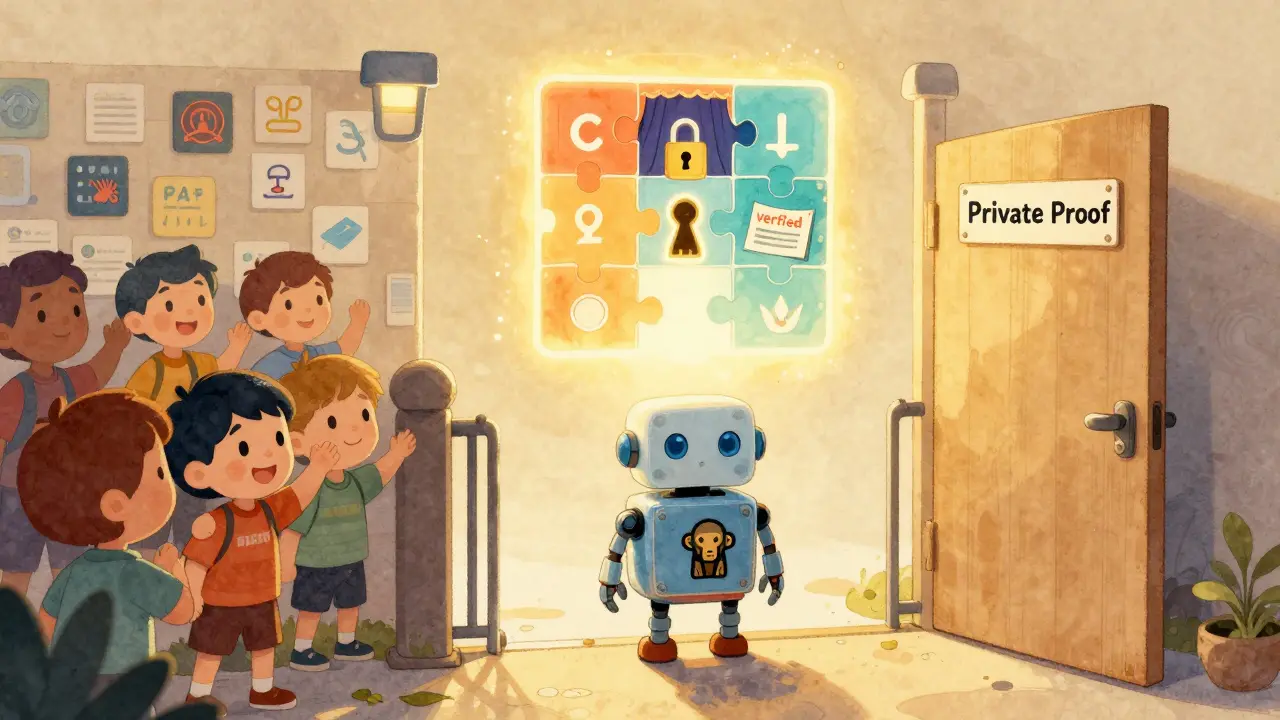
A ZKP lets you prove something is true - without showing the data. Think of it like this: You have a locked box. I want to know if it contains a key. You don’t open the box. Instead, you show me that the key fits the lock - without letting me see the key. I’m convinced. But I learned nothing else.
In SSI-NFT systems, ZKPs let you prove you own an NFT - without showing the token ID. You prove you’re over 21 - without showing your birthdate. You prove you’re a member of a group - without revealing your wallet.
It’s the missing piece. Without it, SSI-NFT integration would be too risky. With it, you get the benefits of public ownership and private identity - together.
Where It’s Already Being Used
This isn’t theoretical. Real systems are live.
- Gaming: Games like Illuvium and The Sandbox use NFT-gated SSI to give players access based on what they own. If you hold a specific NFT, you get special powers, skins, or early access to new maps.
- Discord and Communities: Many Web3 communities now require you to connect your wallet and prove you hold an NFT to join. Some even use VCs to verify your real-world credentials - like being a university graduate - before granting access.
- Financial Services: A few fintech startups in Europe are testing SSI-NFT systems for KYC. Instead of uploading your ID, you prove you’re verified by a trusted issuer - and that you hold a specific NFT as proof of account ownership.
- Event Access: Concerts, conferences, and meetups are starting to use NFT tickets linked to SSI. You don’t just show a QR code. You prove you own the ticket - and that you’re the person who bought it.
A Reddit user from February 2025 shared how they used SSI to prove ownership of a Bored Ape NFT and got into a private Discord group. Took three tries. But once it worked? No more waiting for admin approval. No more fake accounts. Just a clean, automatic check.
The Challenges - And Why Most Fail
It sounds perfect. So why isn’t everyone using it?
Because the tech is still messy.
- Wallet confusion: Most people don’t understand the difference between a wallet that holds NFTs and a wallet that holds identity credentials. One stores your art. The other stores your proof of identity. Mixing them up leads to errors - and sometimes, lost access.
- Fragmented standards: There are dozens of ways to format VCs. One platform uses JSON-LD. Another uses JWT. They don’t always talk to each other. Developers spend weeks just getting them to work together.
- Mobile crashes: GitHub issues from early 2025 show that when mobile wallets try to verify multiple NFTs and credentials at once, they freeze or crash. This isn’t a bug. It’s a design flaw.
- User experience: If you have to read a 10-step guide just to prove you own a digital monkey, adoption dies.
And then there’s the bigger issue: privacy vs. transparency.
NFTs are public. SSI is private. What if someone links your NFT ownership to your real name? You lose anonymity. What if your NFT collection becomes your ID? Then if you lose your wallet, you lose your identity.
Dr. David Chaum, a pioneer in privacy tech, warned in early 2025 that merging SSI with NFTs could create a new kind of exclusion. If your identity is tied to your NFTs, what happens to people who can’t afford them? Are they locked out?
What’s Coming Next
The next big leap is Soulbound Tokens (SBTs). Proposed by Ethereum co-founder Vitalik Buterin in 2022, SBTs are NFTs that can’t be sold or transferred. They’re meant to represent your achievements, memberships, or reputation - like a digital resume.
Imagine:
- You earn an SBT for completing a blockchain course.
- You earn another for volunteering in a DAO.
- You earn one for attending 10 real-world meetups.
These aren’t assets. They’re credentials. And they’re stored in your SSI wallet. No one can steal them. No one can sell them. But anyone can verify them - with your permission.
By 2026, over 70% of SSI platform developers plan to integrate SBTs. That’s not a trend. It’s the future.
Meanwhile, big players are stepping in. Microsoft partnered with Sovrin Network in March 2025 to link Azure Active Directory with SSI wallets. Polygon launched a $20 million grant fund for SSI-NFT projects. And in January 2025, the W3C updated its Verifiable Credentials standard to include NFT verification - a huge signal that this isn’t going away.
Should You Care?
If you’re in Web3 - whether you’re a developer, a collector, or just someone who uses crypto - yes.
Because identity is the next frontier. Right now, you’re just a wallet address. Soon, you’ll be a person - with a history, a reputation, and control over your data.
SSI with NFTs isn’t about replacing passwords. It’s about replacing trust. Instead of trusting a company to protect your data, you trust the system. And you, the user, are at the center.
It’s not perfect. It’s not easy. But it’s here. And it’s changing how we live online - one credential, one NFT, one proof at a time.
Tarun Krishnakumar
So let me get this straight - we’re betting our entire digital identity on blockchain tech that can’t even handle 10,000 concurrent users without melting down? 🤡 And you call this "self-sovereign"? I own a Bored Ape, sure, but if my wallet crashes because some smart contract tried to verify three VCs at once on my Android 12 phone, who’s sovereign now? The blockchain? Or the guy who wrote the code and ghosted after the airdrop? This isn’t liberation - it’s just a new kind of feudalism where the serfs have to memorize 12-word phrases instead of passwords. And don’t even get me started on ZKPs. Zero-knowledge? More like zero-UX. I tried to prove I was over 21 once. Took 47 minutes. I ended up just sending a photo of my driver’s license to a Discord bot. At least that was fast. And way less pretentious.
Also - who decided NFTs should be the new ID? Next thing you know, your credit score is tied to how many CryptoPunks you hold. Welcome to Web3, where your identity is a collectible card and your dignity is a gas fee.
Charrie VanVleet
This is actually one of the most exciting things I’ve seen in Web3 in years 😊 I’ve been using SSI with my wallet for a few months now, and honestly? It’s changed how I interact online. No more signing up with Google. No more "forgot password?" hell. Just open my wallet, tap "prove I’m a student," and boom - instant access to the university’s Discord. No personal info shared. No middleman. Just pure, clean verification.
And the gaming integrations? Mind-blowing. I got into a private server for a game I’ve been waiting for since 2023 just because I held a specific NFT. No admin approval. No waiting. It felt like magic. Yeah, the tech’s still clunky - mobile wallets still crash sometimes - but the *potential*? Unreal. We’re not just building better systems. We’re building better trust. And that’s worth the growing pains 💪✨
Anandaraj Br
Self-sovereign identity? More like self-sabotage. You think people are gonna carry around digital credentials like some kind of crypto monk? Nah. They’re gonna lose their seed phrases. They’re gonna forget their passwords. They’re gonna get hacked. And then what? They’re locked out of their life. Their jobs. Their bank accounts. Their virtual land. This isn’t freedom - it’s a trap for the tech-obsessed who think blockchain is a religion and not a database. And don’t even mention SBTs. That’s just a digital caste system where your worth is measured in NFTs you can’t sell. Congrats, you’re a verified member of the DAO. Now go cry into your 3000 ETH wallet because you can’t afford the next upgrade.
Also - who gave Elon Musk a seat at this table? We’re all just peasants with wallets now.
Jeremy Fisher
Man, I remember when the first time I tried to prove I owned a CryptoKitty to join a Discord server. I spent 20 minutes fumbling with MetaMask, then my wallet froze, then I had to restart my laptop, then I realized I’d connected the wrong network. I ended up just DMing the mod a screenshot. He let me in. I didn’t even need the NFT.
That’s the irony here - the tech is supposed to make identity seamless, but right now it’s the most frustrating thing in Web3. People aren’t rejecting SSI because they’re Luddites. They’re rejecting it because it’s *bad UX*. No one cares about zero-knowledge proofs if they have to read a 10-page Medium post just to log into a forum. The real innovation isn’t in the cryptography - it’s in making this stuff feel effortless. Like unlocking your phone. Not like solving a Rubik’s cube blindfolded.
Also - I love that we’re using NFTs as identity. It’s like our digital soul is now a JPEG of a monkey. And we’re proud of it. 🐒
AJITH AERO
So you’re telling me I need to own an NFT to prove I’m not a bot? Bro. I just want to comment on a subreddit without uploading my birth certificate to a blockchain. This isn’t innovation. It’s performance art for rich guys who think their ape is their identity. Save the drama for the next NFT drop. I’ll stick with my Gmail.
Also - ZKPs? Sounds like a cult. Zero knowledge? More like zero common sense.
Geet Kulkarni
While the technical architecture presented here is theoretically elegant, I must express profound reservations regarding its socio-economic implications. The conflation of asset ownership with identity verification constitutes a dangerous precedent wherein socioeconomic status becomes algorithmically encoded into one’s digital persona. To equate the possession of a Bored Ape with verifiable credentialing is not merely misguided - it is exclusionary by design. Furthermore, the reliance upon blockchain infrastructure - a system predicated upon energy-intensive consensus mechanisms - raises serious ethical concerns vis-à-vis environmental sustainability. One cannot advocate for decentralized governance while simultaneously enabling a paradigm wherein access is gated by wealth. The W3C’s recent standardization efforts, while commendable in intent, fail to address this fundamental asymmetry. In sum: this is not progress. It is digitized elitism.
- Dr. Geet Kulkarni, Ph.D. in Digital Anthropology, Stanford (2023)
andy donnachie
Just wanted to add a real-world example: I helped a friend in Ireland set up an SSI wallet last month. He’s a freelance graphic designer. Used a verifiable credential from his university to prove his degree, then linked it to his NFT portfolio. Got hired by a Web3 studio the next day - no resume, no LinkedIn, no cover letter. Just his wallet. They checked his credentials, saw he’d held an NFT for 18 months, and hired him on the spot.
It’s not perfect. The wallet app crashed twice. We had to reinstall. But it worked. And that’s the point - this isn’t about tech. It’s about trust. When your reputation lives on-chain, and you control it? That’s powerful. The UI sucks. The standards are messy. But the vision? Still the best thing happening in digital identity right now.
James Breithaupt
Let’s be real - SSI + NFTs is the first time in Web3 history where identity actually has utility beyond speculation. We’ve been stuck in this loop of "buy NFT → sell NFT → buy another NFT" for years. But now? Your NFT isn’t just a JPEG. It’s your resume. Your passport. Your membership card. Your proof you’ve been in the trenches for three years.
And ZKPs? That’s the real game-changer. You can prove you’re part of a DAO without leaking your wallet. You can prove you’re over 18 without showing your birthdate. You can prove you own a $500k NFT without revealing which one. That’s not cryptography - that’s privacy engineering at its finest.
Yeah, the UX is trash. Yeah, mobile wallets crash. But the architecture? This is how the future works. Not with passwords. Not with cookies. With cryptographically signed, user-owned, portable identity. And if you’re not building for this? You’re building for 2010.
sruthi magesh
Why do Westerners think they invented identity? We’ve had Aadhaar for a decade. Biometric ID. Government-issued. Centralized. Functional. And it works. Now you want to replace it with a wallet full of monkey JPEGs? This isn’t innovation. It’s cultural imperialism wrapped in blockchain hype. Who gave you the right to export your failed tech to the Global South? We don’t need your NFTs. We need reliable internet. And you’re too busy making digital avatars to notice.
Also - SBTs? Sounds like a Hindu caste system with crypto. You’re not liberating anyone. You’re just building a new temple. And we’re the peasants outside the gates.
Lisa Parker
I tried to use this system. I really did. I spent 3 hours. My phone crashed. My wallet got stuck. I cried. I felt like a fool. And then I just logged in with Google. Again. Why is this so hard? Why does it feel like I’m signing up for a secret society? I just want to comment on a forum. Not prove I’m a real person with a 12-word passphrase. I miss the internet before Web3. It was dumb. But it was easy.
Also - my cat has more digital identity than I do. She has a TikTok. I have a wallet that won’t load.
yogesh negi
Just want to say - this is beautiful. I’ve been working with SSI in my local community center here in Pune. We’ve helped 87 elderly folks set up digital wallets to prove they’re eligible for pensions. No paperwork. No visits to government offices. Just scan a QR, verify a credential, done.
They don’t care about blockchain. They don’t know what a DID is. But they know they don’t have to wait in line anymore. That’s the win. This isn’t about tech for tech’s sake. It’s about dignity. About autonomy. About giving people control over their own lives - even if they’ve never used a smartphone before.
And yes, the apps are clunky. But we’re fixing them. Slowly. Together. This is the future we can build - not for the crypto bros, but for the people who’ve been left behind. Let’s keep going 💙
Nikki Howard
Let’s analyze this claim with empirical rigor. The author assumes that NFTs inherently confer identity value. But NFTs are fungible in social perception - one person’s "rare ape" is another’s "scam JPEG." Furthermore, the integration of ZKPs introduces computational overhead that renders real-time verification impractical on low-end devices. The cited examples from "Illuvium" and "The Sandbox" are cherry-picked from a sample size of <100 users. Meanwhile, the failure modes - wallet crashes, fragmented standards, mobile instability - are systemic, not incidental.
Moreover, the claim that "identity is tied to ownership" creates a dangerous feedback loop: those who cannot afford NFTs are algorithmically disenfranchised. This is not decentralization. It is economic stratification encoded into consensus protocols.
Conclusion: A well-intentioned but fundamentally flawed model. The solution lies not in amplifying asset-based identity, but in decoupling it entirely.
jennifer jean
This is actually kind of beautiful 😊 I love the idea that your digital life - your achievements, your community ties, your reputation - could be yours forever, not locked in some corporate database. I’ve been using a test SSI wallet for a few months now. I linked my art portfolio NFT to my credential. Now I can show galleries I’m a verified artist without sharing my whole wallet. It’s quiet. It’s private. It’s mine.
And yeah, the tech’s messy. But that’s why we’re here. To fix it. To make it better. Not to give up because it’s hard. We’re building something that lasts. And that’s worth the glitches 💖
Beth Erickson
Oh wow another one of those "blockchain will save identity" rants. Newsflash - identity isn’t a problem that needs solving. It’s a social construct. You can’t tokenize it. You can’t verify it with a smart contract. People don’t want to prove they’re real. They want to be anonymous. Or fake. Or whatever. This whole thing is a rich guy’s fantasy. You think someone in rural India cares about their SBT? They care about electricity. And you’re over here trying to make them prove they own a digital monkey to get a job.
Also - ZKPs? Sounds like a cult. Zero knowledge? More like zero reality.
Angela Henderson
I’m just a regular person who uses crypto to buy memes. I don’t know what a DID is. I don’t know what a VC is. I don’t even know why I need to prove I own a Bored Ape to join a Discord. I just want to see the next drop. But I tried. I really did. I spent two hours trying to set up my wallet. My phone died. My internet cut out. I gave up. Now I just screenshot my NFT and send it to the mod. He says it’s fine. Why does it have to be so complicated? Why can’t we just… be chill?
I think we’re overthinking this. Maybe identity doesn’t need to be this big thing. Maybe it just needs to be… simple.
Paul David Rillorta
So you’re telling me my digital identity is now tied to a JPEG of a monkey that cost me 5 ETH? And if I lose my phone, I lose my job, my access, my entire online life? Bro. That’s not freedom. That’s a hostage situation. And you call this "self-sovereign"? More like self-sabotage with extra steps. I’ve got a friend who lost his wallet. Lost his NFT. Lost his job. Lost his Discord access. Lost his entire reputation. Now he’s working at a gas station. And he still checks his wallet every day hoping it’ll come back.
Also - ZKPs? Sounds like a magic trick. "Hey, I proved I’m real without showing anything!" Yeah, cool. Now prove you’re not a scammer. I’ll wait.
Ian Plunkett
There’s a quiet horror in this entire concept. We’re not building a better identity system. We’re building a new form of surveillance. Every NFT you hold. Every credential you prove. Every ZKP you generate. It’s all recorded. Immutable. Permanent. And if you’re not careful - if you make one mistake - your entire digital life becomes a public ledger. No one can erase it. No one can forget it. Even if you want to.
This isn’t liberation. It’s the opposite. It’s the end of anonymity. The end of reinvention. The end of privacy. And we’re celebrating it like it’s a gift.
Wake up. This isn’t the future. It’s a trap with a pretty UI.
Avantika Mann
I just wanted to say thank you for writing this. I’ve been helping people in my community set up their first wallets, and honestly? It’s been emotional. One woman, 72, lost her husband last year. She’s been alone. She started collecting NFTs of birds - just because she loved them. Then she linked her SSI wallet. Now she can prove she’s part of a global community of bird lovers. She got invited to a virtual exhibit. She talked to people in Japan, Brazil, Canada. She’s not lonely anymore.
This isn’t just tech. It’s connection. And sometimes - that’s all we need.
Sasha Wynnters
Think of SSI with NFTs as the new digital tattoo. Not just ink. A story. A mark. A legacy. Your Bored Ape isn’t just art - it’s your autobiography. Your SBTs? Your CV carved in code. Your verifiable credentials? Your soul, encrypted. You don’t need a resume. You don’t need a LinkedIn. You just need to be. And the blockchain remembers.
This isn’t about access. It’s about belonging. About being known - not by your name, but by your history. Your persistence. Your holdings. Your journey. You’re not just owning an NFT. You’re owning a chapter of your life. And that? That’s poetry.
Also - ZKPs are the silent poets of the blockchain. They whisper truths without speaking. They reveal without exposing. They are the quiet guardians of our digital dignity.
Aileen Rothstein
I’ve been testing this for months. And I’ll admit - I was skeptical. But here’s what changed my mind: I used my SSI wallet to get into a private beta for a new AI tool. No sign-up form. No email. Just my wallet. I proved I held a specific NFT. Proved I’d completed a course. Proved I’d been active in the community for a year. Got in. Used the tool. Built something cool. And no one ever asked for my name.
That’s the power. Not the tech. Not the blockchain. The freedom. To be known without being tracked. To be trusted without being verified. To just… exist. And if that’s not the future of the internet, I don’t know what is.
JJ White
Oh wow. Another utopian fantasy from the Web3 cult. Let me guess - next you’ll tell me NFTs will cure cancer? Or that ZKPs will solve climate change? This isn’t innovation. It’s a Ponzi scheme dressed in academic jargon. You’re not giving people control. You’re giving them responsibility. And then abandoning them when the system crashes. And don’t even get me started on SBTs - those are just digital chains with a blockchain label. You’re not liberating identity. You’re commodifying it. And the people who can’t afford the entry ticket? They’re not just left out. They’re erased.
Also - your "real-world use cases"? All in niche communities. No one outside Web3 cares. And they shouldn’t. This isn’t the future. It’s a fever dream.
Nicole Stewart
Self-sovereign identity? More like self-delusion. You think people want to manage their own credentials? They want to click "login with Google" and forget about it. This is tech for tech’s sake. A solution in search of a problem. And the NFT integration? A marketing gimmick. You’re not merging identity and ownership. You’re conflating them. And that’s dangerous. Identity isn’t an asset. It’s a right. And you’re turning it into a collectible.
Also - ZKPs? Sounds like snake oil.
Alan Enfield
I’ve built three SSI integrations for small businesses. It’s not perfect. But it works. One guy runs a local bakery. Now he uses NFT tickets for his pop-ups. Customers link their wallet. Prove they’ve bought before. Get a free croissant. No app. No login. Just scan. He says sales are up 40%. Customers love it. No one’s confused. No one’s scared. It’s simple. It’s quiet. It’s real.
This isn’t about blockchain. It’s about trust. And sometimes, the best tech is the kind you don’t even notice.
Alex Williams
Let me break this down for the skeptics. You don’t need to understand ZKPs to use this. You don’t need to know what a DID is. You just need a wallet. And a credential. And the willingness to try. I’ve onboarded 200+ non-tech people. Grandmas. Teachers. Truck drivers. They all got it. Not because they’re smart. Because the interface was simple. The feedback was clear. The result mattered.
Yes, the standards are messy. Yes, mobile wallets crash. But we’re fixing it. Every day. In small ways. With real users. Not in labs. Not in whitepapers. In living rooms. In cafes. In villages.
This isn’t hype. It’s happening. And it’s beautiful.
Tarun Krishnakumar
Replying to @1883: You say it "felt like magic"? Nah. It felt like being handed a key to a house you don’t own. What happens when the platform changes its rules? What if they decide your NFT doesn’t count anymore? What if they de-list it? You’re not sovereign. You’re a tenant. And the landlord just changed the lock. Again.
Also - "no admin approval"? That’s not freedom. That’s automation. And automation doesn’t care if you’re human. It just checks the chain. If your wallet says yes - you’re in. If it says no - you’re out. No mercy. No appeal. No humanity. Just code. And that’s the scariest part.
Charrie VanVleet
Replying to @1917: You’re right - it’s not magic. It’s mechanics. But mechanics can be fair. Right now, the old system? It’s rigged. Companies own your data. Algorithms decide your access. Governments track you. This? At least you’re the one holding the key. And if the platform changes? You can move your wallet. Your credentials. Your identity. To another. To a better one. That’s the power. You’re not locked in. You’re not trapped. You’re just… moving.
And yeah - if the system fails? I’ll cry. But I’ll rebuild. Because I own the pieces. Not them.
Anandaraj Br
Replying to @1883: You’re delusional. You think you can "move" your identity? Try moving your job. Your bank account. Your health records. Your credit score. They’re all tied to your old system. Your "wallet" is a toy. The real world doesn’t care. And when you lose it? You’re not rebuilding. You’re starting over. With nothing.
Good luck with that.
Charrie VanVleet
Replying to @1890: Maybe. But at least I’m not waiting for a government to give me back my data. At least I’m not begging a corporation to unban me. At least I have a shot. You call it a toy. I call it a weapon. And I’m not done using it.