
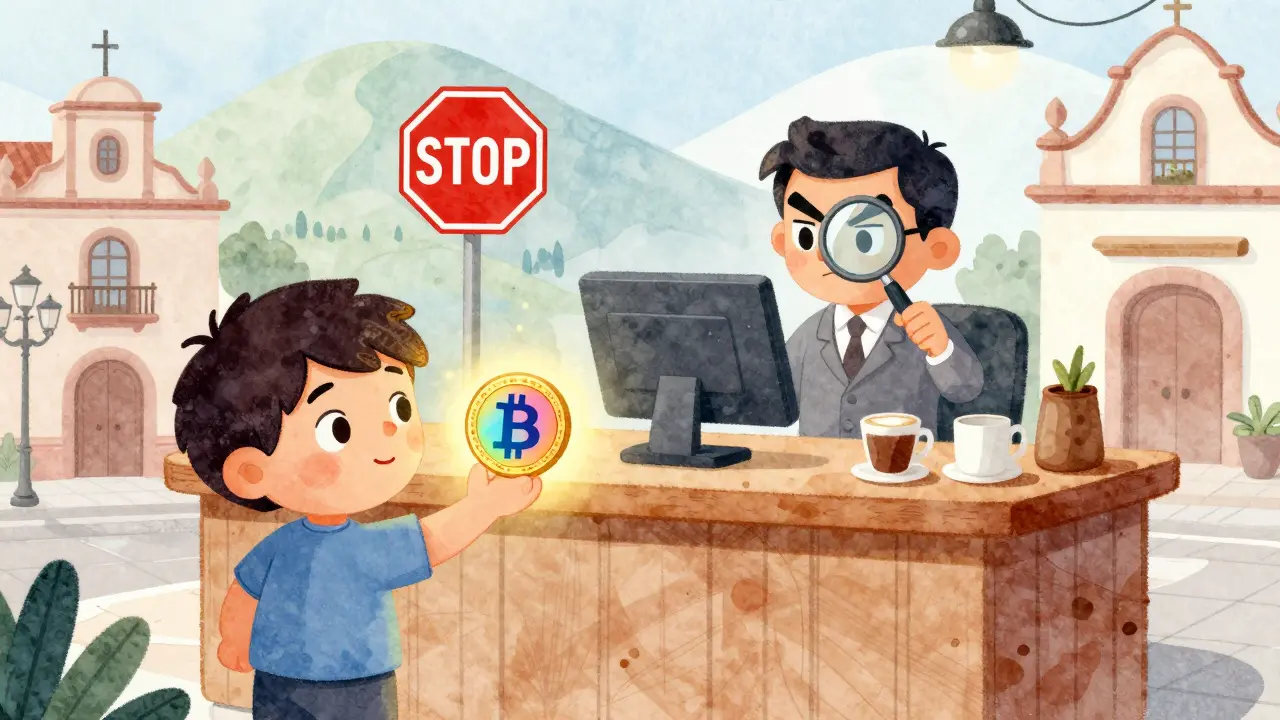
Imagine trying to buy coffee with Bitcoin in Quito and having your bank account frozen within minutes. That is the reality for thousands of people living in Ecuador right now. The country has built one of the strictest walls against digital assets in Latin America, yet millions of dollars still flow through unofficial channels every day. If you are holding crypto while living in or sending money to Ecuador, understanding these rules is not just about compliance-it is about keeping your funds safe.
Ecuador does not explicitly criminalize owning Bitcoin or Ethereum. However, it makes using them incredibly difficult by cutting off the bridge between the digital world and the traditional banking system. This guide breaks down exactly how the ban works, who enforces it, and what options remain for users in 2026.
Why Ecuador Banned Crypto Transactions
To understand the ban, you have to look at the dollar. Ecuador adopted the US dollar as its official currency in 2000 after a severe economic crisis. For over two decades, this move stabilized the economy but also meant giving up control over monetary policy. The Central Bank of Ecuador (BCE) is the government agency responsible for maintaining financial stability and enforcing the use of the US dollar as the sole legal tender views cryptocurrencies as a direct threat to that stability.
The core fear is capital flight. If people can easily convert their savings into Bitcoin and move it out of the country, the demand for physical US dollars could spike, causing shortages and inflation. By blocking banks from processing crypto transactions, the BCE aims to keep all money flowing through regulated channels where they can monitor it.
This stance is rooted in Article 94 of the Monetary Code, which declares only the US dollar as legal tender. In January 2022, the Junta de Política y Regulación Monetaria y Financiera (JPRM) issued Resolution 001-22, formally excluding cryptocurrencies from authorized payment methods. They doubled down in March 2023 with Resolution 002-23. These documents create a clear message: crypto is not money here, and banks cannot touch it.
How the Ban Works in Practice
The restriction is not just a suggestion; it is enforced through technology and heavy fines. Every major bank in Ecuador must deploy specific transaction filtering systems. As of early 2025, the Superintendency of Banks required all institutions to implement Transaction Monitoring System (TMS) Version 3.1. This software scans for 47 specific patterns linked to cryptocurrency activity.
If you try to send money to a known exchange like Binance, OKX, or Mercado Bitcoin, the system flags it immediately. Here is what typically happens:
- Automatic Blocking: Transactions to recognized crypto addresses are rejected before they leave the bank.
- Account Freezes: If a transfer slips through or looks suspicious, your account may be frozen for 3 to 14 days while investigators review your history.
- Fines for Businesses: Companies caught accepting crypto payments face fines up to $50,000 per violation under Article 144 of the Monetary Code.
Banco Pichincha, which holds about 38% of the market share, is particularly aggressive. Reports from mid-2025 indicate that transactions exceeding $200 to platforms associated with crypto exchanges trigger automatic alerts. Most first-time violators see temporary freezes, but repeat offenders risk permanent closure of their accounts.
The Legal Gray Area for Individuals
Here is where things get confusing. While banks are banned from helping you, the law does not explicitly say you cannot own crypto. Rolando Emilio Chica Cordero, the President of the BCE, stated in April 2025 that the central bank "has no power to ban" private trading. This creates a paradoxical situation.
You can legally hold Bitcoin in a personal wallet. You can even trade it privately with another person if you both agree. But you cannot use the formal financial system to move those assets. This means you cannot deposit crypto into your checking account, withdraw fiat from an exchange to your debit card, or use crypto to pay for groceries at a supermarket.
This distinction matters because it pushes most activity underground. Since there is no legal way to bridge crypto and dollars through banks, users turn to peer-to-peer (P2P) networks, informal cash exchanges, and offshore platforms. The World Bank estimated in June 2025 that roughly 385,000 Ecuadorians-about 2.2% of the population-are navigating this gray area daily.
Taxation and Regulatory Bodies
Even though you cannot bank with crypto, you still owe taxes on it. The Internal Revenue Service (SRI) clarified this in Circular 007-2024. Gains from cryptocurrency sales are taxed at progressive rates up to 35% for individuals and 25% for corporations. This applies to income sourced from Ecuador, regardless of whether the transaction went through a bank or a Telegram group.
Four main agencies enforce these rules:
- Central Bank of Ecuador (BCE): Sets monetary policy and issues consumer warnings. They have published 17 official notices on crypto risks since 2022.
- Junta de Política y Regulación Monetaria y Financiera (JPRM): Determines what counts as legal tender.
- Superintendency of Banks (SB): Enforces the banking ban. In 2024 alone, they sanctioned 12 financial institutions with fines totaling $1.2 million for facilitating crypto transactions.
- Internal Revenue Service (SRI): Collects taxes on crypto gains.
Additionally, the Superintendency maintains a public registry of unauthorized service providers. As of July 2025, 47 entities were listed as operating illegally. Being on this list means your business is officially flagged, making any attempt to integrate with local services nearly impossible.
Workarounds Used by Ecuadorian Users
Despite the bans, demand remains high. According to Chainalysis' 2025 User Behavior Report, the average Ecuadorian crypto user maintains 3.2 separate exchange accounts and spends nearly 9 hours a month managing complex transactions. Here are the most common methods people use to bypass the banking block:
| Method | Prevalence | Average Cost/Risk |
|---|---|---|
| P2P Trading via Exchanges | High | 3-5% fees; moderate security risk |
| Stablecoin Settlement (USDT) | Very High (74%) | Low fee; high chargeback risk if mislabeled |
| Cross-Border Services (e.g., Wise) | Moderate (31%) | 4.8% fees; potential account closure |
| Gift Card/Otc Desks | Low (22%) | High fees; significant fraud risk |
Peer-to-Peer (P2P) Networks: Platforms like Binance P2P are popular because they allow users to find local buyers willing to send USD via bank transfer or mobile payment apps in exchange for crypto. However, this relies entirely on trust. Scams happen frequently when sellers release crypto without receiving payment, or buyers reverse bank transfers after getting the keys.
Stablecoins as Intermediaries: Many users convert volatile coins like Bitcoin into Tether (USDT) first. They then try to pass off USDT transfers as regular USD transactions. Sometimes this works if the labeling is vague, but banks are getting smarter. In Q2 2025, there were 147 reported cases of frozen funds totaling $382,000 due to this tactic.
Offshore Platforms: Some residents open bank accounts in neighboring countries like Colombia or Panama, which have more permissive frameworks. They use cross-border services like Wise to move money. While effective, this adds complexity and higher fees, averaging 4.8% compared to 1.2% in friendly jurisdictions.

Future Outlook: Bill 6538 and CBDCs
Is the ban permanent? Not necessarily. In May 2025, National Assembly member Shirley Rivera introduced Bill 6538. This proposal seeks to create a licensing framework for crypto exchanges. It would require minimum capital of $500,000, proof-of-reserves audits, and real-time monitoring integration with the Financial Analysis Unit (UAF).
However, don't expect quick changes. Analysts predict at least 18 months before this bill could become law, given it is currently stuck in three congressional committees. Meanwhile, the BCE is exploring a Central Bank Digital Currency (CBDC). Prototype testing is scheduled for late 2025. A state-backed digital dollar could offer a controlled alternative to private crypto, potentially reducing pressure to lift the current bans.
The International Monetary Fund expressed concern in its 2025 report about "regulatory arbitrage," noting that 63% of crypto transactions in Ecuador occur through unregulated Telegram-based desks. This shadow market is growing, with average transaction sizes increasing 18% year-over-year. The government faces a choice: continue fighting a losing battle against informal markets or regulate the space to capture tax revenue and ensure consumer safety.
Risks for Investors and Residents
If you are considering investing in Ecuadorian blockchain startups or moving funds to the country, proceed with extreme caution. Venture capital inflow was only $12.7 million in 2024, compared to $210 million in Brazil. Institutional investors stay away due to regulatory uncertainty.
For individual residents, the biggest risk is liquidity. If you need to access your crypto funds quickly during an emergency, you cannot simply withdraw to your bank. You must rely on finding a counterparty willing to meet you in person or trust a P2P escrow system. This delay can cost you dearly in volatile markets.
Furthermore, legal support is scarce. Only three law firms in the country specialize in cryptocurrency matters. If your account is frozen or you fall victim to a scam, resolving the issue takes an average of 63 days through the Financial Ombudsman's Office-significantly longer than standard financial disputes.
Is it illegal to own cryptocurrency in Ecuador?
No, owning cryptocurrency is not explicitly illegal for private individuals. The Central Bank of Ecuador has stated it lacks the authority to ban private possession. However, you cannot use banks to buy, sell, or transfer crypto, and businesses are prohibited from accepting it as payment.
Will my bank account be closed if I trade crypto?
It is highly likely. Banks are required to flag transactions to known exchanges. First violations often result in temporary freezes (3-14 days), but repeated attempts to process crypto-related transfers can lead to permanent account closure and being blacklisted from other institutions.
Do I have to pay taxes on crypto gains in Ecuador?
Yes. According to SRI Circular 007-2024, profits from cryptocurrency sales are taxable. Individuals face progressive rates up to 35%, and corporations pay up to 25%. This applies even if the transaction occurred outside the formal banking system.
Can I use Binance or Coinbase in Ecuador?
You can register and trade on these platforms, but you cannot link your local Ecuadorian bank account or card directly. Most users rely on Peer-to-Peer (P2P) sections within these apps to find local traders who accept bank transfers manually, which carries higher security risks.
When might the crypto ban be lifted?
There is no set date. Bill 6538, introduced in May 2025, proposes a licensing framework, but analysts expect it to take at least 18 months to pass. Until then, the current restrictive policies are expected to remain in place through 2027.
mark valmart
honestly this whole situation is just a mess for regular folks trying to save money. i mean if you cant move your own cash without the bank freezing your account its basically theft of freedom.
Crystal Davis
You are completely missing the point here. The Central Bank isn't trying to steal your freedom; they are trying to prevent capital flight that could collapse the entire dollarized economy. It's basic macroeconomics 101, something most crypto bros fail to grasp because they're too busy chasing yield on sketchy P2P platforms. The fines exist for a reason, and ignoring them is financial suicide.
kamal ifrani
Oh please, spare me the lecture from someone who clearly doesn't understand how oppressive systems work. This is classic government overreach disguised as 'stability.' They want control, plain and simple. And you people sitting there defending it? You're part of the problem. It's morally bankrupt to support a system that criminalizes holding digital assets while the elite probably have offshore accounts anyway. Disgusting really.
Bill Gunn
Look, I get the frustration 😩 but let's keep it real. The TMS 3.1 software is no joke. I've seen friends in Quito get burned hard by trying to use stablecoins as a loophole. If you're going to play in this gray area, you need to be smarter than the algorithm. Maybe look into cross-border services like Wise, even with the fees, it's safer than getting flagged by Banco Pichincha 📉🚫
Hadleigh Edwards
I think what we really need to focus on here is the long-term vision rather than just the immediate panic, because while the current restrictions are certainly annoying and perhaps even a bit draconian in their execution, one has to consider the broader economic context which includes the historical trauma of the 2000 crisis that led to dollarization in the first place, and so when we look at Bill 6538 we can see a glimmer of hope that maybe, just maybe, the regulatory framework will evolve to include some form of licensed exchange activity which would provide much needed clarity for investors and residents alike who are currently navigating this minefield of uncertainty and risk every single day they try to transact digitally.
saradee dee
It is truly heartbreaking to see how difficult life has become for ordinary citizens in Ecuador.
The fear of having your account frozen while just trying to buy coffee or send money to family is such a heavy burden to carry daily.
I really hope that the new bill passes soon so everyone can feel safe again.
We all deserve peace of mind when managing our savings, and this constant anxiety is just not fair to anyone involved in this complex situation.
Eric Grosso
so u guys r using binance p2p still? seems risky af wth all these scams happening. heard rates r crazy high tho.
Sam Dashti
Well, it's a bit of a gamble, isn't it? Like walking a tightrope without a net. I suppose if you know your counterparty personally, it's less terrifying, but trusting strangers online feels like playing Russian roulette with your savings. Still better than paying the exorbitant fees on offshore accounts, though, wouldn't you agree?
Joe Clements
Hey Eric, yeah it's definitely risky. I always suggest meeting in person if possible or using escrow features carefully. It's tough out there but we gotta help each other stay safe. Let me know if you need tips on spotting fake sellers!
Dana Rapoport
The philosophical implication here is profound: when the state dictates the medium of exchange, it controls the narrative of value itself. We must ask ourselves what liberty means in a digital age where code can be both shield and sword. The reserved nature of the regulation suggests a deeper societal tension between trust in institutions and trust in mathematics.
Rosie Morris
its soo sad that ppl have to do this stuff just to survive. i feel bad for everyone dealing with these bans. hope things get better soon :/
Debbie Lewis
I've been watching this unfold for years. Honestly, the CBDC prototype testing sounds like a trap to me. Once they have a state-backed digital dollar, they'll have total visibility into every transaction. It's convenient, sure, but at what cost to privacy? I'm staying away until I see more transparency.
Craig Swanson
Listen up! If you're in Ecuador, stop messing around with shady Telegram desks. You are exposing yourself to massive fraud risks. Use established P2P platforms with escrow, verify your traders thoroughly, and for heaven's sake, keep records of everything. Don't be lazy with your security because the banks won't care when your funds vanish. Take responsibility for your own financial safety right now!
Edith Mair
This article misses the mark on the tax implications. The SRI circular is vague on how exactly they track P2P transactions if no bank is involved. How are they enforcing the 35% rate on informal trades? Seems like a lot of talk and little teeth unless they start monitoring social media groups directly.