
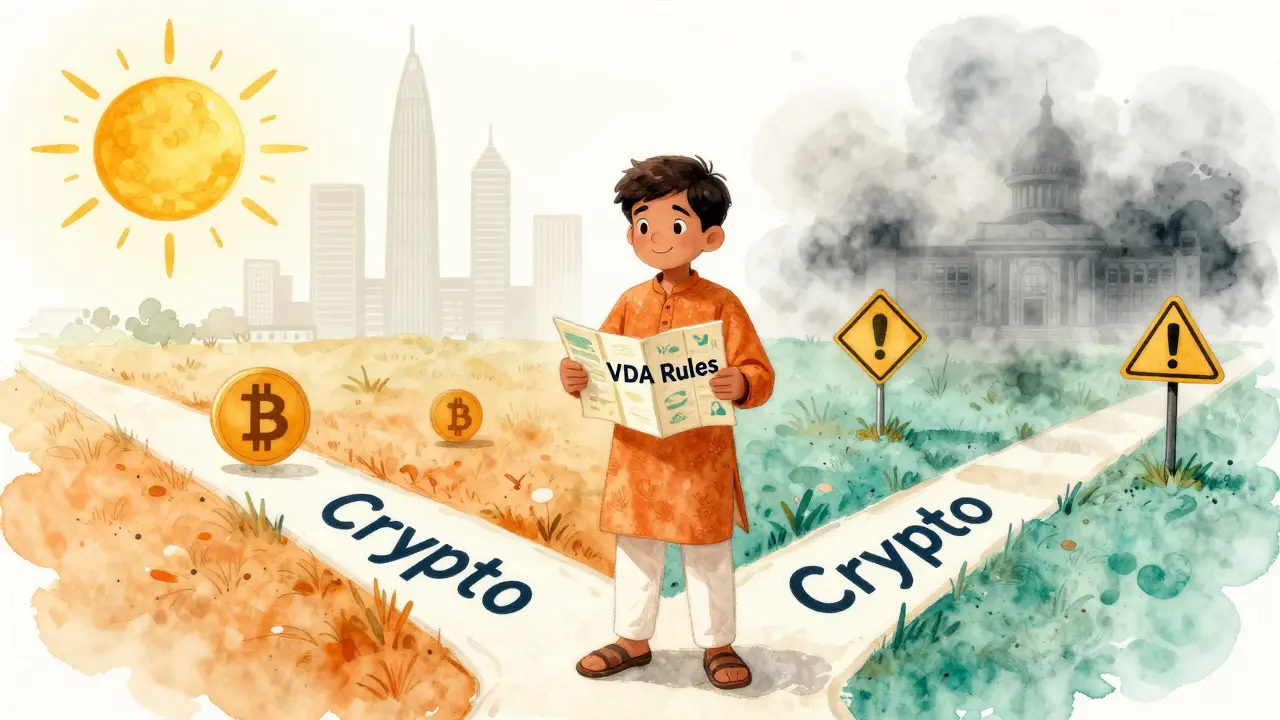
Is it safe to buy Bitcoin in India right now? The short answer is yes. But the long answer involves a maze of taxes, strict compliance rules, and shifting regulatory bodies that can turn a simple trade into a legal headache if you aren't careful. As of July 2026, cryptocurrencies are not banned in India, but they are certainly not treated like regular money. They exist in a gray zone where you can own them, trade them, and even pay for things with them (if someone accepts them), but the government views them with deep suspicion.
If you are an Indian citizen looking to navigate this space, understanding the term Virtual Digital Assets is crucial. This is the official legal term used by the Indian government instead of "cryptocurrency." Knowing the difference between what is technically allowed and what is practically difficult due to high taxes and banking restrictions is the key to staying compliant and profitable.
From Ban to Regulation: How We Got Here
To understand today's rules, you have to look at the wild ride India took between 2018 and 2020. Back in April 2018, the Reserve Bank of India (RBI) issued a circular that effectively banned all banks from dealing with cryptocurrency exchanges. This was known as the Crypto Prohibition. It didn't make owning Bitcoin illegal, but it made trading it nearly impossible because you couldn't deposit or withdraw fiat currency (Indian Rupees) through any bank account. Exchanges froze, users were stranded, and the market crashed.
The turning point came in March 2020. The Supreme Court of India struck down the RBI's ban in the landmark case Internet and Mobile Association of India v Reserve Bank of India. The court ruled that the RBI could not prohibit financial institutions from providing services to crypto businesses without sufficient justification. This decision restored banking access, allowing Indians to buy and sell crypto again. However, the RBI has never fully warmed up to private cryptocurrencies, maintaining a stance of caution regarding monetary stability and financial risks.
Who Regulates Crypto in India Now?
Regulation in India isn't handled by one single agency. Instead, it’s a multi-agency approach that can feel fragmented. Here is who holds the power:
- Ministry of Finance: Handles the taxation framework. They decided how much tax you pay on your gains.
- Financial Intelligence Unit-India (FIU-IND): Manages anti-money laundering (AML) compliance. Since March 2023, all crypto exchanges serving Indian users must register here.
- Securities and Exchange Board of India (SEBI): Started overseeing crypto tokens that look like securities on April 1, 2025. If a token acts like a stock, SEBI watches it.
- Reserve Bank of India: Keeps an eye on monetary policy. While they don't directly regulate every trade, their influence on banking relationships remains strong.
This structure means that while you can trade, you are being watched from multiple angles. The goal is to balance innovation with risk mitigation, though many traders argue it creates more complexity than clarity.

The Tax Burden: Why India Is One of the Most Expensive Places to Trade
This is the part that hurts most for active traders. India’s tax regime for Virtual Digital Assets is among the harshest in the world. Here is the breakdown as of mid-2026:
| Tax Type | Rate / Rule | Key Details |
|---|---|---|
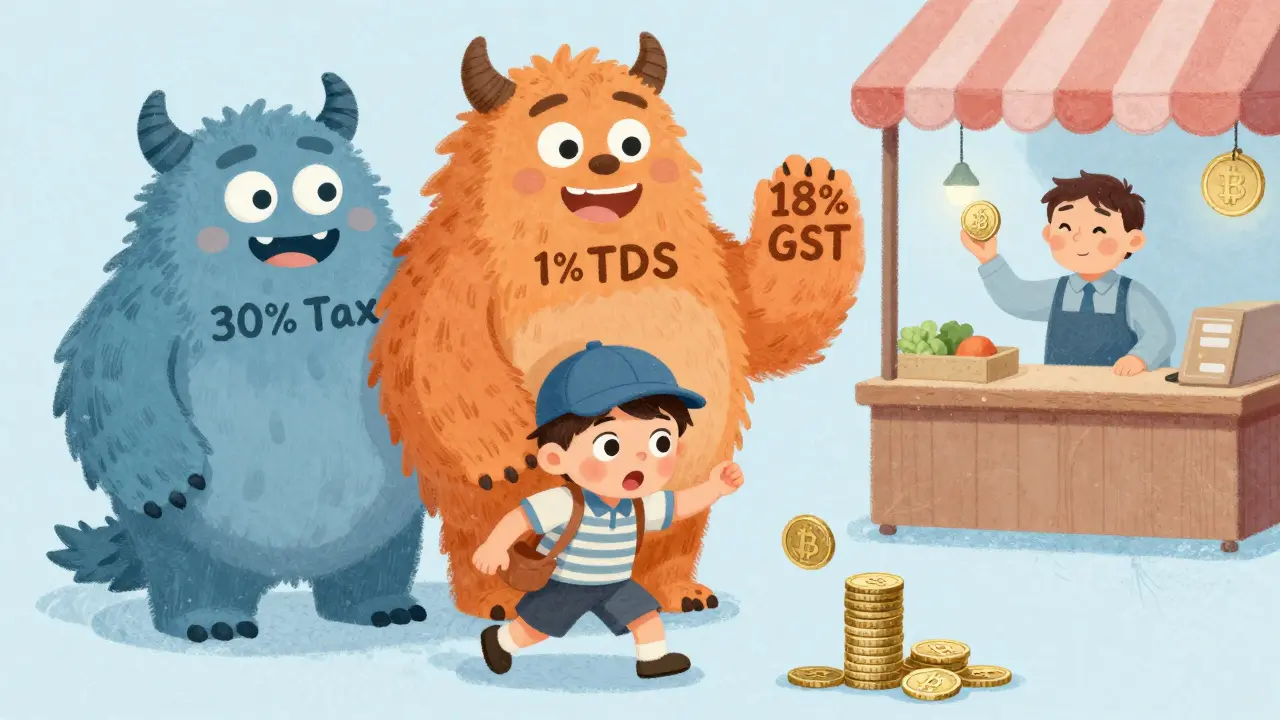
| Income Tax on Gains | 30% Flat | No deductions allowed except cost of acquisition. Applies regardless of holding period. |
| TDS (Tax Deducted at Source) | 1% | Deducted on transaction value above thresholds. Paid on turnover, not profit. |
| GST (Goods and Services Tax) | 18% | Applied on certain transfers and services since July 2025. Adds to effective tax rate. |
Let’s break down why this matters. If you make a profit of ₹100,000, you pay 30% income tax on that gain. You cannot offset losses from other crypto trades against these gains easily. On top of that, the 1% TDS is deducted from the total transaction value. If you are a high-frequency trader, this TDS can eat up your capital before you even realize a profit. With the addition of the 18% GST on specific activities introduced in 2025, the effective tax burden can exceed 49% in some scenarios. This has led many small traders to move toward decentralized exchanges (DEXs) or peer-to-peer (P2P) methods to avoid these costs, though such practices carry significant legal risks.
Can You Use Crypto as Money in India?
Here is a critical distinction: Owning crypto is legal. Using it as legal tender is not. In India, only the Indian Rupee (and the upcoming digital rupee issued by the RBI) is recognized as legal tender. This means a shopkeeper cannot be forced to accept Bitcoin for payment. If you try to pay for groceries with Ethereum, the merchant can legally refuse.
However, private contracts are different. If two parties agree to settle a debt or purchase using crypto, it is generally permissible. But remember, these transactions are taxable events. Every time you swap one crypto for another, or use crypto to buy goods, the Income Tax Act treats it as a transfer, triggering potential tax liabilities. There is no "tax-free" way to spend your crypto holdings in daily life.
Compliance for Exchanges and Users
For exchanges operating in India, the bar has been raised significantly. Since March 2023, all Virtual Digital Asset Service Providers (VDASPs) must register with FIU-IND under the Prevention of Money Laundering Act. This requires robust Know Your Customer (KYC) protocols, transaction monitoring, and suspicious activity reporting.
For users, this means:
- Strict KYC: You will need to provide PAN cards, Aadhaar details, and often biometric verification to trade on regulated platforms.
- Record Keeping: You must maintain detailed records of all transactions for tax filing purposes. The tax authorities require specific accounting methods to calculate gains.
- TDS Reporting: Exchanges will deduct TDS automatically. You will see this reflected in your Form 26AS (tax credit statement).
International exchanges face a dilemma. Some have geo-blocked Indian users to avoid the hassle of Indian compliance, while others have invested heavily in local infrastructure to stay competitive. Always check if an exchange is registered with FIU-IND before depositing funds.
What’s Next for Crypto in India?
The regulatory landscape is still evolving. In June 2025, the government announced plans for a discussion paper to create a formal regulatory framework, but as of July 2026, comprehensive legislation is still pending. Meanwhile, India is preparing for a Financial Stability Board (FSB) peer review, aiming to align its rules with global standards set by bodies like the FATF.
Experts predict a bifurcated future. Tokens that resemble securities will fall under SEBI’s strict oversight, while utility tokens may remain under the broader VDA framework. The launch of the digital rupee (CBDC) by the RBI might also influence policy, as the central bank seeks to promote its own digital currency while limiting competition from private stablecoins.
For now, the message is clear: Crypto is legal, but it is expensive and heavily monitored. Stay informed, keep meticulous records, and consult a tax professional before making large moves.
Is buying Bitcoin illegal in India?
No, buying and holding Bitcoin is legal in India. The Supreme Court overturned the RBI's ban in 2020. However, you must comply with tax laws and KYC regulations when trading through registered exchanges.
Do I have to pay tax on crypto gifts in India?
Yes. Under Indian law, transferring VDAs, including gifting them, is considered a taxable event. The recipient may be liable for income tax on the fair market value of the assets received, depending on the relationship and value thresholds defined in the Income Tax Act.
Which crypto exchanges are legal in India?
Exchanges that are registered with the Financial Intelligence Unit-India (FIU-IND) are compliant with current anti-money laundering laws. Look for exchanges that display their FIU registration number. Unregistered international platforms may block Indian users or pose higher security risks.
Can I use crypto to pay for online shopping in India?
Technically yes, if the merchant accepts it, but it is not legal tender. Most major Indian e-commerce platforms do not accept crypto directly. You would typically need to use a third-party payment processor, which may involve additional fees and tax implications.
Will India ban crypto mining?
There is no explicit ban on crypto mining in India as of July 2026. However, miners face high electricity costs and regulatory scrutiny regarding energy consumption. Future regulations may impose stricter environmental or operational guidelines on mining activities.
Hamza k
holy shit this tax structure is absolutely brutal for anyone trying to actually trade. its like they want you to just give up and go back to gold or something. the 30% flat rate plus tds is a death sentence for active strategies.
Brad Semp
It is quite amusing how the masses continue to flock to these digital fiascos despite the regulatory hammer swinging ever closer. The notion that one can simply 'own' value in a vacuum, devoid of state backing or intrinsic utility, is a testament to the collective delusion of our times. One must question the intellectual rigor of those who ignore such glaring economic realities.
Korn Arrieta
The article fails to address the sheer incompetence of the regulatory bodies involved. It is not about balancing innovation; it is about extracting maximum revenue from a panicked populace while pretending to protect them. The fragmentation between SEBI, RBI, and FIU-IND is not a feature; it is a bug designed to confuse and ensnare.
Furthermore, the claim that P2P methods carry 'significant legal risks' is disingenuous. The real risk is the government seizing assets without due process under vague AML pretexts. Users are being treated as suspects by default, which is a fundamental violation of civil liberties. The tax burden exceeds 49% in some scenarios because the system is predatory by design.
Those advocating for compliance are essentially volunteering for their own financial strangulation. The decentralized exchanges mentioned are not a loophole; they are the only rational response to an oppressive framework. To suggest otherwise is to ignore the historical precedent of governments crushing private currency initiatives.
The Supreme Court ruling in 2020 was a temporary reprieve, not a victory. The current multi-agency approach ensures that no single entity can be held accountable for the chaos. This ambiguity allows regulators to shift goalposts at will. Traders who believe they are 'staying compliant' are merely delaying the inevitable audit.
The introduction of GST on specific activities since 2025 is particularly egregious, adding layers of bureaucracy that serve no purpose other than to increase administrative overhead. This is not regulation; it is extortion wrapped in legal jargon. The so-called 'gray zone' is actually a black hole where capital goes to die.
Anyone reading this should understand that the government does not care about your profitability. They care about control. The distinction between owning and using crypto as money is irrelevant when the act of holding it triggers taxable events upon transfer. There is no safe harbor here.
The mention of the digital ruede (CBDC) is a clear signal of the endgame: total surveillance of transactions. Private stablecoins are threatened not because of monetary stability concerns, but because they offer an alternative to state-controlled finance. This is a war on privacy, and the taxes are just the ammunition.
Do not be fooled by the polite language of 'compliance' and 'record keeping.' These are tools of oppression. The best strategy is not to consult a tax professional, but to remove yourself from the jurisdiction entirely if possible. For those stuck, minimize exposure and avoid centralized platforms at all costs.
The future predicted by experts is likely a complete ban disguised as 'strict oversight.' History shows that states do not tolerate competition for their monopoly on money. India is following the same path as China, albeit with more bureaucratic delay. Prepare accordingly.
Natalie Lucas
omg korn u r so intense lol but like yeah the taxes r crazy high. i feel like im gonna cry every time i check my portfolio. why is it so hard to just buy bitcoin??
Curtis Johnson
i hear ya natalie. it really is a lot to take in. maybe we should just focus on the long term hold aspect? seems less stressful than trading back and forth with all these deductions eating into gains. peace out everyone lets stay chill
Steven Briggs
just keep records. simple as that. dont overthink it.
Kat Barr
hey steven!! u r right but it feels overwhelming sometimes 😩✨ but hey we got this! 💪💖 just remember to breathe and maybe talk to a friend about it. ur not alone in this journey! 🌈🚀
Jackie D
wait so if i gift crypto to my sister do i still have to pay tax on it? that sounds kinda harsh doesn't it? i mean like family gifts are usually exempt from everything else. why is crypto different?
Ruth Williams
One would assume that basic knowledge of fiscal law is a prerequisite for participating in such speculative ventures. The recipient is liable for income tax on the fair market value. It is elementary. Perhaps educating oneself before engaging in complex financial instruments would prevent such naive inquiries. The law makes no exceptions for familial affection in the context of Virtual Digital Assets.
Kristy Morrow
nah ruth ur too uptight. its not about education its about the system being rigged. why should gifting be taxed? its absurd. typical gov greed. whatever tho
John Harman
listen up folks the guy who wrote this post knows his stuff but he missed one key thing. the banks are still sketchy. even if its legal the moment u try to withdraw large amounts they flag u. its called 'enhanced due diligence' but its basically a soft ban. i learned this the hard way last year. so yeah legal status is one thing practical access is another. dont trust the exchanges blindly.
Antony Lopez
typical indian bureaucracy. always finding new ways to squeeze the citizens. first they ban it then they allow it but make it expensive. its a trap. american freedom looks better every day. why are we even discussing this mess? just move to usa if u want to trade freely.
Kim Kay
i think antony is a bit harsh there. not everyone can just move countries. its complicated. but john is right about the banks being tricky. i had issues with my account getting frozen for no reason. scary stuff.
Sophie Nakasako
this brings up an interesting philosophical point about sovereignty vs individual liberty. the state claims authority over money but individuals seek autonomy through decentralization. its a clash of worldviews. what do you all think is the root cause of this tension? is it fear of losing control or genuine concern for stability?