
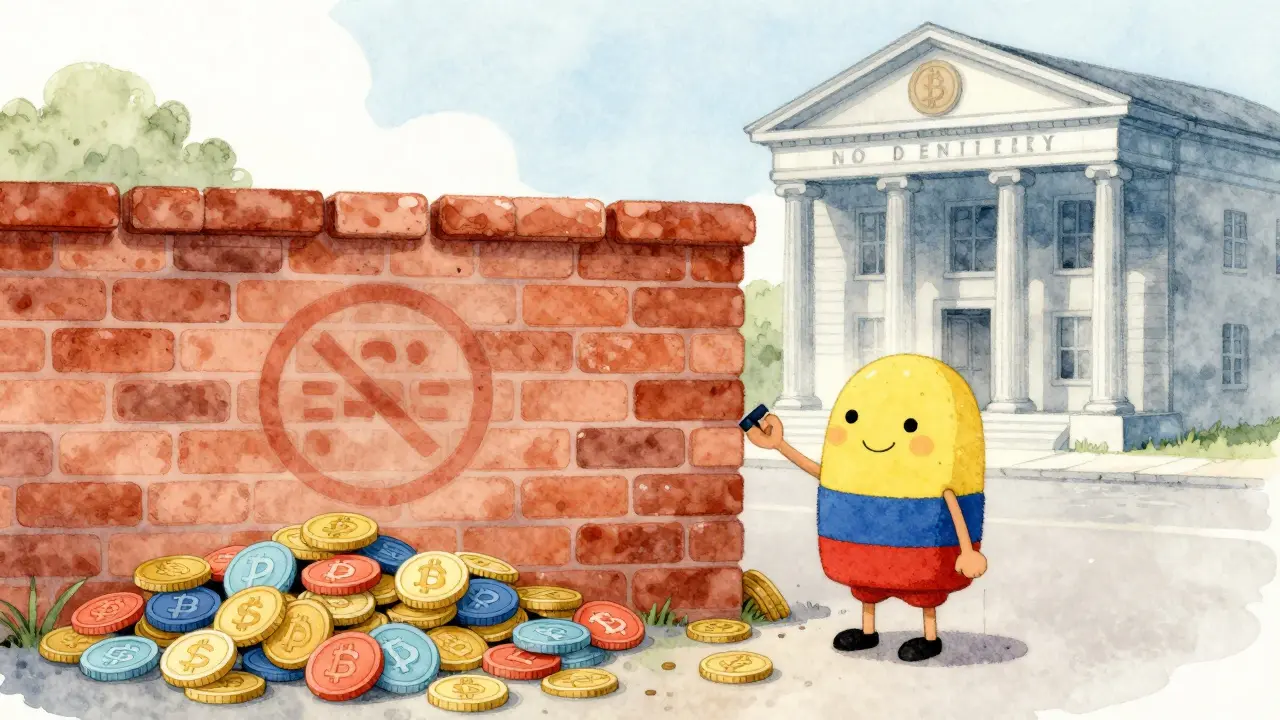
You can own Bitcoin in Colombia. You can trade it. But if you try to move that money through a standard bank account, you will hit a wall. This is the reality for millions of Colombians navigating a financial system where digital assets exist in a legal gray area while traditional banks face strict prohibitions on handling them. The Financial Superintendency of Colombia (SFC) has effectively cut off the bridge between your crypto wallet and your local bank account.
This isn't just a minor inconvenience; it's a structural barrier designed to protect the national currency and prevent money laundering. For years, this ban created frustration for users who couldn't easily convert their gains into pesos. However, the landscape shifted significantly in recent years. Major players like Bancolombia have found ways to operate within these rules by launching dedicated platforms like Wenia. Understanding how this ban works, what is actually prohibited, and how institutions are adapting is crucial for anyone involved in the Colombian crypto market.
The Core of the Ban: What Banks Cannot Do
To understand the restriction, you need to look at the specific directives issued by the SFC. The regulator doesn't ban individuals from holding crypto. Instead, it bans supervised financial institutions from touching it. This means banks, investment funds, and pension managers cannot hold custody of cryptocurrencies, invest in them, or facilitate transactions involving them.
If you walk into a branch of Davivienda or Banco de Bogotá and ask to buy Ethereum with your savings account balance, they will say no. Their platforms are explicitly barred from processing these transfers. The SFC views cryptoassets as high-risk instruments that could threaten financial stability or be used for illicit activities. By keeping banks out of the loop, the regulator aims to contain any potential fallout from crypto market volatility away from the core banking system.
This prohibition covers the entire spectrum of traditional banking services. It’s not just about buying and selling. Banks cannot offer insurance products backed by crypto, nor can they provide loans secured by digital assets. The separation is absolute. Your fiat money stays in the regulated banking system, and your crypto stays in the unregulated (or differently regulated) digital space. There is no direct pipe connecting the two under current SFC rules.
How Fintechs and PSPs Navigate the Gray Area
If banks are blocked, how does money move? The answer lies in Payment Service Providers (PSPs) and fintech companies. These entities operate under different regulatory pressures than traditional banks, though they are still heavily scrutinized. They act as the intermediaries that allow Colombians to enter and exit the crypto market.
The key mechanism here is compliance. PSPs must submit suspicious transaction reports to the Financial Information and Analysis Unit (UIAF) for all crypto transactions exceeding USD 150. This threshold is low enough to catch significant movement but high enough to filter out tiny micro-transactions. When you use a platform like Bitso or LocalBitcoins in Colombia, you are interacting with a PSP that has built robust systems to capture full sender and recipient data.
| Entity Type | Regulatory Body | Crypto Activity Allowed? | Key Restriction |
|---|---|---|---|
| Traditional Banks | SFC | No | Cannot hold, invest, or facilitate crypto transactions. |
| Fintechs / PSPs | UIAF / Superintendency of Companies | Yes (with conditions) | Mandatory reporting for transactions >$150; strict KYC/AML. |
| Stablecoin Issuers | SFC (via Sandbox) | Limited | Must participate in regulatory sandbox programs. |
The cost of non-compliance is steep. In recent years, some PSPs faced fines topping USD 1.5 million for failing to meet these reporting standards. This has led to a rise in RegTech adoption, where companies use software to automate audit trails and speed up customer onboarding while ensuring every transaction meets UIAF requirements. For the user, this means stricter Know Your Customer (KYC) processes. You can’t just buy crypto anonymously anymore. Your identity is verified, and your transactions are monitored in real-time.

The Bancolombia Exception: Wenia and COPW
So, how did Bancolombia, the largest bank in the country, launch a crypto exchange called Wenia? And what about the COPW stablecoin? This seems to contradict the ban, but it’s actually a clever navigation of the rules.
Bancolombia didn’t integrate crypto directly into its core banking platform. Instead, it launched Wenia as a separate entity or service line that adheres strictly to the PSP and VASP (Virtual Asset Service Provider) regulations. By doing so, they bypassed the SFC’s direct prohibition on *banking* operations while still offering crypto services to their massive customer base. The key is segregation. The crypto activity is ring-fenced from the traditional deposit-taking functions of the bank.
The introduction of COPW, a peso-pegged stablecoin, further illustrates this strategy. Stablecoins reduce volatility risk, making them more palatable to regulators. Bancolombia’s involvement signals institutional support for crypto, provided it is done within a controlled, compliant framework. This model suggests that future growth in Colombian crypto won’t come from banks breaking the rules, but from creating parallel structures that respect them.
Regional Context: How Colombia Compares to Neighbors
Colombia’s approach is unique in Latin America. While it maintains banking restrictions, it hasn’t imposed an outright ban on trading. This places it in the middle ground compared to its neighbors. Let’s look at how other major economies in the region are handling crypto in 2026.
- Brazil: Became the first Latin American country to pass comprehensive crypto tax legislation in 2024. As of January 2025, clear tax rules apply, providing certainty for investors.
- Argentina: Recognized Bitcoin as a legal means of payment for international trade transactions in 2025, focusing on cross-border utility rather than domestic speculation.
- Chile: Took a more permissive route. The Financial Markets Commission approved three digital asset custodians in early 2025, allowing for regulated custody services without banning banks entirely.
- Mexico: Expanded its Fintech Law in 2024 to include crypto asset management and custody services, integrating digital assets into the broader financial ecosystem.
- Peru: Launched a pilot program for government bond issuance via blockchain in 2025, exploring public sector use cases.
In contrast, Colombia remains cautious. The SFC’s stance is driven by a desire to maintain the autonomy of the Central Bank and ensure that the peso remains the sole source of primary issuance. Minister of Finance Ricardo Bonilla acknowledged in 2023 that crypto is a reality, but emphasized that regulation must protect the Central Bank’s independence. This political and economic priority shapes the slow pace of regulatory change in Colombia compared to Brazil or Chile.

Tax Implications for Crypto Users
Navigating the banking ban is only half the battle. You also need to handle taxes correctly. In Colombia, digital assets are treated as intangible property. This classification has significant implications for how you report your earnings.
If you sell Bitcoin for a profit, that gain is subject to income tax. It falls under existing personal or corporate income frameworks. There is no special "crypto tax" rate yet, unlike in Brazil. This means your crypto profits are added to your other income sources and taxed according to the progressive tax brackets. For businesses, crypto holdings are part of the corporate tax base.
The challenge lies in documentation. Because banks don’t facilitate these transactions, proving the source of funds and calculating capital gains requires meticulous record-keeping. Exchanges and PSPs provide transaction histories, but you must reconcile these with your tax filings. Failure to report crypto income can lead to audits by the DIAN (National Tax and Customs Directorate), which has been increasing its focus on digital asset compliance.
Future Outlook: Will the Ban Lift?
The regulatory landscape is not static. The SFC’s regulatory sandbox, which allowed for testing new business models, expired in December 2023. This created uncertainty, but it also highlighted the need for updated guidelines. Industry experts anticipate that Colombia will move toward comprehensive regulation rather than maintaining the current patchwork of restrictions.
The development of the Bre-B payment platform offers a potential pathway for greater integration. If the Central Bank prohibits charges for Bre-B usage and creates incentives for widespread adoption, it could facilitate a smoother link between traditional finance and digital assets. Legal analysts suggest that implementing general standards for anti-money laundering (AML) and counter-terrorism financing (CTF) could pave the way for banks to re-enter the space cautiously.
However, any change will likely be gradual. The SFC prioritizes consumer protection and financial stability over rapid innovation. Expect to see more defined roles for Virtual Asset Service Providers (VASPs) and clearer guidelines for stablecoin issuers before traditional banks are allowed to touch crypto again. For now, the workaround remains using compliant fintech platforms, accepting the friction as the cost of operating in a cautious regulatory environment.
Is cryptocurrency illegal in Colombia?
No, owning and trading cryptocurrency is not illegal in Colombia. However, traditional banks are prohibited from facilitating these transactions. You must use specialized fintech platforms or exchanges that comply with UIAF reporting requirements.
Why can't I buy crypto directly from my Colombian bank?
The Financial Superintendency of Colombia (SFC) bans supervised financial institutions from holding, investing in, or facilitating crypto transactions. This is to mitigate risks related to money laundering and to protect the stability of the national banking system.
What is the $150 transaction rule for crypto in Colombia?
Payment Service Providers (PSPs) must report suspicious transactions to the UIAF for any crypto transfer exceeding USD 150. This includes capturing full sender and recipient data to ensure compliance with anti-money laundering laws.
How does Bancolombia offer crypto services if there is a ban?
Bancolombia operates through Wenia, a separate platform that complies with fintech and VASP regulations rather than traditional banking rules. This allows them to offer crypto services while keeping them segregated from core banking operations.
Do I pay taxes on crypto gains in Colombia?
Yes. Cryptocurrencies are treated as intangible assets. Profits from sales are subject to personal or corporate income tax under existing frameworks. You must report these gains to the DIAN along with your other income.
Will the banking ban on crypto be lifted soon?
There is no immediate timeline for lifting the ban. The SFC is focused on developing comprehensive regulations and AML standards. Changes are expected to be gradual, prioritizing financial stability and consumer protection over rapid liberalization.