

Buying Bitcoin or Ethereum in Taiwan feels simple enough until you sit down to file your taxes. You might wonder if the government even cares about your digital gains. The short answer is yes, but the long answer is messy. As of August 2026, Cryptocurrency taxation in Taiwan is governed by a patchwork of existing laws rather than a single, dedicated crypto tax code. This means you are navigating rules designed for traditional commodities and securities, applied to assets that exist only on blockchains.
If you trade frequently, run a business involving tokens, or simply hold investments that have appreciated, understanding these obligations is critical. The regulatory landscape has shifted significantly since 2014, moving from outright warnings to structured oversight under Anti-Money Laundering (AML) frameworks. However, confusion remains regarding Value Added Tax (VAT) applicability and how to calculate taxable income when purchase records are missing. Let’s break down what you actually owe, who collects it, and what changes are coming in the near future.
The Core Classification: Virtual Commodities
To understand the tax, you first need to understand how the government sees your asset. In Taiwan, cryptocurrencies are not legal tender. They are classified as virtual commodities. This classification matters because it dictates which tax laws apply. Unlike fiat currency, which is exempt from capital gains tax for individuals in many jurisdictions, virtual commodities fall under broader commercial and income tax regulations.
This status was cemented early on. Back in 2014, the Financial Supervisory Commission (FSC) issued warnings about Bitcoin’s volatility and banned financial institutions from processing Bitcoin transactions at ATMs. For years, this created a gray area where traders operated without clear guidance. Today, while the stigma has lessened, the legal definition remains rigid. Your crypto is treated similarly to trading goods or stocks, subject to specific reporting requirements depending on whether you are an individual or a business entity.
Value Added Tax (VAT): The 5% Rule
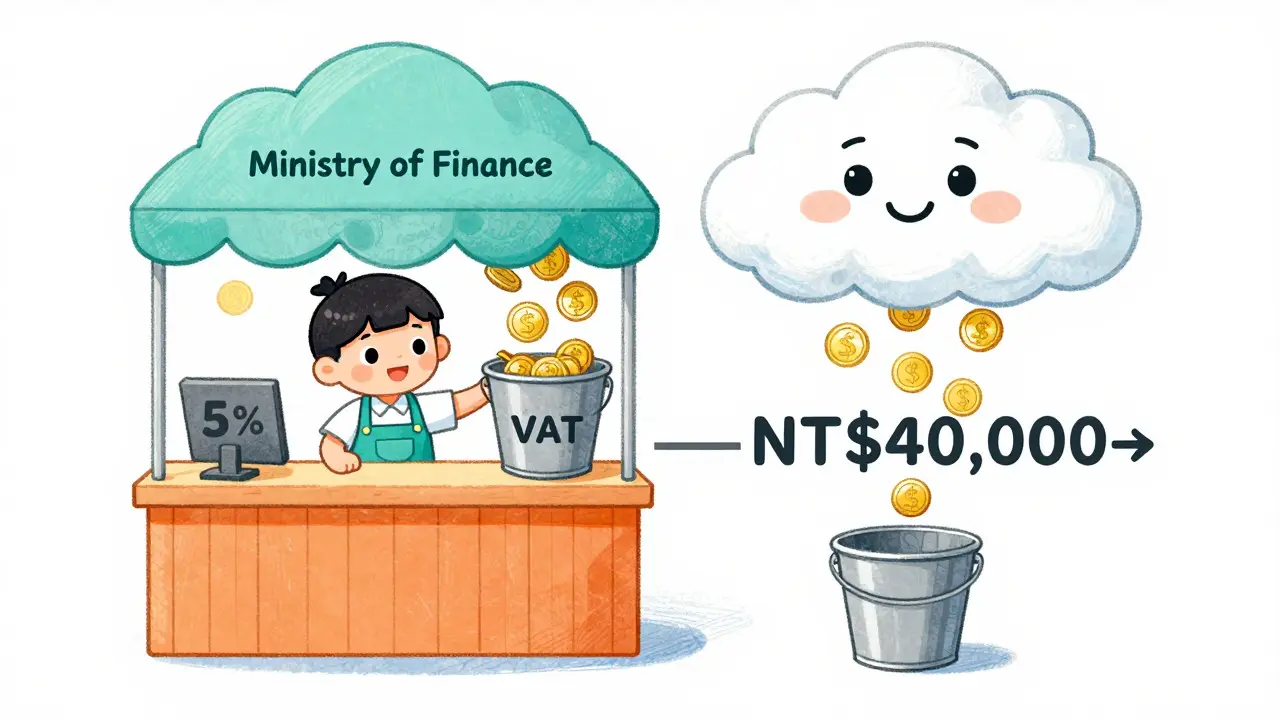
One of the most confusing aspects of Taiwanese crypto tax is the Business Tax, commonly known as Value Added Tax (VAT). There is conflicting information online, with some sources claiming no VAT applies because crypto isn’t money. However, the prevailing interpretation by the Ministry of Finance (MOF) treats cryptocurrency trading as a service or commodity transaction, triggering VAT obligations.
Here is how the 5% VAT rate breaks down based on your status:
- Taiwanese Businesses: If you operate a business selling crypto, you must charge and remit 5% VAT on all revenue generated from these transactions.
- Taiwanese Individuals: If you trade regularly, you may need to register for tax purposes. You pay 5% VAT on your revenue unless your monthly sales stay below NT$40,000 (approx. US$1,300). This de minimis threshold offers a safe harbor for casual traders.
- Foreign Entities: If a foreign exchange has a fixed place of business in Taiwan, they pay the 5% VAT. If they do not have a local presence, the obligation shifts. If they sell to Taiwanese businesses, the buyer handles the tax. If they sell to Taiwanese individuals, the foreign seller must register and pay VAT, again subject to the NT$40,000 monthly exemption.
The key takeaway here is volume. If you are a high-volume trader, the VAT liability can eat into profits significantly. Ensure you are tracking your gross revenue, not just net profit, for VAT calculations.
Income Tax: Calculating Gains and Losses
Beyond VAT, you face income tax on your profits. Since there is no specific "crypto capital gains" category, these gains are typically folded into your comprehensive income tax return. The effective rate varies based on your total income bracket, but traders often see rates hovering around 20% or higher for significant gains.
The biggest headache? Documentation. To calculate your taxable income, you need to prove your cost basis-the price you paid for the asset. In the early days of crypto, many Taiwanese users bought coins via peer-to-peer transfers or obscure platforms that didn’t issue proper receipts. Without proof of purchase, the tax authority may assume your entire sale amount is profit, leading to massive tax bills.
| Trader Type | VAT Obligation | Income Tax Basis | Key Challenge |
|---|---|---|---|
| Casual Individual | Exempt if < NT$40k/month | Added to annual income | Proving cost basis for old holdings |
| Active Trader/Business | 5% on all revenue | Business income tax rates | Maintaining detailed audit trails |
| Foreign Exchange | Varies by buyer type | N/A (Corporate) | Compliance with AML registration |
Keep every receipt, screenshot, and blockchain transaction hash. If you traded on platforms like BitoPro, MaiCoin, or Binance, download your full transaction history annually. These platforms now comply with stricter reporting standards, making it easier for authorities to cross-check your declarations.
Regulatory Evolution: From Gray Area to Compliance
The regulatory environment has tightened considerably. The FSC now requires Virtual Asset Service Providers (VASPs) to register and adhere to strict Anti-Money Laundering (AML) rules. This shift aligns Taiwan with global standards set by the Financial Action Task Force (FATF).
In July 2024, new measures solidified the requirement for VASPs to complete AML registration before operating. This means the exchanges you use are no longer anonymous havens. They are required to implement real-name verification. For taxpayers, this is double-edged. On one hand, it increases security and legitimacy. On the other, it makes hiding income much harder. The MOF has indicated that once full real-name verification is adopted across all major platforms, more specific tax reporting obligations will likely be introduced.
Additionally, certain digital assets are being reclassified. Tokens that exhibit characteristics of securities are now subject to the Securities and Exchange Act (SEA). This means if you invest in Initial Coin Offerings (ICOs) that qualify as securities, you face even stricter disclosure and reporting requirements than standard spot trading.

Legal Ambiguities and Court Precedents
Despite these advancements, legal uncertainty persists. Recent court cases have highlighted the tension between traditional banking laws and modern crypto practices. For instance, the Banking Act prohibits unauthorized deposit-taking. Some businesses have been prosecuted for accepting crypto payments, arguing they were acting as banks.
However, a notable Taiwan High Court decision ruled that Bitcoin does not constitute "payments" or "funds" under the Banking Act, effectively excluding it from those specific deposit-taking provisions. This ruling provides some relief for merchants and traders, clarifying that holding or trading crypto doesn’t automatically make you an illegal bank. Yet, fraud and AML violations remain heavily penalized. Always ensure your trading activity is transparent and documented to avoid any association with illicit finance.
What’s Next: The 2026 Outlook
Looking ahead, the framework is expected to become more defined. In November 2024, the Ministry of Finance pledged to review regulations on taxing cryptocurrency gains, citing the surge in digital asset prices and the need for clearer guidelines. This review is likely to result in:
- Standardized Reporting Forms: Expect new tax forms specifically for virtual asset transactions, simplifying the process for both taxpayers and auditors.
- Real-Time Data Sharing: Enhanced integration between VASPs and tax authorities, allowing for automated verification of trades and holdings.
- Clarification on Staking and Yield: Current rules are vague on passive income from staking or lending. Future regulations will likely classify these as taxable interest or dividend income.
For now, treat your crypto activities with the same rigor as traditional stock trading. Maintain separate accounts for trading versus holding, keep meticulous records, and consult with a tax professional familiar with digital assets. The days of flying under the radar are ending, and compliance is the best strategy for long-term success in Taiwan’s evolving crypto market.
Is cryptocurrency considered legal tender in Taiwan?
No. Cryptocurrencies are classified as "virtual commodities" rather than legal tender. This means they are not backed by the government and are subject to commodity and service tax regulations rather than currency laws.
Do I need to pay VAT on my crypto trading profits?
Yes, potentially. If you are a business or an individual with monthly sales exceeding NT$40,000, you must pay a 5% Value Added Tax (VAT) on your trading revenue. Casual traders below this threshold are generally exempt.
How is income tax calculated for crypto gains?
Crypto gains are added to your comprehensive annual income. The tax rate depends on your total income bracket, often resulting in an effective rate of around 20% or higher. You must subtract your verified cost basis from your sale proceeds to determine the taxable gain.
What happens if I lose my purchase records?
If you cannot provide documentation for your initial purchase cost, tax authorities may assume the entire sale amount is profit. This can lead to significantly higher tax liabilities. It is crucial to maintain detailed records from exchanges like BitoPro or Binance.
Are foreign exchanges taxed differently in Taiwan?
Yes. Foreign entities without a fixed place of business in Taiwan have different VAT obligations. If they sell to Taiwanese individuals, they must register and pay VAT unless sales are under NT$40,000 per month. Sales to Taiwanese businesses shift the tax burden to the buyer.
Will new crypto tax laws be introduced soon?
Likely. The Ministry of Finance pledged in late 2024 to review and update regulations as real-name verification becomes standard. Expect more specific reporting requirements and potential standardization of tax forms for virtual assets in the near future.