
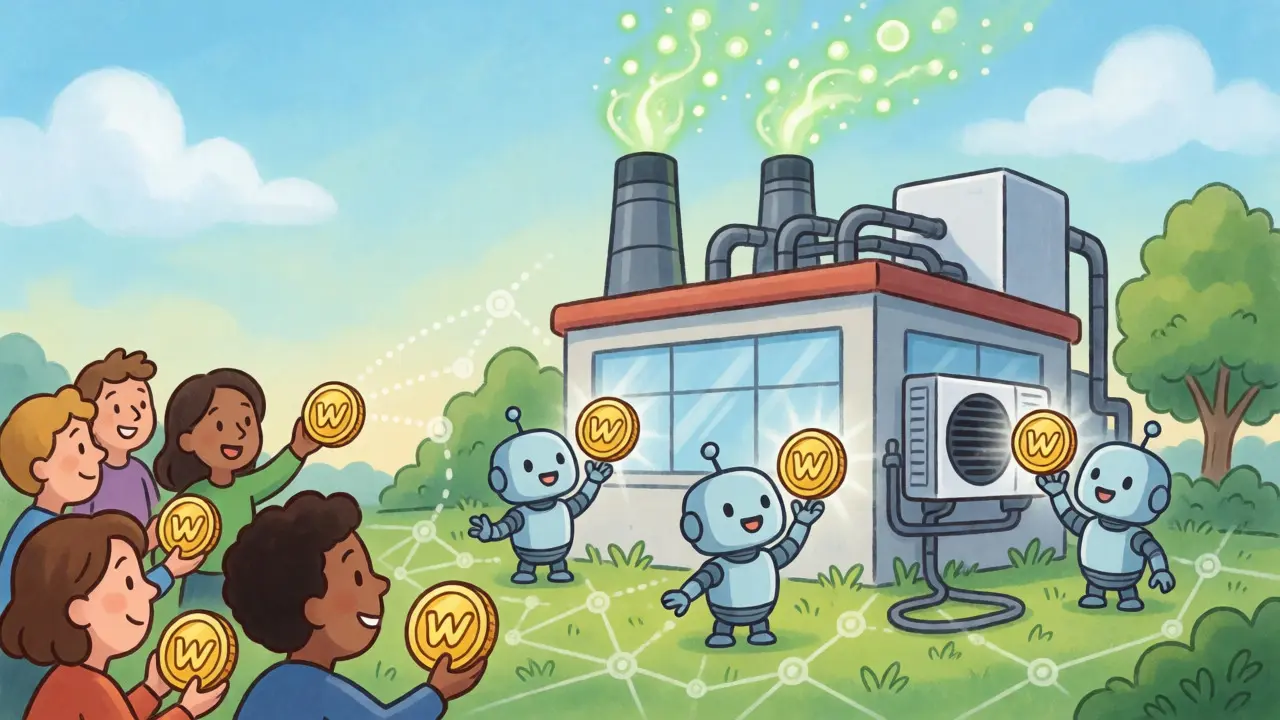
You probably know Steve Wozniak as the co-founder of Apple. But in late 2020, he put his name behind a different kind of venture: Efforce, a blockchain platform designed to let anyone invest in global energy efficiency projects via its native token, WOZX. The pitch was simple and ambitious. Companies need money to upgrade their facilities to save energy. Banks are often too slow or strict. Efforce promised to bridge this gap by letting everyday crypto holders fund these upgrades in exchange for a share of the actual savings.
But what actually happened? Did the technology deliver on the hype? If you are looking at WOZX today, you are likely seeing a price far removed from its launch highs. This guide breaks down exactly how Efforce works, why it launched with such fanfare, where it stands in 2026, and whether the "Woz effect" still holds any weight in the current market.
The Core Concept: Tokenizing Energy Savings
At its heart, Efforce is not just another meme coin or payment token. It attempts to solve a specific financial bottleneck in the climate tech sector. Traditional energy efficiency projects-like installing LED lighting in a factory or upgrading HVAC systems in an office building-require upfront capital. The return on investment comes later, through reduced electricity bills. Many companies hesitate to make this leap because they lack immediate cash flow or prefer to spend capital elsewhere.
Efforce introduced a model called "reward-based crowdfunding." Here is the workflow:
- Project Identification: An Energy Service Company (ESCO) identifies a facility that can reduce its energy consumption.
- Evaluation: Efforce evaluates the project’s potential savings and structures a contract.
- Funding: The project is listed on the Efforce platform. Investors buy WOZX tokens to fund the initial costs.
- Reward Distribution: As the facility saves energy, smart contracts distribute WOZX tokens back to investors based on the measured savings.
This mechanism relies heavily on trust and data accuracy. The platform claims to use blockchain to verify these savings transparently, removing intermediaries like banks. By tying the token’s value directly to real-world energy reduction, Efforce aimed to create a utility-driven asset rather than a purely speculative one.
The Wozniak Factor and Launch Hype
When Efforce launched in December 2020, the market reaction was explosive. Why? Because Steve Wozniak wasn't just an advisor; he was presented as the founder and public face of the venture. For many retail investors, seeing a legend from the personal computer revolution endorse a green-tech crypto was irresistible.
The numbers reflected this excitement. Within days of listing on HBTC, the token’s market cap reportedly surged to nearly $950 million. The price spiked to over $3.60 per WOZX. This wasn't just growth; it was a frenzy. Early commentators noted that the valuation seemed disconnected from the actual number of funded projects. Critics on Reddit and crypto forums quickly labeled it a "celebrity-backed bubble," warning that without a robust portfolio of completed projects, the price was built on hope rather than hardware.
Did the hype sustain itself? Not really. By the end of 2020, the price had retraced significantly. The initial surge demonstrated the power of celebrity endorsement in crypto marketing, but it also highlighted the fragility of assets lacking deep fundamental traction.

Technical Architecture and Tokenomics
Technically, Efforce operates on the Ethereum blockchain. WOZX is an ERC-20 standard token, meaning it integrates seamlessly with most Ethereum wallets and decentralized exchanges (DEXs). The platform uses smart contracts to automate the settlement of rewards. When a project reports energy savings, the code executes the distribution of tokens to contributors.
However, the tokenomics have been a source of confusion for years. Early documentation suggested a fixed supply of 100 million tokens. Yet, major data aggregators like Coinbase and Gate.com report a total supply closer to 1 billion tokens. This discrepancy matters. A higher circulating supply dilutes individual token value if demand doesn't grow proportionally.
| Metric | Launch Period (Dec 2020) | Current Status (Mid-2026) |
|---|---|---|
| Price Per WOZX | $3.60 - $3.66 | $0.0015 - $0.0019 |
| Market Cap | ~$950 Million | ~$1.15 Million |
| Total Supply | Reported as 100M (Fixed) | Reported as ~1B (Variable/Circulating) |
| Primary Narrative | Celebrity-backed Green Revolution | Niche Micro-cap / Legacy Project |
Vesting schedules also played a role. Community discussions revealed that team tokens were locked for up to 20 years, while private sale tokens vested over 1 to 3 years. This long-term lockup was intended to align incentives, ensuring the team stayed committed. However, in a micro-cap environment, even small sell-offs from vesting cliffs can crash the price due to thin liquidity.
Real-World Adoption: Where Are the Projects?
The biggest question for any utility token is: "Is it being used?" Efforce positioned itself as a marketplace for ESCOs. Ideally, we would see case studies: "Factory X saved 20% on energy, and investors earned Y% returns."
As of 2026, finding granular, independent verification of large-scale deployments remains difficult. While the platform is technically operational, mainstream media coverage has shifted away from project milestones toward price tracking. There are no widely reported partnerships with Fortune 500 companies or major government initiatives. This lack of visible adoption suggests that while the concept is sound, the execution has struggled to scale beyond early pilots.
For investors, this creates a risk. Without a steady stream of new projects requiring funding, the demand side of the token economy weakens. If fewer companies list projects, fewer people buy WOZX to fund them. This feedback loop can lead to stagnation, which seems to be the current reality for Efforce.

Investment Risks and Market Position
If you are considering buying WOZX today, you are entering a high-risk, low-liquidity zone. The token trades in the bottom tier of cryptocurrency rankings, often below rank 2,500. Daily trading volumes can be as low as a few hundred dollars. This means selling a significant position could move the price dramatically against you.
Key risks include:
- Liquidity Risk: Thin order books make it hard to exit positions without slippage.
- Adoption Gap: Limited evidence of mass-market corporate usage.
- Competition: Other climate-tech blockchains and traditional green bonds compete for the same investor capital.
- Regulatory Uncertainty: Like all ERC-20 tokens, it faces evolving regulatory scrutiny regarding securities status.
Despite these risks, some analysts argue that the fundamentals remain intact. The problem of financing energy efficiency is real and unsolved. If Efforce can secure a handful of high-profile corporate clients, the narrative could shift rapidly. But betting on a turnaround requires patience and a tolerance for volatility.
How to Buy and Store WOZX
Getting into Efforce is straightforward for those familiar with DeFi. Since it is an ERC-20 token, you do not need a specialized account. You can acquire WOZX through centralized exchanges that still list it, such as Gate.io, or via decentralized exchanges like Uniswap V2 using USDT or ETH pairs.
To store your tokens securely, use a wallet that supports Ethereum networks. Hardware wallets like Ledger or Trezor offer the best security for larger holdings. For smaller amounts, software wallets like MetaMask are convenient for interacting with the Efforce platform directly. Always verify the contract address before adding the token to your wallet to avoid scams.
Is Efforce (WOZX) a good investment in 2026?
It is considered a high-risk speculative asset. While the concept of tokenizing energy savings is innovative, the token has lost over 99% of its peak value. Its future depends on whether the platform can secure more corporate clients and increase trading volume. It is suitable only for investors who understand micro-cap risks.
Who founded Efforce?
Steve Wozniak, the co-founder of Apple, is the primary public figure and founder associated with Efforce. His involvement was the main driver behind the initial hype and market cap surge in late 2020.
How does WOZX generate value for investors?
Investors earn WOZX tokens as rewards when the energy efficiency projects they fund achieve measurable savings. The smart contracts automatically distribute these rewards based on the verified reduction in energy consumption.
What is the total supply of WOZX?
There is conflicting data. Early documents cited a fixed cap of 100 million tokens. However, current data aggregators report a total supply closer to 1 billion tokens, with a circulating supply around 500-600 million. Always check live data before investing.
Can I stake WOZX?
The platform allows users to commit WOZX to specific projects to earn rewards. This functions similarly to staking, where you lock up tokens to support a project and receive yield from the energy savings generated.