
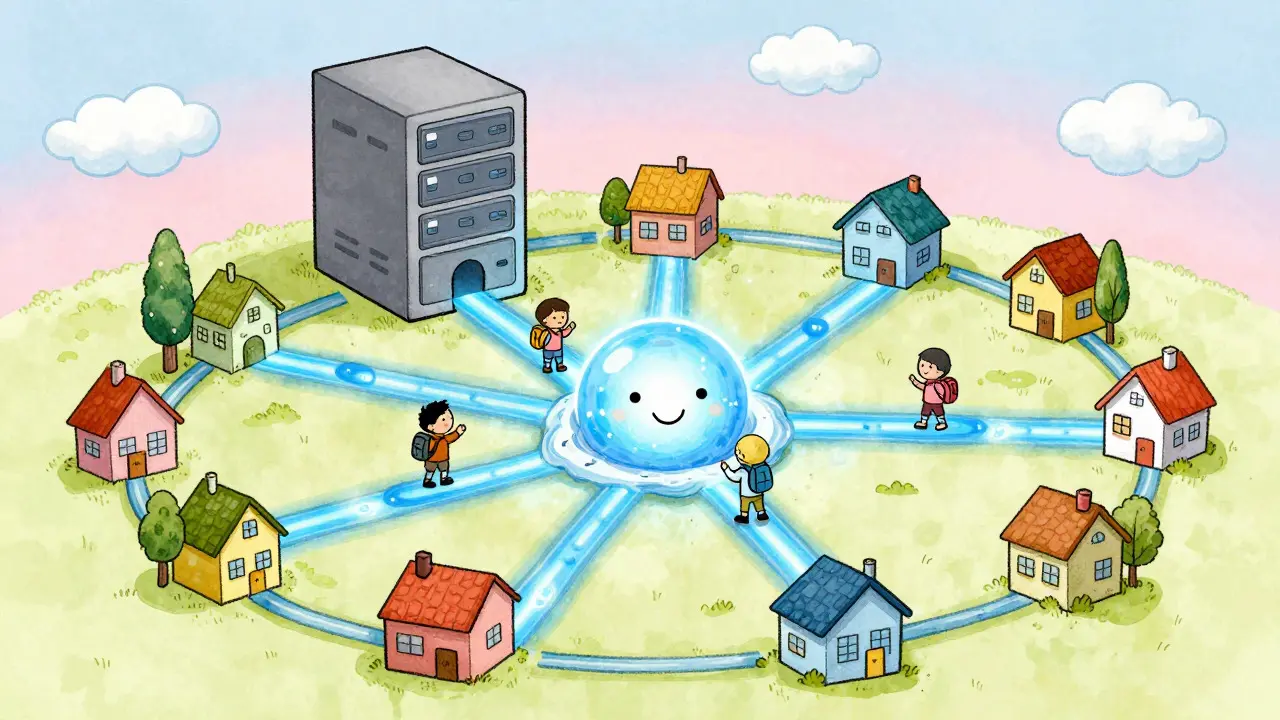
Imagine a world where the live video you watch or the financial data you trade isn't stored on a single company's server but flows through a decentralized web of users sharing bandwidth. That is the promise of Streamr, a project aiming to build a peer-to-peer infrastructure for real-time data. But what exactly is the DATA token, and why should you care about it in 2026?
If you are looking at your portfolio and wondering if this low-cap coin has any legs left after years of volatility, you are not alone. Streamr launched with massive hype in 2017, raised millions, and promised to revolutionize how we handle information. Today, it sits as a niche player in the Decentralized Physical Infrastructure Networks (DePIN) space. Let’s break down what Streamr actually does, how the DATA token works, and whether it still holds value for investors and developers alike.
The Core Concept: BitTorrent for Real-Time Data
To understand Streamr, you have to look past the buzzwords. At its heart, Streamr is an open-source, decentralized platform designed for continuous data streams. Think of it like BitTorrent, but instead of downloading static files like movies or software updates, you are streaming live information-video feeds, IoT sensor readings, or market data-in real time.
Streamr Network operates on a peer-to-peer (P2P) model. In traditional systems, if you want to stream live video, you pay a centralized provider like AWS or Azure for their servers. In Streamr’s world, independent node operators provide the bandwidth and computing power needed to relay that data. They get paid in DATA tokens. This removes the middleman, theoretically lowering costs and increasing censorship resistance.
The project relies on cryptography rather than trust. This means data integrity is verified mathematically, ensuring that the information arriving at your screen hasn’t been tampered with during transit. For Web3 applications that need reliable, secure, and scalable real-time communications, this architecture offers a compelling alternative to centralized intermediaries.
How the DATA Token Works: Utility and Governance
The DATA token is the lifeblood of the Streamr ecosystem. It is an ERC-20 token native to the Ethereum mainnet, but its utility extends far beyond just being a tradable asset. The token serves four distinct roles within the network:
- Governance: Holders can vote on protocol proposals, economic parameters, and reserve allocations. This gives the community direct control over the network’s evolution.
- Incentives: Node operators earn DATA tokens for contributing bandwidth and reliability to the network. These rewards flow from sponsorship budgets and inflationary issuance controlled by governance.
- Staking and Security: To operate nodes or delegate stake, participants must lock up DATA tokens. This mechanism aligns incentives; if an operator performs poorly, they risk losing their stake (slashing).
- Payments: DATA is used to pay for access to specific data streams on the Streamr Hub dApp. It separates the cost of data transport from the cost of the data content itself.
This multi-role design is ambitious. It attempts to create a self-sustaining economy where Sponsors (who fund data availability), Operators (who deliver the data), and Delegators (who provide capital) all benefit from a growing network. However, complexity can be a double-edged sword. Users need to understand staking mechanics on Polygon, bridging assets across chains, and assessing operator reliability before participating effectively.
Tokenomics and Supply Dynamics
When evaluating any crypto asset, supply dynamics are crucial. Streamr’s tokenomics have evolved since its launch, and there are some discrepancies in public data that warrant attention.
| Metric | Value / Status | Source Context |
|---|---|---|
| Circulating Supply | ~1.3 Billion DATA | Q4 2025 Transparency Report |
| Project Reserves | ~700 Million DATA | Includes unallocated funds subject to governance |
| Max Supply Estimates | ~2 Billion DATA | Inferred from circulating + reserves; varies by source |
| ICO Price (Oct 2017) | $0.0615 USD | Raised ~$27 million total |
| Current Price (July 2026) | ~$0.00048 USD | Significant drawdown from ATH |
The Q4 2025 transparency report indicates that while approximately 1.3 billion DATA tokens are in circulation, the project holds around 700 million in reserves. After accounting for specific governance reservations (SIP-23 and SIP-24), roughly 530 million DATA remains unallocated. This suggests a total effective supply closer to 2 billion tokens.
Be cautious of conflicting data online. Some aggregators list a max supply of only 143 million, which appears erroneous given the official reports and the sheer volume of tokens already in circulation. Analysts generally rely on the Streamr team’s own transparency reports, which point toward a multi-billion total supply structure. This large supply means that price appreciation requires significant demand growth to offset dilution from staking rewards and treasury sales.

Recent Developments: Live Video and AutoStaker
Streamr hasn’t been sitting idle. Recent developments highlight a shift toward practical, user-facing features. By late 2025, the network had extended support for live video streams through decentralized Operator nodes. This is a significant step because video requires high bandwidth and low latency, proving the network’s technical capabilities.
To make participation easier, Streamr introduced AutoStaker in Q3 2025. This tool automates the staking and reward distribution process for Operator nodes. Previously, running a node required technical know-how and manual management. AutoStaker lowers the barrier to entry, allowing technically literate users to become productive nodes with less overhead. This automation is critical for scaling the network and ensuring consistent data delivery.
Additionally, the project continues to expand its multichain presence. While DATA is issued on Ethereum, it can be bridged to Polygon, BNB Chain, and Gnosis Chain. Plans for further multichain support aim to increase accessibility and liquidity across different EVM-compatible networks.
Market Performance and Investment Reality
Let’s talk numbers. If you bought DATA at the ICO price of $0.0615 in October 2017, your investment has seen a rough ride. As of March 2026, the return on investment (ROI) relative to the ICO price was approximately -98.3%. The token hit an all-time high return of roughly 6x (+509%) at some point, implying a peak price near $0.37, but current trading levels tell a different story.
In July 2026, DATA traded around $0.00048 USD. Trading volumes are relatively low, often hovering between $3,500 and $5,100 per day on major venues like Uniswap V4. This indicates moderate liquidity but also suggests that the token is currently viewed as a speculative, small-cap asset rather than a mainstream blue-chip cryptocurrency.
Despite the price decline, Streamr maintains listings on more than 40 exchanges, showing a baseline level of adoption and accessibility. The continued listing on platforms like Coinbase and CoinGecko signals that the asset retains enough user interest to warrant coverage. However, investors should recognize that the market has moved on from the initial hype cycle. Success now depends on tangible adoption of the data marketplace and network usage, not just promises.

Streamr in the DePIN Landscape
Streamr is often categorized under the DePIN (Decentralized Physical Infrastructure Networks) narrative. Unlike projects that focus solely on storage (like Filecoin) or compute (like Render), Streamr specializes in real-time data transport. This niche positions it alongside tools like Apache Kafka but with a decentralized, token-incentivized twist.
Its competitors include oracle networks and data feed providers, but Streamr’s emphasis on P2P streaming and monetization tools sets it apart. The potential upside lies in the growing demand for decentralized data sources in Web3 applications, from gaming telemetry to financial market data. If developers choose Streamr over centralized APIs for these use cases, demand for DATA could rise organically.
However, challenges remain. Bootstrapping network participation is difficult. You need enough operators to ensure reliability and enough sponsors to fund the streams. The complex tokenomics, while innovative, require users to understand staking risks and delegation strategies. Compared to enterprise solutions, Streamr may lack the immediate ease of integration and dedicated support teams that large corporations expect.
Conclusion: Is Streamr Worth Your Attention?
Streamr represents a bold experiment in decentralizing real-time data infrastructure. Technically, it offers a robust, cryptographically secure alternative to centralized servers, with recent advancements in live video support and automated staking. The DATA token plays a vital role in governing and incentivizing this network.
From an investment perspective, however, caution is advised. The token has suffered a massive drawdown from its historical highs, and current liquidity is modest. It remains a speculative play on the broader DePIN trend. For developers and early adopters interested in building censorship-resistant data applications, Streamr provides unique tools. For passive investors, it requires a long-term horizon and a tolerance for volatility, as success hinges on widespread developer adoption and network usage growth.
What is the primary use case for the Streamr DATA token?
The DATA token is used for four main purposes: governance voting, rewarding node operators for bandwidth contribution, staking to secure the network, and paying for access to data streams on the Streamr Hub marketplace.
Is Streamr considered a DePIN project?
Yes, Streamr is widely classified as a Decentralized Physical Infrastructure Network (DePIN) project. It incentivizes individuals to contribute physical resources (bandwidth and computing power) to a decentralized network for real-time data transmission.
What is the maximum supply of DATA tokens?
Official transparency reports suggest an effective total supply close to 2 billion DATA tokens, comprising approximately 1.3 billion in circulation and 700 million in project reserves. Be wary of lower figures cited by some third-party aggregators, which appear outdated or incorrect.
How does Streamr differ from traditional data services like AWS?
Unlike AWS, which relies on centralized servers owned by one company, Streamr uses a peer-to-peer network of independent node operators. This decentralization aims to reduce costs, prevent single points of failure, and offer censorship resistance through cryptographic verification.
Can I stake DATA tokens without running a node?
Yes, through the delegation mechanism. Delegators can lock their DATA tokens to back specific Operators. They share in the staking rewards earned by those operators without needing to run the hardware themselves, though they also share in the slashing risks if the operator performs poorly.
What is the current price performance of DATA?
As of mid-2026, DATA trades at sub-cent levels (around $0.00048), representing a significant decline from its ICO price of $0.0615 and its all-time high. Trading volume remains modest, indicating it is currently a niche, speculative asset.
Marcia Albert
honestly this whole decentralized data thing feels like a vibe but i’m not sure if the tech is actually ready for prime time yet. it’s kinda cool that people can just share bandwidth and get paid in tokens, right? reminds me of old school p2p file sharing but with more crypto jargon thrown in. i guess we’ll see if it catches on or if it just fades away like so many other projects from 2017.
Emma Smith
the epistemological crisis inherent in trusting node operators without centralized oversight is profound... do we really believe in the moral compass of anonymous strangers to relay our financial data? the tokenomics suggest a meritocracy but human nature suggests otherwise. we are building castles on sand while ignoring the tidal waves of regulatory scrutiny looming overhead. it is a fascinating paradox of trust vs verification.
Ed Mitchell
IT IS A SCAM DESIGNED TO EXTRACT VALUE FROM THE PROLETARIAT WHILE THE ELITE PROFIT FROM THE ILUSION OF DECENTRALIZATION. THEY WANT YOU TO THINK YOU ARE PART OF A REVOLUTION BUT YOU ARE MERELY A BATTERY FOR THEIR DIGITAL MACHINE. THE GOVERNANCE TOKENS ARE A SHAM BECAUSE THE REAL DECISIONS ARE MADE IN BACKROOMS BY VENTURE CAPITALISTS WHO DO NOT CARE ABOUT YOUR DATA PRIVACY. WAKE UP SHEEPLE BEFORE IT IS TOO LATE AND YOUR ASSETS ARE SLASHED INTO OBLIVION.
Michael Mostyn
One must consider the philosophical implications of decentralizing real-time data streams. If truth is subjective, then perhaps the integrity of the data stream is also negotiable. The cryptographic verification offers a semblance of objectivity, yet it relies on the assumption that the underlying protocol is flawless. This raises questions about the nature of trust in digital ecosystems. Are we merely shifting the locus of control from corporations to algorithms?
Erica Johnson
actually you guys are missing the point entirely because the supply dynamics are what matter most here and everyone ignores the dilution factor which is huge. the max supply is closer to 2 billion not 143 million as some sites say so do your homework before buying. :)
Ken G
it is morally bankrupt to incentivize hoarding bandwidth when millions lack basic internet access. these elites talk about freedom but they only care about their own profits. the system is rigged against the little guy who just wants fair play. stop pretending this is about technology it is about greed and control. simple as that.
Lorraine Surringer
i feel like this project has so much potential but the community is so toxic sometimes. why can’t we just support each other instead of tearing down every idea? i know staking is complicated but let’s be kind to newbies who are trying to learn. we need more love and less hate in this space don’t you think? let’s uplift each other!
Alex Di Mango
I think there is value in both perspectives here. On one hand, the technical challenges are significant, but on the other, the innovation is undeniable. We should remain open-minded and supportive of experimentation. Let’s focus on the positives and help build a better future together rather than getting bogged down in negativity.
Amor Jordan
It breaks my heart to see such innovative ideas dismissed by cynics. Imagine the possibilities if we truly embraced this technology! Live video streaming without censorship could change the world for activists and journalists everywhere. Let’s keep the faith and support these brave pioneers who are trying to make a difference.
Nick Darring
oh sure let’s all pretend that aws isn’t just a monopoly that crushes competition under its boot heel. streamr is cute but it’s like bringing a knife to a gunfight against amazon and google. they have infinite resources and zero incentive to let a p2p network steal their lunch money. i’m betting against it because history shows incumbents always win unless forced otherwise by regulation which never happens fast enough.
Eden Tadesse
i thnik the auto staker feature is reallly cool bcuz it makes things easier for ppl who dont wanna deal with tehncical stuff. maybe this will finally get more users onboard if it becomes as easy as clicking a button. lets hope so!
Eric Zehr
This is a fantastic analysis of the current state of Streamr. It is encouraging to see such detailed breakdowns of the tokenomics and utility. Keep up the great work in educating the community. Your insights are valuable and appreciated by many of us who are navigating this complex landscape.
Namrata Mapgaonkar
from india perspective this looks interesting esp for live events where bandwidth is expensive. maybe it can help local creators save costs? i am watching closely but waiting for more adoption signals. :)
Rita Dutta
the metaphysical essence of data flow is akin to the river of consciousness itself. streamr attempts to dam this river into discrete packets of information which is inherently contradictory to its fluid nature. yet perhaps this fragmentation allows for greater clarity in understanding the underlying structure of reality. a beautiful paradox indeed.