
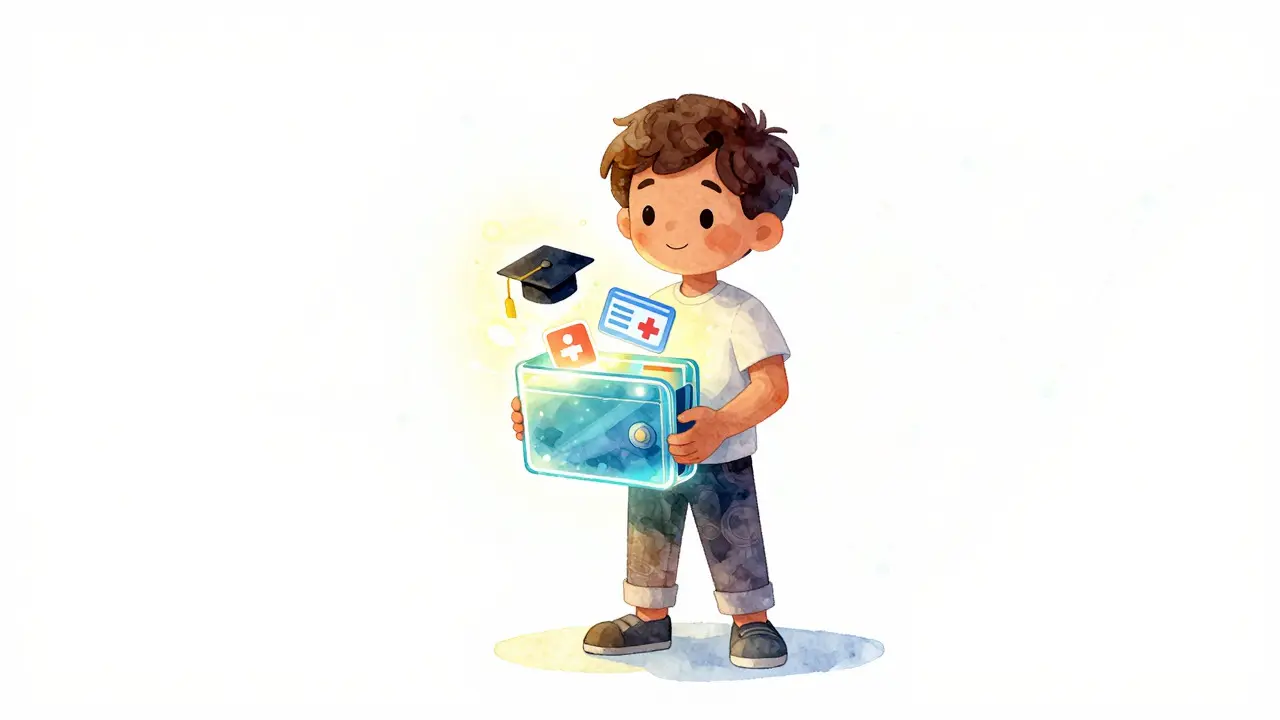
Imagine proving you are over 21 without showing your driver's license. Or verifying your medical degree to a new employer without calling your university for a background check. This is the promise of blockchain-based identity verification. It shifts control from giant corporations and government databases back to you. Instead of storing your data on a server that can be hacked, this technology uses distributed ledger systems to create a secure, tamper-proof record of who you are.
In 2026, this isn't just sci-fi theory. Major institutions like IBM and governments like Estonia are already using these systems. But how does it actually work? And is it really safer than the passwords and ID scans we use today? Let’s break down the mechanics, the benefits, and the real-world hurdles of this shifting landscape.
What Is Blockchain-Based Identity Verification?
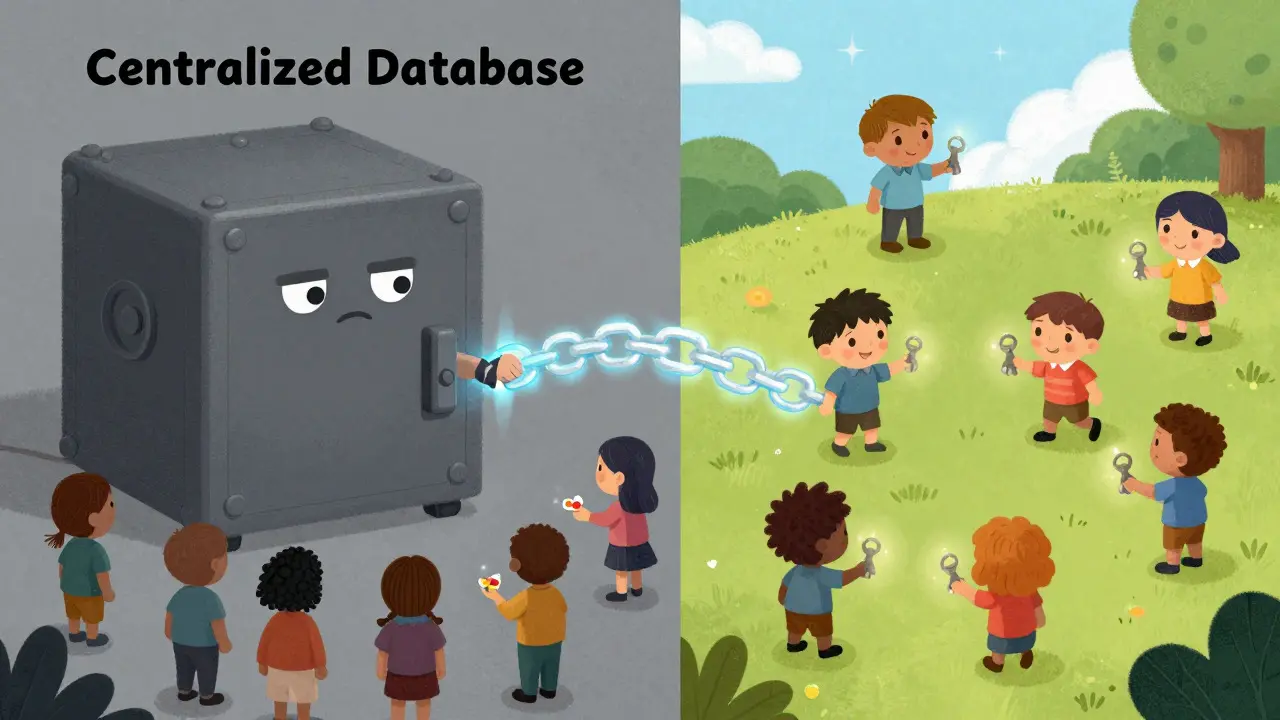
Traditional identity management relies on centralized authorities. You give your passport number to an airline, your social security number to a bank, and your email to every website you visit. These companies store your data in massive databases-honeypots for hackers. If one database gets breached, your identity is compromised across multiple platforms.
Blockchain-based identity verification is a decentralized approach to authenticating individuals using distributed ledger technology, providing a secure, transparent, and immutable system for identity management. Instead of trusting a single entity, trust is distributed across a network. Your identity data doesn’t live on the blockchain itself (which would be a privacy nightmare). Instead, cryptographic hashes-digital fingerprints of your data-are stored on-chain. The actual sensitive documents stay off-chain, often in secure storage like IPFS (InterPlanetary File System).
This model supports Self-Sovereign Identity (SSI), where you hold the keys to your own digital identity. You decide who sees what, and for how long. Once shared, the recipient can verify the authenticity of the credential instantly, knowing it hasn’t been altered since issuance.
The Core Components: DIDs and Verifiable Credentials
To understand how this works, you need to know two key terms: Decentralized Identifiers (DIDs) and Verifiable Credentials (VCs). These are the building blocks defined by the W3C standards finalized in early 2023.
- Decentralized Identifiers (DIDs): Think of a DID as a unique username that exists independently of any central registry. Unlike an email address tied to Gmail or Outlook, a DID is controlled entirely by you. It points to a DID Document, which contains public keys and service endpoints. When you register with a blockchain identity provider, you generate a pair of private and public keys. Your public key might be stored on-chain to allow others to verify your signatures, while your private key stays secret on your device.
- Verifiable Credentials (VCs): These are the digital equivalents of physical certificates. A university issues you a VC for your degree. A government issues a VC for your citizenship. These credentials are cryptographically signed by the issuer. When you present them to a verifier (like an employer), they can check the signature against the issuer’s public key on the blockchain to confirm it’s genuine.
Together, these components enable Zero-Knowledge Proofs (ZKPs). ZKPs allow you to prove a statement is true without revealing the underlying data. For example, you can prove you are over 18 without revealing your exact birthdate. This selective disclosure is a game-changer for privacy.
How the Verification Process Works Step-by-Step
Let’s walk through a practical scenario. Say you want to open a high-security account with a fintech app. Here is how a blockchain-based flow typically operates, based on implementations by providers like Dock.io and IBM:
- Registration & Key Generation: You download a digital wallet app. The app generates your cryptographic key pair. Your public key is linked to your DID on the blockchain.
- Credential Issuance: You upload a photo of your government ID to a secure off-chain storage (like IPFS). The system creates a hash of this document. A trusted issuer (or the government agency via an API) verifies the document and issues a Verifiable Credential to your wallet, signed with their private key.
- Storage & Trust Score: The hash reference is stored on the blockchain. Some systems, as noted by Debut Infotech, generate a "smart contract trust score" based on the validity and source of your credentials.
- Presentation Request: The fintech app asks for proof of identity. You select the specific VC (e.g., "Government ID") from your wallet.
- Verification: Your wallet signs a request with your private key. The fintech app receives the credential and checks the issuer’s signature against the public key on the blockchain. It also verifies that the hash matches the original document. This happens in seconds.
IBM reports that this process can reduce verification time from days to mere seconds. No manual review needed. No paper trails. Just cryptographic certainty.
Why It’s Better Than Traditional Systems
The shift to blockchain identity isn’t just about cool tech; it solves fundamental flaws in current systems.
| Feature | Centralized Database | Blockchain-Based SSI |
|---|---|---|
| Data Control | Owned by corporation/government | Owned by the user |
| Security Risk | High (Single point of failure) | Low (Distributed, no central honeypot) |
| Privacy | Full data sharing required | Selective disclosure / Zero-knowledge proofs |
| Portability | Siloed per platform | Universal across compatible networks |
| Fraud Resistance | Moderate (Relies on internal checks) | High (Cryptographic immutability) |
Dr. Gavin Woods, co-founder of Ethereum, has called decentralized identity one of the most promising applications of blockchain because it returns control to individuals. In Estonia, a pilot program showed that 87% of citizens felt more in control of their data compared to traditional systems. Healthcare providers reported reducing patient onboarding time from 45 minutes to under five minutes using solutions like Dock.io.
Challenges and Real-World Hurdles
It’s not all smooth sailing. Security researcher Bruce Schneier warned in 2021 that blockchain is not a panacea. Several significant barriers remain in 2026:
- Key Management Complexity: If you lose your private key, you might lose access to your identity forever. While recovery mechanisms exist, they add complexity. A PreciseHire survey found that 28% of enterprise users cited "key management complexity" as their top challenge.
- Integration with Legacy Systems: Most banks and governments still run on old IT infrastructure. Connecting a modern blockchain wallet to a 1990s mainframe is difficult. Gartner notes that ease of integration remains a weak point, scoring only 3.8/5 in user reviews.
- Regulatory Uncertainty: The EU’s eIDAS 2.0 framework supports blockchain identity, but other regions lag behind. GDPR compliance is tricky because blockchain’s immutability conflicts with the "right to be forgotten." Companies must ensure personal data never touches the chain directly to stay compliant.
- User Experience: The average person doesn’t understand DIDs or cryptographic keys. Interfaces need to be incredibly simple. Early adopters report a steep learning curve, though apps are improving rapidly.

Market Growth and Future Outlook
Despite the hurdles, adoption is accelerating. The blockchain identity market grew from $0.87 billion in 2021 to $1.84 billion in 2023. MarketsandMarkets projects it will hit $17.24 billion by 2030, growing at a 38.2% CAGR. Financial services lead the charge, accounting for 42% of implementations, followed by government (28%) and healthcare (19%).
Major players are pushing boundaries. Microsoft’s ION protocol runs on Bitcoin and Ethereum to provide scalable DID resolution. 1Kosmos announced AI-enhanced fraud detection for late 2024. Dock.io introduced biometric-bound credentials, ensuring the person presenting the digital ID is physically present. By 2027, Forrester predicts blockchain-based verification will handle 30% of digital identity transactions in developed economies.
The convergence with Decentralized Finance (DeFi) is also notable. As 78% of identity providers plan DeFi integrations, your verified identity could soon serve as collateral or credit score in decentralized lending protocols, removing the need for traditional credit bureaus.
Getting Started: What Users Should Know
If you’re interested in adopting blockchain identity, here’s what you need to do:
- Choose a Reputable Wallet: Look for wallets that support W3C standards (DIDs and VCs). Examples include Microsoft Identity Wallet, SpruceID, or Truvera. Avoid closed-source proprietary systems unless necessary.
- Secure Your Keys: Treat your private key like cash. Write it down on paper, store it offline, and consider multi-signature setups for high-value identities.
- Start Small: Use blockchain identity for low-risk scenarios first, like professional networking or age verification, before moving sensitive financial or medical data.
- Check Interoperability: Ensure the wallet you choose works with the issuers you care about (e.g., your university or local government).
The technology is maturing fast. While it may feel complex now, the goal is seamless invisibility. Soon, you won’t think about DIDs or hashes. You’ll just tap your phone, and the world will know you are who you say you are-without you having to prove anything else.
Is blockchain-based identity verification safe?
Yes, it is generally safer than centralized databases because there is no single point of failure for hackers to target. However, security depends heavily on how well you manage your private keys. If you lose your key or fall for a phishing scam, your identity can be locked out or compromised. Using hardware wallets and reputable software mitigates these risks significantly.
Can I delete my data from the blockchain?
Not exactly. Data written to a blockchain is immutable. However, in proper SSI designs, only a hash (a fingerprint) of your data is stored on-chain, not the data itself. To "delete" your identity, you revoke the Verifiable Credentials associated with your DID. The hash remains, but it becomes useless without the corresponding off-chain data and active credentials.
Which industries are using blockchain identity the most?
Financial services lead with 42% of implementations, using it for KYC (Know Your Customer) processes. Government follows at 28%, particularly in countries like Estonia and Singapore. Healthcare accounts for 19%, using it to streamline patient records and reduce onboarding times.
What is a Decentralized Identifier (DID)?
A DID is a unique identifier that you control, independent of any central registry. It acts like a username but is cryptographically secured. It links to a DID Document containing your public keys, allowing others to verify your digital signatures without needing to trust a third-party authority.
How does zero-knowledge proof help privacy?
Zero-knowledge proofs allow you to prove a fact is true without revealing the underlying data. For instance, you can prove you are over 18 without showing your birth date. This minimizes data exposure, reducing the risk of identity theft if the verifier’s system is later breached.
Is blockchain identity legal in the US and EU?
The EU actively supports it through the eIDAS 2.0 regulation, which includes provisions for European Digital Identity Wallets compatible with blockchain. In the US, regulations are less unified, but major states are piloting mobile driver’s licenses (mDL) on blockchain. Compliance with GDPR requires careful architecture to ensure personal data isn’t stored directly on-chain.
What happens if I lose my private key?
If you lose your private key, you may lose access to your identity credentials. Most modern wallets offer social recovery options, where trusted contacts can help restore access, or multi-sig setups that split the key into parts. Always backup your seed phrase securely during setup.