
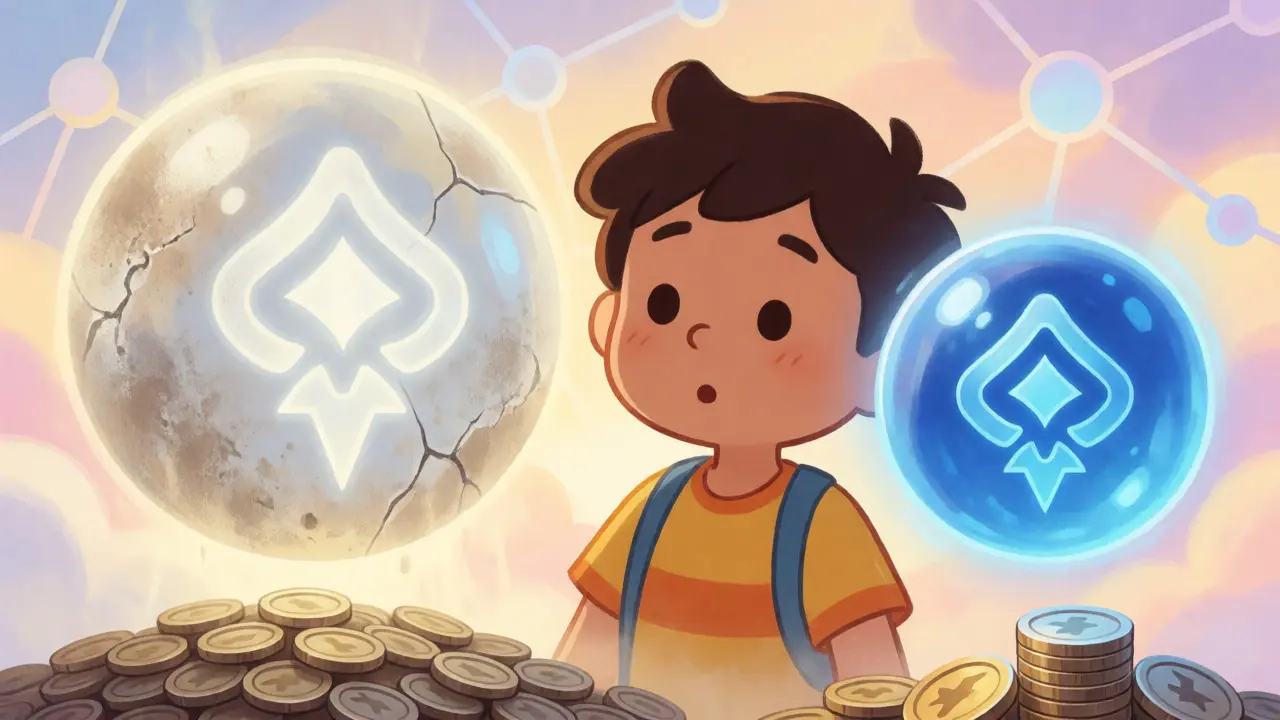
Ever stared at your wallet balance wondering why the Liquidus tokens you earned in an early campaign look nothing like what is trading today? You are not alone. The crypto world is messy, and when projects rebrand or relaunch, things get confusing fast. If you participated in the original Liquidus (old) campaign, you might be holding a bag of tokens that feel like digital ghosts. This guide cuts through the noise to explain exactly what happened with the LIQ airdrop, the difference between the "old" and new versions, and how you can actually check if you have anything left to claim.
| Feature | Liquidus (Old) | Liquidus Foundation (New) |
|---|---|---|
| Token Symbol | LIQ (Legacy) | LIQ (Current) |
| Approx. Price (Sept 2026) | $0.0081 | $0.0622 |
| Market Cap | $55K | $240K |
| Total Supply | 67.26 Million | 6.31 Million |
| Holders | 4,680 | 1,030 |
| Status | Historical/Legacy | Active Development |
The Great Token Split: What Actually Happened?
Let's be real for a second. In crypto, "old" usually means "deprecated." The Liquidus (old) token isn't just a different version; it represents a completely different era of the project. Back in late 2021, this token hit an all-time high of $4.80. That’s right, four dollars and eighty cents. Today? It trades for less than a penny. Why the massive drop? Projects evolve. Sometimes they pivot, sometimes they fail, and sometimes they migrate to new contracts entirely.
The current iteration, known as Liquidus Foundation (LIQ), operates with a much smaller supply-only about 6.31 million tokens compared to the old version's 67 million. This scarcity drives the price up slightly, but liquidity remains thin. If you were part of the initial LIQ airdrop campaign, you likely received the older contract address tokens. These do not automatically convert to the new ones. You have to check if a swap mechanism exists or if your tokens are essentially stranded on the legacy chain.
Did You Qualify for the Campaign?
Airdrops aren't magic. They require action. For the Liquidus project, eligibility often hinged on specific on-chain behaviors or social quests. Did you hold a certain amount of ETH in a specific wallet during the snapshot date? Did you complete tasks on platforms like Galxe or Zealy? Many users assume their tokens appeared automatically, only to find out later they missed the claiming window.
Here is the hard truth: there is no single, centralized database that lists every eligible participant from years ago. You need to do some detective work. Check your transaction history for any interactions with the Liquidus smart contracts around the time of the launch. If you see incoming transactions labeled "LIQ" from unknown addresses, those are likely your airdropped tokens. But remember, these are the "old" tokens. Their value today is negligible unless you can swap them.
How to Claim or Swap Your LIQ Tokens
If you found tokens in your wallet, don't celebrate just yet. Having tokens in your wallet doesn't mean you can sell them. You need to know where they live and how to move them. Most likely, your old LIQ tokens are on the Ethereum mainnet or a compatible Layer-2 solution like Arbitrum or Optimism, depending on which chain the original campaign used.
- Check the Contract Address: Copy the token contract address from your wallet (like MetaMask). Search this address on Etherscan. Does it say "Liquidus" or "Liquidus (Old)"?
- Look for Liquidity Pools: Go to a decentralized exchange like Uniswap or SushiSwap. Paste the contract address into the search bar. If you see a trading pair (e.g., LIQ/USDT), you can try to swap. If the pool is empty or has huge slippage, you might be stuck.
- Official Migration Tools: Sometimes, projects provide a migration portal. Visit the official Liquidus Foundation website. Look for a "Claim" or "Migrate" button. If it links to a dashboard, connect your wallet there to see if your old balance maps to the new one.
Be careful with scams. Because the old token is low-value, scammers create fake websites promising high returns if you "validate" your wallet. Never sign a transaction you don't understand, especially if it asks for unlimited approval.
The Current State of Liquidus Foundation
While the old token struggles, the new Liquidus Foundation team is trying to build something practical. They describe themselves as a decentralized development studio focused on simplifying blockchain for regular users. Their flagship product is a mobile app for iOS and Android that lets you deposit and earn on crypto holdings without needing to be a DeFi expert.
The new LIQ token serves a utility role here. It unlocks premium features in the app and offers discounts. With a market cap hovering around $240K, it is still a micro-cap asset. This means high volatility. One tweet from the founder could double the price, or a lack of updates could halve it. If you managed to swap your old tokens for new ones, you are now betting on the success of this mobile app strategy. Is it worth it? That depends on whether they can attract more than their current 1,030 holders.
Why Was There So Little Documentation?
You might be frustrated by the lack of clear info. Why is it so hard to find details about the original airdrop? Fragmentation. Crypto projects often start small, with community-led campaigns rather than formal corporate announcements. The Gate.io trading competition mentioned in past records offered $51,000 in rewards, including shares for the first 600 depositors. This suggests the distribution was tied to exchange activity rather than just pure on-chain holding.
Additionally, the "old" version had 4,680 holders, while the new one has only 1,030. This massive drop indicates that most people either sold their old tokens, forgot about them, or failed to migrate. The data shows a 99.82% decline from the 2021 peak. When prices crash that hard, communities often disintegrate, leaving documentation scattered across dead Discord servers and outdated Medium posts.
What Should You Do Now?
So, where does this leave you? If you are holding old LIQ, your options are limited but clear. First, determine if swapping is even possible. If the liquidity pool is dry, your tokens might be effectively worthless until a new exchange lists them. Second, keep an eye on the Liquidus Foundation official channels. If they announce a buyback or a new partnership, sentiment could shift.
For those who missed the airdrop entirely, don't worry too much. The new token is available for purchase, though volume is low ($646 daily). Buying now is a speculative play on their mobile app adoption. It is not a sure thing, but it is cleaner than chasing ghost tokens from a defunct era.
Is my old LIQ token worth anything?
Currently, Liquidus (old) trades at approximately $0.0081 USD. Given its low market cap of roughly $55,000 and minimal trading volume, its value is very low. However, if you can swap it for the new LIQ token via a migration tool or DEX, you might recover some value based on the newer token's higher price point.
How do I distinguish between Liquidus (old) and Liquidus (new)?
The primary difference is the smart contract address and supply. The old version has a total supply of 67.26 million tokens, while the new Liquidus Foundation token has a supply of only 6.31 million. Always verify the contract address on Etherscan before interacting with any token.
Can I still claim unclaimed airdrop tokens?
This depends on whether the project maintained a claimable contract. Check the official Liquidus Foundation website for a "Claim" portal. If no such portal exists, your tokens may have been distributed directly to wallets during the snapshot, meaning they should already be in your wallet if you qualified.
Why did the price of the old token drop so significantly?
The old token peaked at $4.80 in November 2021 and has since declined by over 99%. This is typical for many altcoins launched during bull markets that lacked sustained utility or faced significant selling pressure as the broader crypto market cooled down.
Where can I trade the new LIQ token?
The new Liquidus Foundation (LIQ) token has limited trading venues due to its small market cap. Check major decentralized exchanges like Uniswap or specialized aggregators like CoinGecko or CoinMarketCap to find active trading pairs. Be aware of low liquidity, which can cause high slippage.