

When you hear someone say, fundamental analysis is the key to finding the next big crypto gem, it sounds logical. After all, in stocks, you look at earnings, debt, management, and market position. Why wouldn’t the same apply to Bitcoin or Ethereum? But crypto doesn’t play by the same rules. The truth is, fundamental analysis in cryptocurrency often leads to wrong decisions-not because it’s useless, but because it’s fundamentally broken for this market.
There Are No Standard Metrics
In traditional investing, you have balance sheets, income statements, cash flow reports-all audited, regulated, and standardized. You can compare Apple to Microsoft because they both report the same way. In crypto? There’s no such thing. A project might have a whitepaper that reads like science fiction. Another might have a team with anonymous GitHub profiles. One coin touts 100,000 users; another claims 10 million, but no one knows how they counted them. You can’t measure “utility” the same way you measure revenue. Is a token useful because it powers a DeFi protocol? Or because it’s used to pay for cloud storage? Or because it’s just a meme with a loyal Discord community? There’s no agreed-upon metric. One analyst calls a project undervalued because of its tech. Another dismisses it because the team hasn’t posted in six months. Both could be right. Neither can prove it.It’s Too Slow for a 24/7 Market
Fundamental analysis is built for patience. You spend weeks reading reports, analyzing tokenomics, checking team backgrounds. Then you buy. But crypto doesn’t wait. Prices swing 30% in a day because a tweet from a billionaire or a new SEC filing drops. You might spend months deciding that a coin is fundamentally strong-only to watch it crash 60% the week after you buy because a major exchange delisted it. This isn’t just frustrating. It’s dangerous. People who rely on fundamentals often hold through massive drawdowns, convinced the market will “catch up.” But in crypto, the market never catches up. It just moves on. A project with great fundamentals today could be irrelevant in six months because a better blockchain launched with lower fees and faster transactions.Information Overload Is Real
You think you’ve got enough to track? Try this: development activity on GitHub, Discord sentiment, Twitter trends, token unlock schedules, exchange listings, regulatory news from five different countries, smart contract audits, staking yields, liquidity pool changes, and competitor launches-all updating in real time. Most retail investors don’t have the time, skills, or tools to filter this noise. They read one article saying a project is “the future of DeFi,” ignore the fact that its liquidity pool is 90% locked in a single wallet, and buy in. Then they wonder why they lost money. The problem isn’t the data-it’s the lack of structure to interpret it. There’s no checklist. No formula. No reliable source that tells you what matters and what’s just noise.Cognitive Biases Kill Your Judgment
Humans aren’t robots. We see what we want to see. That’s confirmation bias. If you believe Solana is going to dominate DeFi, you’ll only notice the good news: new partnerships, developer growth, performance benchmarks. You’ll ignore the fact that its network has crashed five times in the last year, or that its token supply is set to explode in the next 12 months. Then there’s recency bias. A coin spikes 200% in a week? Must be undervalued! But that spike was fueled by a single influencer’s hype post. The fundamentals haven’t changed. The tokenomics are worse than ever. But now you’re emotionally invested. You hold, hoping for another run. Meanwhile, the real value keeps eroding. And let’s not forget the “great project fallacy.” Just because a team is smart, the tech is cool, and the vision is bold doesn’t mean people will pay for it. Ethereum had all that. So did hundreds of other projects that are now dead. Fundamentals don’t guarantee adoption. Adoption drives price.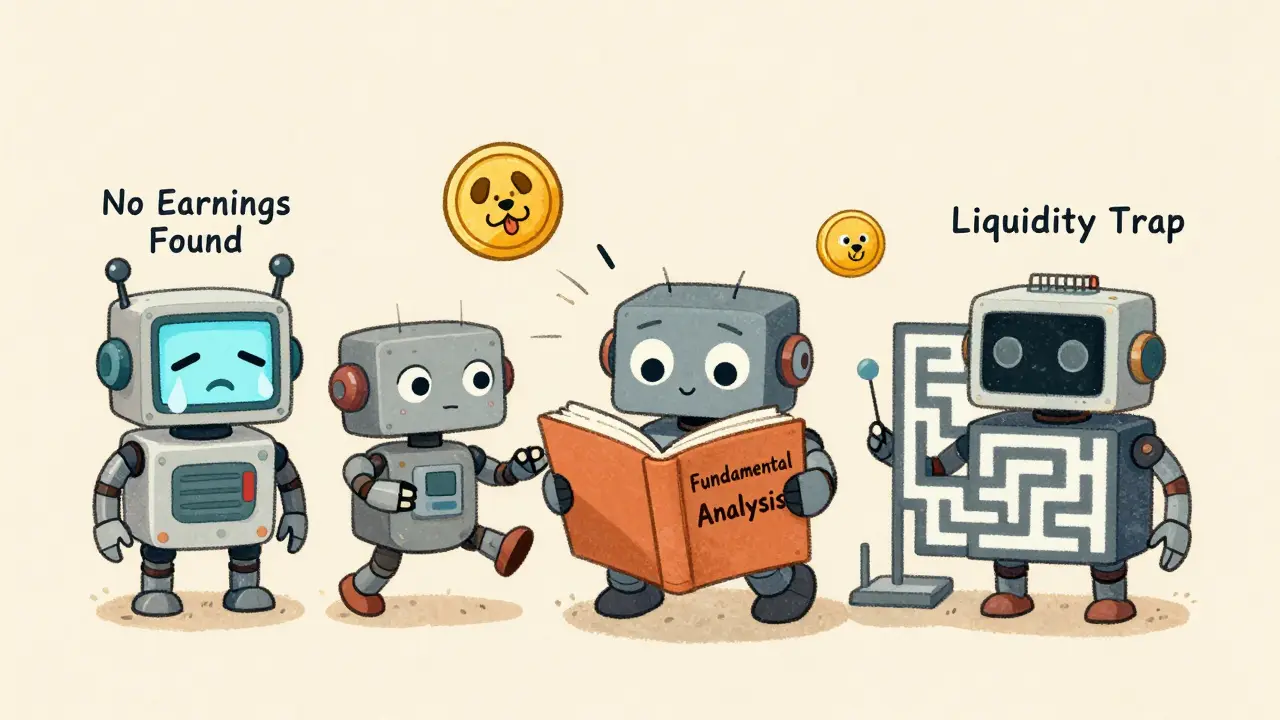
Regulation Changes Overnight
In 2024, the U.S. SEC labeled 12 major tokens as unregistered securities. In 2025, the EU passed MiCA, forcing projects to disclose everything from team identities to token distribution. One week, a coin is a promising DeFi protocol. The next, it’s illegal to trade in 40 countries. No fundamental model predicts that. No balance sheet accounts for it. You can’t analyze the risk of a government decision. You can only react to it. This isn’t theoretical. In 2024, a project called ChainLink was valued at $12 billion based on its oracle network and enterprise partnerships. Then the SEC sued them for selling unregistered securities. Within 72 hours, its market cap dropped 38%. The tech didn’t change. The team didn’t quit. The partnerships were still there. But the market didn’t care. Regulation killed the price.Liquidity Is a Silent Killer
You might find a coin with perfect fundamentals: strong team, clear roadmap, real use case, active community. Sounds like a buy, right? But what if only 500 people trade it daily? What if the biggest holder owns 40% of the supply? Fundamental analysis doesn’t tell you if you can actually sell. If you buy $10,000 worth of a low-liquidity token, you might not be able to exit without crashing the price. You’re stuck. You thought you were investing in the future. You’re actually trapped in a graveyard. This is why many “fundamentally strong” coins stay flat for years. Not because the market is wrong. Because there’s no one left to buy. No liquidity. No volume. No exit.Whales and Manipulation Don’t Care About Fundamentals
In crypto, a single wallet can move the market. You might read a detailed report proving that a coin is undervalued. But if a whale dumps 10% of their holdings overnight, the price crashes. The fundamentals didn’t change. The analysis was correct. But the market didn’t care. This isn’t rare. It’s standard. Pump-and-dump schemes run on “fundamental” narratives. A team releases a whitepaper about “AI-powered blockchain.” No code. No product. Just buzz. The price rockets. Retail investors buy in, thinking they’ve found the next Bitcoin. Then the team vanishes. The token crashes to 5% of its peak. The fundamentals? Never existed. But the analysis? It was flawless. Just irrelevant.
It’s Not About What’s Right-It’s About What’s Popular
The most successful crypto investments in the last five years weren’t the ones with the best fundamentals. They were the ones with the loudest communities, the best memes, the most viral Twitter threads. Dogecoin. Shiba Inu. Pepe. None had serious technology. None had clear utility. But they had something fundamental analysis can’t measure: mass psychology. Crypto isn’t a stock market. It’s a social experiment. People buy because they believe. Not because they’ve done the math. If you’re trying to value crypto like a company, you’re playing the wrong game.What Should You Do Instead?
You don’t throw fundamental analysis out the window. You use it as a filter-not a decision engine.- Use it to avoid obvious scams: anonymous teams, no code, no whitepaper, no audits.
- Use it to spot projects with real traction: active GitHub, real partnerships, growing user base.
- But never buy based on it alone.
The Bottom Line
Fundamental analysis in crypto isn’t useless. It’s just incomplete. It’s like trying to navigate a storm with a map that only shows landmasses-not the wind, the waves, or the hidden reefs. You’ll know where the islands are. But you’ll still get wrecked. The market doesn’t reward the most rational investor. It rewards the most adaptable one. If you want to survive in crypto, stop waiting for fundamentals to justify a price. Start watching what the market actually does.Is fundamental analysis completely useless in crypto?
No, it’s not useless-but it’s not enough. Fundamental analysis helps you avoid obvious scams and identify projects with real potential. But it can’t predict price movements, react to regulation, or account for market manipulation. Use it as a filter, not a signal.
Why do some coins with bad fundamentals skyrocket?
Because crypto is driven by hype, social trends, and liquidity-not financial metrics. A coin with no tech, no team, and no use case can explode if influencers promote it, whales accumulate it, or it becomes a meme. Price in crypto is often a reflection of belief, not value.
Can you use traditional stock metrics like P/E ratio in crypto?
No. Most crypto projects don’t generate revenue, let alone profit. A P/E ratio requires earnings, which most tokens don’t have. Even if they did, there’s no standard accounting for crypto income. Trying to apply traditional metrics to crypto is like using a ruler to measure sound-it’s the wrong tool for the job.
How long should I hold a crypto based on fundamental analysis?
There’s no set timeframe. Some projects take years to gain adoption. Others die in months. Fundamental analysis doesn’t give you a timeline-it only tells you if the project has a chance. You need on-chain data, technical signals, and market sentiment to decide when to enter or exit.
Are there any tools that improve fundamental analysis in crypto?
Yes. Tools like Nansen, Arkham, and Token Terminal help track on-chain activity, wallet behavior, and tokenomics. They don’t replace human judgment, but they reduce guesswork. Combine them with whitepaper reviews and team research for better results.
What’s the biggest mistake people make with fundamental analysis in crypto?
Believing that strong fundamentals guarantee price growth. They don’t. Many projects with perfect teams, tech, and use cases have gone to zero because of bad timing, low liquidity, or sudden regulation. Fundamentals get you in the door. Market dynamics decide if you stay.
Joe West
Really nailed it. I used to think if a project had a solid team and whitepaper, I was safe. Then I bought into one that had 12 devs on GitHub and zero activity for 8 months. Turned out the lead dev was a 19-year-old in his mom’s basement. The tech looked great on paper - but no one was building anything. Fundamentals don’t mean squat if no one’s actually using it.
Now I check on-chain activity first. If the wallet activity is flat and the liquidity is locked, I walk away. Doesn’t matter how fancy the tokenomics look.
michael cuevas
so you’re telling me all those reddit threads about ‘this coin has real utility’ were just vibes
and the 5000 word analysis i wrote last week was just fanfiction
lol ok i guess i’ll go back to memeing
Nina Meretoile
crypto is the wild west of human psychology 🌪️💸
we’re not investing in tech - we’re investing in belief systems
dogecoin didn’t win because of code - it won because people wanted to laugh while getting rich
the real asset isn’t the blockchain - it’s the community’s collective hope
and that? that’s the only metric that never lies
Barb Pooley
you think this is bad wait till the fed prints 5 trillion and the gov starts tracking every wallet
they’re gonna shut this all down and blame us for ‘market instability’
they don’t want you to be rich they want you to be obedient
fundamental analysis is just the opium of the crypto masses
Shane Budge
so what’s the alternative?
sonia sifflet
You are all wrong. Fundamental analysis is not broken. You are just too lazy to do it properly. Real analysis means reading every whitepaper in its original language, checking every GitHub commit since 2018, mapping every whale wallet across 17 block explorers, and cross-referencing Twitter sentiment with Telegram bot logs. If you don’t do all that, you’re not an investor - you’re a gambler with a debit card.
Chris Jenny
THEY KNOW. THEY ALL KNOW. THE WHALES ARE CONTROLLED BY THE SAME 3 CORPORATIONS THAT OWN THE EXCHANGES AND THE AUDIT FIRMS. THEY CREATE FAKE ‘FUNDAMENTALS’ TO LURE YOU IN. THEN THEY DUMP. YOU THINK YOU’RE ANALYZING A PROJECT? YOU’RE JUST A PIG IN THE SLAUGHTERHOUSE WITH A TIKTOK CHART.
THEY WANT YOU TO BELIEVE IN ‘UTILITY.’ THEY WANT YOU TO THINK IT’S ABOUT TECHNOLOGY. IT’S NOT. IT’S ABOUT CONTROL. THEY’RE BUILDING A DIGITAL FEUDAL SYSTEM.
AND YOU’RE STILL READING WHITEPAPERS.
WHY?
Jon Visotzky
been in since 2017. seen 3 bull runs. lost my shirt twice. made it back once.
turns out the only thing that matters is: who’s buying right now?
if the whales are accumulating and the volume’s rising, it doesn’t matter if the team is anonymous or the whitepaper is written in Comic Sans.
if the chart’s going up and people are talking about it - that’s the only fundamental that counts.
Isha Kaur
I totally agree with the point about liquidity being a silent killer - I learned this the hard way last year when I bought into a project that had an amazing team, clear roadmap, and even had a partnership with a Fortune 500 company. I was so excited I invested 15% of my portfolio. But when I tried to sell a month later, the bid was 40% below my entry, and the slippage was insane. Turns out 78% of the supply was held by one wallet that had been quietly accumulating since genesis. I held for six months hoping it would recover - but the volume never came back. I ended up losing 82% of that position. The fundamentals were flawless - but the market structure was a trap. I wish someone had warned me about the liquidity depth metrics before I jumped in.
Glenn Jones
fundamental analysis is a scam designed by wall street bots to keep retail idiots busy while the alts get rug pulled by the same devs who wrote the ‘whitepaper’ in 3 hours on a chromebook while eating doritos
you think you’re analyzing tech? you’re just doing the market’s laundry
every ‘utility’ token is just a glorified ponzi with a github repo
and if you’re still reading tokenomics instead of watching whale wallets - you’re not an investor, you’re a data entry clerk for the crypto cult
Nelson Issangya
you’re not wrong - but don’t give up on fundamentals. they’re the foundation. you just need to layer in real-time signals. check Nansen for whale accumulation, look at Dune dashboards for active addresses, track social volume spikes. fundamentals tell you if the house is built on solid ground. on-chain and sentiment data tell you if the storm is coming. combine them - and you’re not gambling. you’re strategizing.
Richard T
really appreciate this breakdown. i’ve been trying to explain this to my cousin who thinks ‘if it’s on coinmarketcap, it’s safe.’
he bought a coin because the team had MIT degrees. the project had no code. no users. no audits.
he’s still holding. says ‘it’s just a long-term play.’
bro, the long-term play was to sell on day 3.
jonathan dunlow
listen - i used to be the guy who spent 40 hours reading whitepapers and mapping token distributions. i thought i was smart. then i lost 60k on a project with a ‘revolutionary’ consensus algorithm that turned out to be copied from a 2017 blog post.
now? i use fundamentals to screen out obvious frauds - no team, no code, no audits - and then i let the market decide. if the price is pumping and the social chatter is hot, i jump in. if it’s flat and quiet? i wait. i don’t try to predict. i react. and honestly? i’ve made more in 6 months this way than i did in 3 years of ‘deep analysis.’
the market doesn’t care how smart you are. it cares how fast you move.
Mariam Almatrook
It is profoundly disconcerting that the intellectual architecture of modern finance has been so egregiously subverted by a decentralized, unregulated, and fundamentally unsound speculative ecosystem. One might argue that the very notion of ‘utility’ in this context is ontologically incoherent, given the absence of any verifiable cash flow, legal recourse, or institutional accountability. To treat crypto as an investable asset class is not merely naïve - it is an epistemological failure of the highest order.
Chris Mitchell
fundamentals are the filter. not the signal.
you don’t drive a car by looking at the engine alone. you look at the road, the traffic, the weather.
same here.
rita linda
Americans think they can analyze everything with spreadsheets. In China, we just follow the leaders. In Russia, we wait for the state to act. Here? You guys read whitepapers and call it ‘research.’ Meanwhile, the real players are already in and out. You’re not investing. You’re doing homework for people who already won.
Martin Hansen
you’re all just jealous because you didn’t buy shiba inu at 0.00000001
you think you’re deep thinkers? you’re just bitter because you let your fear of ‘risk’ make you miss the biggest meme in human history
the market doesn’t reward logic - it rewards audacity
and if you’re still debating ‘tokenomics’ while pepe is at 500x - you’re not a strategist. you’re a spectator.
Lore Vanvliet
they’re watching us. every click. every wallet. every time you say ‘this coin has potential’ - they tag you. then they pump it. then they dump. then you cry. i saw it happen 3 times. i even got a DM from someone claiming to be ‘the team’ offering me ‘early access’ - it was a bot. they’re not just manipulating prices. they’re manipulating your mind.
stop reading whitepapers.
start deleting your wallet.
Scott Sơn
bro the real crypto is the one where the devs are on discord at 3am arguing about whether to use Solidity or Rust while a guy in the back sells NFTs of their cat
the ‘fundamentals’? that’s the marketing brochure.
the real project? the chaos.
and if you’re not high on that energy - you’re already out.
Frank Cronin
you think you’re clever for saying ‘fundamentals are incomplete’? newsflash: they’re irrelevant. you’re not an investor. you’re a data miner for people who already know the answer. every ‘analysis’ you do is just noise to the whales. they don’t care about your charts or your whitepapers. they care about your FOMO. and you’re handing it to them on a silver platter.
go touch grass.
Stanley Wong
i’ve been thinking about this a lot lately
maybe the problem isn’t that fundamental analysis fails
maybe it’s that we’re trying to apply old rules to a new kind of game
like trying to play chess with a deck of cards
we need new tools
new language
new way of seeing
not just better analysis
but a new mindset
miriam gionfriddo
the fact that you guys are still talking about ‘fundamentals’ is why you lost all your money
you didn’t lose because you didn’t know enough
you lost because you thought you could outthink the market
the market doesn’t think
it reacts
it follows hype
it chases memes
and if you’re still reading github commits while pepe is at 1000x
you’re not a trader
you’re a relic
Brooke Schmalbach
you’re all missing the point. the real fraud isn’t the scam coins - it’s the so-called ‘experts’ who sell you ‘fundamental analysis’ courses for $299. they’re the ones profiting from your delusion. they don’t want you to win. they want you to keep buying their ‘masterclass’ while they dump their own bags. the only fundamental you need to know? never pay for crypto advice.
Cristal Consulting
love this. i’ve been telling my friends for years - don’t buy based on what a project says it will do. buy based on what it’s actually doing.
if the devs are pushing commits daily, the community is growing, and whales are accumulating - that’s your signal.
if the team is silent and the discord is dead? walk away.
fundamentals are just the starting line. the race is run by action, not promises.
Joe West
^^^ this. i started tracking dev activity on GitHub after my last loss. one coin had zero commits for 4 months - then suddenly 20 in one day. turned out it was a rebrand. the old team vanished. new team? no track record. i didn’t buy. turned out it was a rug. saved me 20k.
real analysis isn’t reading. it’s watching.
Jon Visotzky
^^^ exactly. i use a simple rule: if the team doesn’t post for 30 days, i assume they’re gone. no exceptions.
if the github is dead, the discord is ghost town, and the twitter’s just memes - it’s not a project. it’s a tombstone with a token attached.