

Have you seen SMIDGE popping up on your crypto feeds or trending lists? It’s easy to get caught up in the hype when a token promises community-driven fun and massive gains. But before you swap your hard-earned ETH for this meme coin, we need to look past the marketing buzzwords. SMIDGE is not just one thing; it is a confusing mix of tokens across different blockchains with a history of extreme volatility.
In this guide, I’ll break down exactly what SMIDGE is, where it lives on the blockchain, and why you should proceed with extreme caution. We will separate the facts from the hype so you can decide if this speculative asset belongs in your portfolio.
Key Takeaways
- SMIDGE exists as two distinct tokens: an ERC-20 token on Ethereum and an SPL token on Solana, creating significant confusion and risk.
- The Ethereum version has a massive supply of 960.42 trillion tokens but often trades with near-zero liquidity and micro-cap valuation.
- Claims of "renounced ownership" and "burned LP" are standard meme coin marketing tactics that do not guarantee safety from smart contract bugs.
- Historical price action shows extreme pumps (up to +175% in a day) followed by severe crashes, indicating high speculation rather than organic growth.
- There is no clear utility, roadmap, or identifiable development team behind the project.
What Is SMIDGE (SMIDGE)?
At its core, SMIDGE is a meme-oriented cryptocurrency token designed for speculation and community engagement rather than technical utility. Unlike Bitcoin, which aims to be digital gold, or Ethereum, which powers decentralized applications, SMIDGE relies entirely on social sentiment. If people believe it has value, it rises. If they lose interest, it crashes.
The biggest red flag right out of the gate is identity confusion. When you search for SMIDGE, you might find data pointing to Ethereum, while other sources claim it is on Solana. This isn’t a seamless cross-chain integration; it appears to be either two unrelated projects using the same ticker or inaccurate metadata on tracking platforms. For a retail investor, this ambiguity is dangerous. Buying the wrong contract address means buying a fake token that holds zero value.
Ethereum vs. Solana: Which SMIDGE Are You Buying?
To understand the risk, you have to distinguish between the two versions currently circulating in market data.
| Feature | Ethereum SMIDGE (ERC-20) | Solana SMIDGE (SPL) |
|---|---|---|
| Blockchain | Ethereum | Solana |
| Token Standard | ERC-20 | SPL |
| Total Supply | 960.42 Trillion | Varies (Unverified) |
| Liquidity Source | Uniswap V2 (DEX) | Raydium/Jupiter (DEX) |
| Verification Status | Listed on CoinMarketCap/CoinGecko | Mentioned on some aggregators, less verified |
The Ethereum version is the one most frequently tracked by major aggregators like CoinMarketCap and CoinGecko. It operates on the ERC-20 standard, meaning you need an Ethereum wallet like MetaMask to hold it. The Solana version, described by some platforms as leveraging Solana’s speed, adds another layer of complexity. Without a single, official source clarifying which is the "real" project, you are navigating a minefield. Always verify the contract address directly from the project’s official social channels before connecting your wallet.

Tokenomics: The Numbers Behind the Hype
Let’s look at the economics of the Ethereum-based SMIDGE, as this is where the most data is available. The numbers here tell a story of hyper-inflationary supply typical of low-tier meme coins.
- Total Supply: 960.42 Trillion tokens. That is a number so large it is difficult to visualize. To put it in perspective, Bitcoin has only 21 million coins. With nearly a quadrillion SMIDGE tokens in existence, each individual token has negligible intrinsic value.
- Circulating Supply: Reports indicate 100% of the total supply is circulating. This suggests there are no locked tokens for developers or future incentives, which proponents call "fair," but critics note means there is no mechanism to prevent immediate dumping by early holders.
- Market Cap Volatility: Data snapshots show wild swings. At times, SMIDGE has been reported with a market cap as low as $31,490. In other instances, during viral hype cycles, it allegedly spiked to around $345 million. This discrepancy highlights how thin the liquidity is. A few large buys can inflate the price artificially, while a single large sell order can crash it.
This structure favors short-term traders looking for quick percentage gains, not long-term investors. The sheer volume of tokens means that for the price to double, billions of dollars would need to flow into the pool, which rarely happens outside of brief manias.
Security Claims: Renounced Ownership and Burned LP
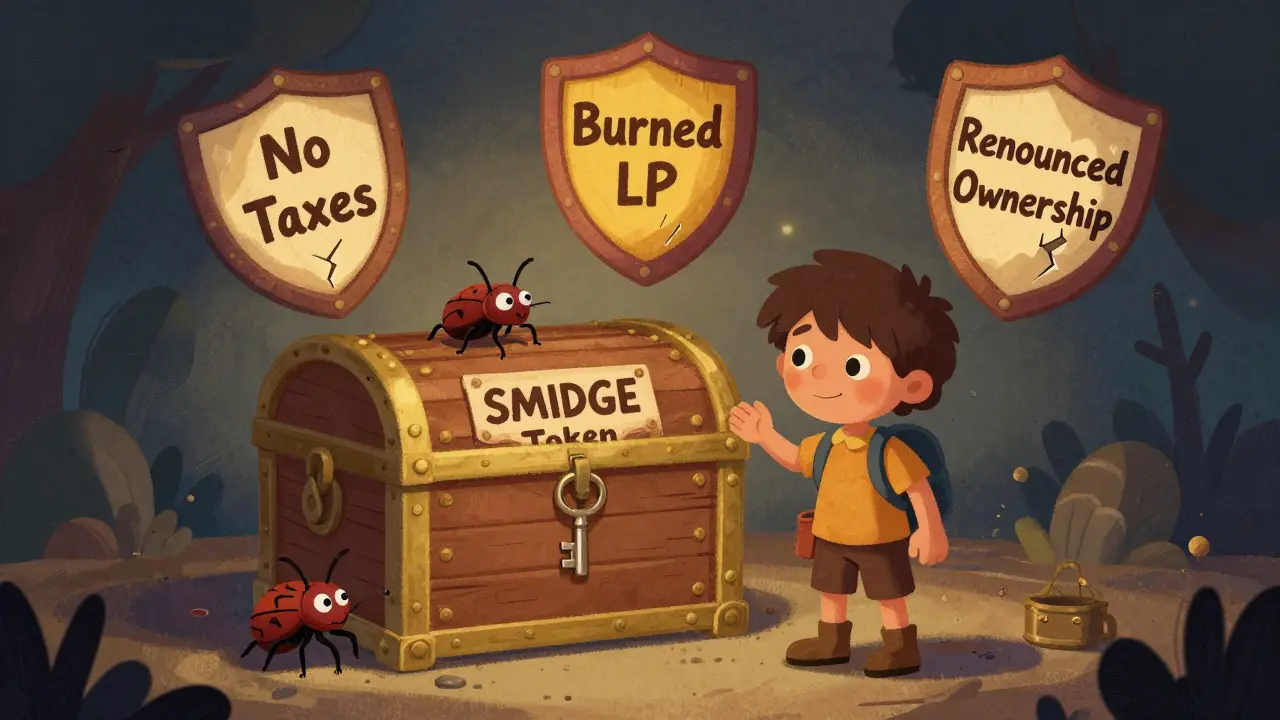
You will likely see three phrases repeated in SMIDGE’s promotional material: "No Taxes," "Burned LP Tokens," and "Renounced Ownership." These are standard defenses against common meme coin scams, but they don’t make the token safe.
- No Taxes: This means the smart contract does not charge a fee (like 5% or 10%) on every buy or sell. While this sounds great for traders, it also means there is no revenue stream for development. It is a pure play on speculation.
- Burned LP Tokens: Liquidity Provider (LP) tokens represent the money locked in the trading pool. Burning them sends these tokens to an unrecoverable address, theoretically preventing the developer from pulling all the funds out (a "rug pull"). However, this must be verified on-chain. Just because a website says it was done doesn’t mean it was.
- Renounced Ownership: This removes the developer’s ability to change the contract code, such as adding taxes later or blacklisting wallets. It makes the token immutable. But immutability cuts both ways: if there is a bug in the code, it cannot be fixed. If hackers find a vulnerability, the funds are gone forever.
Crucially, there is no mention of third-party audits from firms like CertiK or Hacken. Most meme coins skip this step to save costs, leaving users to trust the code blindly. For a token with such volatile history, the lack of an audit is a significant risk factor.
Price History and Market Sentiment
SMIDGE’s price action is a textbook example of meme coin psychology. It doesn’t move based on earnings reports or technological upgrades; it moves based on attention.
In late 2023 and early 2024, SMIDGE experienced periods of intense virality. During one such spike, it trended #1 on CoinMarketCap’s search list. Analysts noted intraday gains of 150% to 175%, driven by social media buzz comparing it to earlier successes like PEPE. During these peaks, the market cap briefly approached $345 million.
However, these highs were not sustained. Following the hype cycle, the token saw a sharp correction. Recent data points show daily trading volumes dropping to under $100 on some days, with the market cap shrinking back to micro-cap levels (around $30k). This pattern-explosive growth followed by rapid decay-is common for tokens without underlying utility. Once the novelty wears off and the next big meme emerges, liquidity dries up, making it difficult for remaining holders to exit their positions without suffering massive losses.
How to Buy SMIDGE (If You Still Want To)
If you have decided that the high risk aligns with your investment strategy, here is how you would typically acquire the Ethereum version of SMIDGE. Note that this process involves interacting with decentralized exchanges (DEXs), which carry higher risks than centralized platforms.
- Set Up a Web3 Wallet: Download a non-custodial wallet like MetaMask or Rabby. Secure your seed phrase offline. Never share it.
- Fund Your Wallet: Purchase Ethereum (ETH) on a reputable exchange like Coinbase or Kraken and transfer it to your wallet address. Keep extra ETH for gas fees, which can vary significantly depending on network congestion.
- Find the Correct Contract Address: This is the most critical step. Go to the official SMIDGE website or verified social media channels to copy the exact ERC-20 contract address. Do not rely on links from random tweets or Telegram groups, as these are often phishing attempts.
- Connect to a DEX: Navigate to Uniswap (the primary venue for SMIDGE on Ethereum). Connect your wallet.
- Add the Token: Paste the contract address into the token field. Verify the name matches SMIDGE.
- Swap ETH for SMIDGE: Enter the amount of ETH you wish to spend. Due to low liquidity, you may need to increase the slippage tolerance (often between 1% and 5%) to ensure the trade executes. Be aware that high slippage means you might receive fewer tokens than expected.
For the Solana version, you would use a Solana-compatible wallet like Phantom and interact with DEXs like Raydium or Jupiter. Again, verifying the correct SPL token address is paramount.
Is SMIDGE a Good Investment?
Let’s be direct: SMIDGE is not an investment in the traditional sense. It is a speculative instrument with no cash flow, no user base, and no product roadmap. Its value is derived solely from the willingness of others to pay more for it tomorrow than you did today.
Compared to established meme coins like Dogecoin (DOGE) or Shiba Inu (SHIB), SMIDGE lacks brand recognition, exchange listings, and ecosystem development. DOGE and SHIB have survived multiple bear markets because they became cultural phenomena with deep liquidity pools. SMIDGE remains in the "long tail" of the crypto market, where thousands of new tokens launch weekly, and most fail within months.
The potential rewards are high-if you catch the bottom of a pump-but the probability of total loss is equally high. If you choose to participate, treat it as entertainment spending, not capital preservation. Never allocate more than you can afford to lose completely.
Final Thoughts
SMIDGE represents the chaotic, unregulated edge of the cryptocurrency market. While the narrative of community-driven, tax-free tokens is appealing, the reality is fraught with risks ranging from smart contract vulnerabilities to simple illiquidity. The confusion between its Ethereum and Solana variants further complicates matters, increasing the chance of accidental fraud.
Before you dive in, ask yourself: Are you buying this because you believe in its long-term future, or because you’re chasing a quick profit? If it’s the latter, you’re playing a game against bots and insiders who have better tools and faster information. Stay informed, verify every detail on-chain, and protect your principal above all else.
Is SMIDGE listed on Binance or Coinbase?
No, SMIDGE is not currently listed on major centralized exchanges like Binance, Coinbase, or Kraken. It is primarily traded on decentralized exchanges (DEXs) such as Uniswap for the Ethereum version. This lack of CEX listing limits accessibility and increases volatility.
Who created the SMIDGE token?
The creators of SMIDGE are anonymous. Like many meme coins, the project emphasizes community over leadership, and no specific individuals or companies are publicly credited with its development. This anonymity adds to the risk, as there is no accountable team to contact in case of issues.
What is the difference between Ethereum SMIDGE and Solana SMIDGE?
They are likely two separate tokens using the same ticker symbol. The Ethereum version is an ERC-20 token traded on Uniswap, while the Solana version is an SPL token. There is no official confirmation that they are bridged or related. Investors must ensure they are buying the correct contract address for their intended chain to avoid losing funds.
Does SMIDGE have any utility or roadmap?
Currently, SMIDGE has no documented utility, staking mechanisms, or public roadmap. It functions purely as a speculative meme token. Its value is driven by social media trends and market sentiment rather than technological innovation or real-world use cases.
Is SMIDGE safe to buy?
SMIDGE carries high risk. While claims of renounced ownership and burned liquidity reduce some scam vectors, the token lacks independent security audits. Additionally, low liquidity and extreme price volatility mean you could lose your entire investment quickly. Only invest what you can afford to lose.