

ASIC Miner Profitability Calculator
ASIC Mining Profitability Calculator
Calculate if mining cryptocurrency with an ASIC miner is profitable based on your electricity costs and current Bitcoin price. See if your hardware investment makes financial sense.
Results
Note: Profitability depends on electricity costs, Bitcoin price, mining difficulty, and hardware efficiency. This calculation shows estimated daily profit after electricity costs only.
Before ASIC miners, anyone with a decent computer could mine Bitcoin. Back in 2009, you could run a mining program on your home PC and actually earn a few coins. Today, that’s impossible. The machines that mine Bitcoin and other Proof-of-Work cryptocurrencies aren’t your laptop or even your gaming rig. They’re ASIC miners - custom-built hardware designed for one thing and one thing only: solving cryptographic puzzles faster than anything else on Earth.
What Exactly Is an ASIC Miner?
ASIC stands for Application-Specific Integrated Circuit. That’s just a fancy way of saying it’s a chip built to do one job, and do it better than anything else. Unlike your CPU or GPU, which can switch between running games, browsing the web, or editing videos, an ASIC miner is hardwired to perform the exact mathematical calculations needed to mine a specific cryptocurrency.
For Bitcoin, that job is solving SHA-256 hashes. For Litecoin, it’s Scrypt. For Kaspa, it’s KHeavyHash. Each ASIC miner is made for one algorithm. If you buy a Bitcoin ASIC, you can’t use it to mine Ethereum or Monero. It’s like buying a lawnmower to cut grass - great for grass, useless for trimming hedges.
The first real ASIC miner hit the market in 2013: the Avalon by Canaan Creative. It was a game-changer. Within months, Bitmain launched the Antminer S1, and the mining world shifted forever. By 2014, regular PCs and even high-end GPUs were already too slow and too power-hungry to compete. Today, ASICs are the only way to mine Bitcoin profitably at scale.
How Do ASIC Miners Actually Work?
Cryptocurrency mining is essentially a race. Miners compete to solve a complex math problem that validates a group of transactions and adds them to the blockchain. The first one to solve it gets rewarded with new coins plus transaction fees.
ASIC miners do this by running billions of hash calculations per second. A top-tier Bitcoin ASIC like the Bitmain Antminer S21 can hit over 200 terahashes per second (TH/s). That means it tries 200 trillion possible solutions every single second. No CPU or GPU comes close. Even the most powerful gaming GPU maxes out at around 100 gigahashes per second - 2,000 times slower.
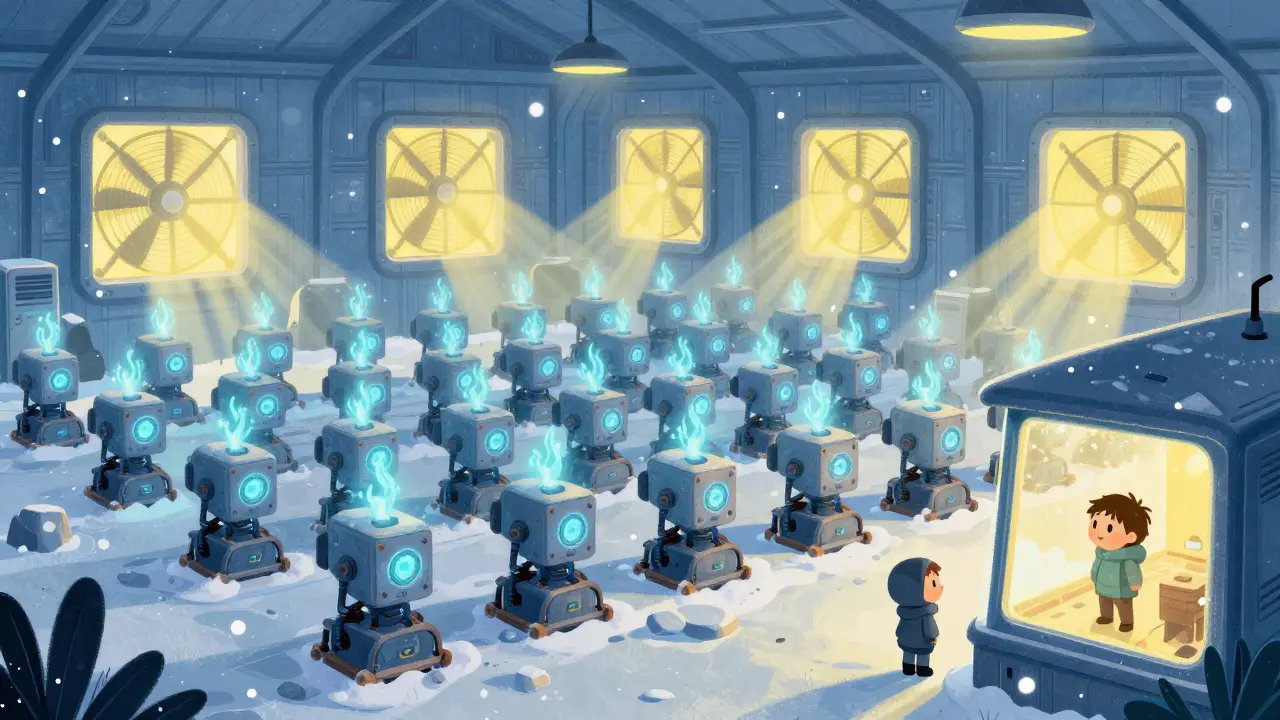
These machines are built with dozens of specialized chips packed tightly together. They’re housed in metal cases with powerful fans and sometimes even liquid cooling. They eat electricity - a single Antminer S21 uses about 3,250 watts when running at full power. That’s more than your entire home fridge, oven, and AC unit combined.
But here’s the key: they do it efficiently. For every watt of power they use, ASIC miners produce far more hash power than any other hardware. That’s why they dominate. It’s not just about speed - it’s about cost per hash. If you’re spending $0.12 per kilowatt-hour on electricity, you can’t compete unless you’re using ASICs.
Why ASIC Miners Are the Only Option for Bitcoin Mining
Bitcoin’s mining difficulty adjusts every two weeks to keep block times at around 10 minutes. As more miners join the network, the puzzles get harder. When ASICs arrived, the difficulty skyrocketed. Today, the network hash rate is over 1,000 exahashes per second. That’s a 1 followed by 21 zeros.
Try mining Bitcoin with a GPU today? You’d need to run 10,000 of them just to match one modern ASIC. And the electricity bill? You’d lose money every minute. Even if you got the hardware for free, the power cost would eat your profits before you even got paid.
That’s why CPU and GPU mining for Bitcoin is dead. It’s not just inefficient - it’s financially suicidal. ASICs aren’t just better. They’re the only viable option.
What Are the Downsides?
ASIC miners aren’t magic. They come with serious trade-offs.
- High upfront cost: A decent Bitcoin ASIC costs between $2,000 and $6,000. Entry-level models are cheaper, but they’re often already outdated by the time you buy them.
- Zero versatility: Once you buy an ASIC for Bitcoin, you can’t use it for anything else. No gaming. No video rendering. No mining altcoins. It’s a single-purpose machine.
- Fast obsolescence: New models come out every 6 to 12 months. The Antminer S19 Pro, released in 2021, was top-tier. By 2025, it’s barely profitable unless you have access to super cheap electricity.
- Heat and noise: These machines run hot and loud. You can’t put one in your bedroom. You need ventilation, cooling, and a dedicated space - often a garage, shed, or warehouse.
- Centralization risk: Because ASICs are expensive and require infrastructure, mining has shifted from individuals to big companies. A handful of firms now control most of Bitcoin’s hash power. That goes against Bitcoin’s original decentralized vision.
Many small miners who bought ASICs in 2021 are now sitting on machines that cost more to run than they earn. Electricity prices don’t drop. Mining difficulty keeps rising. Without access to renewable energy or subsidized power, the math doesn’t work.
Who Uses ASIC Miners Today?
There are two main groups: industrial miners and hobbyists with serious resources.
Industrial miners operate massive farms - sometimes thousands of ASICs in a single warehouse. They’re often located in places with cheap electricity: Quebec, Texas, Kazakhstan, or parts of Scandinavia. These operations are run like factories, with teams managing cooling, maintenance, and grid connections. They buy ASICs in bulk, directly from manufacturers like Bitmain, MicroBT, or Canaan.
Individual miners still exist, but they’re a shrinking group. Most are either:
- Early adopters who bought in before prices surged
- People with access to near-free electricity (like solar-powered homes)
- Those who mine altcoins like Kaspa or Kadena, where ASICs are newer and competition is lower
If you’re thinking about buying an ASIC today, ask yourself: Do I have access to electricity under $0.06 per kWh? Do I have space to cool it? Can I afford to lose $3,000 if the price of Bitcoin drops 30%? If the answer isn’t a solid yes, don’t buy one.
ASIC Miners vs. Other Hardware
Here’s how ASICs stack up against older mining hardware:
| Hardware Type | Hash Rate (Bitcoin) | Power Efficiency (J/TH) | Multi-Algorithm? | Resale Value |
|---|---|---|---|---|
| CPU (2009) | 0.0005 TH/s | 50,000+ | Yes | High |
| GPU (2015) | 0.1 TH/s | 10,000+ | Yes | High |
| ASIC (2025) | 200 TH/s | 15-25 | No | Very Low |
The difference isn’t just incremental - it’s exponential. ASICs are 2,000 times faster and 400 times more energy-efficient than GPUs. That’s why they replaced everything else.
What’s Next for ASIC Miners?
ASIC manufacturers are racing to build even more efficient chips. New models in 2025 use 5nm or even 3nm semiconductor technology, squeezing more hashes out of every watt. Some companies are experimenting with heat recovery - using the waste heat from ASICs to warm buildings in cold climates.
But the big question is sustainability. Critics say ASIC mining consumes too much power. Supporters argue it’s no worse than the global banking system or gold mining. The truth? It’s a lot. But as renewable energy becomes cheaper, more miners are switching to solar, hydro, or wind-powered farms.
There’s also the looming threat of Bitcoin moving to Proof-of-Stake. That would make ASICs worthless overnight. But that’s not happening. Bitcoin’s core philosophy is built on Proof-of-Work. It’s unlikely to change.
For now, ASIC miners are here to stay. They’re the engine of Bitcoin’s security. They’ve made mining a high-stakes industrial game - not a hobby for hobbyists.
Should You Buy an ASIC Miner?
Here’s the honest answer:
- Buy one if: You have access to electricity under $0.06/kWh, you’re okay with a 12-18 month payback period, you have space to install it, and you’re not counting on it to make you rich.
- Don’t buy one if: You think it’s a quick way to profit, you’re using grid power at $0.15+/kWh, you don’t have cooling or space, or you expect to resell it for a profit later.
Most people who buy ASICs today are either tech enthusiasts or investors betting on long-term Bitcoin adoption. They’re not chasing quick wins. They’re playing the long game.
If you’re just starting out, stick with buying Bitcoin directly. Mining isn’t the entry point it used to be. It’s a business now - and like any business, you need capital, infrastructure, and a clear plan.
Can ASIC miners be used for anything besides mining?
No. ASIC miners are designed to run one specific algorithm - like SHA-256 for Bitcoin or Scrypt for Litecoin. They can’t run games, render videos, or mine other coins. They’re single-purpose machines, like a toaster that can only make toast.
How much electricity does an ASIC miner use?
A modern Bitcoin ASIC miner like the Antminer S21 uses about 3,250 watts per hour. That’s roughly the same as running a large electric oven and a space heater at the same time. If electricity costs $0.12 per kWh, it costs about $9.36 per day to run. Over a month, that’s over $280 in power alone.
Are ASIC miners profitable in 2025?
Profitability depends on three things: electricity cost, Bitcoin price, and mining difficulty. If your electricity is below $0.06/kWh and Bitcoin is above $50,000, some newer ASICs can break even in 12-18 months. At higher electricity rates or lower prices, most ASICs lose money. Many older models from 2021-2023 are already unprofitable.
Can I mine other cryptocurrencies with a Bitcoin ASIC?
No. A Bitcoin ASIC only works with SHA-256 coins. That includes Bitcoin, Bitcoin Cash, and a few others. You can’t use it for Litecoin (Scrypt), Ethereum (Ethash), or Dogecoin (Scrypt). Each ASIC is locked to its algorithm.
Why are ASIC miners so loud?
They’re loud because they need powerful fans to cool down the intense heat generated by the chips. A single ASIC miner can sound like a jet engine running at low throttle. Most people install them in garages, basements, or separate buildings to avoid noise complaints.
What happens when a new, more efficient ASIC is released?
The mining difficulty increases automatically to match the new hash power. Older ASICs become less profitable - sometimes overnight. If your machine is 12-18 months old, it might not cover its electricity cost anymore. That’s why mining is a constant arms race: buy new hardware, or get left behind.
If you’re curious about mining, start by using a mining calculator. Plug in your electricity cost, the model of ASIC you’re considering, and the current Bitcoin price. See what the numbers say. Most people are shocked by how little profit they’d actually make after power, cooling, and maintenance.
ASIC miners changed cryptocurrency forever. They made mining a business, not a hobby. They secured Bitcoin’s network. But they also made it harder for ordinary people to participate. That’s the trade-off.
Heather Hartman
Just bought my first ASIC last month and honestly? It’s been a wild ride. I got it for $2,800 with solar power at $0.04/kWh - barely breaking even but it feels like I’m part of something real. No get-rich-quick dreams, just quiet hums and steady hashes. Worth it for the tech joy alone.
Catherine Williams
Y’ALL. I just watched my neighbor’s Antminer S21 in his garage and it sounded like a jet engine trapped in a tin can. He said he pays $180/month in electricity. I said, ‘Bro, you’re literally running a small data center in your backyard.’ He nodded. Then offered me a beer. We’re all just weirdos with wires now.
Paul McNair
People forget this isn’t just tech - it’s geopolitics. China banned mining. Russia got squeezed. Now Texas and Kazakhstan are the new gold rushes. The U.S. is quietly becoming the world’s Bitcoin farm. And yeah, it’s messy. But it’s also the most decentralized thing we’ve got left. Who knew electricity could be sovereignty?
Mohamed Haybe
ASICs are just western corporate toys. In India we mine with old laptops and dreams. You think power cost matters? We use generator fuel and patience. Your $3000 machine? We build rigs from scrap. You call it obsolete. We call it innovation. Your tech is dead. Our spirit isn't
Marsha Enright
For anyone thinking about buying one - USE A MINING CALCULATOR. Seriously. I did. Thought I’d make $500/month. Turned out I’d lose $120 after cooling and wear. Now I just HODL and cheer from the sidelines. You don’t need to mine to believe in Bitcoin. 💪
Durgesh Mehta
the heat thing is real i put mine in the garage and my wife says its like having a furnace that never turns off. but the noise? worse. my dog hates it. i think i might move it to the shed next month
Sarah Roberge
Okay but… what if the whole proof of work thing is just a giant energy scam? Like… we’re burning fossil fuels to secure a digital ledger that no one really needs? I mean… what if we’re all just… addicted to the idea of scarcity? Like… is Bitcoin even real? Or is it just… a very expensive glitter bomb?
Jess Bothun-Berg
Let’s be honest: ASIC mining is the death of decentralization. You need $5k, a warehouse, a power contract, and a PhD in cooling systems just to break even. This isn’t ‘mining’-it’s industrial monopolization disguised as blockchain. And now you’re telling me this is ‘the future’? No. It’s the corporate takeover of a revolutionary idea. Sad.
Mark Stoehr
my buddy bought an s19 pro in 2022 now its sitting in his basement like a fancy toaster that eats electricity. he still talks about it like its a pet. the only thing it mines now is regret
Shari Heglin
The claim that ASICs are the only viable option for Bitcoin mining is technically accurate but ideologically misleading. It assumes that profitability is the sole metric of legitimacy. This ignores the philosophical and decentralizing intent of the original protocol. The hardware monoculture is not progress-it is regression.
Reggie Herbert
Let’s cut through the noise: ASICs are just the next stage of capital concentration. The same pattern as oil, gold, even farming. Early adopters win. Everyone else pays rent. This isn’t tech evolution-it’s feudalism with hash rates. And the worst part? The devs who built this knew exactly what they were doing. They called it ‘progress.’
Lawal Ayomide
you think this is bad? in Nigeria we use solar panels and stolen grid power. the ASICs don't care where the juice comes from. they just mine. and we don't talk about profit. we talk about survival. your electricity bill? ours is a prayer.
justin allen
ASICs are the reason Bitcoin is doomed. America is turning crypto into a corporate energy tax. You think Elon or Musk gives a damn about decentralization? Nah. They just want to sell you more power. This isn’t freedom. It’s a utility bill with a blockchain sticker on it.