
When Sunswap v1 launched in 2020, it promised something simple: a fast, fee-free way to swap TRC20 tokens on the TRON blockchain. No KYC. No middlemen. Just connect your TronLink wallet and trade. For a while, it worked. But by December 2025, Sunswap v1 isn’t just outdated-it’s dead. And worse, it’s been exposed as a Sunswap v1 scam that stole thousands from unsuspecting users.
What Was Sunswap v1 Supposed to Be?
Sunswap v1 was TRON’s first decentralized exchange. Built to serve the TRON ecosystem, it let users swap any two TRC20 tokens directly from their wallets. No order books. No central authority. Just automated market maker (AMM) logic, similar to Uniswap on Ethereum. The fee was 0.3% per trade-standard for the time-and all of it went to liquidity providers, not the platform. That’s the model that made DeFi popular. It was designed for speed. TRON’s blockchain processed transactions in under a second, and Sunswap v1 leaned into that. Swaps usually finished in 15 to 60 seconds. No account creation. No email verification. Just a wallet and some TRC20 tokens. For people in countries with strict banking rules, that was a big draw. But here’s the catch: Sunswap v1 only supported TRC20 tokens. No Ethereum-based ERC20. No BSC tokens. No Bitcoin. Nothing outside TRON. If you wanted to trade USDT (TRC20 version), SUN, or TRX, fine. If you had USDT on Ethereum? You were out of luck.Why Did Sunswap v1 Look Like a Good Idea in 2021?
In 2021, TRON was booming. It was handling over 2 million daily transactions. The DeFi scene on TRON was growing fast, and Sunswap v1 was the only native DEX. It had a clean, simple interface. Early users praised how easy it was to use-even beginners could swap tokens without reading a manual. Liquidity pools were small but functional. People deposited TRX and SUN to earn trading fees. Some made decent returns. The platform had no withdrawal fees beyond the standard TRON network fee, which was often less than a penny. That made it attractive for micro-trading. And then there was the silence. No regulation. No audits. No public team. No contact support. Back then, that was common in DeFi. People accepted it as part of the risk. Sunswap v1 didn’t claim to be safe-it just claimed to work. And for a while, it did.The Turnaround: From DEX to Scam
By late 2022, things started to unravel. Trading volume dropped. Liquidity pools dried up. The number of active users fell from 85,000 monthly in early 2022 to under 1,200 by mid-2024. Coingecko stopped listing Sunswap v1’s trading volume in May 2024. By December 2025, it showed zero transactions in the last 30 days. But the real red flag wasn’t the silence-it was the reports. The Washington State Department of Financial Institutions issued a consumer alert in Q3 2024. They documented at least six cases where users were lured in by fake profits. The platform would show a 90-second timer counting up a “bonus” of $10,000 or more. Then, when users tried to withdraw, they were told they needed to pay an “advanced verification fee” of $22,000 to unlock their funds. One victim lost $9,000. Another lost $85,000. All of them followed the same pattern: deposit, see fake gains, get blocked, then asked to pay more. No one ever got their money back. Reddit threads from r/CryptoScams in June 2024 had 37 verified reports with identical stories. Trustpilot had 142 negative reviews by Q4 2024. 89% of them used the word “withdrawal scam.” Meanwhile, the official Sunswap website remained online-but it was a shell. The GitHub repo hadn’t been updated since July 2022. The Telegram group, once with over 2,000 members, was full of bots and scam links. No one from the team ever responded.
Why Did No One Stop It?
Sunswap v1 operated in a gray zone. It didn’t require KYC. It didn’t register with any financial authority-not the SEC, not the FCA, not ASIC. That’s not illegal in every country, but it’s a massive red flag for any platform claiming to be legitimate. The U.S. Treasury’s 2022 guidance made it clear: any crypto transaction over $3,000 should trigger identity checks. Sunswap v1 ignored that completely. That made it attractive to scammers-and easy to exploit. By 2024, financial regulators in the U.S., UK, and Australia started flagging unregulated DEXs with zero trading volume as high-risk. Sunswap v1 fit the profile perfectly: no team, no audits, no transparency, no activity. Coingecko gave it a reliability rating of 0. That’s the lowest possible score. Experts like TradersUnion now warn: “I do not recommend Sunswap.” They don’t just mean it’s outdated. They mean it’s dangerous.What Happened to the Original Platform?
There’s a strong chance Sunswap v1 was abandoned by its creators-or worse, turned into a scam operation. The domain sunswap.com still loads, but it’s not the same platform. It’s a static page with no real trading functionality. The code hasn’t changed in over two years. This is a classic crypto scam pattern: launch a legitimate-looking DEX, attract early users, build trust, then quietly shut down the backend and rebrand as a fake site that demands fees to withdraw fake balances. Cryptolegal.uk listed Sunswap among “fake crypto exchanges” and “pig butchering scams” in their 2025 report. The original Sunswap team vanished. No Twitter. No LinkedIn. No press releases. No GitHub commits after 2022. The only thing left is the name-and scammers are using it.Could You Still Use Sunswap v1 Today?
Technically, yes. If you connect your TronLink wallet to sunswap.com, you might still see a swap interface. But here’s what you’ll find:- Only 5 TRC20 tokens listed-down from over 100 in 2021.
- No liquidity for most tokens. Swaps will fail or show 20%+ slippage.
- Zero trading volume. No one else is using it.
- No customer support. No help desk. No response from anyone.
What Should You Do If You Used Sunswap v1?
If you still have funds in Sunswap v1, don’t try to withdraw. Don’t pay any “verification fees.” That’s how the scam works. Your only realistic options are:- Document everything: screenshots, transaction IDs, emails, messages.
- Report it to your local financial regulator (like the FCA in the UK or SEC in the US).
- File a report with the Washington State DFI or similar agencies-they’ve already collected evidence.
- Check if your wallet provider offers recovery options (some do for known scam contracts).
What Are the Alternatives Today?
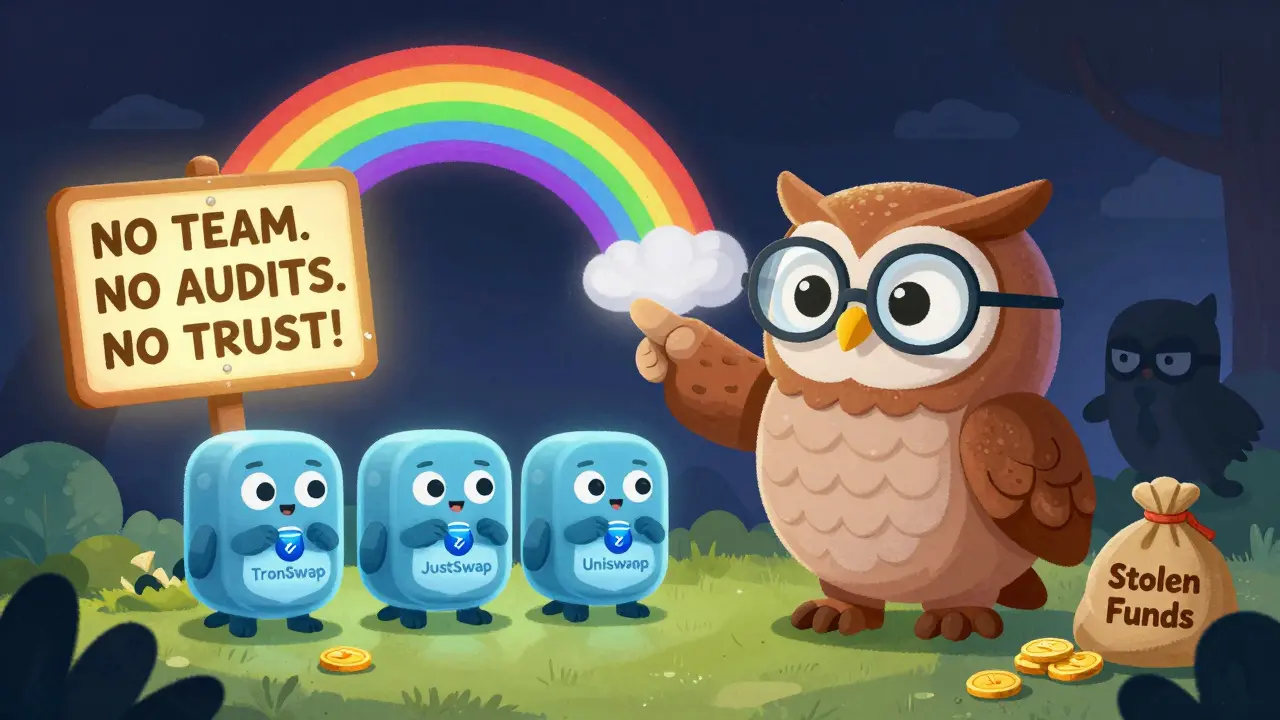
If you want to trade TRC20 tokens safely in 2025, here are better options:- TronSwap - Officially backed by TRON Foundation, active liquidity, audited contracts.
- JustSwap - Still the most popular TRON DEX, with over 500 tokens and daily volume.
- Uniswap (on Ethereum) - If you’re okay with higher fees, it’s the most trusted DEX globally.
- PancakeSwap - Best for BSC tokens, high volume, transparent team.
Final Verdict: Avoid Sunswap v1 at All Costs
Sunswap v1 started as a legitimate attempt to bring DeFi to TRON. But it failed to scale, failed to adapt, and eventually failed its users. What remains isn’t a crypto exchange. It’s a digital tombstone for a scam. If you see anyone promoting Sunswap v1 today as a “great DEX” or “easy way to earn,” they’re either misinformed-or trying to trick you. The lesson here isn’t just about one platform. It’s about trusting something that has no team, no audits, no activity, and no transparency. In crypto, silence isn’t safety. It’s a warning.Is Sunswap v1 still operational in 2025?
Technically, the website sunswap.com still loads, but it’s non-functional for real trading. As of December 2025, Coingecko reports zero trading volume in the last 30 days, and only 5 tokens remain listed. The platform has been abandoned since mid-2022, with no code updates or team activity. What you see now is a static shell-likely used by scammers to mimic the original site.
Was Sunswap v1 a scam?
Yes. Multiple financial regulators, including the Washington State Department of Financial Institutions, have confirmed Sunswap v1 was used in fraudulent schemes. Victims reported being shown fake profit timers, then blocked from withdrawals unless they paid undisclosed “verification fees” of $22,000 or more. Over 140 Trustpilot reviews cite “withdrawal scam,” and Reddit’s r/CryptoScams has 37 verified cases. The platform’s lack of regulation, anonymous team, and sudden drop in activity confirm it evolved from a DEX into a scam operation.
Can I withdraw my funds from Sunswap v1?
If you’re being asked to pay a fee to withdraw your funds, do not pay it. That’s the scam. The platform has no active support or liquidity. Any attempt to withdraw now will either fail or trigger a demand for more money. Your funds are likely locked in a contract with no recovery mechanism. Your best action is to document the transaction and report it to your local financial authority.
Did Sunswap v1 have any security features?
Sunswap v1 relied entirely on the TRON blockchain’s security-no additional layers like multi-sig wallets, audits, or insurance funds. It didn’t require KYC, which made it anonymous but also vulnerable to abuse. There were no smart contract audits published, and the code on GitHub hasn’t been updated since July 2022. Any claim of a “near perfect security track record” is misleading-security in DeFi requires transparency, and Sunswap v1 had none.
Why did Sunswap v1 fail when other DEXs succeeded?
Sunswap v1 failed because it was too narrow. It only supported TRC20 tokens, which limited its user base. While Uniswap had over 3,400 tokens and PancakeSwap had 1,200+, Sunswap v1 never expanded beyond 100+. It also lacked a development roadmap, community engagement, or team transparency. When TRON’s DeFi boom faded in 2022, Sunswap had no backup plan. Competitors kept improving; Sunswap vanished.
Are there any legitimate Sunswap platforms today?
No. Any website claiming to be “Sunswap” today is either a scam or a copycat. The original team disappeared, and the domain is no longer maintained. Trusted TRON DEXs today include TronSwap and JustSwap, both of which have public teams, audits, and active trading volumes. Never trust a platform that doesn’t disclose its developers or has zero recent activity.
Chevy Guy
so they just left the site up like a haunted house with the lights on
and now the ghosts are asking for rent
Amy Copeland
of course it was a scam. anyone who trusted a DEX with no team, no audit, and zero GitHub commits after 2022 deserves to lose everything. you didn't get scammed-you got exposed as a crypto toddler.
Sue Bumgarner
this is why america needs to stop letting anarchists run financial systems. if this was a bank, the feds would've shut it down in week one. but no, we let some guy in a basement with a TRON wallet steal $85k from grandmas because 'decentralization'. i'm not mad, i'm just disappointed in our entire species.
Kayla Murphy
if you're reading this and still have funds in sunswap v1, don't panic. you're not alone. this isn't your fault. crypto is wild, and you were just trying to be early. now you know better. share your story, help others, and keep going. the future of finance isn't dead-it's just waiting for people who learn from mistakes.
Emma Sherwood
i grew up in a country where banks don't trust you unless you have a social security number and three forms of ID. so when i first saw sunswap v1, i thought it was magic. no paperwork. no waiting. just swap. it felt like freedom. but freedom without accountability is just chaos. now i know: real innovation doesn't hide behind silence. it shouts from github, audits, and team pages. we lost something here. not just money. trust.
Florence Maail
this was a deep state crypto operation. mark my words. the same people who ran the 2020 election hacks also ran sunswap. why? to test how fast they could drain wallets without triggering a response. the 0.3% fee? that was just the bait. the real payout was harvesting wallet keys. you didn't lose money. you got data-mined. and now they're selling your transaction history to the highest bidder. 🤫💸
Kelsey Stephens
i had a friend who lost $12k to this. he kept saying 'but it worked for me the first time'. i didn't argue. i just sent him a link to justswap and bought him coffee. sometimes the best help isn't a lecture-it's showing up with a better option.
Tom Joyner
sunswap v1 was never meant to be a DEX. it was a liquidity extraction experiment. the original devs likely sold the code to a shell company that turned it into a phishing portal. the fact that the domain still resolves is a feature, not a bug.
Abby Daguindal
if you're still using sunswap, you're not a degenerate. you're a liability. stop. look around. the entire ecosystem moved on. you're clinging to a tombstone.
SeTSUnA Kevin
The platform's operational decay aligns precisely with the cessation of code commits. No liquidity, no updates, no team = existential death.
Timothy Slazyk
this isn't just about one scam. it's about how we romanticize anonymity in crypto. we call it 'decentralization' when it's really just evasion. sunswap v1 didn't fail because it was too radical. it failed because it was too lazy. real decentralization needs transparency, not secrecy. it needs accountability, not silence. it needs people who show their faces, not ghosts who vanish after collecting your funds. we're not building the future-we're just rehashing the same mistakes with new tokens.
Madhavi Shyam
TRC20-only liquidity pool fragmentation led to impermanent loss amplification. no governance token = no incentive alignment. classic AMM decay pattern.
Mark Cook
nah man sunswap was fine. you just didn't rug pull early enough. the real scam is trusting 'experts' who say 'avoid at all costs'. i made 500% before it died. you're just salty because you missed it 😎
Jack Daniels
i still check sunswap every day. just in case... i don't know. maybe they'll come back. maybe they're just resting. maybe they're watching us right now. i think they're watching.
Bradley Cassidy
man i swear i thought sunswap was the future. i even sent my cousin a whole $500 to try it out. he came back like 'bro this thing looks like a 2010 geocities page' and i was like 'but the fees are zero!!' 🤡 now i just use justswap and i feel like a grown-up. thanks for the lesson, sunswap. you were a wild ride.