
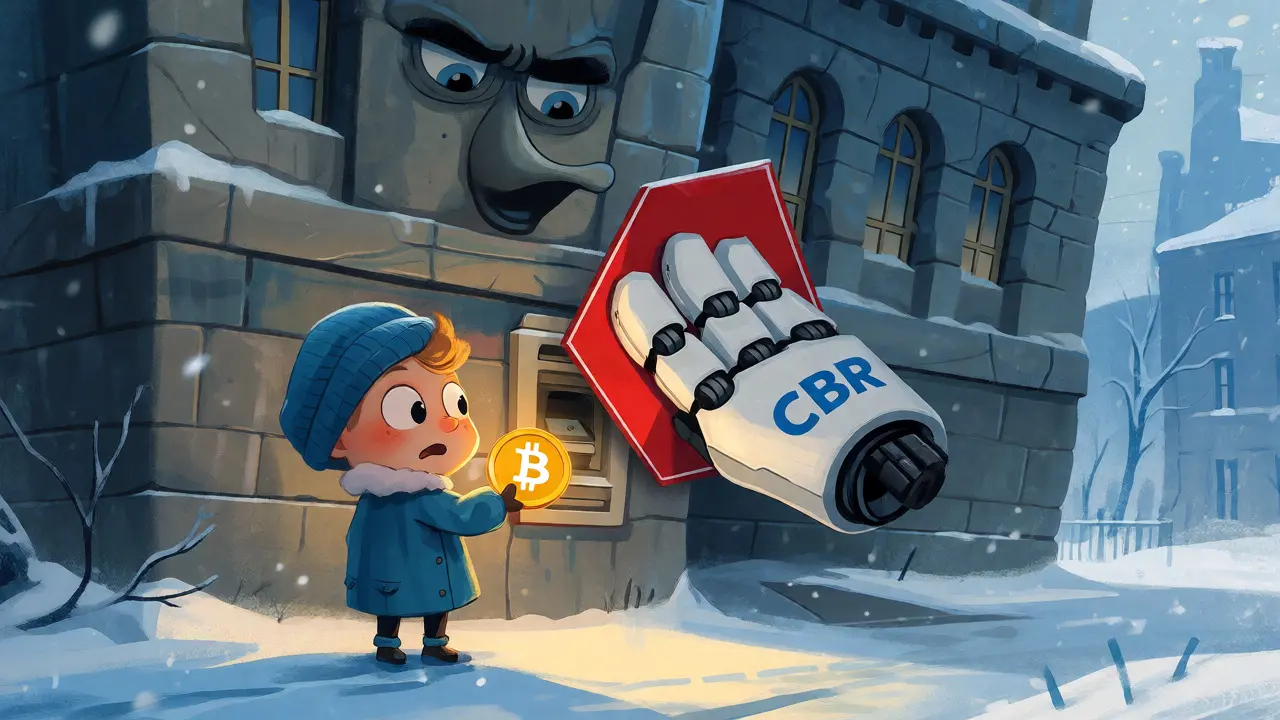
Imagine trying to buy a coffee with Bitcoin in Moscow, only to find your bank has frozen the transaction because you withdrew cash too quickly. This isn't a hypothetical scenario from a dystopian novel; it is the daily reality for Russian cryptocurrency traders as of late 2025. The Russia's crypto banking ban is not a single law but a complex web of restrictions, most notably the September 2025 implementation of strict cash withdrawal limits designed to curb fraud but which inadvertently choked the liquidity of local crypto markets. If you are a trader, miner, or investor navigating this landscape, understanding the mechanics of these bans and finding effective Bitcoin trading workarounds is no longer optional-it is essential for survival.
The situation feels like a high-stakes game of cat and mouse. On one side, you have the Central Bank of Russia (CBR) which maintains a hardline stance against decentralized digital currencies circulating domestically, citing financial stability and fraud prevention. On the other, you have a vibrant community of users who turned to crypto out of necessity during sanctions and now face a regulatory wall that seems to grow higher every month. This article breaks down exactly what changed in September 2025, why it matters, and how smart money is moving around the blockade.
The September 2025 Cash Withdrawal Restrictions
Let’s get specific about the rule that broke many traders' backs. Effective September 1, 2025, Russian banks gained the power to limit daily ATM cash withdrawals to 50,000 rubles (approximately $600) for 48-hour periods if they detect "suspicious" activity. This wasn't applied universally; it was triggered by algorithmic monitoring systems looking for patterns associated with fraud. But here is the catch: legitimate crypto transactions often look exactly like fraudulent ones to a rigid algorithm.
Why? Because crypto trading in Russia, particularly at the retail level, remained heavily reliant on cash. Small exchange offices and peer-to-peer (P2P) platforms used physical rubles to settle trades. When a trader moved large sums into an account to buy Bitcoin, or when a miner cashed out earnings, the sudden spike in activity flagged the system. The CBR reported 273,100 fraud cases totaling 6.3 billion rubles in Q2 2025 alone. To combat this, they tightened the screws. For a trader trying to move 500,000 rubles, this meant spreading transactions over ten days or more, destroying the speed advantage of crypto.
| Operational Aspect | Pre-September 2025 | Post-September 2025 |
|---|---|---|
| Cash Liquidity | High availability via ATMs | Limited to 50k RUB/day during flags |
| P2P Settlement Speed | Instant or same-day | Delayed due to withdrawal caps |
| Miner Cash-Out | Direct sales to local buyers | Complex multi-day liquidation |
| Bank Monitoring | Standard AML checks | Algorithmic flagging of spikes |
Why Banks Flag Crypto Transactions as Fraud
You might ask, "How do banks know I'm buying Bitcoin?" They don't always know explicitly, but they see the footprint. The new monitoring system looks for specific behavioral triggers. Did you suddenly change your mobile banking authorization number? Did you register a loan and then immediately withdraw cash? Are you transferring more than 200,000 rubles between accounts? These are classic signs of "mule" accounts used in fraud rings. Unfortunately, active crypto traders exhibit similar behaviors.
For instance, if you use a P2P platform like Bybit or Huobi (now HTX) to sell USDT for rubles, you receive a transfer from a stranger. Then, you go to the ATM to withdraw that cash to meet another buyer. To the bank, this looks like layering-moving money through different hands to obscure its origin. The result is a freeze or a cap on your cash access. This friction has pushed many traders away from traditional banking rails entirely, seeking alternatives that don't rely on the fragile trust of state-controlled banks.
Effective Workarounds for Bitcoin Trading
So, how do you trade without hitting the 50,000-ruble wall? The market has adapted, and several strategies have emerged as viable crypto workarounds.
- Foreign Platform Reliance: Since there is no explicit ban on owning crypto, Russians increasingly use foreign exchanges that accept Russian cards for deposits but settle trades internally. You deposit rubles via card (if allowed), buy USDT, and then trade. The risk here is card blocking, but many users rotate cards across different banks to mitigate this.
- Gift Card Arbitrage: This method involves buying gift cards (for Ozon, Yandex Market, etc.) using crypto or bank transfers, then selling those cards for cash or bank transfers. It bypasses direct crypto-to-bank flows, making the transaction look like standard consumer spending rather than investment activity.
- Stablecoin Bridges: Instead of holding Bitcoin directly, traders hold stablecoins like USDT or USDC. These are less volatile and easier to move between platforms. Some traders use non-custodial wallets to swap BTC for USDT, then send USDT to a friend abroad who converts it back to rubles via their own local network, effectively creating a private remittance channel.
- Multi-Day Cash-Out Strategies: For miners, the solution is patience. Instead of dumping all mined BTC at once, they stagger sales. By keeping daily inflows below the threshold that triggers aggressive monitoring, they can maintain normal ATM access. It’s slower, but it keeps the bank happy.

The Rise of the "Crypto Bank" Proposal
Not everyone is resigned to these hurdles. Evgeny Masharov, a member of the Russian Civic Chamber, has been vocal about a structural fix: establishing a dedicated crypto-enabled bank modeled after Belarus's Hi-Tech Park framework, which would legally integrate crypto operations into the formal banking sector. The logic is sound. Currently, crypto sits in a gray zone. It’s legal to own, but illegal to pay with domestically. This ambiguity forces businesses into shadow operations.
A crypto bank would allow licensed institutions to handle fiat-on-ramps and off-ramps with clear KYC/AML protocols. This would solve the fraud issue by bringing transparency to the flow of funds while allowing legitimate traders to move large sums without fear of arbitrary freezes. While the CBR remains skeptical, fearing capital flight and loss of monetary control, the pressure from the mining industry-which generated billions in revenue despite regional bans-is mounting. In 2025, mining continued to thrive even with restrictions in 10 out of 46 regions, proving that the demand for infrastructure is real.
Global Context: Russia's Declining Adoption Rank
It is worth noting the broader trend. Russia fell from 7th place in the Chainalysis Global Adoption Index in 2024 to outside the top 10 in 2025. This drop correlates directly with increased regulatory friction. Compare this to Ukraine, which also dropped (from 6th to 8th) but for different reasons-war-time disruptions. In Russia, the decline is policy-driven.
This doesn't mean usage stopped. It means the nature of usage changed. It shifted from speculative retail trading to institutional and cross-border utility. Companies use crypto to bypass SWIFT restrictions for international trade. Individuals use it to preserve wealth against ruble volatility. But the casual "buy low, sell high" trader is being squeezed out by compliance costs and operational friction.

Navigating the Experimental Legal Regime
If you are a serious investor, you might qualify for the experimental legal regime. This program targets "qualified investors"-those with portfolios exceeding 100 million rubles and annual incomes over 50 million rubles. For these elites, the rules are different. They can participate in structured crypto products under supervision. For the rest of us, we operate in the wild west of P2P and foreign exchanges.
The key takeaway? Do not rely on a single bank. Diversify your banking relationships. Keep your crypto holdings in self-custody wallets where possible. And stay updated on CBR directives, as they can shift with little notice. The goal is to remain liquid enough to act when opportunities arise, without getting caught in the net of anti-fraud algorithms.
Frequently Asked Questions
Is it illegal to buy Bitcoin in Russia?
No, owning and buying Bitcoin is not illegal. However, using it for domestic payments (like buying groceries) is prohibited. The restrictions primarily target the banking channels used to convert fiat to crypto, specifically through cash withdrawal limits and enhanced monitoring.
What is the daily cash withdrawal limit for crypto traders?
As of September 2025, banks can limit cash withdrawals to 50,000 rubles ($600) per day for 48 hours if suspicious activity is detected. This is not a universal ban but a conditional restriction triggered by algorithmic monitoring of unusual transaction patterns.
Can Russian citizens use foreign crypto exchanges?
Yes, there is no explicit prohibition on using foreign platforms. Many traders use exchanges like Bybit, HTX, or Binance (depending on current accessibility) to trade. However, funding these accounts via Russian bank cards can be difficult due to potential blocks by local banks.
How do miners cash out their earnings?
Miners often use a combination of methods: selling gradually to avoid triggering withdrawal caps, using P2P networks, or utilizing specialized OTC (Over-The-Counter) desks that handle large volumes privately. Some also export mining equipment or services to jurisdictions with clearer regulations.
What is the "experimental legal regime" for crypto?
This is a special status for qualified investors (high net worth individuals) that allows them to participate in regulated crypto activities under a controlled framework. It excludes the general public and aims to test crypto integration without exposing the broader economy to risks.