

Imagine living in a country where the government has blocked access to major cryptocurrency exchanges. You cannot buy Bitcoin on Binance, you cannot sell Ethereum on Coinbase, and your bank account is frozen if it detects any crypto-related activity. For millions of people around the world, this is not a hypothetical scenario-it is their daily reality. In these environments, non-custodial crypto wallets are not just a convenience; they are often the only way to maintain financial sovereignty.
The core promise of non-custodial wallets is simple: 'not your keys, not your crypto.' Unlike custodial services that hold your private keys for you, non-custodial solutions give you direct control over your assets. This distinction becomes critical when operating under regulatory constraints. While custodial exchanges can be shut down, frozen, or forced to comply with local laws, a non-custodial wallet exists purely on the blockchain. No central authority can freeze your funds, no matter how restrictive the local regulations become.
Why Non-Custodial Wallets Are Essential in Restricted Jurisdictions
To understand why these wallets matter, we need to look at the fundamental difference between custodial and non-custodial systems. When you use a centralized exchange like FTX or Binance, you are trusting a third party to safeguard your assets. If that company goes bankrupt, gets hacked, or faces regulatory pressure, your funds are at risk. The collapse of FTX in November 2022, which left customers without access to $8 billion in assets, serves as a stark reminder of this vulnerability. Even though repayments were expected by mid-2024, the process took 18 months and involved significant trade-offs in liquidity and asset selection.
In contrast, non-custodial wallets are digital tools that grant users complete control over their private keys without third-party intermediaries. According to Cointracker’s 2024 documentation, these systems are defined by 'user-controlled private keys' and 'no third-party reliance.' This architecture provides enhanced security through decentralization. For citizens in nations with cryptocurrency restrictions, this means they can interact directly with the blockchain without needing approval from an intermediary. As noted in the Wilson Center's July 2024 report, non-custodial wallets function as 'the only true and verifiable ownership' model that cannot be easily blocked or monitored by authorities.
This independence allows users to bypass mandatory KYC (Know Your Customer) processes that are standard for custodial services. In countries where identity verification leads to surveillance or asset confiscation, the ability to create a wallet without providing personal information is invaluable. It enables direct access to decentralized exchanges like Uniswap and PancakeSwap, allowing users to trade assets peer-to-peer without triggering alerts at centralized points of failure.
Types of Non-Custodial Wallets and Their Technical Specifications
Not all non-custodial wallets are created equal. Understanding the different types available is crucial for choosing the right tool based on your security needs and technical comfort level. Generally, these wallets fall into three categories: browser extensions, mobile applications, and hardware devices.
MetaMask is a popular browser extension wallet that connects users to the Ethereum network and other compatible blockchains. As of August 2024, MetaMask version 11.15.0 was widely used, offering a user-friendly interface for interacting with decentralized applications (dApps). Browser extensions are convenient for desktop users but require careful management of browser permissions to avoid phishing attacks.
Mobile applications like Trust Wallet is a mobile-first non-custodial wallet supporting multiple blockchain networks. Version 2.10.0 offers robust support for various cryptocurrencies and integrates seamlessly with mobile dApps. These apps are ideal for users who prefer managing their assets on the go, but they carry the risk of malware if the device itself is compromised.
For maximum security, hardware wallets are the gold standard. Ledger Nano S costs approximately $79 USD, while the Ledger Nano X is priced at $149 USD, according to Ledger Academy's 2024 specifications. These devices store private keys offline, ensuring that signing transactions happens within the hardware wallet itself before being sent online to the blockchain. This 'air-gapped' approach significantly reduces the risk of remote hacking, making them particularly valuable in high-risk environments.
| Wallet Type | Security Level | Convenience | Cost | Best For |
|---|---|---|---|---|
| Browser Extension (e.g., MetaMask) | Moderate | High | Free | Desktop dApp interaction |
| Mobile App (e.g., Trust Wallet) | Moderate | High | Free | On-the-go management |
| Hardware Device (e.g., Ledger) | High | Low | $79-$149 | Long-term storage & large holdings |
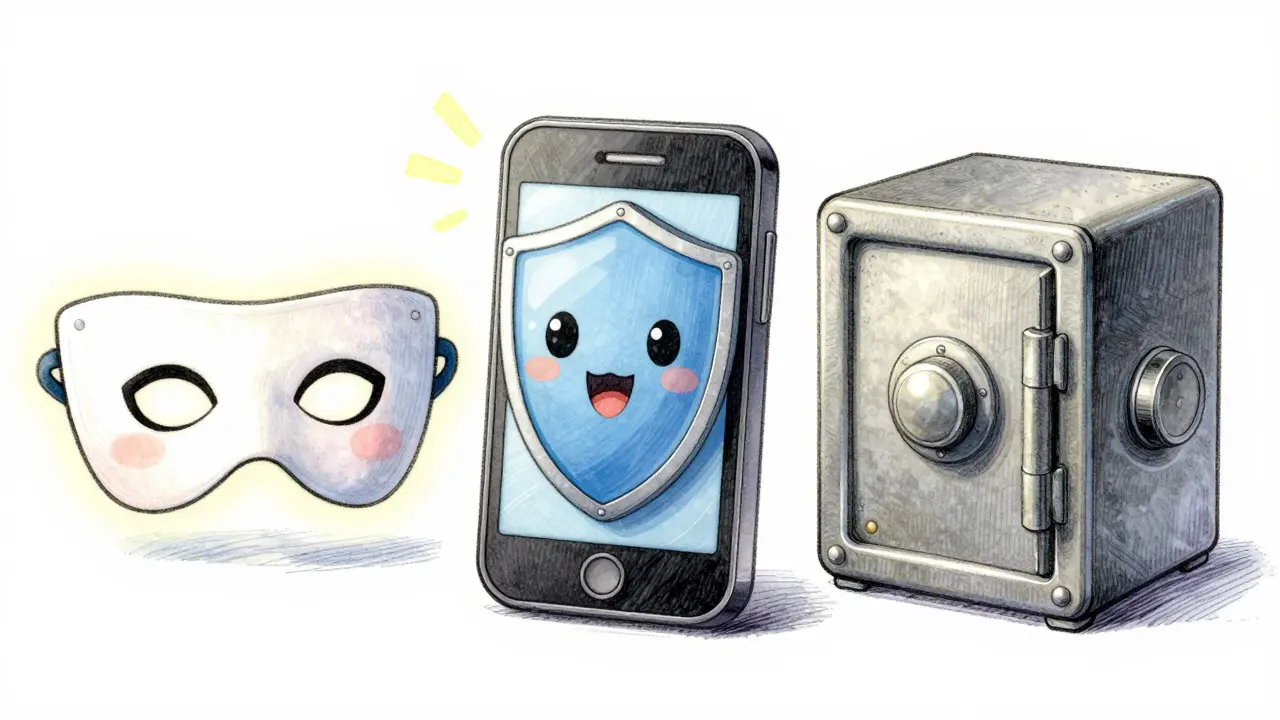
The Critical Role of Seed Phrases and Recovery
The most important feature-and the biggest risk-of any non-custodial wallet is the recovery phrase, also known as a seed phrase. During setup, your wallet generates a 12-24 word sequence that serves as the sole means of account recovery. There is no customer support team that can reset your password. If you lose this phrase, your funds are gone forever. As Forvismazars' March 2025 risk management report notes, 'if a private key is lost or compromised, there is no way to recover the funds.'
In restricted countries, the stakes are even higher. Users may face physical threats or confiscation attempts, making secure backup methods essential. You should never store your seed phrase digitally-no screenshots, no cloud storage, no email drafts. Instead, write it down on paper and store it in a safe, fireproof location. Some advanced users opt for metal plates to protect against water and fire damage.
Consider the story of u/KeyLoser2024, who reported losing $3,200 after misplacing their seed phrase while moving countries. This tragedy could have been avoided with proper backup practices. In environments where users cannot access customer support channels, the responsibility for security falls entirely on you. This double-edged sword offers ultimate freedom but demands rigorous discipline.
Navigating Technical Challenges and Security Risks
While non-custodial wallets offer superior privacy, they come with a steep learning curve. BitPay’s 2024 analysis highlights that users appreciate 'more advanced functions and features' but consistently struggle with the 'more technical knowhow needed.' Understanding how blockchain transactions work, interacting with different networks, and safeguarding private keys requires time and effort.
Transaction fees vary by network congestion, typically ranging from $0.01 to $50 USD. Unlike custodial services that charge hidden service fees, non-custodial wallets pass along native blockchain costs. This transparency is beneficial, but unexpected gas spikes can catch inexperienced users off guard.
Security practices are critical. Users must create 'air-gapped' backup systems, verify smart contract addresses to avoid phishing scams, and keep their software updated. MoonPay’s 2024 security analysis points out that while non-custodial wallets offer 'better protection against data breaches' compared to custodial solutions vulnerable to hacks like the $90 million Liquid exchange incident, their technical complexity presents particular challenges in restricted countries where educational resources may be limited or censored.
Time investment for proficiency ranges from 10-40 hours according to MetaMask's user onboarding data. In restricted regions, users often need additional time to navigate censorship circumvention tools like VPNs, which are necessary to access wallet interfaces and blockchain explorers safely.

Real-World Applications and User Experiences
User feedback reveals patterns highly relevant to restricted country contexts. On Reddit’s r/CryptoCurrency forum in August 2024, user u/PrivacySeeker99 commented, 'In my country where exchanges are banned, MetaMask is my only gateway to DeFi.' This sentiment is shared by many who rely on non-custodial wallets to participate in the global economy despite local prohibitions.
However, the community also shares warnings. The absence of customer support creates anxiety among beginners. Ledger’s community forums show users in restricted regions valuing the 'turned off when not in use' security model, yet Trustpilot reviews indicate an average rating of 3.8/5, with 32% mentioning difficulty in usage. This gap between potential and usability underscores the need for better education and intuitive design.
Despite these challenges, adoption continues to grow. Global non-custodial wallet usage reached an estimated 85 million active users in Q2 2024, according to DappRadar data cited by Cointracker. The market is evolving with innovations like multi-signature wallets and multi-party computation, which require a majority of participants to agree to transactions. These emerging models offer enhanced security options for high-risk environments.
Future Outlook and Regulatory Adaptations
As regulatory frameworks evolve, non-custodial wallets will likely remain the essential interface for storing, accessing, and controlling tokens within the Web3 ecosystem. Forvismazars suggests that their relevance will persist, especially in jurisdictions where financial sovereignty remains contested. Current developments include enhanced security features such as passphrase protection and Shamir backup options introduced by Ledger in version 2.3.0 (June 2024), specifically valuable for plausible deniability in oppressive regimes.
Cross-chain interoperability solutions allow users to navigate multiple blockchain networks from single interfaces, potentially circumventing network-specific restrictions. However, there are no formal industry adaptations specifically targeting restricted countries. This remains a user-driven adaptation rather than an organized market segment, highlighting the resilience and ingenuity of individuals seeking financial freedom.
Can I use a non-custodial wallet if my country bans cryptocurrency?
Yes. Non-custodial wallets operate on the blockchain, which is decentralized and cannot be shut down by any single government. As long as you have internet access and can download the wallet software, you can create and manage your own wallet without registering with any local authority.
What happens if I lose my seed phrase?
If you lose your seed phrase, your funds are irrecoverable. There is no customer support to help you reset your password. This is why creating multiple physical backups in secure locations is absolutely critical.
Are hardware wallets safer than mobile apps?
Generally, yes. Hardware wallets like Ledger store private keys offline, protecting them from online malware and hacking attempts. Mobile apps are more convenient but carry higher risks if your phone is infected with malicious software.
Do non-custodial wallets require KYC verification?
No. Creating a non-custodial wallet does not require Know Your Customer (KYC) verification. You simply generate a new wallet address locally on your device, maintaining full anonymity.
How do I pay transaction fees in a non-custodial wallet?
You must hold the native cryptocurrency of the blockchain you are using (e.g., ETH for Ethereum, SOL for Solana) to pay for gas fees. These fees are paid directly to network validators, not to the wallet provider.