
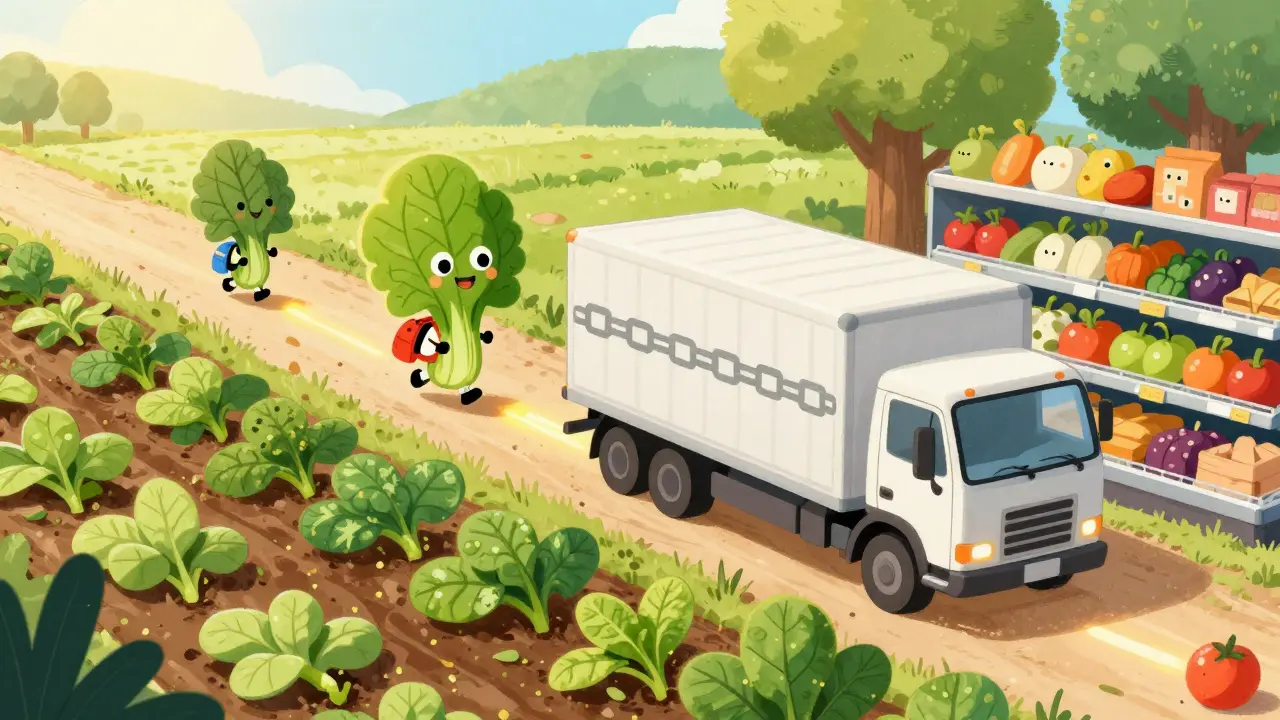
When a batch of spinach causes a foodborne illness outbreak, how long does it take to find out where it came from? In the old system, it could take weeks. With blockchain, it takes seconds. That’s not hype - it’s what Walmart, IBM, and dozens of major food suppliers have already proven.
Why Traditional Traceability Fails
For decades, food safety relied on paper logs, spreadsheets, and barcode scans. Each step - from the farm to the warehouse to the store - had its own system. Data didn’t talk to other systems. If a contaminated product showed up, companies had to call dozens of suppliers, dig through files, and guess which batch was the problem. In 2015, a listeria outbreak in the U.S. took 21 days to trace back to its source. By then, 10 people were dead. The problem wasn’t bad people. It was bad technology. Paper gets lost. Barcodes can be misread. Different companies use different formats. No one could trust the data fully. And if someone made a mistake - or worse, hid something - there was no way to catch it.How Blockchain Solves This
Blockchain is just a digital ledger. But it’s not stored in one place. It’s copied across hundreds of computers - suppliers, processors, shippers, retailers - all connected in a network. Every time a product changes hands, a new block is added. That block contains key data: what it is, where it came from, when it was packed, who handled it, and under what conditions. Here’s the catch: once it’s recorded, it can’t be changed. Not by accident. Not on purpose. No one person controls it. That’s why it’s called “immutable.” If a bag of lettuce was grown in California, shipped to Texas, then sent to a store in New York, every step is locked in. And anyone in the chain with permission can see it - in real time. This isn’t sci-fi. It’s built on GS1 standards - the same global system used for barcodes. The data uses EPCIS (Electronic Product Code Information Services), so systems from different companies can understand each other. No more guessing. No more silos.Real-World Proof: Walmart’s Leafy Greens Breakthrough
In 2018, Walmart made a bold move. They told every supplier of leafy greens: if you want to keep selling to us, you must use IBM’s Food Trust blockchain network. No exceptions. Before: tracing a bag of pre-washed salad back to the farm took 7 days. After: it took 2.2 seconds. They didn’t just test it on one product. They traced mangoes, strawberries, baby food, dairy, and poultry. They could scan a barcode on a salad box and instantly see: the farm in Yuma, Arizona; the packing facility; the refrigerated truck that carried it; the distribution center in Ohio; and the exact store shelf where it ended up. All in real time. That’s not convenience. That’s life-saving. If E. coli is found in one batch, you don’t recall 10,000 products. You recall exactly the 37 bags from that one truck on that one day. Less waste. Less panic. Fewer sick people.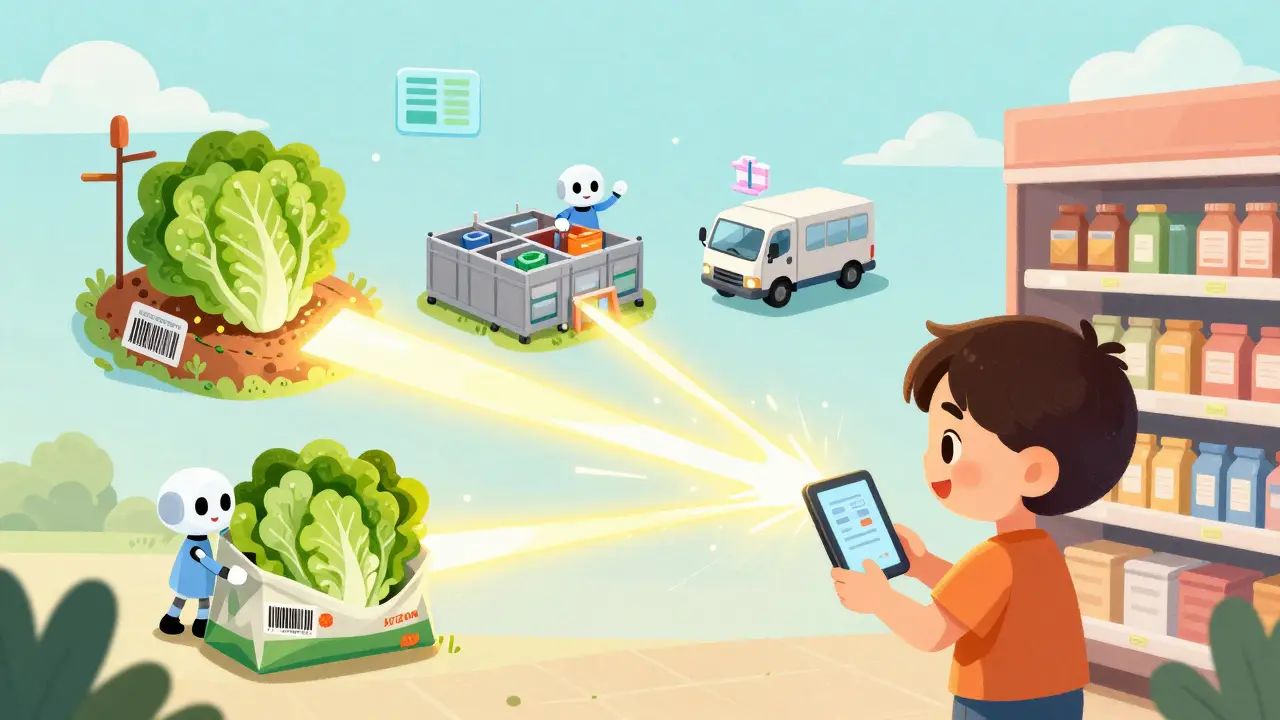
Who’s Using It Now?
Walmart wasn’t alone. Albertsons, Kroger, Carrefour, Dole, Nestlé, Tyson Foods, and Unilever all joined the IBM Food Trust network. Today, over 100 companies are on it. The system isn’t owned by one company - it’s a shared public utility for food safety. In Europe, Carrefour uses blockchain to track chicken from French farms to their stores. Consumers can scan a QR code on the packaging and see the farm name, the feed used, and the slaughter date. In China, Walmart’s pork traceability system reduced contamination risks by 90% in pilot zones. Even small farms are getting involved. In the UK, a group of organic vegetable growers in Somerset partnered with a local tech startup to use a lightweight blockchain app. They don’t need IBM’s full system - they use a simplified version that still gives them proof of origin. Buyers at farmers’ markets can now verify their produce is truly local.What Data Gets Recorded?
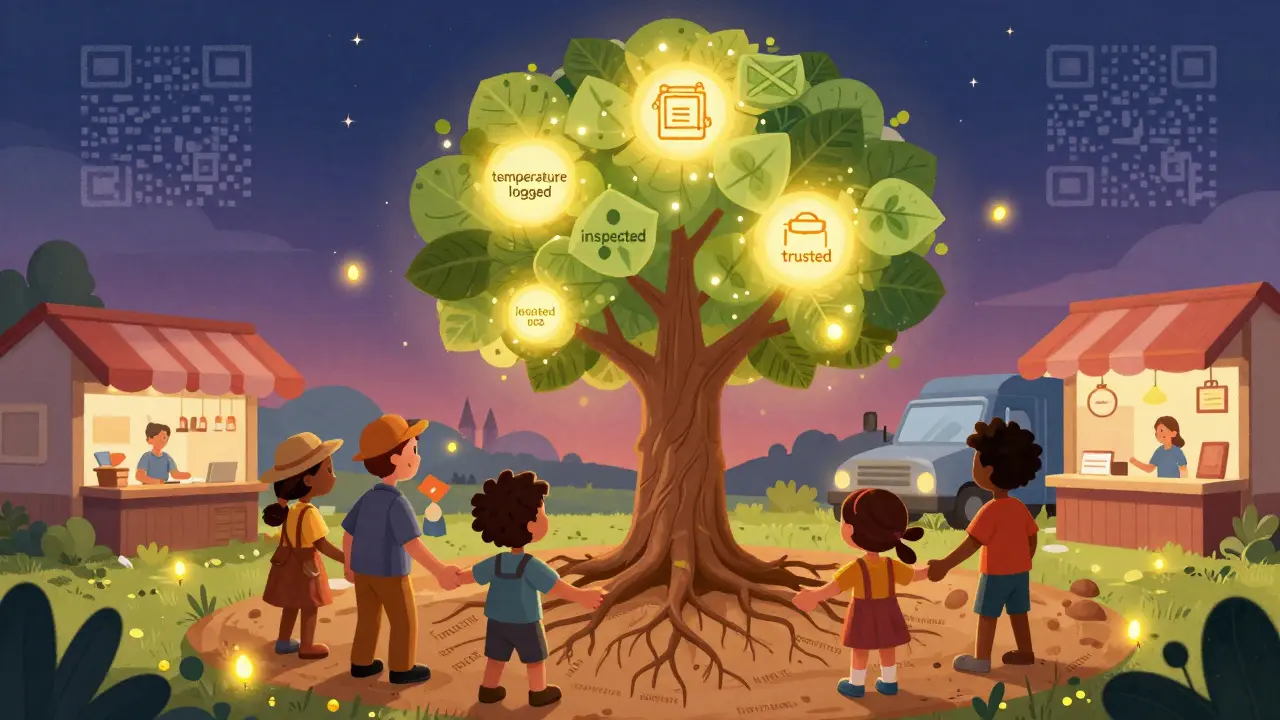
It’s not magic. It’s details. Every block includes:- Product ID (GTIN-14 barcode)
- Lot or batch number
- Date and time of harvest, processing, packaging
- Temperature logs during transport
- Inspection results
- Location of every handoff
- Supplier and transporter IDs
Benefits Beyond Safety
Yes, stopping outbreaks is huge. But blockchain does more:- Reduces waste: Instead of recalling entire product lines, you recall only the affected batch. The USDA estimates this could cut food waste by up to 30% in high-risk categories.
- Builds trust: Consumers are asking for transparency. 72% of shoppers in the UK say they’d pay more for food with verifiable origins.
- Speeds up audits: Regulators can access records instantly. No more waiting weeks for paperwork.
- Helps farmers: Small producers can prove their organic or fair-trade claims with digital proof - not just a sticker.
- Improves compliance: Meets EU and FDA requirements for traceability without extra paperwork.
Challenges and Hurdles
It’s not perfect. Adoption still faces roadblocks:- Cost: Setting up sensors, scanners, and software costs money. Small farms struggle to afford it.
- Training: Workers need to learn how to enter data correctly. A wrong barcode scan breaks the chain.
- Integration: Older warehouses still use 1990s software. Connecting them to blockchain isn’t plug-and-play.
- Privacy: Some companies worry competitors will see their supplier lists. The solution? Permissioned blockchains - only approved parties can view certain data.
The Future Is Already Here
By 2026, blockchain traceability won’t be optional. It’ll be standard. The FDA is pushing new rules requiring digital traceability for high-risk foods. The EU’s Farm to Fork strategy mandates it by 2030. Investors are pouring billions into food-tech startups building blockchain tools. The next time you buy a carton of eggs or a bag of spinach, you’ll be able to scan it and see its journey - not because it’s trendy, but because it’s safer. Because someone didn’t have to die to prove it worked. This isn’t just about technology. It’s about accountability. About fixing a broken system that let people get sick because no one could find the source. Blockchain doesn’t fix food. But it fixes the story behind it.How does blockchain make food traceability faster than traditional methods?
Traditional methods rely on paper records, spreadsheets, or isolated digital systems that don’t communicate. To trace a contaminated product, companies had to call each supplier, request files, and manually piece together the path - often taking days or weeks. Blockchain creates a single, shared digital ledger where every step is recorded in real time with a unique digital fingerprint. When a problem arises, a scan of the product’s barcode instantly pulls up its entire journey - from farm to shelf - in seconds. No calls. No emails. No waiting.
Is blockchain food traceability only for big companies like Walmart and Nestlé?
No. While big retailers drove early adoption, smaller farms and suppliers are now using simplified, cloud-based blockchain platforms. Some apps let a small organic grower log harvest dates and delivery info via a smartphone. These systems cost as little as $50 a month and connect to larger networks like IBM Food Trust. Retailers often help cover the cost because they benefit from cleaner supply chains. It’s no longer just for corporations - it’s becoming accessible to anyone in the food chain.
Can blockchain prevent food fraud, like fake organic labels or mislabeled fish?
Yes. Blockchain makes it nearly impossible to falsify a product’s origin. If a fish is labeled as wild-caught from Alaska but was actually farmed in Vietnam, the blockchain record will show its actual location, processing date, and transporter. Any mismatch is flagged immediately. Retailers like Carrefour and Whole Foods already use blockchain to verify seafood origins. Consumers can scan the label and see the truth - not just a sticker.
Does blockchain protect data privacy between competitors in the supply chain?
Yes. Most food blockchain systems are permissioned, meaning only authorized parties can view certain data. A supplier might share temperature logs with a retailer but hide their pricing or exact farm location from competitors. Each participant has controlled access levels. The system ensures transparency where it matters - safety and compliance - while keeping business-sensitive details private.
What happens if someone enters bad data into the blockchain?
You can’t delete or change bad data - but you can add a correction. If a worker scans the wrong batch number, they can record a new block saying, “Correction: Batch #X was mislabeled. Correct batch is #Y.” The original error stays in the chain for audit purposes, but the correction is clear and permanent. This creates an unbreakable audit trail, which is actually more valuable than perfect data. It proves accountability.
Is blockchain more expensive than traditional traceability systems?
Upfront, yes - installing scanners, sensors, and training staff costs more than paper logs. But over time, blockchain saves money. It cuts recall costs by up to 90%, reduces waste from over-recalls, lowers audit fees, and prevents costly lawsuits from foodborne illness. A 2023 study by the Food Marketing Institute found that retailers using blockchain saw a 22% reduction in supply chain losses within 18 months. The ROI isn’t just about safety - it’s about efficiency.
Andy Simms
Blockchain traceability isn’t just about speed-it’s about accountability. I’ve worked in food logistics for 15 years, and the amount of time wasted chasing paper trails is insane. One time, we spent three weeks trying to trace a contaminated batch of spinach because the trucker forgot to log the temperature. With blockchain, that’s a 10-second lookup. No more guesswork. No more finger-pointing. Just facts.
And the best part? It’s not just for Walmart. Small farms in Iowa are using $50/month apps to prove their organic claims. That’s democratizing trust.
People think tech is cold, but this saves lives. Real ones.
Also, the correction system? Genius. You can’t delete mistakes, but you can document them. That’s transparency, not perfection.
Harshal Parmar
Man, I just read this and my mind is blown. I’m from India, and we’ve got these tiny mom-and-pop vegetable vendors who sell to local markets, right? They don’t even have refrigerated trucks, let alone blockchain scanners. But now? There’s this startup in Kerala that’s giving them QR stickers and a simple app where they just snap a pic of the harvest date and upload it. No fancy sensors, no tech degree needed. And guess what? People are buying more from them now because they can see it’s fresh, local, and not some imported junk masquerading as ‘organic.’
It’s not about being high-tech. It’s about being honest. And honestly? That’s the revolution. Not the blockchain. The truth.
I’m telling my cousin who runs a small dairy in Punjab to check this out. He’s been getting ripped off by middlemen for years. This could change everything. Seriously. Just imagine if every egg carton told you exactly which hen laid it and when. That’s not sci-fi. That’s 2025.
Also, the fact that the EU is mandating this by 2030? Good. We need global standards. Not just for safety, but for fairness. No more fake ‘free-range’ labels on chicken that’s been in a warehouse since 2021. I’m all in.
Darrell Cole
Blockchain is a solution in search of a problem. The system worked fine for decades. People got sick before. People get sick now. The number of outbreaks hasn’t gone down because of blockchain-it’s gone down because of better hygiene standards and FDA inspections. You’re attributing causality to a flashy tech trend when the real heroes are the inspectors who show up unannounced at 6am.
And let’s not forget the cost. Small farms can’t afford this. So now you’re creating a two-tier system where only corporations can prove their innocence. That’s not progress. That’s exclusion disguised as innovation.
Also, immutable ledger? So if someone inputs the wrong batch number, you’re stuck with it forever? That’s not transparency. That’s a digital scarlet letter.
And don’t get me started on the energy use. Bitcoin’s already a disaster. Now we’re layering blockchain on food? Please.
This isn’t a breakthrough. It’s a marketing campaign funded by IBM’s PR budget.
Linda Prehn
Okay but have you thought about the emotional toll on the farmers who have to log every single thing? Like imagine being out in the field at 5am, sweating, covered in dirt, and now you have to stop and open your phone and tap through five screens to log the temperature of your lettuce because Walmart said so
It’s not just about data it’s about dignity
And who’s gonna fix it when the app crashes and your entire harvest gets flagged as ‘untraceable’ because you forgot to hit save
I’m not saying it’s bad I’m saying it’s dehumanizing
Also why is no one talking about the fact that this tech is owned by IBM and Walmart and if they decide to change the rules tomorrow your farm is out of business
It’s not freedom it’s surveillance with a QR code
Clark Dilworth
From an EPCIS and GS1 interoperability standpoint, the real breakthrough here is the adoption of standardized data schemas across disparate supply chain actors. The blockchain component is merely the distributed ledger infrastructure enabling trustless consensus on data integrity-what’s truly transformative is the harmonization of product identification hierarchies, event capture protocols, and party identification schemes.
This isn’t just traceability. It’s supply chain semantic alignment.
Legacy systems operated on siloed, proprietary formats-think EDI 850s with custom extensions that broke every time a vendor upgraded their ERP. Now, with GS1 Digital Link and EPCIS 2.0, you’ve got machine-readable, semantically consistent data flowing from farm to fork.
The immutability of the ledger is a feature, not a bug-it enforces auditability, not control.
And yes, the cost barrier for SMEs remains a challenge, but cloud-native SaaS platforms like FoodTrust Lite are reducing entry points to sub-$50/mo. This is infrastructure evolution, not vaporware.
Brenda Platt
This is so powerful 💪 I just cried reading this. I’m a mom of two and the thought of my kid getting sick from something that could’ve been caught in seconds… it breaks my heart. We’ve all seen those news headlines-‘Recall: 100K Bags of Spinach’-and you just pray it wasn’t the one you bought.
But now? You scan the barcode and you see the whole journey. The farm. The truck. The date it was packed. The temperature. It’s like giving every family a superpower.
And to the small farmers? You’re not being left behind. You’re being lifted. I’ve seen local co-ops in Ohio use these apps to sell directly to schools. Kids learn where their food comes from. That’s education. That’s connection.
This isn’t just tech. It’s healing. It’s trust rebuilt.
Thank you to everyone making this real. You’re changing lives.
Paru Somashekar
While the technological implementation of blockchain for food traceability is commendable, one must also consider the socio-economic implications in developing economies. In India, where 70% of the agricultural workforce operates in the informal sector, the introduction of digital traceability systems without concurrent investment in digital literacy, infrastructure, and subsidy programs may exacerbate existing inequalities.
Furthermore, the reliance on proprietary platforms such as IBM Food Trust raises concerns regarding vendor lock-in and data sovereignty. A public-good approach, perhaps through a government-backed open-source blockchain framework, would ensure equitable access and prevent monopolization of food safety infrastructure.
While the benefits are undeniable, scalability must be paired with inclusivity.
Steve Fennell
One thing that’s often overlooked is how this system reduces legal liability for everyone involved. Before, if a product caused illness, everyone in the chain was blamed-even if they did everything right. Now, the data tells the truth. If a trucker didn’t maintain temperature, it’s on them. If a distributor mislabeled the batch, it’s on them. No more blanket recalls. No more lawsuits against innocent parties.
That’s not just efficient. It’s fair.
And the fact that small farms can now prove their organic claims with a QR code? That’s huge. I’ve seen farmers get ripped off for years because they couldn’t prove their practices. Now they have the evidence. That’s justice.
Also, the correction system? Brilliant. You can’t erase mistakes, but you can document them. That’s accountability, not perfection. And in food safety, accountability matters more than perfection.
Heather Crane
I’m so glad someone finally talked about this without sounding like a corporate ad. I’ve been following this since Walmart first announced it, and honestly? I was skeptical. But then I saw how it helped a local dairy in Oregon recall only 12 cartons instead of 12,000 after a single container leaked. That’s not tech-that’s compassion.
And yes, it’s expensive-but retailers are paying for it because it saves them millions in recalls. So it’s not just altruism-it’s smart business. And that’s okay. We don’t need everything to be charity to be good.
Also, the fact that people can scan a bag of spinach and see the name of the farm? That’s the future. We’re not just buying food anymore. We’re buying a story. And people want to know the truth.
Let’s not make this about blockchain. Let’s make it about transparency. The tech just makes it possible.
Catherine Hays
Blockchain? More like block-scam. This is all just another way for big agribusiness to control the food supply. You think small farmers are actually using this? No. They’re being forced into it by Walmart’s ultimatums. And who owns the data? IBM. Who decides what gets recorded? Big corporations. Who gets punished if something goes wrong? The little guy.
And don’t even get me started on the surveillance. Now every farmer’s every move is tracked. No more privacy. No more autonomy. Just a digital leash.
They’re calling it ‘transparency’ but it’s control. And the FDA pushing this? Classic. They’re not protecting you-they’re protecting the corporations.
Wake up. This isn’t safety. It’s surveillance capitalism with spinach.
Mike Stay
Let’s not romanticize this. Blockchain doesn’t make food safer. It just makes the paperwork faster. The real problem is that we’ve outsourced food safety to profit-driven corporations who care more about shelf life than soil health. A farm that uses regenerative practices still has to log data the same way as a factory farm that sprays pesticides. The system doesn’t judge quality-it just records movement.
So now we know exactly where the toxic lettuce came from… but we still don’t know why it was grown that way.
And yes, Walmart saved 7 days on tracing. But how many lives did they save? Hard to say. The real win? Reduced recall costs. That’s the metric that matters to them.
This isn’t a revolution. It’s automation with a moral veneer.
Taylor Mills
Blockchain? More like blockchain bs. You think this stops food poisoning? Nah. It just makes the headlines prettier. People still get sick. The only difference is now the CEO gets a nice dashboard instead of a pile of paper.
And the cost? You think a farm in Texas can afford sensors and scanners? No. They’re getting squeezed by Walmart’s demands while the big boys get subsidies.
Also, who’s gonna fix it when the system glitches and every bag of kale gets flagged as ‘contaminated’? No one. Because it’s ‘immutable.’
And don’t even get me started on the energy. Bitcoin’s already a joke. Now we’re burning power to track lettuce?
This isn’t innovation. It’s tech bros playing god with groceries.
HARSHA NAVALKAR
I read this and felt nothing. I’ve seen too many tech solutions that promise the world and deliver paperwork. Blockchain sounds cool, but in the end, it’s just another layer between the farmer and the consumer. And who benefits? Not the person harvesting the crops. Not the person eating the food. The middlemen. The tech vendors. The corporations.
I’m not against progress. I’m against pretending this changes anything real.
Ryan Depew
Bro, I work at a grocery store and I’ve seen the chaos after a recall. Last year we had to pull 300 items because one batch of eggs was bad. We spent 48 hours manually checking labels. If we had blockchain? We’d have known in 10 minutes which 3 boxes to pull. No stress. No overtime. No angry customers.
And honestly? My grandma asked me the other day if she could scan her eggs and see where they came from. I showed her. She cried. Said she hadn’t trusted store-bought eggs since the ’90s.
So yeah, it’s tech. But it’s also trust. And that’s worth something.
Jessica Boling
So we’re just gonna ignore the fact that this tech is owned by IBM and Walmart and the only reason it works is because they forced their suppliers to use it? Classic corporate co-opting. You call it ‘transparency’ but it’s really just a way to lock out competitors and control the narrative.
Also, who’s gonna audit the auditors? What if IBM’s system gets hacked? Or worse-what if they decide to delete a bad batch from the record? Oh wait, it’s immutable. So they just keep it there forever. Great. Now we have a digital scarlet letter for every mistake.
This isn’t progress. It’s corporate feudalism with QR codes.
Tammy Goodwin
My dad used to be a produce buyer for a regional chain. He used to say, ‘If you want to find the source of a problem, go to the last person who touched it before the complaint.’ That’s how it worked for 30 years.
Now we’ve got a system that tells us exactly who touched it… but does it make the food safer? Not really. It just makes the blame game faster.
And the real issue? We’re still growing food in ways that make it unsafe. Blockchain doesn’t fix that. It just makes us feel better about it.
tim ang
Just had a chat with a guy who runs a small farm in Georgia. He’s using a $40/month app to log harvest dates and delivery info. No sensors. No fancy software. Just his phone and a QR sticker. And guess what? His sales are up 40%. Customers love seeing the ‘journey.’
It’s not about the blockchain. It’s about the story. People want to know where their food comes from. This just makes it possible.
And the best part? He’s not scared of the tech. He’s excited. He said, ‘Now I can prove I’m not a liar.’
That’s powerful.
Julene Soria Marqués
So let me get this straight. You’re telling me that if a farmer forgets to scan a box, the whole system breaks? And now we’re trusting a digital ledger to prevent food poisoning? What if the barcode is smudged? What if the phone dies? What if the internet goes out?
This isn’t a solution. It’s a fragile fantasy.
And don’t give me that ‘correction block’ nonsense. You can’t fix a contaminated product with a digital note.
We need better hygiene. Better inspections. Not more tech.
Abdulahi Oluwasegun Fagbayi
Technology is a mirror. It reflects our values. Blockchain traceability doesn’t create safety-it reveals our willingness to be accountable. For centuries, food systems were built on secrecy, convenience, and profit. Now, we’re choosing to make the invisible visible.
It’s not about the ledger. It’s about the choice.
And if we’re honest-we’ve needed this for a long time.
Anna Topping
I mean… is this really about food safety? Or is it about making us feel like we’re in control of something we can’t actually control? Like, we scan a QR code and suddenly we feel like we know the truth… but what if the truth is just a carefully curated narrative? What if the farm is still using pesticides? What if the temperature log is correct but the actual product was contaminated before it was scanned?
It’s not transparency. It’s performance.
And we’re buying it because we’re tired of being afraid.
But the fear didn’t go away. It just got a new interface.
katie gibson
Okay but imagine if this was used for vaccines. Or baby formula. Or anything else people die from because of bad supply chains. This isn’t just about spinach. It’s about every time we trust something we can’t see.
And the fact that a farmer in Somerset can now prove their produce is local? That’s beautiful. That’s real.
Stop acting like this is just tech. It’s connection.
Also, I cried reading the Walmart part. 2.2 seconds? That’s faster than my wifi loads.
Ashok Sharma
Blockchain is a good tool, but the real issue is training. In India, many workers do not know how to use smartphones. If we introduce this system without proper education, it will fail. We need government support, local language apps, and simple interfaces. Technology alone cannot solve human problems.
Margaret Roberts
This is all a lie. The FDA and IBM are using blockchain to track you. Every time you scan a product, they get your location, your phone ID, your buying habits. This isn’t about food safety. It’s about building a national food surveillance system. Next thing you know, they’ll ban foods you buy too often. Or charge you extra for ‘high-risk’ items.
They’ve been planning this since 2016. It’s all in the documents.
Wake up. This isn’t progress. It’s control.
Tselane Sebatane
Let me tell you something. In South Africa, we’ve got farmers who walk 10 kilometers to sell their veggies. No phones. No internet. No blockchain. But they know every customer by name. They know who buys the spinach, who buys the tomatoes, who gives them extra cash when times are hard.
Blockchain can’t replicate that. It can’t replace trust built over years.
So yes, it’s useful in big cities. But don’t pretend it’s the future for everyone. The future is human. Not digital.
And if you’re telling me that a farmer in Johannesburg needs to pay $50 a month to prove his tomatoes are real? That’s not innovation. That’s exploitation.
Andy Simms
That’s exactly why the correction system matters. You can’t erase a mistake, but you can document it. That’s not a flaw-it’s a feature. It means accountability. No one can hide. Not the trucker. Not the distributor. Not the retailer.
And in a system where 80% of contamination comes from human error, that’s the real win.
Also, the fact that Walmart’s system reduced contamination risks by 90% in China? That’s not hype. That’s data.
This isn’t about tech. It’s about not letting people die because no one could find the source.
Harshal Parmar
And in India, we’re seeing something even cooler. Some small farms are using blockchain to prove they’re pesticide-free-not because they’re certified, but because they’ve logged every spray, every date, every water source. And customers are paying 20% more for it. That’s real change.
It’s not about the tech. It’s about giving power back to the people who grow the food.
And honestly? If my mom can use this app to see where her onions came from, then it’s worth it.
Steve Fennell
Exactly. And the best part? The data isn’t just for regulators. It’s for consumers. I showed my 8-year-old how to scan a carton of eggs and see the farm name. He said, ‘So the chicken that laid this lived in Ohio?’
And I said, ‘Yep.’
That’s the future. Not just safe food. Connected food.
Tselane Sebatane
And what about the farmers in rural areas who don’t have smartphones? Or electricity? Or internet? This system works great in cities, but what about the people who feed the cities?
Technology should lift people up-not leave them behind.
Maybe the answer isn’t blockchain. Maybe it’s better roads. Better storage. Better training.
Let’s not confuse convenience with justice.
Mike Stay
And here’s the quiet truth: blockchain doesn’t fix broken systems. It just makes them more efficient. We still have factory farms. We still have monocrops. We still have pesticides. We still have labor exploitation.
Knowing where the toxic lettuce came from doesn’t make it less toxic.
But it does make the people who caused it easier to punish.
And that’s something.
Anna Topping
So we’re replacing one kind of ignorance with another. Before, we didn’t know where the food came from. Now we think we know-but we’re just looking at a screen.
What if the farm is lying? What if the temperature sensor is faulty? What if the QR code was printed on a stolen label?
Blockchain doesn’t guarantee truth. It just guarantees consistency.
And consistency isn’t always honest.
Heather Crane
But that’s the point. We don’t need perfection. We need honesty. And blockchain gives us a record that can’t be erased. Even if someone lies, we know they lied. And that’s more than we had before.
Before, we had silence. Now we have a trail.
And sometimes, that’s enough.
Andy Simms
One sentence: This isn’t about tech. It’s about not letting another child die because no one could find the spinach.