
Buying crypto in the United States feels like navigating a maze with shifting walls. You want low fees, you want security, and you definitely don’t want to get blocked by regulators halfway through a trade. That’s where Binance.US is a U.S.-based cryptocurrency exchange launched in 2019 to serve American customers who cannot access the global Binance platform due to regulatory restrictions. But does it actually deliver on its promise of being the "global giant's" compliant sibling, or is it just another clunky interface hiding behind a famous name?
I’ve spent weeks testing the platform, comparing its fee structures against competitors, and digging into the regulatory baggage that follows this brand. Here is the raw truth about using Binance.US in mid-2026.
The Quick Verdict: Who Should Use Binance.US?
- Best For: Active traders who want lower fees than Coinbase and higher staking yields than most competitors.
- Avoid If: You live in New York, Texas, Hawaii, or Vermont, or if you need phone support for urgent issues.
- Key Advantage: Fee-free trading on select Bitcoin and Ethereum pairs makes small trades viable.
- Major Drawback: The user experience is less polished than Coinbase, and KYC verification can take days.
If you are a beginner looking for hand-holding, this might not be your first stop. If you are an experienced trader tired of paying 1%+ fees on every swap, keep reading. This platform sits in a weird middle ground: more advanced than a simple buy-button app, but stripped down compared to the global Binance.com.
Fees and Costs: Where the Money Actually Goes
Let’s talk numbers because that’s why you’re here. Trading fees are the silent killer of portfolio growth. On many major exchanges, you pay a maker/taker fee structure that can range from 0.1% to 0.6%.
According to recent data from Bankrate (2025), standard transaction fees on Binance.US start at 0.40%. However, there is a catch-and a benefit. The platform offers fee-free trading on select Bitcoin (BTC) and Ethereum (ETH) pairs when traded against USD. This is a massive differentiator. If you are primarily moving between dollars and the two biggest coins, your costs drop to zero.
For altcoins, however, you pay the standard rate. Let’s break down how this compares to the competition.
| Exchange | Standard Maker/Taker Fee | BTC/USD Fee-Free Option? | Minimum Trade Size |
|---|---|---|---|
| Binance.US | 0.40% | Yes (Select Pairs) | $1 |
| Coinbase | 0.60% - 1.49% | No | $2 |
| Kraken | 0.16% - 0.26% | No | $5 |
| Gemini | 0.35% - 1.00% | No | $1 |
Notice Kraken? They have lower base fees for high-volume traders. But for the average person making $100-$500 trades, Binance.US’s fee-free BTC/ETH option is hard to beat. Also, note the minimum trade size. You can start with just $1. There is no minimum account balance required to open an account, which lowers the barrier to entry significantly.
User Experience: Simple vs. Advanced
When you log in, you aren’t greeted by a confusing wall of charts immediately. Binance.US offers three distinct modes, which is smart design for mixed audiences.
- Instant Buy: This is the "Apple Store" mode. You see the price, you click buy, you confirm. It’s designed for people who just want to park some money in Bitcoin without learning what a candlestick chart is.
- Advanced Trading: Here, you get the full toolkit. Candlestick charts, technical indicators (RSI, MACD, etc.), and multiple order types like limit and stop-loss orders. This is where the power users live.
- Staking Dashboard: A dedicated section to earn yield on your idle assets.
The mobile app mirrors the web interface closely. According to Milkroad’s 2025 analysis, feature parity between web and mobile is strong. You won’t find features on the desktop that are missing on your phone. However, the UI isn’t as intuitive as Coinbase. Coinbase wins on simplicity; Binance.US wins on functionality per dollar spent. If you hate clicking through menus, you might find the layout slightly cluttered. But if you value having all your tools in one place, it works.
Security and Regulation: The Elephant in the Room
We need to address the regulatory history. Binance.US operates under a shadow. Its parent company, Binance Holdings Limited, paid a historic $4.3 billion settlement with U.S. authorities in 2023 for money laundering and sanctions violations. CEO Changpeng Zhao resigned amidst these charges.
Does that mean your funds are unsafe on Binance.US? Not necessarily. Binance.US is a separate legal entity. It was built specifically to comply with U.S. laws. In November 2023, Binance.US itself settled with the Commodity Futures Trading Commission (CFTC) for $4.3 million over illicit payment handling and registration violations. While smaller than the global fine, it shows they are actively engaging with regulators rather than hiding.
From a technical security standpoint, the platform is robust:
- Two-Factor Authentication (2FA): Mandatory SMS verification and Google Authenticator integration.
- Fund Storage: The platform claims all customer funds are held 1:1 in U.S.-based storage facilities. This means if you deposit $100, they hold $100 in reserve. No fractional reserves.
- Insurance: While not explicitly detailed as FDIC insurance for crypto (which doesn't exist), the 1:1 reserve policy is the industry standard for solvency claims.
However, remember: "Not your keys, not your coins." Any centralized exchange carries counterparty risk. For large holdings, consider withdrawing to a hardware wallet like Ledger or Trezor.
Staking Yields: Earning While You Sleep
This is where Binance.US shines. If you are holding altcoins long-term, leaving them idle is expensive. Binance.US has positioned itself as the "#1 Largest U.S. Staking Platform" as of early 2025.
You can stake up to 26 cryptocurrencies. Yields vary based on market conditions, but some tokens offer up to 15% APY. Compare this to traditional savings accounts offering less than 5%, and even inflation-adjusted returns look better.
How does it work? You lock up your coins for a fixed period (e.g., 30, 60, or 90 days). During this time, you cannot trade them. In return, you earn daily rewards distributed in the same token. It’s simple, passive income. Just be aware of the tax implications-in the U.S., staking rewards are taxable events when received.
Availability and Limitations
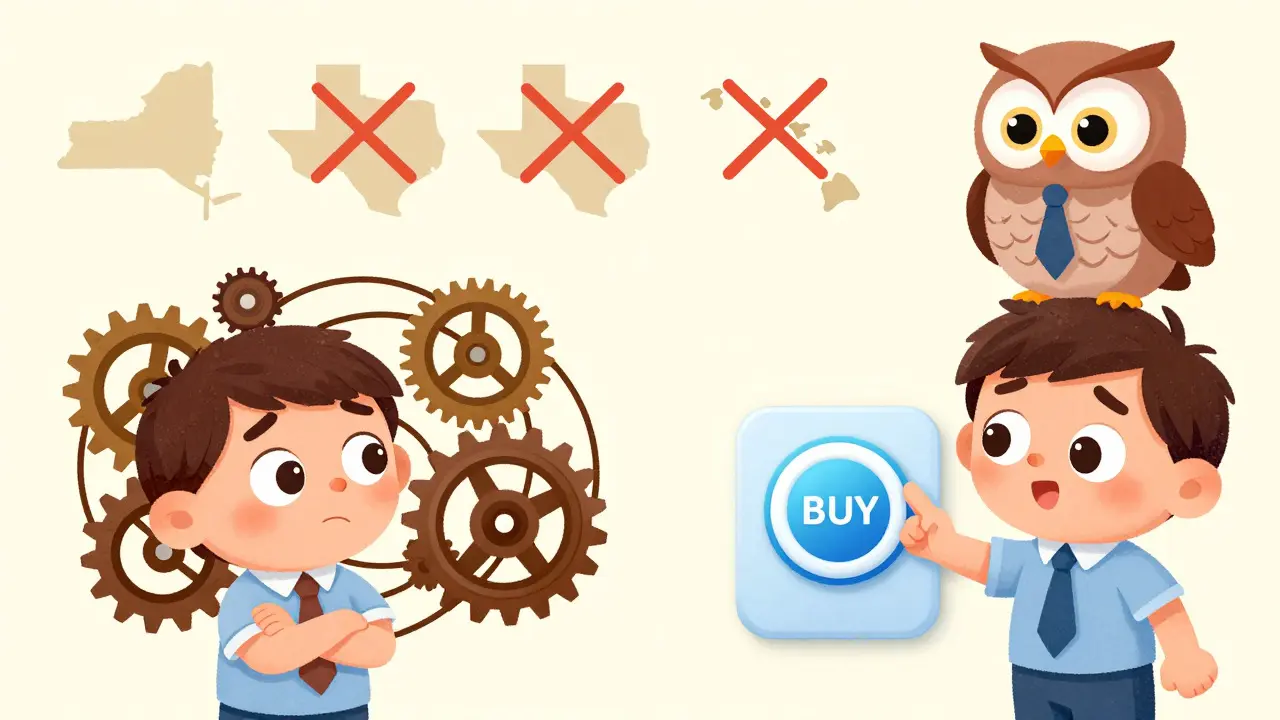
Here is the dealbreaker for some: Geography matters. As of 2026, Binance.US is operational in only 45 U.S. states. You cannot use the platform if you reside in:
- New York
- Texas
- Hawaii
- Vermont
New York has strict BitLicense requirements that Binance.US hasn’t met. Texas has been particularly aggressive against crypto platforms recently. If you live in these states, you’ll need to look at Coinbase, Kraken, or Gemini instead.
Another limitation: Payment methods. You can fund your account via ACH bank transfer, debit card, or wire transfer. However, there is no PayPal integration. And while deposits are free, withdrawals have quirks. Reddit users frequently complain about the $50 minimum for ACH withdrawals, which is annoying if you are trying to cash out small profits. Coinbase allows $2 minimums, giving them the edge for micro-traders.
Customer Support: The Silent Struggle
Let’s be honest-crypto customer support is often terrible across the board. Binance.US is no exception. There is no phone support. Ever. If you have an urgent issue, you are stuck with:
- An AI chatbot (useful for basic FAQs)
- Live chat (available, but wait times can be long)
- Email tickets (slowest method)
User feedback from Trustpilot in late 2024 highlighted a major pain point: KYC verification delays. About 32% of reviews mentioned waiting more than 72 hours for identity verification. When you are eager to trade, sitting around for three days waiting for approval is frustrating. Make sure your ID documents are clear and well-lit to avoid rejection loops.
Binance.US vs. The Competition
Who should you choose? It depends on your profile.
Choose Coinbase if: You are a complete beginner, you live in NY/TX/HI/VT, or you prioritize ease of use over fees. Their educational materials are superior, and their interface is cleaner. You pay for convenience.
Choose Kraken if: You are a high-volume trader who wants the absolute lowest fees (0.16%) and excellent customer service (they do have phone support!). Their selection of coins is also vast, though sometimes less trendy than Binance.
Choose Binance.US if: You want a balance of low fees, decent coin selection (180+ assets), and high staking yields. You are comfortable navigating a slightly more complex interface and don’t mind the lack of phone support. You are likely trading BTC and ETH heavily to take advantage of fee-free pairs.
Final Thoughts: Is It Worth Your Time?
Binance.US is not perfect. It carries the stigma of its parent company’s legal troubles, and its geographic restrictions are a headache. But functionally, it is a solid, compliant exchange that offers real value through low fees and competitive staking rates.
If you are active in the market, the savings on fees add up quickly. If you are a passive holder, the staking yields make it attractive. Just verify your state eligibility first, prepare for a potentially slow KYC process, and never store more than you can afford to lose on any centralized platform.
Is Binance.US safe to use in 2026?
Binance.US employs strong security measures including 2FA and holds customer funds 1:1 in U.S. storage. However, it is a centralized exchange, so it carries counterparty risk. While it is a separate legal entity from the global Binance, users should remain cautious and consider hardware wallets for long-term storage.
Which states cannot use Binance.US?
As of 2026, residents of New York, Texas, Hawaii, and Vermont cannot use Binance.US due to regulatory restrictions. Users in these states must look to alternatives like Coinbase or Kraken.
Are there really fee-free trades on Binance.US?
Yes, Binance.US offers fee-free trading on select Bitcoin (BTC) and Ethereum (ETH) pairs when traded against USD. This applies to both buying and selling. Other altcoin pairs incur a standard 0.40% fee.
How long does KYC verification take?
Verification typically takes 24 to 72 hours. However, user reports indicate that delays exceeding 72 hours occur in about 32% of cases. Ensure your ID photos are clear and well-lit to speed up the process.
Does Binance.US have phone support?
No, Binance.US does not offer phone support. Customer assistance is provided via AI chatbot, live chat, and email tickets. This is a common complaint among users seeking immediate help.