

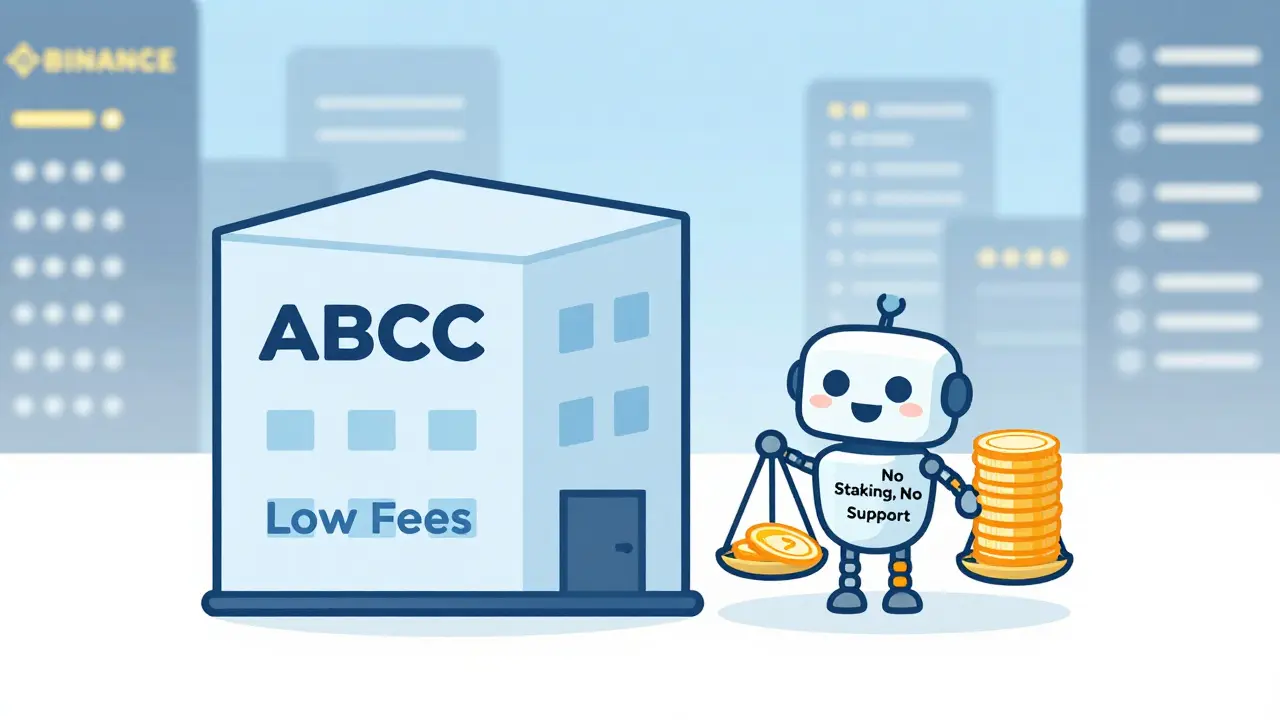
ABCC isn't another crypto exchange trying to be everything to everyone. It doesn't offer staking, futures, or copy trading. It doesn't even have a referral program. What it does offer is simple: spot trading with some of the lowest fees in the market. If you're an active trader who wants to buy and sell Bitcoin, Ethereum, or altcoins fast and cheap, ABCC might be worth a look. But if you're looking to earn interest, automate investments, or trade with leverage, you'll need to look elsewhere.
What ABCC Actually Offers
ABCC launched in 2018 and is based in Singapore. It’s built for traders, not investors. The platform supports just over 20 cryptocurrencies, including major names like BTC, ETH, DOT, LINK, and AAVE. All trading pairs are against USDT or USDC - no fiat pairs like USD/BTC. This keeps things simple but also means you need to already own stablecoins to start trading.
You can deposit as little as $10 via bank transfer or credit card. There’s no minimum trade size - you can buy $1 worth of SUSHI if you want. Withdrawals are processed quickly, often within minutes. The mobile app works well for on-the-go trading, and the interface uses TradingView, which is familiar to anyone who’s used charting tools before.
Fees That Actually Matter
Most exchanges charge 0.25% per trade. ABCC charges 0.1% - half that. Maker and taker fees are identical, which is rare. If you trade through their API, fees drop again to 0.05%. That’s a 80% discount compared to the industry average.
But here’s the real trick: ABCC has its own token, AT. If you hold AT, you can use it to pay trading fees and get an extra discount. The more AT you hold, the bigger the cut. And if you’re one of the top holders? You get 80% of all trading fees collected on the platform paid back to you. It’s a revenue-sharing model that’s rare in crypto exchanges - and it’s designed to reward the heaviest traders.
Security: Fast, But Not Fully Transparent
ABCC doesn’t have a license from any major financial regulator. You won’t find it on the FCA, SEC, or MAS lists. That’s a red flag for many. But here’s the odd part: it hasn’t been hacked. Not once in six years. No customer funds lost. No outages due to security breaches.
According to CER.live, ABCC scored 94/100 on server security and 93/100 on user security. It uses SSL encryption, two-factor authentication, and anti-phishing tools. It also separates trading activity from asset storage - meaning even if someone breaks into the trading system, they can’t touch your coins.
Still, CER.live gave ABCC an overall rating of just 24%. That’s because transparency is missing. No public audits. No proof of reserves. No clear ownership structure. For some, that’s enough to walk away. For others, it’s a trade-off: lower fees for less oversight.
What’s Missing - And Why It Matters
ABCC is painfully simple. And that simplicity comes at a cost.
- No staking. No earning interest on your crypto.
- No futures. No leverage. No shorting.
- No auto-invest. No DCA plans.
- No copy trading. You can’t follow expert traders.
- No referral program. You don’t get paid for bringing friends.
- No demo account. You have to trade with real money to learn.
If you’re new to crypto and want to practice before risking cash, ABCC won’t help. If you want to set up recurring buys to average your entry price, you’ll need another platform. If you’re looking to grow your portfolio passively, ABCC isn’t built for that.
Customer Support and Trust
ABCC has zero live chat. No phone number. No help desk. You can only reach them via email or a ticket system. Response times vary. Some users report answers in 24 hours. Others wait days.
Trustpilot gives ABCC a 2 out of 5. ScamAdviser rates it 40/100. Traders Union says it’s a higher-than-average risk platform. These aren’t flukes. They reflect real frustrations: lack of support, no regulation, and a feeling that the exchange doesn’t care about beginners.
But here’s the twist: none of these reviews point to theft, fraud, or frozen funds. The complaints are about service, not safety. That’s unusual. Most exchanges with low trust scores have real security issues. ABCC’s problem is perception, not proof.

Who Is ABCC Really For?
ABCC isn’t for everyone. It’s not for beginners who need hand-holding. It’s not for passive investors. It’s not for people who want to earn interest on their holdings.
It’s for one type of user: the active spot trader who values speed, low fees, and simplicity. If you’re trading $100 or $10,000 a day, and you’re already comfortable with crypto, ABCC’s 0.1% fees and AT token rewards could save you hundreds - or thousands - a year. The fact that it’s unregulated might be a dealbreaker for some. But for others, it’s just the cost of doing business in crypto.
Compare ABCC to Binance or KuCoin. Those platforms have hundreds of coins, staking, futures, and customer support teams. But their fees are higher. ABCC doesn’t try to compete with them. It doesn’t need to. It’s carving out a narrow, profitable niche: cheap, fast trading for people who know what they’re doing.
Final Verdict: Simple, Cheap, But Not Safe
ABCC is a trading engine, not a crypto bank. It’s fast, cheap, and surprisingly stable - despite having no license and minimal public oversight. If you’re already trading regularly and want to cut costs, it’s worth testing. Deposit $10. Trade a few times. See how the interface feels. Watch how fast your withdrawals go through.
But if you’re looking for safety, support, or passive income, walk away. There are better options. ABCC doesn’t pretend to be one. And that honesty, however cold, might be its biggest strength.
Is ABCC exchange safe to use?
ABCC has never been hacked or lost user funds since its launch in 2018. It uses SSL encryption, two-factor authentication, and separates trading systems from asset storage. However, it lacks regulatory licensing, public audits, or proof of reserves. Security scores from CER.live are high (94/100), but overall trust ratings are low due to opacity. Use it only if you understand the trade-off: lower fees for less oversight.
Does ABCC offer staking or passive income?
No. ABCC does not offer staking, auto-invest plans, yield farming, or any other way to earn passive income on your crypto holdings. The platform is designed solely for spot trading. If you want to earn interest on Bitcoin or Ethereum, you’ll need to use another exchange like Binance, Kraken, or Coinbase.
What are ABCC’s trading fees?
ABCC charges 0.1% for both maker and taker trades - half the industry average. If you use the API for automated trading, fees drop to 0.05%. Holding ABCC’s AT token gives you additional discounts, and top AT holders receive 80% of all platform trading fees as revenue share. This makes ABCC one of the cheapest exchanges for active traders.
Can I deposit fiat currency on ABCC?
Yes. ABCC accepts fiat deposits via bank transfer and credit/debit card. The minimum deposit is $10 USD or 0.0001 BTC. You can’t deposit directly in EUR or GBP - all fiat is converted to USDT or USDC before trading. Withdrawals back to bank accounts are supported, but processing times depend on your bank.
Does ABCC have a mobile app?
Yes. ABCC has a mobile app available for iOS and Android. It uses the same TradingView interface as the web platform, so the experience is consistent. You can place trades, check prices, and manage your portfolio on the go. However, the app doesn’t offer any features beyond what’s on the website - no extra tools or alerts.
Why doesn’t ABCC have futures or copy trading?
ABCC chose to focus exclusively on spot trading to keep things simple and low-cost. Adding futures, leverage, or copy trading would require more infrastructure, compliance, and risk management. By avoiding these features, ABCC keeps fees low and avoids regulatory headaches. It’s a deliberate trade-off: fewer features, but better pricing for active traders.
Is ABCC better than Binance or KuCoin?
It depends on what you want. Binance and KuCoin have hundreds of coins, staking, futures, and better customer support. But their fees are higher - often 0.1% or more, with discounts only for large traders. ABCC’s flat 0.1% fee applies to everyone, and API users get 0.05%. If you trade frequently and don’t need extra features, ABCC can save you money. If you want more coins, support, or passive income, Binance or KuCoin are better choices.
How do I verify my account on ABCC?
ABCC requires KYC verification for full access. You’ll need to submit a government-issued ID (passport or national ID) and a live video selfie. The process is straightforward but can take 1-3 business days. Without verification, you can only make small deposits and trades. Higher limits require full KYC.
Andrew Midwood
ABCC is the kind of exchange I wish more platforms would copy. No fluff, no bait-and-switch fees, just pure spot trading at 0.1%. I’ve been trading there for a year now and never once had a delay on withdrawals. The AT token discount is the real kicker - I hold like 5k AT and I’m basically getting paid to trade. Who needs staking when your fees are half of Binance’s?
Also, no KYC on small trades? Love it. I keep my main stack on Ledger and just move pocket change over to ABCC. Simple. Clean. Efficient.
Kayla Thompson
Let’s be real - this isn’t an exchange, it’s a crypto brothel for degens who think ‘low fees’ makes up for zero regulatory accountability. 94/100 on server security? Cool. But if your entire business model relies on opacity, you’re not a platform - you’re a gamble wrapped in a TradingView interface.
And don’t get me started on that AT token revenue share. It’s a Ponzi incentive disguised as loyalty. The top 10 holders are probably whales who manipulate volume just to get their 80% cut. This isn’t innovation. It’s exploitation with a clean UI.
Brijendra Kumar
Bro, ABCC is literally the only sane option for serious traders. You think Binance is better? Try paying 0.25% on 50 trades a day. That’s $125 in fees daily. At ABCC? $50. That’s $27,000 a year saved. And yes, no staking - because staking is for people who don’t understand market dynamics. If you’re holding crypto to ‘earn interest,’ you’re already losing.
Also, no license? Good. Licenses mean bureaucracy. Bureaucracy means fees. Fees mean less profit for YOU. ABCC doesn’t care about your grandma’s portfolio. It cares about traders who move volume. And that’s the only audience that matters.
Shelley Dunbrook
It’s fascinating how ABCC has managed to build a loyal user base precisely by refusing to conform to industry norms. The absence of staking, leverage, and referral programs isn’t a flaw - it’s a philosophical stance. This isn’t a financial product; it’s a minimalist tool. Like a Swiss Army knife with only the blade.
Perhaps the real question isn’t whether ABCC is ‘safe,’ but whether we’ve become too dependent on platforms that infantilize us with features we don’t need. Sometimes, less really is more - even in crypto.
Aman Kulshreshtha
As someone from India, I’ve tried 7+ exchanges. ABCC is the only one where I didn’t feel like I was being sold a dream. No ‘earn 15% APY’ nonsense. No confusing UI. Just buy, sell, repeat. The fact that I can trade $1 of SUSHI without KYC is wild - especially compared to Indian exchanges that demand 10 documents just to deposit ₹500.
Yeah, no support. But honestly? I don’t need someone holding my hand when I’m trading. I need speed, low fees, and uptime. ABCC delivers. The rest? Nice-to-haves for beginners.
kavya barikar
Simple. No staking. No leverage. Just trading. That’s all I need. I don’t want complexity. I want clarity. ABCC gives me that. Fees are low. Withdrawals are fast. I don’t need a support team or a referral bonus. I just want to trade. And it works.
Andrea Zaszczynski
Let’s be honest - if you’re comfortable using an unregulated exchange with no public audits, you’re either a crypto anarchist or you’ve been burned too many times to care anymore. ABCC doesn’t pretend to be a bank. It’s a trading terminal with a side of risk.
And honestly? That’s refreshing. Most platforms are trying to be Coinbase 2.0. ABCC just wants you to trade. No fluff. No ads. No ‘learn to invest’ videos. Just price charts and a 0.1% fee. I respect that.
Cordany Harper
For anyone thinking about trying ABCC: start small. Deposit $10. Trade a couple of times. Watch how fast your withdrawal hits your wallet. If it’s under 5 minutes, you’re already ahead of 90% of exchanges.
The AT token thing? Totally legit. I hold AT because it’s not a hype coin - it’s a utility token. The revenue share is real. I’ve received $180 in fee rebates over 6 months just from trading $20k. That’s not marketing - that’s a business model that rewards users.
And yes, no live chat. But I’ve never needed it. The interface is intuitive. If you’re trading, you already know how to use it.
DarShawn Owens
I came into crypto looking for passive income. Staking, yield farms, LP rewards - I tried it all. Lost more than I made. Then I found ABCC. No staking? Fine. No leverage? Cool. Just let me trade spot with low fees and move on.
It’s weird how liberating it is to not have to chase yield. I’m not trying to get rich overnight. I just want to trade smart. ABCC lets me do that. No drama. No scams. Just clean execution. I wish more platforms were like this.
Andy Green
ABCC is the crypto equivalent of a gas station convenience store: cheap, no frills, and you’re probably getting scammed on the snacks. No license? No audits? No transparency? That’s not ‘simplicity’ - that’s negligence wrapped in a TradingView skin.
And that AT token ‘revenue share’? Classic. You’re not being rewarded - you’re being used as a liquidity pump. The top holders are likely shilling volume to boost their cut. This isn’t a platform. It’s a casino where the house doesn’t even show its ID.
JOHN NGEH
It’s wild how many people miss the point. ABCC isn’t trying to be Binance. It’s trying to be the best tool for spot traders. If you want staking, use Kraken. If you want copy trading, use eToro. But if you just want to buy BTC and sell it 3 hours later without paying 0.25%? ABCC is the answer.
I’ve been using it for 2 years. Never lost funds. Never had downtime. No drama. Just clean, cheap trades. The lack of features isn’t a bug - it’s the feature.
Jenni Moss
Y’all are overthinking this. ABCC is like that one friend who shows up with snacks and zero drama. No fluff. No speeches. Just ‘hey, here’s your trade, here’s your withdrawal, peace out.’
Low fees? Yes. No staking? Fine. No support? I’ve never needed it. I don’t need a babysitter to trade crypto. I need a fast, cheap, reliable tool. ABCC is that tool. And honestly? I’m tired of exchanges that treat me like I need a tutorial just to place an order.
vu phung
ABCC’s AT token revenue share is genius. I hold 12k AT. Last month, I got $420 back in fee rebates. That’s not a bonus - that’s a salary. And I didn’t do anything special. Just traded like normal.
People say ‘no regulation = risky.’ But if your funds are never stolen, your platform never crashes, and your withdrawals are instant… what’s the real risk? Perception? That’s a marketing problem, not a security one.
ABCC doesn’t need your trust. It just needs your volume. And it’s doing just fine without it.
Lorna Gornik
ABCC is the crypto equivalent of a perfectly brewed black coffee - no sugar, no cream, no distractions. Just pure, strong, efficient fuel. 🤘
I used to chase every new feature - staking, futures, NFTs, AI bots. Now? I just want to trade spot, fast, cheap. ABCC gives me that. And the AT token? It’s like getting cash back on your gas card. Why would I leave?
Joshua T Berglan
For anyone scared of ABCC because it’s unregulated - ask yourself: have you ever lost money on it? No? Then why are you scared? The fear isn’t real. It’s just noise from people who need hand-holding.
ABCC doesn’t care if you’re a beginner. It doesn’t have to. It’s built for the ones who already know what they’re doing. And if that’s you? You’re already winning.