
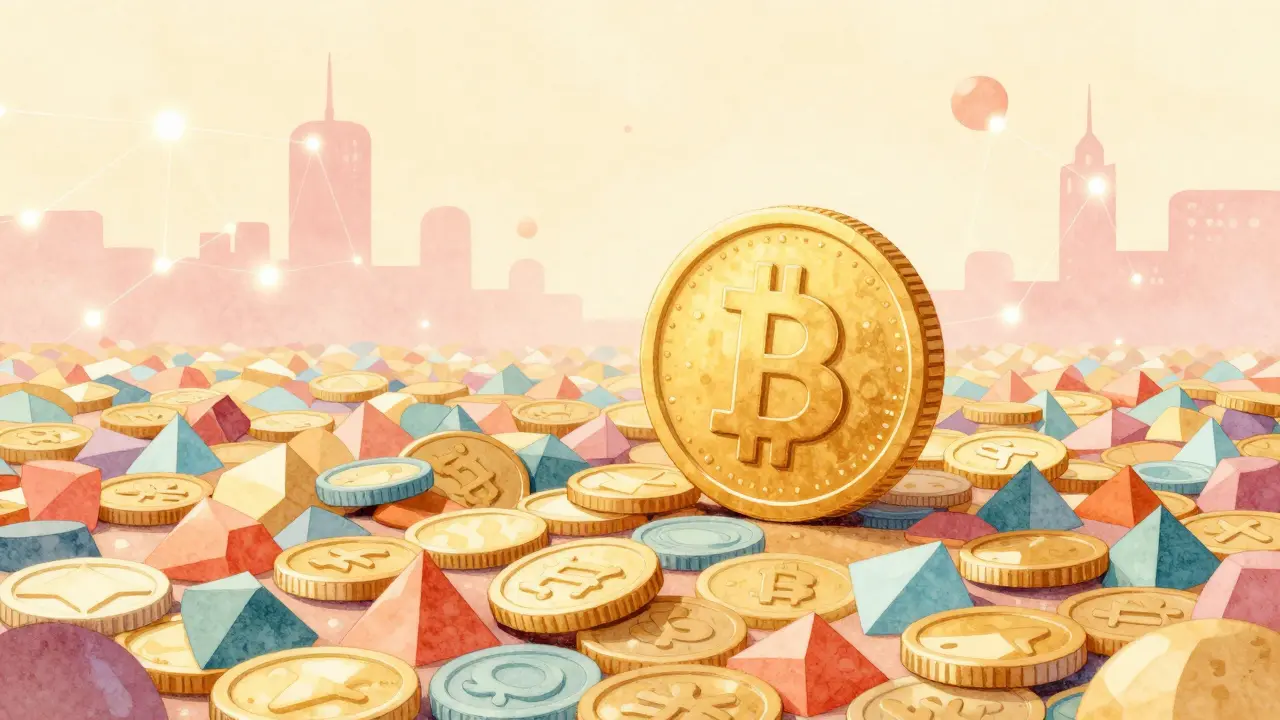
You might have searched for "Altcoin (ALT) crypto coin", hoping to find a specific asset to buy with the ticker symbol ALT. Here is the hard truth right off the bat: there is no legitimate "ALT" token on major exchanges. You are looking for a category, not a single product.
Altcoin stands for alternative coin. It is the blanket term for any cryptocurrency launched after Bitcoin. Think of Bitcoin as the original smartphone and every other phone ever made since as altcoins. By October 2023 alone, there were over 24,000 of these digital assets listed on tracking platforms, creating a landscape far more complex than just one currency.
The confusion is understandable. In the early days of the 2010s, the community used "altcoin" to distinguish any non-Bitcoin coin. Over time, Ethereum grew so large it often got its own seat at the table, leading many traders to define altcoins as "everything except Bitcoin and Ethereum." Regardless of how you draw the line, the concept remains the same: these are the challengers, innovators, and alternatives to Satoshi Nakamoto's pioneer network.
Beyond the Label: Why They Were Created
Why would anyone build something else when Bitcoin works? It wasn't just ego; it was necessity. Early developers noticed bottlenecks in Bitcoin's code. Transaction speeds were slow-taking ten minutes per block-and energy costs were high. They wanted to fix these specific problems.
| Feature | Bitcoin | Ethereum | Solana | Litecoin |
|---|---|---|---|---|
| Launch Year | 2009 | 2015 | 2020 | 2011 |
| Primary Function | Digital Gold / Store of Value | Smart Contracts / dApps | High-Speed Transactions | Faster Payments |
| Block Time | ~10 Minutes | ~12 Seconds | ~400 ms | ~2.5 Minutes |
| Consensus Model | Proof-of-Work (PoW) | Proof-of-Stake (PoS) | Proof-of-History (PoH) + PoS | Proof-of-Work (PoW) |
Look at Litecoin, launched in 2011 by Charlie Lee. He literally tweaked Bitcoin's code to process blocks four times faster, making it useful for buying coffee or paying bills without waiting hours for confirmation. Then came Ethereum in 2015. Vitalik Buterin didn't just speed things up; he added a computer to the blockchain called smart contracts. This allowed people to build money apps directly on the chain, sparking the entire Decentralized Finance (DeFi) revolution we see today.
How They Actually Work Under the Hood
If you hold an altcoin, understanding the engine matters more than the logo. Most cryptocurrencies rely on a consensus mechanism to agree on transactions without a boss. Bitcoin uses Proof-of-Work (PoW), where miners solve puzzles. This is secure but hungry for electricity. Many newer altcoins switched to Proof-of-Stake (PoS).
With PoS, validators lock up coins to propose new blocks rather than burning electricity. Ethereum completed this switch in September 2022 during an event known as "The Merge," cutting their energy usage by roughly 99.95%. This shift isn't just environmental; it changes the economy of holding the coin. Instead of mining hardware, profit comes from staking rewards, similar to earning interest in a bank account.
Then there are the architectural differences. Some altcoins focus purely on privacy. Monero, for instance, hides the sender, receiver, and amount on the ledger by default using ring signatures. Bitcoin's blockchain is public; you can trace every satoshi spent. In contrast, a transaction on XRP or Stellar focuses on liquidity and banking efficiency, aiming to replace SWIFT transfers between banks rather than competing with gold.
The Real Market Reality: Survival Rates
I've seen many retail investors get excited about a new coin on Twitter, only to lose everything months later. The statistics are brutal. While the total market cap of altcoins exceeded $1.2 trillion in late 2023, analysis suggests roughly 95% of all altcoins eventually go to zero. Why do they fail?
Most altcoins lack genuine utility. They are issued by anonymous teams with no roadmap, no open-source code, and no actual problem being solved. A healthy altcoin project typically shows over 50 active code commits per month on GitHub. If a project hasn't updated its code in six months, the team has likely abandoned the ship. DataDash analysts have long warned that without a dedicated developer base or real-world adoption, the token price follows gravity back to the floor.
This brings us to the survival curve. Projects that survive usually fall into three buckets:
- The Utility Play: Like Chainlink (LINK), which connects blockchains to real-world data such as weather reports or stock prices. Without Chainlink, smart contracts cannot trigger automatically.
- The Infrastructure Play: Platforms like Polygon or Avalanche that let developers build on top of them because their main networks are too crowded or expensive.
- The Governance Play: Tokens like Uniswap (UNI) that allow holders to vote on protocol changes, giving actual power to users rather than corporate CEOs.

Navigating the Investment Pitfalls
Buying these assets feels like Bitcoin, but the mechanics are trickier. One major headache is network selection. You cannot send an ERC-20 token like USDT to a BEP-20 address. These look identical on paper but live on completely different blockchains. Sending funds across the wrong network results in permanent loss, accounting for 18% of all user errors in the sector.
Liquidity is another hidden trap. When selling Bitcoin, the market is deep enough that your sell order rarely impacts the price significantly. Smaller altcoins can drop 20% on a single large sell-off due to thin order books. During "altcoin seasons"-cycles where capital rotates from Bitcoin into riskier assets-top performers can yield over 300% returns. However, catching this requires timing and tolerance for volatility that averages 85% annually, nearly double that of Bitcoin.
Regulatory status plays a massive role too. The SEC in the United States distinguishes strictly between commodities and securities. While Bitcoin is widely treated as a commodity, many altcoins face legal scrutiny as unregistered securities. In 2023, regulators filed lawsuits against several tokens, freezing assets and causing massive price crashes. Always check if a project is delisting from major exchanges in response to legal threats before investing.
Building Your Knowledge Before Buying
Before adding a random coin to your wallet, ask yourself if it solves a problem better than existing solutions. If you are looking at a payment coin, does it settle faster than Visa? If it's a gaming token, is there actual play activity? Look for active communities on Discord or Telegram-specifically, those discussing development updates rather than just price pumps. A community of 10,000 engaged users is often a stronger signal of longevity than a viral marketing campaign.
Finally, understand your portfolio allocation. Institutional investors tend to keep 82% of their exposure in Bitcoin, treating altcoins as high-risk satellites. Retail investors often overweight altcoins, seeking moonshot gains. To balance this, limit speculative altcoins to a small percentage of your total crypto holdings. Treat the rest as long-term infrastructure plays on proven technologies like Ethereum or Solana, rather than gambling tickets.
Lisa Miller
This is such a helpful guide for understanding the terminology better than any news article I read recently!
Ashley Stump
Its all just a ponzi scheme disguised as tech innovation anyway.
Callis MacEwan
Your assessment ignores the nuances of cross-chain bridging protocols and liquidity fragmentation risks inherent in the current ecosystem architecture.
Addy Stearns
I've been thinking about this for years regarding the fundamental nature of value storage in a digital age. When we talk about Bitcoin versus everything else, we aren't discussing currency anymore than discussing a stone tool is a modern hammer. The original promise was trustless transaction verification without intermediaries controlling the flow. Now we have thousands of tokens promising faster speeds or cheaper fees but lacking the network effect security. Security is the product, not the ticker price or the marketing slogan thrown around on social media feeds every day. A true store of value requires immutability that cannot be compromised by a developer team changing rules. Altcoins often fail because they prioritize utility over resilience, making them fragile systems prone to failure modes. We must consider whether the consensus mechanism actually aligns incentives with the participants holding the ledger. Proof-of-work burns real energy to secure data, creating a physical bond between computation and state. Proof-of-stake creates a correlation between wealth and block creation that centralizes power among large holders quietly. The philosophical difference isn't just technical specs found in a white paper table comparing numbers side by side. It is about what we sacrifice for efficiency versus what we protect for security against censorship. I believe most people ignore the history of failed experiments that paved the way for current infrastructure standards. We see innovation but forget the graveyard of projects that promised more than they could deliver in reality. Ultimately the market will weed out noise until only the robust networks remain standing tall. We should focus on longevity rather than quick gains during speculative seasons happening now.
Matt Bridger
the distinction drawn is superficial given the underlying tokenomics are fundamentally similar across the board
Alex Kuzmenko
im glad you explained the diffrence btwn btc and ethers so clary now. probabaly going to check out solana next week too.
Joy Crawford
i lost so much money on those meme coins last year u_u thought i was smart but no
Jay Starr
That is truly tragic indeed to hear about your losses on the project earlier in the year.
Beverly Menezes
just hold bitcoin i think and do not worry about the small ones so much.
Justin Smith
Regulatory compliance is the primary determinant of asset survival rather than mere technological superiority metrics alone.
Wade Berlin
Sure tell me all about the revolution while my portfolio bleeds red on the screen.
Jamie Riddell
Perhaps there is truth in that skepticism and you should take care of yourself.
Chris R
Do not give up and always do your own research before putting funds at risk.
Lisa Miller
Thank you everyone for sharing your perspective and experience on this complicated topic today.