

Most people know Bitcoin as digital gold - slow, secure, and not built for apps or smart contracts. But what if you could keep Bitcoin’s security while adding the power to run real programs on its network? That’s where TuringBitChain (TBC) comes in. It’s not another altcoin trying to replace Bitcoin. It’s a new layer built on top of it - one that lets developers write smart contracts without touching Bitcoin’s core code.
How TuringBitChain (TBC) Works: Bitcoin’s Missing Piece
TuringBitChain (TBC) started as a hard fork of Bitcoin. That means it copied Bitcoin’s original code - the same Proof of Work, the same UTXO model, the same SHA-256 mining - but then added something Bitcoin never had: full smart contract support.
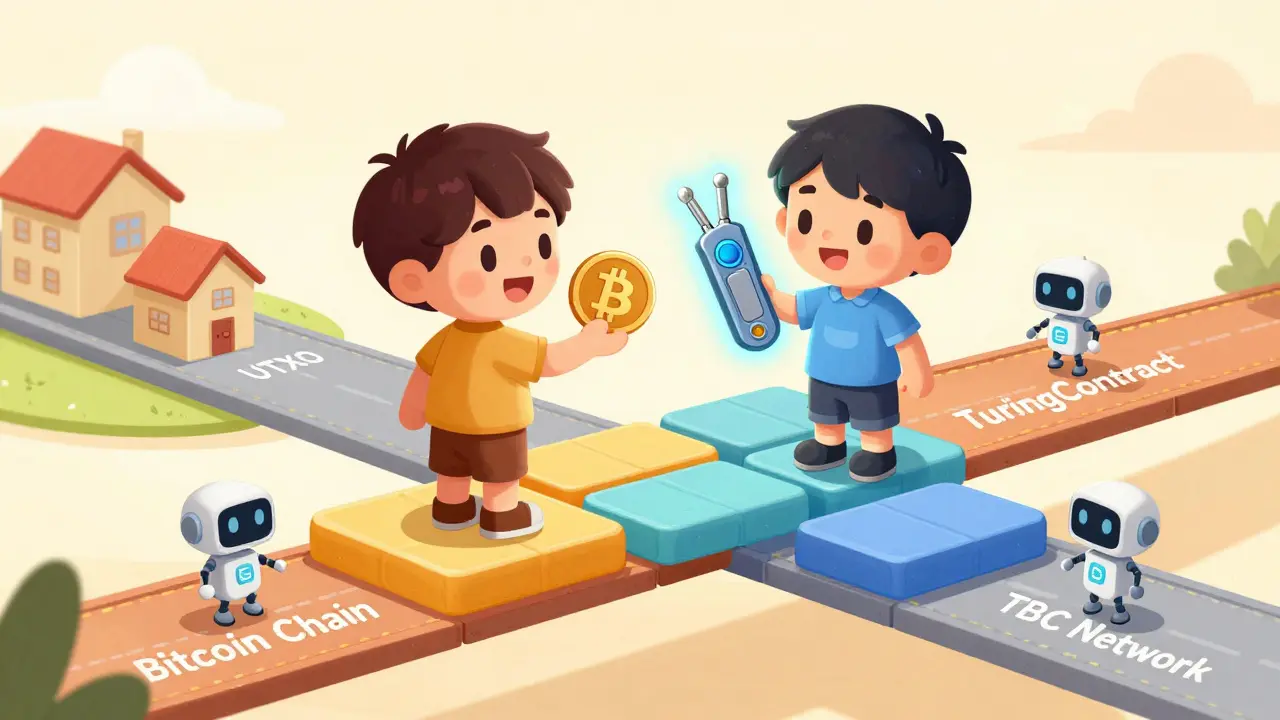
Bitcoin’s scripting language is intentionally limited. It can handle simple payments, but not complex logic like loans, insurance, or automated marketplaces. TBC fixes that with something called the Bitcoin Virtual Machine (BVM). Think of it like a separate engine plugged into Bitcoin’s chassis. It runs programs written in Turing-complete code, meaning it can do anything a regular computer can - as long as it has enough resources.
This isn’t a sidechain that runs independently. TBC stays tightly linked to Bitcoin. Every TBC transaction is anchored to Bitcoin’s blockchain. That means if Bitcoin stays secure, TBC stays secure too. You’re not trading away Bitcoin’s trust for speed - you’re keeping it while gaining new tools.
Key Tech: TuringTXID and TuringContract
TBC doesn’t just copy Ethereum’s model. It built its own system from the ground up using Bitcoin’s structure. Two core innovations make this possible:
- TuringTXID - A new way to label and track transactions that carry smart contract data. Unlike Bitcoin’s plain TXIDs, TuringTXID includes metadata that tells the network what program to run when the transaction is processed.
- TuringContract - The actual smart contract code. Developers write these in a language designed to work with UTXOs (Unspent Transaction Outputs). Instead of account-based balances like Ethereum, TBC uses Bitcoin’s UTXO model, where each contract input/output is a standalone piece of data that gets verified independently.
This design matters. UTXO-based smart contracts are harder to exploit than account-based ones. They’re also more transparent - every change is traceable back to a specific input. That’s why some developers say TBC’s approach is more secure than Ethereum’s EVM for certain use cases.
Why TBC Isn’t Just Another Ethereum Clone
You’ve heard of Layer 2s like Lightning Network or Arbitrum. They speed up Bitcoin or Ethereum transactions. TBC does something different: it adds functionality, not just speed.
Lightning lets you send Bitcoin faster. TBC lets you build a decentralized lending platform using Bitcoin as collateral - all on-chain, with no third party. You can create tokenized assets, automated escrows, or even Bitcoin-based DeFi apps that don’t require wrapping BTC into ETH-style tokens.
It’s like Bitcoin got a new set of tools instead of a new engine. You still drive the same car, but now you can install a GPS, a backup camera, and a voice assistant - all without changing the chassis.
Market Data: Price, Supply, and Trading Activity
As of February 2026, here’s what the numbers show:
- Price: $5.94 USD
- 24-hour volume: Around $1.15M (varies by exchange)
- Market cap: $230.18M
- Circulating supply: 38.71M TBC
- Total supply cap: 142M TBC
- All-time high: $17.17 (September 12, 2025)
- All-time low: $5.32 (February 14, 2026)
Over the last week, TBC rose nearly 10%, outperforming most other crypto assets. That’s not unusual - TBC has shown strong momentum during periods of Bitcoin consolidation. But it’s also volatile. It lost over 65% from its peak, which is typical for newer blockchain projects with limited liquidity.
Most trading happens on Gate.io, where the TBC/USDT pair accounts for nearly 80% of volume. The spread is tight at 0.04%, meaning it’s easy to buy and sell without big price swings. That’s a good sign for traders.
Supply and Tokenomics: What You Need to Know
TBC’s total supply is capped at 142 million tokens. That’s a big difference from what some data sites say - CoinGecko lists a total supply of 150 million and a max supply of 2.1 billion. This mismatch suggests some trackers haven’t updated their data, or the project’s official docs are still being clarified.
The current market cap of $230 million is only about 27% of the fully diluted valuation (FDV) of $844 million. That means if the full 142 million tokens were in circulation today, the price would be much lower. This isn’t necessarily bad - it just means future token unlocks could pressure the price unless demand grows.
There’s no official emission schedule published, but based on mining activity and exchange listings, it appears new TBC is being released gradually through mining rewards, not pre-mined or team allocations. That’s a positive sign for decentralization.
Where TBC Fits in the Bitcoin Ecosystem
TBC isn’t trying to be Bitcoin 2.0. It’s trying to be Bitcoin’s smart contract layer - like how Ethereum became the app platform for crypto. The project’s team compares it to Arbitrum’s relationship with Ethereum: a scaling and functionality layer that inherits security from the base chain.
If Bitcoin ever adopts BIPs that allow more flexible scripting (like Schnorr signatures or Taproot upgrades), TBC could become even more powerful. It’s already positioned as the go-to platform for Bitcoin-native DeFi, NFTs, and Web3 apps. Right now, developers are building on it because it’s the only Bitcoin-based chain that supports full Turing-complete code without needing wrapped assets.
For users, this means: you can hold BTC, send it to a TBC address, and instantly use it in a decentralized exchange, a lending protocol, or a gaming app - all without converting it to another coin.
Real-World Use Cases Already Live
TBC isn’t just theory. Here’s what’s live right now:
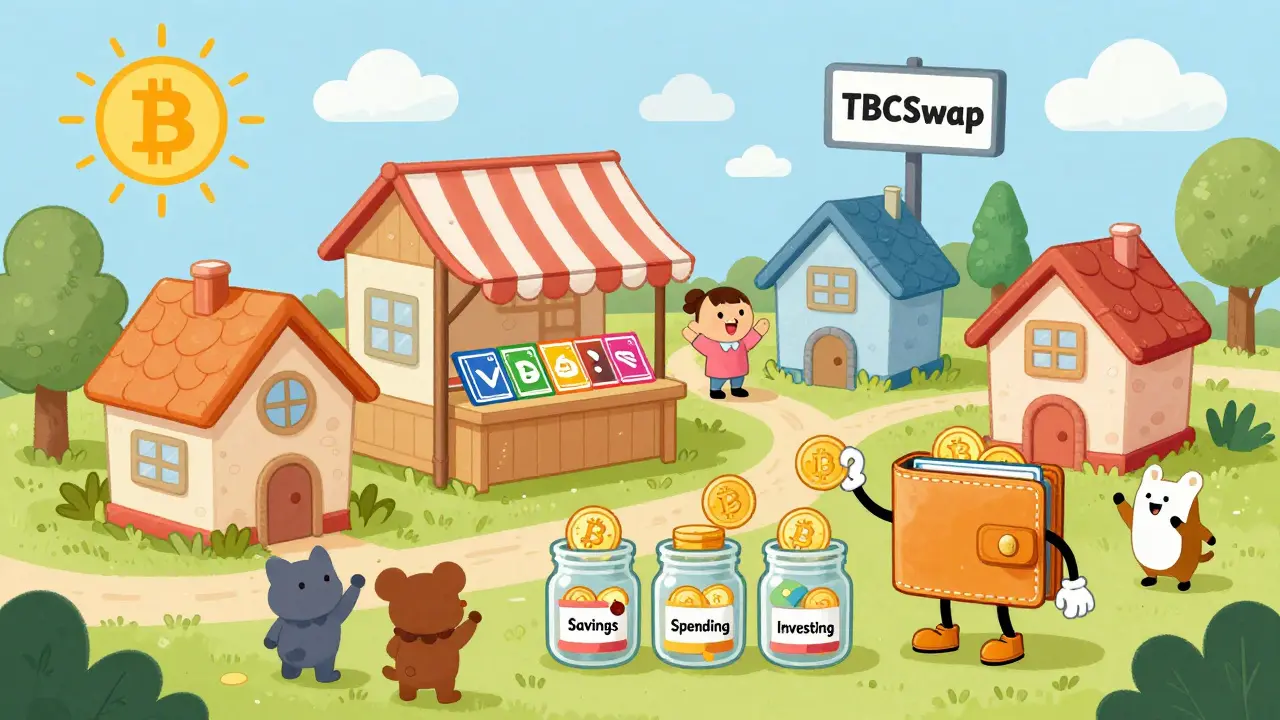
- A decentralized exchange (DEX) called TBCSwap, where users trade TBC and other tokens directly on-chain.
- A Bitcoin-based NFT marketplace that lets you mint and sell collectibles using TBC as the gas fee.
- A smart contract wallet that auto-splits incoming BTC into savings, spending, and investment buckets - all without a middleman.
- Automated trading bots (like REVENUEBOT) that execute TBC trades based on market signals.
These aren’t prototypes. They’re live, functional, and being used daily. That’s rare for a project this young.
Is TBC Worth Paying Attention To?
It’s not for everyone. If you’re looking for a quick flip, TBC’s volatility makes it risky. If you’re waiting for Bitcoin to become a payment network, TBC won’t help - it’s not about speed.
But if you care about Bitcoin’s long-term evolution - and want to see it become a platform for real apps - then TBC is one of the few projects doing something meaningful. It’s not copying Ethereum. It’s not trying to replace Bitcoin. It’s trying to give Bitcoin a new kind of power.
That’s worth watching.
Is TuringBitChain (TBC) a fork of Bitcoin?
Yes, TBC started as a hard fork of Bitcoin. It uses Bitcoin’s Proof of Work, UTXO model, and SHA-256 mining. But it adds a new layer - the Bitcoin Virtual Machine - that enables smart contracts without changing Bitcoin’s core protocol.
Can I use TBC to send Bitcoin faster?
No, TBC doesn’t make Bitcoin transactions faster. It doesn’t replace Lightning Network. Instead, it lets you run smart contracts on top of Bitcoin. If you want speed, use Lightning. If you want apps, use TBC.
Is TBC more secure than Ethereum?
It’s designed to be more secure for certain uses. Because TBC uses Bitcoin’s UTXO model and doesn’t rely on account balances, it’s harder to exploit with reentrancy attacks - a common flaw in Ethereum smart contracts. But Ethereum has a larger, battle-tested codebase. Security depends on how the contract is written.
Where can I buy TBC?
TBC is available on major exchanges like Gate.io, LBank, and KuCoin. The most active trading pair is TBC/USDT on Gate.io. You can also trade it via peer-to-peer platforms or automated bots like REVENUEBOT.
Does TBC have a future if Bitcoin doesn’t upgrade?
Yes. TBC operates independently of Bitcoin protocol upgrades. It anchors its transactions to Bitcoin’s blockchain for security, but it runs its own network for smart contracts. Even if Bitcoin stays unchanged, TBC can still grow as a standalone platform for Bitcoin-native applications.
Sriharsha Majety
this tbc thing is actually kinda cool i didnt think bitcoin could do smart contracts without getting messy
the way they anchored it to the original chain is smart af
Tabitha Davis
oh wow another "bitcoin layer" that's gonna make everyone rich
let me guess next they'll claim it's powered by unicorn energy and moon math
we've seen this movie 20 times already and the ending is always the same: rug pull at 200% gain
Vishakha Singh
I find this development truly remarkable. The integration of Turing-complete functionality while preserving Bitcoin’s foundational security model represents a significant leap forward in blockchain architecture. This is not merely an enhancement-it is an evolution.
Don B.
so you're telling me i can finally use btc to buy nfts without paying 50 bucks in gas?
cool i guess
but like... why not just use ethereum
it's already doing this
why reinvent the wheel with a square one
Arya Dev
I’m sorry, but I have to ask: is this even real? Who authorized this fork? Did the Bitcoin Foundation approve this? The UTXO model was never meant for this. This is a dangerous precedent. I’m genuinely concerned.
Leslie Cox
tbc? more like tbc (too bad crypto)
everybody loves a new layer that promises to "solve everything"
but here’s the truth: if bitcoin wanted smart contracts, it would’ve added them 10 years ago
you’re not building on bitcoin-you’re parasiting it
Andrew Hadder
i just checked gate.io and tbc/USDT has a 0.04% spread wow that's tight
also the dextools chart looks clean no weird whale dumps
maybe this is legit? idk just saying
Derek Sasser
i’ve been following this for a while and honestly the uxo-based smart contract design makes a lot of sense. ethereum’s account model is prone to reentrancy attacks-this avoids that entirely. plus, anchoring to bitcoin means you inherit its 15-year security record. it’s not flashy, but it’s solid.
Neeti Sharma
india has better crypto projects than this garbage
why are we even talking about some american fork when we have polygon and solana doing real work
tbc is just another west trying to steal our thunder
Nadia Shalaby
honestly i’m just here for the memes
but also i like that they’re not trying to be ethereum
bitcoin with apps feels weirdly right
like a classic car with a bluetooth stereo
Fiona Monroe
The architectural integrity of TuringBitChain is commendable. By preserving the UTXO model while introducing Turing-complete execution via a segregated virtual machine, the project demonstrates a rigorous adherence to cryptographic principles. This is not a hack-it is a meticulously engineered extension.
Molley Spencer
market cap of 230M? lol
fully diluted valuation is 844M
that means 75% of supply is still locked
this is a pump waiting to happen
they’ll dump on the next bull run and vanish
mark my words
John Fuller
tbc swap is live. used it. works.
Lucy Simmonds
this is all a fed scheme to get people to move away from real bitcoin
they know if bitcoin becomes a platform, the government can track every smart contract
they’re planting the seeds for surveillance crypto
you’re being played
Maggie House
i love how this doesn’t require wrapping btc. i’ve been stuck in that loop for years-btc to weth to eth to defi. this feels like the first time i can use btc how it was meant to be used. like, actually use it. not just hold it. i’m excited.
Dana Sikand
i’ve been mining tbc for months and the community is actually amazing
no drama, no shilling, just devs and users building real stuff
the smart contract wallet i made auto-splits my btc into savings and spending-i haven’t touched my budget app since
it’s quiet, but it’s changing lives
Cameron Pearce Macfarlane
another one of these "bitcoin is dead, long live bitcoin" projects
it’s 2026 and we’re still pretending layer 2s are innovation
just admit it: bitcoin is a store of value. stop trying to turn it into a toy
Elizabeth Smith
the real question isn’t whether tbc works-it’s whether we should be building on top of a chain that refuses to evolve
we’re creating a house of cards on a foundation that says no to change
that’s not progress. that’s delusion
Robert Kromberg
i think both sides have a point. bitcoin should stay simple. but if people want to build on it without leaving the network, why not let them? it’s not breaking anything-it’s adding a parallel layer. harmlessly.
Daisy Boliaan
okay but who’s funding this? why is gate.io the only exchange with real volume?
why is there no listing on binance?
why does the whitepaper have typos?
something smells off. i’m not buying it
Nicki Casey
the fact that you’re even considering this as a legitimate innovation shows how far we’ve fallen. bitcoin was meant to be censorship-resistant, not a playground for corporate-backed smart contracts. this is the beginning of the end. the central banks will use this infrastructure to freeze assets. mark my words: tbc is the first step toward a global financial surveillance state.
Jessica Carvajal montiel
they’re using bitcoin’s hashpower but calling it their own? that’s theft. they’re not building-they’re leeching. and the market cap? laughable. they’re inflating it with fake volume on gate.io. i’ve seen the bot activity. this is a ghost town with flashing lights.
maya keta
tbc is the future. why? because it’s the only way to make bitcoin relevant again. everyone else is stuck in 2017. this? this is 2026. we’re finally building on the real blockchain. the one that never went down. the one that’s still running. the one that’s still secure. this isn’t altcoin chaos. this is evolution.
Curtis Dunnett-Jones
I must emphasize the profound significance of this development. The adherence to cryptographic purity while enabling Turing-complete computation constitutes a monumental achievement in decentralized systems. One must recognize this not as a fork, but as a dignified augmentation of Bitcoin’s original vision.