

Imagine buying coffee without handing your credit card to a cashier. You just scan a code, the money moves directly from your phone to the shop’s account, and no bank holds onto your funds for a second. That is the core promise of Decentralized Exchanges, or DEXs. They are peer-to-peer marketplaces where you trade cryptocurrency directly with other users, skipping brokers, banks, and centralized platforms entirely.
If you have ever wondered why people keep talking about "self-custody" or "trustless finance," this is it. But before you rush in to swap tokens, you need to understand how these systems actually work, what risks they carry, and whether they are right for your trading style. This guide breaks down the mechanics, the benefits, and the hidden pitfalls of DEXs so you can make informed decisions.
How Do Decentralized Exchanges Actually Work?
Traditional exchanges like Coinbase or Binance act as middlemen. When you buy Bitcoin on them, the exchange holds the coins in a digital vault until you decide to sell. With a DEX, there is no middleman holding your assets. Instead, smart contracts-self-executing code on the blockchain-handle the entire transaction.
There are three main ways these trades happen:
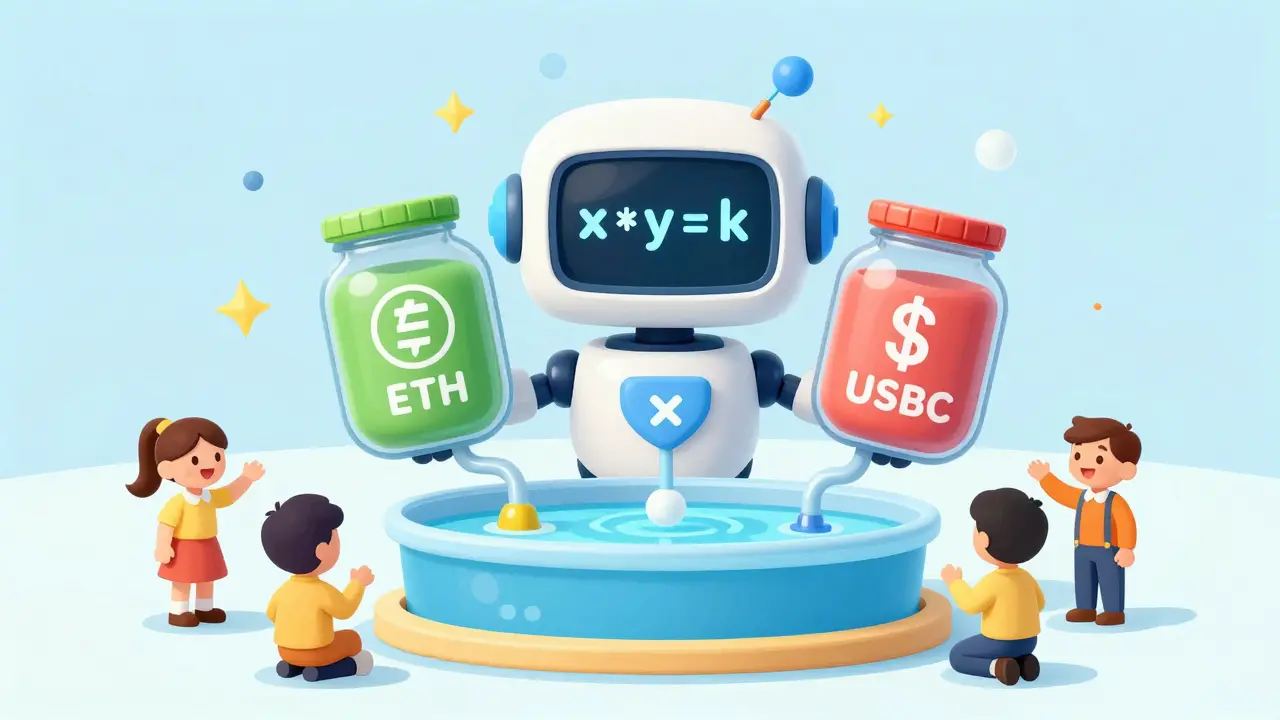
- Automated Market Makers (AMMs): This is the most common model today. Instead of matching buyers and sellers, AMMs use liquidity pools. Users deposit pairs of tokens (like ETH and USDC) into a pool, and traders swap against that pool. The price is determined by a mathematical formula, not by order books. Uniswap is the pioneer here, using a simple constant product formula ($x \times y = k$) to set prices based on supply and demand.
- Order Book DEXs: These look more like traditional stock markets. They maintain lists of buy and sell orders. Trades execute when a buyer’s price matches a seller’s. dYdX is a notable example, offering leveraged trading with an interface familiar to traditional traders.
- DEX Aggregators: Tools like 1inch don’t hold liquidity themselves. Instead, they split your trade across multiple DEXs to find you the best possible price, minimizing slippage and saving you fees.
The key takeaway? You never give up control of your private keys. Your wallet connects directly to the protocol, and the trade happens on-chain.
DEX vs. Centralized Exchange: What’s the Real Difference?
To understand why someone would choose a DEX over a Centralized Exchange (CEX), you have to look at who controls your money and data.
| Feature | Decentralized Exchange (DEX) | Centralized Exchange (CEX) |
|---|---|---|
| Custody | You hold your keys (Non-custodial) | Exchange holds your keys (Custodial) |
| KYC Requirement | None (Anonymous) | Mandatory (Identity Verification) |
| Fiat Support | Crypto-only (usually) | Direct bank deposits & withdrawals |
| Security Risk | Smart contract bugs / User error | Hacks / Exchange insolvency |
| Token Selection | Virtually unlimited (any token) | Curated list (strict listing criteria) |
CEXs are easier for beginners. You can link a bank account, get customer support if you forget your password, and trade instantly. DEXs offer freedom. You can trade any token listed on the blockchain, even if it’s brand new and hasn’t been vetted by a central authority. However, that freedom comes with responsibility. If you lose your private key, there is no "Forgot Password" button. No one can help you.
The Hidden Costs: Gas Fees, Slippage, and Impermanent Loss
Trading on a DEX isn’t free, and the costs aren’t always obvious. Here is what you need to watch out for.
Gas Fees: Every transaction on a blockchain requires computational power. On Ethereum, this is paid in ETH as "gas." During busy periods, gas fees can spike dramatically. In May 2021, average gas prices hit 300 gwei, making small trades uneconomical. Always check a gas tracker like Etherscan before swapping. Layer 2 solutions like Arbitrum or Optimism have largely solved this, offering fees under $0.10.
Slippage: Slippage is the difference between the expected price of a trade and the price at which the trade is executed. It happens when there isn’t enough liquidity in the pool. If you try to swap $10,000 worth of a rare token with only $5,000 in liquidity, the price will move significantly against you. Most DEXs let you set a "slippage tolerance" (e.g., 0.5% or 1%). If the price moves beyond that limit, the transaction fails, protecting you from bad deals.
Impermanent Loss: This is specific to liquidity providers-the people who deposit funds into pools. If the price of one token in the pair changes drastically compared to the other, you might end up with less value than if you had just held the tokens in your wallet. For stablecoin pairs, this risk is low (5-15% annually). For volatile pairs, it can reach 15-35% during high volatility periods.
Security: Who Is Really Protecting Your Funds?
When you use a CEX, you rely on their security team. When you use a DEX, you rely on code-and yourself.
Smart contracts are immutable once deployed. If there is a bug, hackers can exploit it. In 2022, CipherTrace reported $2.8 billion lost to DeFi hacks, with 65% affecting DEXs and liquidity protocols. While major protocols like Uniswap are heavily audited, smaller, newer DEXs may not be.
More commonly, users fall victim to their own mistakes. A 2023 Chainalysis report noted that 72% of negative user experiences stemmed from security misunderstandings. The biggest trap? Unlimited token approvals. When you approve a token to be traded on a DEX, you are giving that smart contract permission to spend your tokens. If you later interact with a malicious contract that uses that same approval, it can drain your wallet. Use tools like Revoke.cash to manage and revoke these permissions regularly.

Getting Started: Your First DEX Trade
Ready to try it? Here is the step-by-step process to trade safely on a DEX like Uniswap or PancakeSwap.
- Set Up a Non-Custodial Wallet: Download MetaMask or Trust Wallet. These wallets store your private keys locally on your device. Never share your seed phrase with anyone.
- Fund Your Wallet: Buy cryptocurrency on a CEX (like Coinbase) and withdraw it to your MetaMask address. Ensure you are sending it on the correct network (e.g., ERC-20 for Ethereum).
- Connect to the DEX: Go to the official DEX website (always verify the URL to avoid phishing sites). Click "Connect Wallet" and select MetaMask.
- Select Tokens and Amount: Choose the token you want to swap from and the token you want to receive. Enter the amount.
- Check Settings: Look at the estimated output and slippage tolerance. For stable pairs, keep slippage at 0.5%. For volatile tokens, you might need 1-2%.
- Approve and Swap: Click "Swap." You may need to sign two transactions: one to approve the token spending, and one to execute the trade. Check the gas fee before confirming.
Pro tip: Start with a small amount. Treat your first few trades as tuition fees for learning the interface. Once you feel comfortable, scale up.
The Future of DEXs: Scalability and Regulation
DEXs are evolving rapidly. The biggest hurdle has always been scalability. Ethereum’s base layer can only handle ~15 transactions per second, leading to high fees. Solutions like zkSync and StarkNet are building zero-knowledge rollups that promise Visa-level throughput (65,000 TPS) while maintaining decentralization.
Regulation is also tightening. In October 2023, Uniswap Labs settled with the SEC for $50 million regarding unregistered securities offerings. This signals that regulators are watching. However, jurisdictions like Switzerland and Singapore are creating friendly frameworks. The future likely involves hybrid models, where DEX liquidity meets CEX-like onboarding for mainstream adoption.
Is it safe to use decentralized exchanges?
It depends on how you define safety. DEXs eliminate the risk of an exchange going bankrupt or stealing your funds centrally, but they introduce smart contract risks and require you to manage your own security. If you lose your private key or click a phishing link, your funds are gone forever. Stick to well-audited, established protocols like Uniswap or Curve, and always double-check URLs.
Do I need to pay taxes on DEX trades?
Yes. In most jurisdictions, including the UK and US, every swap on a DEX is considered a taxable event. You are disposing of one asset and acquiring another, which may trigger capital gains tax. Keep detailed records of all transactions, including dates, amounts, and fair market values at the time of trade.
Why are gas fees so high on Ethereum DEXs?
Ethereum’s network is congested because it hosts the majority of DeFi activity. High demand for block space drives up gas prices. To save money, consider using Layer 2 networks like Arbitrum, Optimism, or Base, which settle transactions cheaper and faster while inheriting Ethereum’s security.
Can I buy crypto with fiat currency on a DEX?
Generally, no. Most DEXs are crypto-to-crypto only. You typically need to buy ETH or USDC on a centralized exchange first, transfer it to your wallet, and then swap it on the DEX. Some emerging protocols are integrating fiat on-ramps, but this often requires KYC verification, defeating the anonymity purpose of many DEX users.
What is impermanent loss and should I worry about it?
Impermanent loss occurs when the price of tokens in a liquidity pool diverges from each other. It is "impermanent" because it disappears if prices return to their original ratio. If you are just swapping tokens, you don’t experience impermanent loss-it only affects liquidity providers. If you provide liquidity, stick to correlated pairs (like ETH/wETH) or stablecoins to minimize risk.