
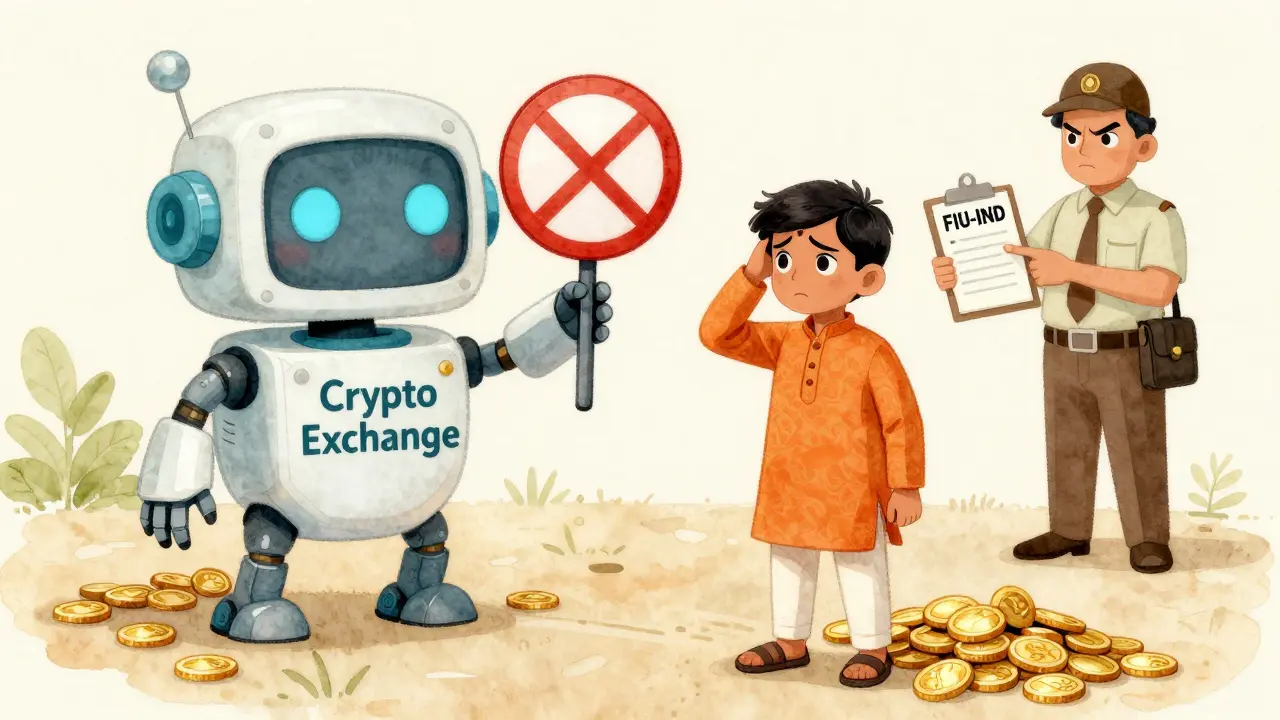
If you are trying to deposit rupees into your favorite international crypto exchange and the transaction keeps failing, you might be wondering if that platform is actually blocked. The short answer is yes, but not in the way most people think. India did not ban cryptocurrency itself. Instead, the government pulled the plug on specific crypto exchanges that refused to play by the new rules.
The landscape changed dramatically over the last few years. If you were trading on a global giant like Binance or KuCoin without checking their local compliance status, you likely faced sudden account freezes or website blocks. This wasn't a random attack; it was a systematic enforcement of the Financial Intelligence Unit-India (FIU-IND) regulations. Today, the line between legal and illegal trading in India is drawn strictly at one point: FIU registration.
The Real Reason Exchanges Got Blocked
To understand which platforms are banned, you first need to understand who holds the power. The Financial Intelligence Unit-India (FIU-IND) is the agency responsible for monitoring financial transactions to prevent money laundering. Under the Prevention of Money Laundering Act (PMLA), any entity acting as a Virtual Asset Service Provider (VASP)-which includes crypto exchanges-must register with the FIU to operate legally in India.
This requirement isn't just paperwork. It’s a license to exist. When an exchange fails to register, it becomes a "non-compliant" entity. The Indian government then issues blocking orders to Internet Service Providers (ISPs). This means the website won’t load, and the app gets removed from the Google Play Store and Apple App Store within the country. For users, this looks like a ban, but technically, it’s a blockage of access to non-compliant services.
The crackdown accelerated after January 2024. Before this period, many international platforms operated in a grey area, hoping regulation would never come. Once the deadline passed, the enforcement became immediate. Platforms that ignored the FIU mandate found themselves cut off from the Indian internet infrastructure overnight.
Which International Exchanges Are Affected?
The list of affected platforms is dominated by major global names that chose not to comply initially. Here is how the situation stands for some of the biggest players:
- Binance: One of the world's largest exchanges, Binance faced significant hurdles. While they have attempted to navigate regulatory waters globally, their operations in India have been severely restricted due to non-compliance with FIU requirements at various points. Users often face difficulties accessing the site directly from Indian IP addresses.
- KuCoin: Similar to Binance, KuCoin has seen its services blocked for Indian users because it did not secure the necessary FIU registration during the initial enforcement waves.
- Bybit: Bybit has also dealt with penalties and access restrictions. Non-compliant exchanges like this pay millions in fines elsewhere, but in India, the penalty is loss of access.
- Coinbase: Interestingly, Coinbase has taken a more cautious approach. Rather than operating a full-service exchange for retail Indians without proper licensing, they have largely stepped back to avoid regulatory friction, effectively limiting their direct service availability compared to compliant domestic rivals.
It is crucial to note that these bans are dynamic. An exchange can apply for FIU registration at any time. If they meet the criteria, the blocks can be lifted. However, as of early 2026, the trend remains that only those who have formally registered can offer seamless INR deposits and withdrawals.
| Feature | FIU-Registered Exchanges | Non-Compliant/Banned Exchanges |
|---|---|---|
| Website Access | Fully accessible via Indian ISPs | Blocked or slow/unstable connections |
| INR Deposits | Supported via UPI, Net Banking | Blocked by banks; high risk of frozen accounts |
| Tax Reporting | Provide mandatory reports to IT Dept | No official reporting; user bears full burden |
| User Protection | Grievance redressal under Indian law | Limited recourse; no legal protection |
| Data Retention | Up to 6 years (as per law) | Variable; may lack transparency |

The Rise of Domestic Giants
When the doors closed for international giants, local platforms rushed to open theirs. The migration of users from banned foreign sites to domestic ones was unprecedented. Platforms like CoinDCX, WazirX, Mudrex, ZebPay, and Unocoin saw explosive growth.
CoinDCX reported deposit growth exceeding 2,000% during the peak of the crackdown. Mudrex onboarded thousands of new users in weeks. Why? Because these platforms offered something the banned exchanges couldn’t: stability. You could deposit money using UPI, trade Bitcoin or Ethereum, and withdraw funds without worrying that your bank account would be frozen by the Enforcement Directorate (ED).
These domestic exchanges didn't just survive; they thrived by embracing compliance. They integrated KYC (Know Your Customer) processes that align with Indian banking standards. This made them safe havens for investors who wanted to stay within the legal framework while still participating in the crypto market.
Legal Risks of Using Banned Platforms
You might think you can bypass the block using a VPN. Technically, you can access the website. But here is where it gets dangerous for your wallet. Even if you can log in, your bank will likely block the transaction. Indian banks are under strict instructions from the Reserve Bank of India (RBI) to monitor transactions related to virtual currencies.
If you send money to a non-compliant exchange, your bank may flag the transaction as suspicious. This can lead to:
- Account Freezes: Your entire bank account could be temporarily locked while authorities investigate the source and destination of funds.
- Transaction Reversals: Banks may reverse transfers sent to known blacklisted entities.
- Enforcement Directorate Scrutiny: In severe cases, large transactions to unregistered entities can trigger investigations for potential money laundering violations.
Furthermore, tax implications are harsh. India imposes a flat 31.2% tax on crypto gains (including TDS). Compliant exchanges deduct this tax at the source. If you use a banned platform, you must calculate and file this manually. If the Income Tax Department discovers undisclosed trades through blockchain analytics-a tool they increasingly use-you could face penalties up to 60% under Section 158BA(7).

Is Cryptocurrency Illegal in India?
No. This is a common misconception. The Supreme Court of India struck down the RBI’s 2018 circular that banned banks from dealing in crypto in 2020. Since then, holding and trading cryptocurrency has been legal. The government has not issued a blanket ban on digital assets.
However, "legal" does not mean "unregulated." The state treats crypto as a taxable asset and a high-risk investment. The recent Finance Bill amendments, including Section 285BAA, require exchanges to maintain detailed transaction records. This retrospective rule means that even if an exchange registers today, they must keep data that could expose past trades. This ensures that the government has a clear trail of every rupee spent on crypto.
What Should You Do Now?
If you are currently using a non-compliant exchange, the safest move is to migrate your assets to an FIU-registered platform. Here is a practical checklist:
- Check Compliance Status: Visit the FIU-IND website to verify if your exchange is listed as a registered VASP.
- Move Funds: Transfer your crypto holdings to a compliant Indian exchange like CoinDCX or WazirX. Avoid sending fiat (INR) to non-compliant platforms.
- Update Tax Records: Ensure you have transaction history from your previous exchange to file accurate taxes for past years.
- Avoid Decentralized Workarounds: While Decentralized Exchanges (DEXs) don’t require KYC, they are not immune to oversight. Indian authorities are increasingly monitoring on-chain activity linked to Indian wallets. Privacy is not guaranteed.
The era of wild-west crypto trading in India is over. The regulatory framework is now structured, strict, and enforced. By sticking to compliant platforms, you protect your capital, your bank account, and your peace of mind.
Is Binance completely banned in India?
Binance is not "banned" in the sense that owning Bitcoin is illegal, but its services are heavily restricted. Because it has faced issues with FIU-IND registration compliance, Indian users often cannot access the website directly, and banks frequently block transactions to and from Binance. It operates in a grey zone where access is unreliable and risky.
Can I use a VPN to trade on banned exchanges?
You can use a VPN to access the website, but it does not solve the banking issue. Indian banks will still block INR deposits to non-compliant exchanges. Additionally, using a VPN to evade financial regulations can be viewed negatively by authorities if discovered during an investigation.
Which crypto exchanges are safe to use in India in 2026?
Safe exchanges are those registered with the Financial Intelligence Unit-India (FIU-IND). Prominent examples include CoinDCX, WazirX, Mudrex, ZebPay, and Unocoin. These platforms allow smooth INR deposits via UPI and provide necessary tax documentation.
What happens if I trade on a non-compliant exchange?
You risk having your bank account frozen, facing transaction reversals, and encountering difficulties filing taxes. Non-compliant exchanges do not report to the Income Tax Department, meaning you must manually track all trades. Failure to declare these gains can lead to heavy penalties and legal scrutiny.
Is cryptocurrency trading legal in India?
Yes, trading cryptocurrency is legal in India. The Supreme Court upheld the right to trade in 2020. However, it is heavily regulated. Traders must pay a 30% tax on profits plus a 1% TDS, and they must use exchanges that comply with FIU-IND registration requirements to avoid legal issues.