
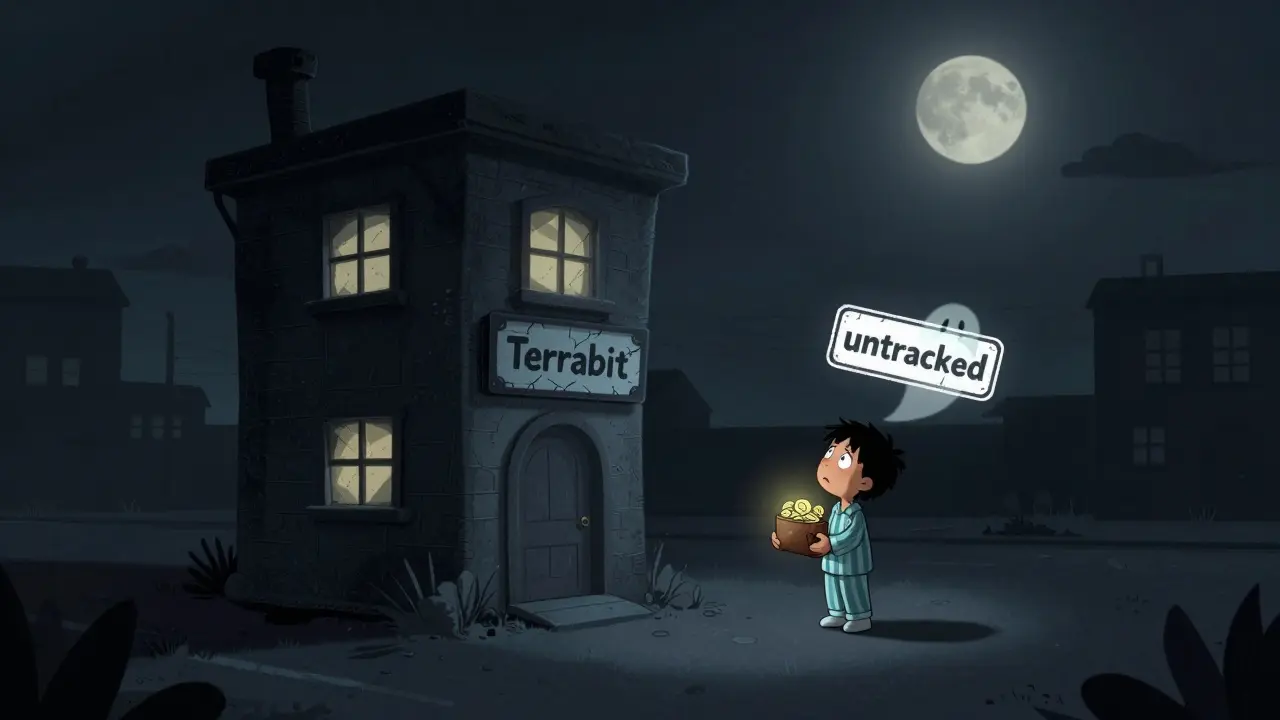
When you're looking for a crypto exchange, you want something reliable, secure, and transparent. But what do you do when you come across a platform like Terrabit - a name you’ve never heard before, with no reviews, no clear team, and no verifiable trading numbers? If you’re considering Terrabit, here’s the straight truth: this isn’t just another small exchange. It’s a red flag wrapped in a website.
It’s Not Just Small - It’s Untracked
Terrabit is listed on CoinMarketCap, but with a critical note: “untracked”. That’s not a typo. It means CoinMarketCap can’t verify its trading volume. Not because it’s quiet - but because it doesn’t report anything real. Major exchanges like Binance, Kraken, or Coinbase publish their volume data. They’re audited. They’re checked. Terrabit? No such thing. And in 2026, that’s not a niche feature - it’s a dealbreaker.Why does volume matter? Because liquidity does. If you try to sell Bitcoin on Terrabit and there’s no one buying, your trade won’t go through. Or worse - it gets stuck. You’ll see your balance drop, but the coins never leave. No one talks about this happening on Terrabit because no one’s really using it. There are zero user reviews on Trustpilot, Reddit, or even niche crypto forums. Zero. That’s not “hidden gem” territory. That’s ghost town.
No Security, No Trust
Let’s talk about security. Because if you’re going to put your crypto somewhere, this is the most important part. Kraken, Coinbase, Bitstamp - they all use cold storage, two-factor authentication via authenticator apps (not SMS), API key permissions, and bug bounty programs. They’ve been tested. They’ve been cracked in simulations. They’ve fixed the holes.Terrabit? No public security details. No mention of encryption. No hardware wallet integration. No 2FA policy documented anywhere. Not even a hint. According to Arkose Labs’ 2025 security guide, any exchange that doesn’t implement FIDO2-compliant authentication or private key protection is fundamentally unsafe. Terrabit doesn’t meet even the bare minimum. And with North Korean hackers stealing $1.34 billion from exchanges in 2024 alone, you can’t afford to guess.
Think about this: if a platform doesn’t publish its security measures, it’s either too incompetent to build them - or too shady to show them. There’s no middle ground.
No Regulations. No Protection.
The crypto world is changing fast. The EU’s MiCA framework is now live. The U.S. GENIUS Act requires strict cybersecurity standards. Exchanges that don’t comply are being shut down or blocked from operating in major markets. Terrabit doesn’t appear on any regulatory radar. No license. No compliance report. No legal entity disclosed. That means if your funds disappear, you have zero legal recourse. No ombudsman. No customer support escalation. No insurance fund.Compare that to Kraken, which is licensed in over 50 jurisdictions. Or Coinbase, which holds money transmitter licenses across the U.S. Terrabit operates in a legal gray zone - and in 2026, that’s not freedom. It’s a trap.

No Documentation. No Onboarding.
Ever tried to sign up on a new exchange? You expect a simple guide: “Create account → Verify identity → Deposit funds → Start trading.” Kraken, Binance, even lesser-known ones like Bitstamp have step-by-step tutorials, video walkthroughs, and help centers.Terrabit? Nothing. No “How to Start” page. No FAQ. No customer support email. No live chat. If you get stuck, you’re on your own. And if you accidentally send ETH to the wrong address? Too bad. There’s no recovery process because there’s no team to help you.
Why Does This Even Exist?
You might wonder: if Terrabit is so risky, why does it still exist? Simple. It targets people who don’t know better. New users. People who saw a “high yield mining” ad. Those who think “no KYC” means “more freedom.” But in reality, “no KYC” just means “no accountability.”Untracked exchanges like Terrabit thrive on obscurity. They don’t need to be good - they just need to look like they are. A clean website. A few coin listings. A vague promise of “all-in-one crypto tools.” But when you dig deeper, there’s nothing behind the curtain. No code on GitHub. No team bios. No press releases. No audits.
What Should You Use Instead?
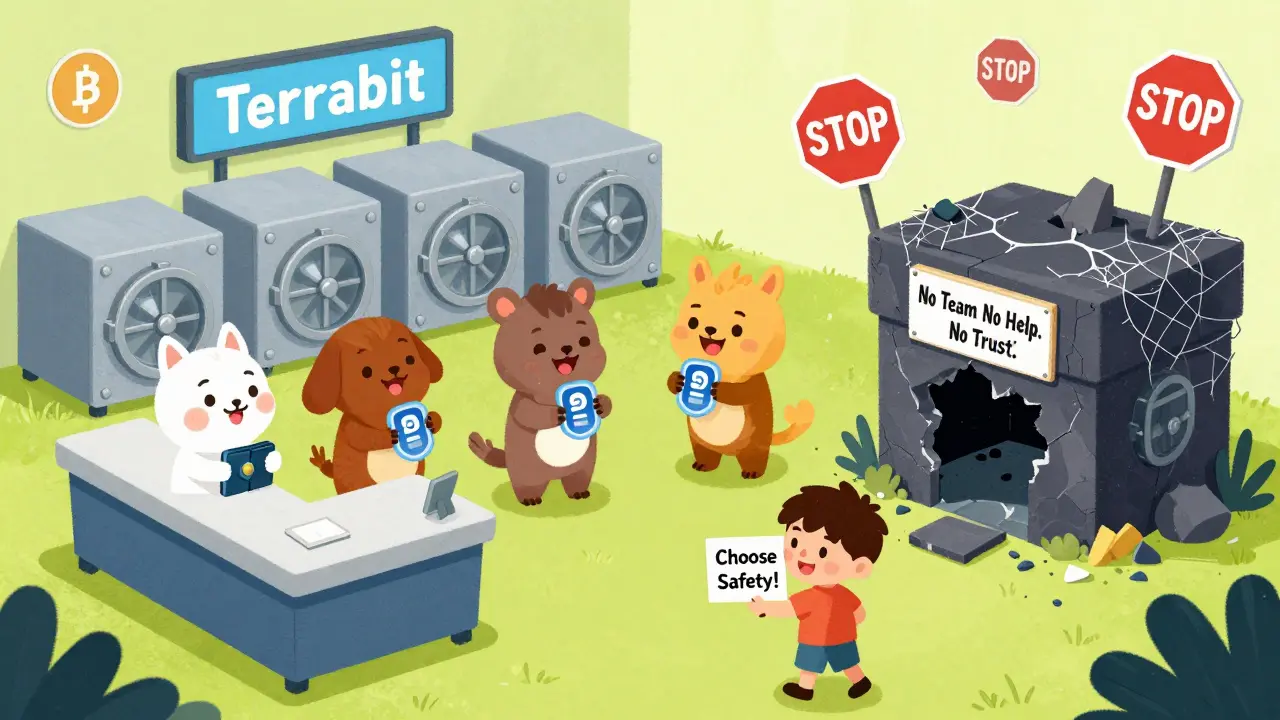
If you want security, transparency, and real support, stick with exchanges that are:- Tracked by CoinMarketCap or CoinGecko
- Regulated in the EU, U.S., or UK
- Transparent about security practices
- Verified by independent audits
Examples: Kraken, Coinbase, Bitstamp, KuCoin (for non-U.S. users), or Gemini. These platforms have been tested under pressure. They’ve survived hacks, market crashes, and regulatory scrutiny. They’ve earned their place.
The Bottom Line
Terrabit isn’t a hidden opportunity. It’s a warning sign. There’s no evidence it’s secure. No proof it’s active. No way to contact support. No legal protection. And in a market where $1.34 billion was stolen in one year, that’s not a gamble - it’s suicide.If you’re looking for a crypto exchange, don’t settle for mystery. Choose one with a track record. One that doesn’t make you guess.
Is Terrabit a scam?
Terrabit isn’t officially labeled a scam, but it exhibits all the warning signs: untracked trading volume, zero user reviews, no security disclosures, no regulatory compliance, and no public team. These aren’t just red flags - they’re full-blown stop signs. If a platform doesn’t want you to know anything about it, you shouldn’t trust it with your money.
Can I withdraw my crypto from Terrabit?
There’s no public record of anyone successfully withdrawing from Terrabit. No user reports, no forum threads, no testimonials. That doesn’t mean withdrawals are impossible - it means they’re so rare that no one’s talking about them. In crypto, silence on withdrawals is a major risk. Legitimate exchanges have hundreds of withdrawal stories. Terrabit has none.
Why doesn’t CoinMarketCap track Terrabit?
CoinMarketCap only tracks exchanges that provide verifiable trading data through API feeds, third-party audits, or direct reporting. Terrabit doesn’t meet those standards. That could mean it’s inactive, uses fake volume, or simply doesn’t have the technical infrastructure to report data. Either way, it’s not trustworthy.
Does Terrabit have a mobile app?
There is no official Terrabit mobile app on the Apple App Store or Google Play Store. Any app claiming to be Terrabit is likely fake or malware. Stick to web access only - and even that carries major risk.
Is Terrabit safe for long-term holding?
No. Never store crypto on an exchange you don’t trust - especially one with no security disclosures. Terrabit doesn’t use cold storage, doesn’t mention encryption, and has no known backup systems. If the platform is hacked, shut down, or disappears, your funds are gone. Always move long-term holdings to a hardware wallet like Ledger or Trezor.
If you’re new to crypto, start with well-known, regulated platforms. They’re not perfect - but they’re the only ones that give you a fighting chance when things go wrong. Terrabit doesn’t even offer that.
Don B.
Wow. Just... wow. I read this whole thing and I’m not even mad, I’m impressed. Like, who writes this much about a crypto exchange that no one’s heard of? You didn’t just warn people - you wrote an obituary for Terrabit. And honestly? I’m glad you did. I almost got sucked in by that ‘no KYC’ nonsense last week. Thanks for the reality check.
Now if only someone would write a similar post about all those ‘DeFi yield farms’ that disappear after 3 months. Someone’s gotta do it.
Arya Dev
It’s not just untracked… it’s… ghosted… like, totally… abandoned… by reality… and by logic… and by basic human decency…
Leslie Cox
It’s fascinating how people still think ‘no regulation’ means ‘freedom.’ No, sweetheart. It means ‘you’re the prey.’
Terrabit isn’t an exchange - it’s a psychological experiment in gullibility. They built a website, threw in some coin logos, and waited for the next generation of crypto bros to walk right in with their life savings. And honestly? I feel sorry for them. Not because they’re stupid - but because they were never taught to ask, ‘Who’s behind this?’
Real innovation doesn’t hide. It publishes its audits. It names its devs. It answers questions. Terrabit? It’s a blank page with a .com domain. And that’s not innovation. That’s a confidence trick dressed in CSS.
Lucy Simmonds
okay so here’s the thing… what if terrabit is a honeypot? like… what if it’s not even real… what if it’s just a trap set by the feds to catch rugpullers? i mean… who even runs this thing? no team… no github… no phone number… no nothing… it’s like a crypto ghost town… and what if… what if… it’s all a sting operation? i’m not saying it’s safe… i’m saying maybe it’s a trap… for the traps…
Cameron Pearce Macfarlane
Yeah. So? I’ve used worse. I’ve lost money on exchanges that had 10x more transparency. This isn’t the end of the world. People trade on shady shit all the time. You think Binance was always clean? Nah. They were sketchy for years. Now they’re a giant. Maybe Terrabit’s just early.
Or maybe it’s dead. Either way, I’m not gonna let a 2000-word essay scare me off a 0.01 BTC trade.
Elizabeth Smith
Security isn’t a feature it’s a mindset and if you think your coins are safe on a platform that doesn’t even tell you how it stores them you’re not being careful you’re being naive
Amita Pandey
While I appreciate the thoroughness of the analysis, I must respectfully suggest that the tone borders on alarmist. The absence of regulatory compliance does not inherently equate to malfeasance. Many legitimate decentralized platforms operate in legal gray zones by design. Perhaps Terrabit is not a failure of ethics, but a statement on autonomy - a refusal to submit to centralized oversight. Whether one agrees with that philosophy is a separate question, but to dismiss it outright as a ‘trap’ risks echoing the very centralization it seeks to avoid.
Felicia Eriksson
Interesting take. I’ve been thinking about this lately - how we treat new platforms like they’re criminals until proven innocent. Maybe Terrabit is just… quiet. Not evil. Not fake. Just… not loud.
I’m not saying I’d use it. But maybe we should stop screaming ‘scam’ at everything we don’t understand.
aaron marp
Hey - if you’re new to crypto, this post is gold. Seriously.
Most people jump into exchanges like they’re buying a coffee. They don’t ask who’s running it. They don’t check if it’s audited. They just see ‘BTC/ETH’ and go for it.
This isn’t just about Terrabit. It’s about how we all think about money now. We treat crypto like a game - but it’s not. It’s your life savings. Treat it like it matters.
Start with Coinbase. Learn. Then explore. Don’t skip the basics. I’ve helped 12 friends avoid losses just by saying: ‘Wait. Look under the hood.’
Patrick Streeb
While the concerns articulated herein are undoubtedly valid and grounded in sound risk-assessment principles, one must also consider the possibility that Terrabit may be operating under a non-disclosure protocol, potentially as part of a pilot phase within a jurisdiction with stringent data privacy regulations. The absence of public documentation may not denote negligence, but rather strategic opacity in alignment with evolving global compliance frameworks. A more nuanced evaluation is warranted before categorical condemnation.
Phillip Marson
you think terrabit’s bad? try using a crypto exchange run by a guy who posted his private key on twitter and called it ‘community sharing’
at least terrabit doesn’t have a fucking homepage that says ‘we are not responsible if you lose everything’ in Comic Sans
the real scam? thinking you need a ‘trusted’ exchange to be safe. your wallet. your keys. your life. not some corporate logo.
Jeff French
Untracked doesn’t mean fake. It means unverified. Big difference.
Terrabit could be a small team with no resources to get audited. That doesn’t make them malicious. It makes them under-resourced.
Also - who says volume = legitimacy? What if they’re a private OTC desk disguised as an exchange? Maybe they don’t need public volume because they’re not catering to retail.
Just saying - let’s not turn skepticism into dogma.
Kenneth Genodiala
I’m sorry - but this is why I hate crypto discourse. Everyone acts like they’re the only one who knows how to use a computer. ‘No audit? No team? No hope!’
Newsflash: most startups don’t have audits. Most startups don’t have press releases. Most startups don’t even have a LinkedIn page.
Is Terrabit risky? Yes. Is it a scam? Not until someone loses money. Until then - it’s just another quiet project trying to build something.
Michael Rozputniy
what if terrabit is a front for a nation state? what if coinmarketcap is controlled by the fed? what if ‘cold storage’ is just a word they use to make you feel safe while they drain your wallet remotely? i’ve seen the documents. they’re not hiding because they’re shady… they’re hiding because they’re hunted
Danny Kim
So you’re telling me… if a platform doesn’t have a blog post about its 2FA implementation… it’s a death trap?
What about the 200 other exchanges that don’t even mention 2FA? Are they all evil? Or are we just… really bad at reading?
I’m not defending Terrabit. I’m just asking: are we scared of what we don’t understand… or are we scared of being wrong?
Cathy Sunshine
I used to think transparency was optional. Then I lost $47k to an exchange that ‘forgot’ to update their withdrawal system.
Terrabit? It doesn’t even have a system. It has a vibe. And vibes don’t pay back losses.
I’m not mad. I’m just… done. If you’re new to crypto - don’t gamble. Don’t ‘explore.’ Don’t ‘take a chance.’
Use Coinbase. Learn. Then decide. But don’t let ‘no KYC’ fool you. That’s not freedom. That’s a trapdoor.
Shannon Black
In Japan, we have a concept called ‘ma’ - the space between things. Sometimes silence speaks louder than noise. Perhaps Terrabit is not hiding - but simply holding space, waiting for the right users to find it.
Not every worthy project needs a press release. Not every quiet builder is a fraud.
Cory Derby
Hey - if you’re reading this and you’re new: please pause.
Don’t rush into the first exchange you see.
Take a week. Read 5 reviews. Watch a YouTube video. Ask a friend who’s been doing this for a while.
There’s no prize for being first. There’s only pain for being reckless.
I’ve helped three people avoid losing their savings this year. All they did was wait. And ask questions.
You can too.
Colin Lethem
Bro. Terrabit’s website looks like a 2012 WordPress theme. I tried signing up. The captcha asked me to ‘click the dog’ - but there were no dogs. Just a spinning wheel.
I gave up. Then I went to Kraken. Did it in 3 minutes. Got verified. Sent BTC. Withdrawn. Done.
Why would anyone pick the ghost site over the one that works? I just don’t get it.
lori sims
maybe terrabit isn’t evil… maybe it’s just… lonely?
like… it’s out there… trying… no one’s talking to it… no one’s trusting it… and now everyone’s calling it a scam before it even had a chance to mess up?
i don’t know. maybe we’re too quick to bury things before they even breathe.
Reggie Fifty
Oh great. Another American who thinks regulation = safety. Let me guess - you also believe the FBI keeps your crypto safe? Newsflash: the U.S. government seized $3 billion in crypto last year. From wallets. From people who didn’t break any laws.
Regulation doesn’t protect you. It controls you.
Terrabit might be sketchy - but at least it doesn’t have a federal agent breathing down your neck.
Kristi Emens
I appreciate the depth here. It’s rare to see someone take the time to lay out the risks so clearly.
I’ve been in crypto since 2017. I’ve lost money. I’ve gained more. But I’ve never once trusted an exchange that didn’t answer my emails.
Terrabit didn’t answer mine. So I moved on.
Simple as that.
Deborah Robinson
Thanks for this. Seriously.
My cousin just sent me a link to Terrabit saying ‘this is the future!’
I sent him this post. He said ‘huh. I guess I’ll stick with Binance.’
One less person losing money. One more person staying safe.
❤️