

Sweden used to be one of the easiest places in Europe to mine cryptocurrency. Cheap electricity, freezing winters, and a government that gave data centers a 98% tax break made it a magnet for miners. By 2022, over 150 megawatts of mining power was running in the north - mostly powered by clean hydroelectric energy. Then, in July 2023, everything changed. The tax break vanished. And the energy tax jumped from SEK 0.006 to SEK 0.36 per kilowatt-hour. That’s a 6,000% increase. Overnight, mining became mathematically impossible.
How Sweden Became a Mining Haven
Back in 2017, Sweden didn’t care about crypto. They cared about data centers. The government wanted tech companies to build big server farms in the north, where the air was cold and the power was cheap. So they gave data centers a 98% reduction on their energy taxes. It worked. Microsoft, Amazon, and Facebook all set up shop. These weren’t crypto mines - they were cloud infrastructure hubs. The tax break was meant to attract jobs, innovation, and long-term tech investment. But something unexpected happened. Miners showed up too. They didn’t care about cloud services. They just wanted cheap power to run ASIC rigs 24/7. And Sweden had it: hydroelectric dams in Lapland, low population density, and winter temperatures that naturally cooled hardware. For years, Sweden was one of the last profitable places in Europe to mine Bitcoin. Miners didn’t need fancy incentives - just low electricity costs. And Sweden delivered.The Sudden Shift: Why Sweden Changed Course
By 2022, the government started asking hard questions. Why were these energy-hungry operations getting a tax break meant for tech companies? Miners weren’t hiring local engineers. They weren’t building software. They were just burning electricity to generate digital coins - coins that didn’t stay in Sweden. Meanwhile, energy prices across Europe were rising due to the war in Ukraine. Sweden’s grid was stable, but the public was watching. Why should miners pay less than factories, hospitals, or homes? The final straw? In 2018, during the last crypto crash, dozens of mining companies vanished. They left behind unpaid energy bills. Local utilities were stuck covering millions in losses. No one came back to clean it up. The government saw a pattern: crypto miners show up, use public infrastructure, then disappear when it gets tough. That wasn’t investment. It was extraction. So in November 2022, Sweden’s budget revealed the plan: eliminate the 98% tax break. And slap on a new energy tax of SEK 0.36/kWh. The change took effect July 1, 2023. No grace period. No transition plan. Just a hard stop.The Numbers Don’t Lie
Let’s say you’re running a mining rig with a 3,000-watt power draw. That’s about 72 kWh per day. Before the tax change, you paid roughly SEK 0.43 per day in energy taxes. After? SEK 25.92. That’s nearly 60 times more. For a 10-megawatt facility? The daily tax bill jumped from SEK 430 to SEK 25,920. That’s over SEK 9.5 million per year - just on energy taxes. Even the most efficient ASIC miners - like the Bitmain Antminer S21 - can’t make money at that rate. At current Bitcoin prices, a miner in Sweden would need to earn over $150,000 per year just to cover energy taxes. That’s impossible. No miner, no matter how optimized, can turn a profit. The math is broken. The industry called it a death sentence.
What Happened to the Miners?
Within six months of the tax hike, nearly every commercial mining operation in Sweden shut down. Some sold their rigs for scrap. Others shipped them out. The main destinations? Kazakhstan, Texas, Georgia, and parts of Canada like Quebec and Manitoba. Why those places? Because they still have cheap, reliable power - and no punitive taxes. Kazakhstan offers state-backed energy deals. Texas has deregulated power markets. Quebec has surplus hydroelectricity and cold winters. All of them welcome miners. Sweden? Now it’s a ghost town. Data centers still operate - but only those that serve cloud computing, AI, or enterprise tech. Miners? Gone. One mining operator in Umeå told a local newspaper: "We had 1,200 rigs. We sold 800 to a buyer in Kazakhstan. The rest? We melted them down for copper. It was cheaper than moving them."How Sweden Compares to the Rest of Europe
Sweden isn’t alone in worrying about crypto mining’s energy use. But it’s the only EU country that went this far. Germany and France have talked about energy caps. Estonia considered a mining license fee. None of them raised taxes by 6,000%. Norway, with similar hydro power and cold weather, didn’t change a thing. Miners there still pay normal electricity rates - no extra tax. Why? Because Norway doesn’t see mining as a threat. They see it as a way to use excess renewable energy that would otherwise go to waste. Swedish officials argued that mining doesn’t create jobs or innovation. That’s true - but it’s also true that mining consumes energy that’s already being produced. In Sweden’s case, the hydro dams were running at full capacity anyway. The grid didn’t need backup. The power wasn’t being wasted. It was being used.Is This a Model for Other Countries?
Yes. And that’s the real story. Sweden didn’t just ban mining. It showed how tax policy can kill an industry overnight. Other governments are watching. The EU is debating a carbon tax on crypto. The U.S. is looking at state-level mining restrictions. Sweden’s move proves you don’t need to outlaw crypto. You just need to make it too expensive to run. It’s not about ethics. It’s about economics. And Sweden used the most powerful tool governments have: taxation.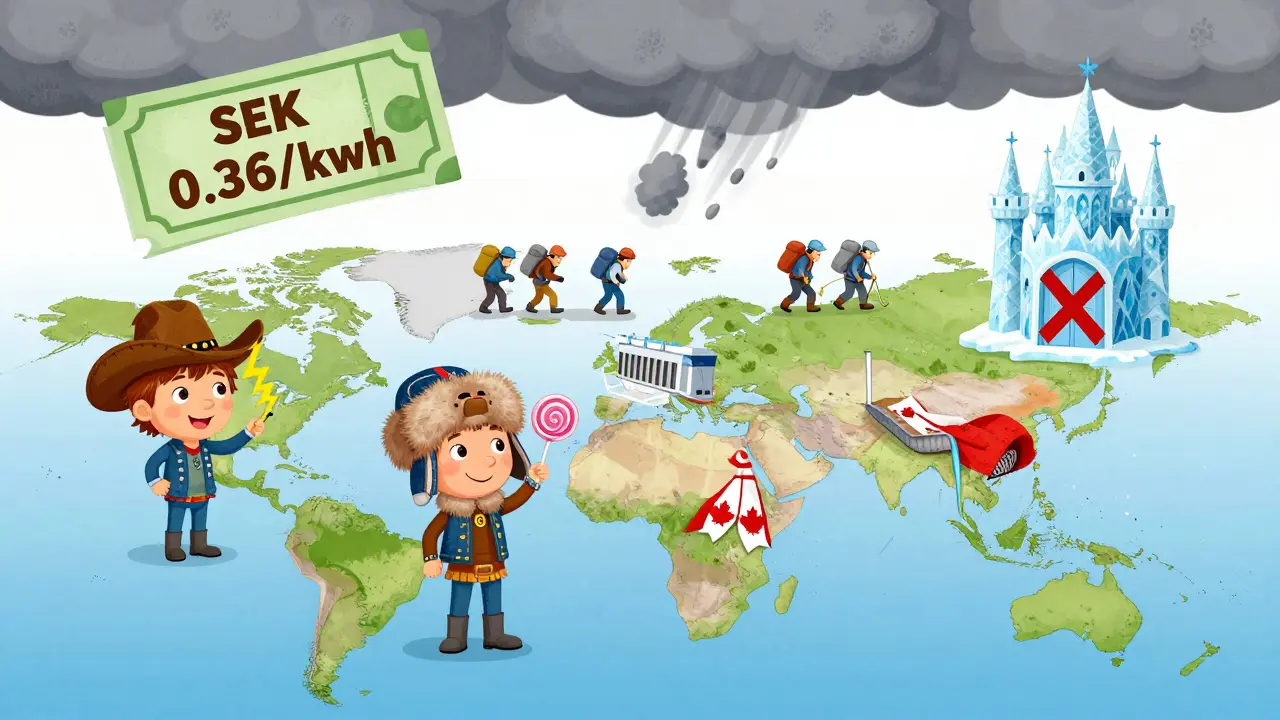
What’s Left in Sweden?
Today, there are maybe a handful of hobbyist miners left - people running one or two rigs in their garages. They pay the full tax. They lose money. But they do it for fun. The industry? Dead. The infrastructure? Mostly abandoned. The data centers? Still running - but now only for cloud services, AI training, or government servers. Sweden didn’t shut down crypto. It just made sure no one could profit from mining there. And that’s exactly what they wanted.What This Means for Miners Today
If you’re thinking of starting a mining operation in Europe, Sweden is off the table. Permanently. The tax structure won’t change. The political will is too strong. Even if Bitcoin hits $200,000, the energy tax still makes mining unprofitable. The lesson? Location matters more than hardware. You can have the best ASICs in the world, but if your electricity costs are too high, you’re not mining - you’re donating money to the power company. Miners who survived the 2022-2023 crash learned one thing: regulatory risk is the biggest risk. Not price drops. Not hardware failure. Not network difficulty. It’s the government changing the rules overnight.Where Should Miners Go Now?
If you’re looking for a place to mine in Europe, the options are slim. Georgia has low taxes and decent power. Romania is trying to attract miners with special zones. But the real hubs are outside Europe:- Texas - deregulated grid, cheap natural gas, and no state-level mining tax.
- Kazakhstan - state-backed energy deals and proximity to Russia.
- Quebec - hydro power surplus, cold climate, and no federal mining tax.
- Georgia - low electricity costs and a government that actively invites miners.
Did Sweden ban cryptocurrency mining entirely?
No, Sweden didn’t make mining illegal. You can still run a rig in your basement. But the tax increase made it impossible to operate profitably. The government didn’t ban mining - it taxed it into oblivion.
Why did Sweden target crypto mining and not other data centers?
Because crypto miners didn’t contribute to the economy the way tech companies did. Microsoft and Amazon built jobs, hired engineers, and invested in local infrastructure. Miners just used electricity and left. After 2018, when miners abandoned unpaid energy bills, the government decided the tax break wasn’t worth it.
Could Sweden reverse this policy if Bitcoin prices rise?
Unlikely. The political backlash from energy providers and taxpayers was too strong. Even if Bitcoin hit $500,000, the government has made it clear: mining won’t get tax breaks again. It’s a policy decision, not an economic one.
What happened to the mining hardware left behind?
Most of it was sold to buyers in Kazakhstan, the U.S., or Canada. Some was scrapped for copper and aluminum. A few facilities were converted into AI server farms. But very little remained as mining equipment. The value of used ASICs dropped sharply after the tax change.
Is Sweden’s approach unique in the EU?
Yes. No other EU country has raised energy taxes by 6,000% to target crypto mining. Other nations have discussed energy caps or licensing fees, but none have used taxation as a blunt instrument to eliminate mining entirely. Sweden is the only one that succeeded.