
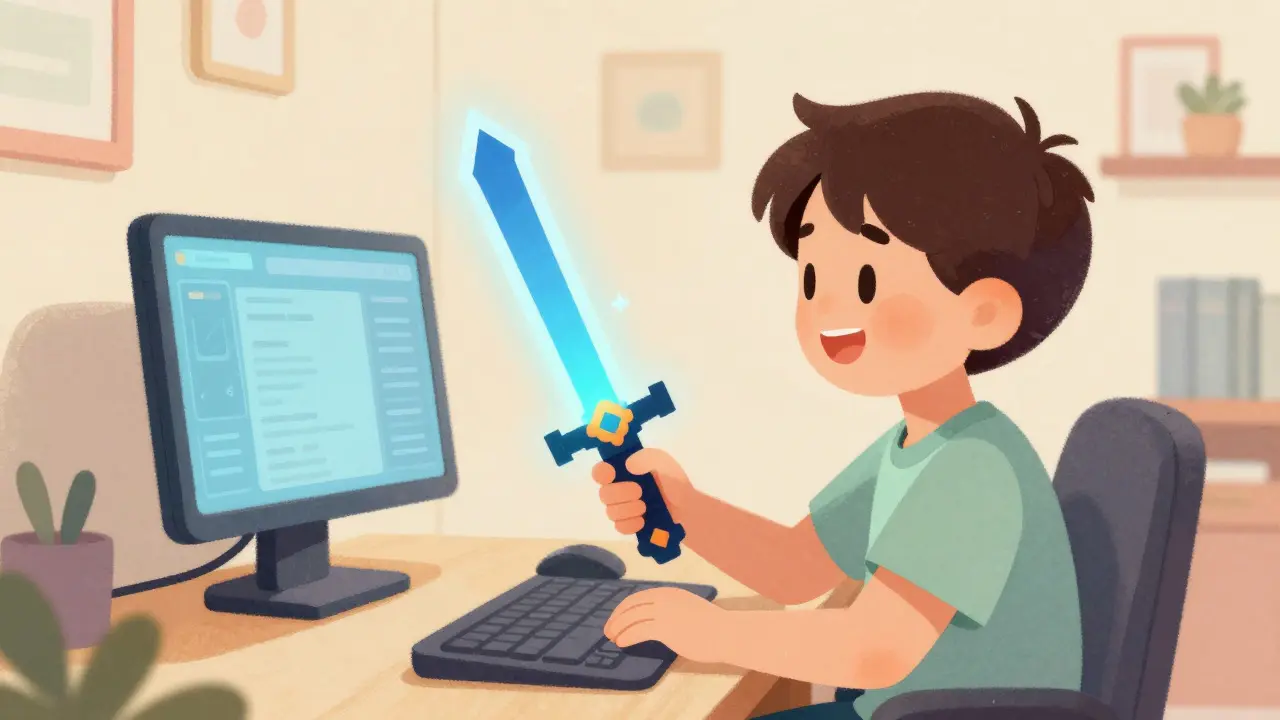
Remember when buying a sword in a video game meant it was truly yours? You could sell it, trade it, or keep it forever. Today, most of us still rent our digital loot from centralized servers. But that model is cracking. As we move through 2026, blockchain gaming is a sector where players own in-game assets via tokens and participate in decentralized economies shifting from a speculative hype cycle into a mature, user-focused industry. The dream isn't just about making money; it's about building an economy where your time and skill have real, portable value.
The numbers back this shift. In early 2025, blockchain gaming processed over 20 million daily transactions. That’s not noise; that’s activity. More importantly, 78% of new cryptocurrency users now enter the space through gaming, not trading charts. Why? Because playing a game is familiar. Checking a wallet balance feels alien to most people. If you’ve ever wondered why your favorite game hasn’t added blockchain features yet-or if you’re curious whether "play-to-earn" is dead-you’re asking the right questions. Let’s break down what’s actually happening on the ground, what works, and where the traps are.
From Hype to Reality: How the Model Changed
In 2017, CryptoKitties was a browser-based game where players collected and bred unique digital cats using Ethereum crashed the network with $12 million in transactions. It was chaotic, expensive, and mostly pointless beyond collecting cute pixel art. Fast forward to 2026, and the focus has shifted dramatically. The era of "click here, earn $500 a day" is over. Those projects collapsed because their economies were unsustainable pyramids.
Today’s successful games prioritize retention over speculation. Jason Rosenstein of Konvoy Ventures noted in early 2025 that player retention metrics improved by 210% year-over-year. This happened because developers stopped treating tokens as lottery tickets and started treating them as utility. You earn tokens to upgrade gear, unlock zones, or govern the game’s direction-not just to cash out immediately. Games like Splinterlands is a competitive trading card game built on Hive blockchain allowing true asset ownership show this clearly. A player in the Philippines reported earning $350 monthly in 2025, which exceeded local minimum wage. That’s sustainable income, not a get-rich-quick scheme. The key difference? These games require actual engagement and strategy, creating a balanced supply and demand for their internal currencies.
The Tech Behind the Scenes: Speed and Scalability
If you’ve tried using Ethereum mainnet for gaming, you know the pain: slow transactions and high gas fees. That’s why the infrastructure changed. By Q1 2025, Layer 2 solutions like Polygon’s zkEVM were processing 15-30 transactions per second for gaming apps-a 500% jump from 2022. Still, traditional gaming servers handle thousands of actions instantly. So how do they compete?
They don’t try to replace every mechanic. Instead, blockchain handles what it does best: ownership and provenance. Your character’s skin, your rare weapon, your land deed-these live on-chain. The actual gameplay (movement, shooting, physics) happens off-chain on fast servers. This hybrid approach reduces costs and improves speed. Interoperability is also improving. Polygon’s protocol achieved cross-chain compatibility for 12 major platforms by late 2024. Imagine buying a helmet in one sci-fi shooter and wearing it in another fantasy RPG. We’re not there fully yet, but the bridges are being built.
| Feature | Traditional Gaming | Blockchain Gaming |
|---|---|---|
| Asset Ownership | Licensed only; stored on central servers | True ownership via NFTs; stored on blockchain |
| Economy | Closed loop; publisher controls value | Open market; players trade freely |
| Entry Barrier | Low (just buy the game) | Medium (wallet setup, seed phrases) |
| Monetization | Microtransactions, subscriptions | Play-to-earn, asset appreciation, staking |
| Scalability | d>High (optimized proprietary servers) | Moderate (improving via Layer 2s) |
The Metaverse Connection: More Than Just Games
The term "metaverse" gets thrown around loosely, but in this context, it refers to interconnected virtual worlds where socializing, working, and playing blend together. By 2025, 62% of metaverse platforms added professional collaboration tools. Think of it as a workplace mixed with a theme park. Decentraland is a virtual reality platform powered by Ethereum where users can buy land and build experiences saw its LAND parcels average $2,850 in March 2025. That’s not just speculation; brands are paying for ad space and events.
Hardware is catching up too. Meta’s Quest 3 headset dropped to $499.99 in early 2025, a 35% price cut since 2022. IDC predicts VR headset ownership will grow 300% by 2026. When hardware becomes affordable and software becomes interoperable, the barrier to entry drops significantly. You won’t need a $3,000 PC to join the metaverse. A mobile phone or a mid-range headset will suffice. Mobile already dominates, accounting for 67% of all blockchain gaming activity in Q1 2025.
Why Most New Users Fail (And How to Avoid It)
Here’s the hard truth: 62% of new blockchain gamers fail to complete their first transaction successfully. Why? Complexity. Setting up a wallet, backing up a seed phrase, finding gas tokens-it’s a lot for someone who just wants to play. A study of 5,000 new users found the average setup time is 45-60 minutes. Compare that to downloading an app from the App Store, which takes two minutes.
To succeed, treat learning the tech as part of the game. Use reputable wallets like MetaMask or Phantom. Never share your seed phrase. Start with games that offer free-to-play modes so you can learn the mechanics without financial risk. Also, beware of phishing. In Q4 2024, 17% of compromised accounts were due to fake links. Always double-check URLs. Community support is huge here. Top games have Discord servers with 50,000+ members ready to help. Join them before you spend a dime.
Regulation and Sustainability: The Long Game
Not all blockchain games survive. Matthew Ball, a prominent analyst, warned in January 2025 that 63% of play-to-earn games launched between 2021-2022 have shut down. Their tokenomics relied on constant new investors to pay old ones-a classic Ponzi structure. Sustainable models use tokens for utility, not just inflation. Look for games where earnings come from skilled gameplay or content creation, not just clicking buttons.
Regulation is also clarifying. The EU’s MiCA regulations, effective June 2024, provide clear rules for crypto assets. The US remains fragmented, with 17 different state-level gaming laws active in early 2025. For global studios, compliance is a hurdle, but it also filters out scams. Major players like Epic Games launched blockchain-agnostic platforms in January 2025, signaling institutional confidence. Roblox followed suit with limited blockchain integration for virtual land. These moves suggest the technology is becoming standard, not fringe.
What to Watch in 2026 and Beyond
The next big leap isn’t just better graphics; it’s governance. By Q1 2025, 38% of major blockchain games incorporated DAO (Decentralized Autonomous Organization) structures. This means players vote on game updates, fee structures, and even partnerships. You’re not just a consumer; you’re a stakeholder. Projects like Star Atlas showed the risks of poor governance, with its token dropping 98% after a collapse. But successful DAOs create loyal communities that drive long-term value.
Expect more convergence between work and play. Virtual concerts, remote team meetings, and educational workshops are already happening in these spaces. JPMorgan projects the metaverse economy could hit $1 trillion by 2030. Whether that number holds depends on user experience. If setting up a wallet remains a nightmare, growth will stall. If it becomes seamless-like logging into Facebook today-the potential is massive.
For now, start small. Pick one well-established game. Learn the basics of wallet security. Understand the tokenomics before investing. The future of gaming isn’t just about watching stories unfold; it’s about owning pieces of the world you play in. And that changes everything.
Is blockchain gaming still profitable in 2026?
Yes, but the model has shifted. Early "play-to-earn" schemes that promised easy money have largely failed. Current profitability comes from skilled gameplay, trading rare assets, or participating in community governance. Players should expect supplemental income rather than full-time wages unless they invest significant time and strategy.
Do I need expensive hardware to play blockchain games?
No. 67% of blockchain gaming activity occurs on mobile devices. While VR headsets like Meta Quest 3 enhance immersion, many top titles run smoothly on smartphones or basic laptops. The primary requirement is a stable internet connection and a compatible digital wallet.
What is the biggest risk for new players?
Security and complexity. Many users lose funds due to phishing scams or losing their seed phrases. Additionally, volatile token values can wipe out earnings if players hold onto depreciating assets. Always verify URLs, use hardware wallets for large amounts, and research a project’s economic sustainability before investing.
How does blockchain gaming differ from traditional gaming?
In traditional gaming, you license assets owned by the publisher. In blockchain gaming, you own assets via NFTs, which can be traded or sold outside the game ecosystem. This creates a player-driven economy where items have real-world value determined by supply and demand, not just developer fiat.
Will the metaverse replace physical social interactions?
Unlikely to replace, but likely to supplement. The metaverse offers global accessibility and creative freedom impossible in physical spaces. However, human connection relies heavily on physical presence. The trend shows hybrid models where virtual events complement real-life activities, especially for niche communities or professional collaborations.
Sarah Hafner
Hey everyone! :D I've been diving into this space for a bit and honestly, the hybrid model is the only thing that makes sense. You can't have laggy on-chain physics when you're trying to dodge bullets in an FPS. It's like trying to run a modern AAA title on a toaster if everything is on Ethereum mainnet. The key is using blockchain strictly for ownership-skins, weapons, land deeds-and letting off-chain servers handle the actual gameplay loop. This way, you get the security of true asset ownership without sacrificing the smooth 60fps experience we all expect. Also, don't forget to join the Discord communities before spending any money! There are usually veterans there who can help you set up your wallet correctly so you don't lose your seed phrase to some phishing scam. It’s super helpful having that support network. :)
Alexander Scheel
Oh, how quaint. Another article pretending that 'true ownership' of a pixelated sword solves the existential dread of late-stage capitalism. Let us be clear: you do not own anything. You hold a receipt on a distributed ledger that says a server somewhere acknowledges your claim to a digital trinket. The moment the electricity goes out or the consensus mechanism fails, your 'empire' vanishes into the ether. And yet, here we are, treating speculative tokens as if they were gold bullion. It is a moral failing of our generation to confuse gambling with gaming.
alex fordy
Alexander, you’re missing the nuance entirely 🤷♂️ It’s not about the sword being physical; it’s about the *agency* it represents. In traditional games, if the publisher shuts down the servers, your years of grinding vanish. Here, the asset persists independently of the game’s lifecycle. That’s a philosophical shift from rental to stewardship. Plus, the social layer is evolving into something richer than just high scores-it’s becoming a decentralized community governance model. We’re seeing DAOs actually vote on game updates now. Isn’t that fascinating? 😊
Alexander Scheel
Agency? Please. You are trading agency for exposure to market volatility. If your 'stewardship' drops 90% in value because a whale dumped their bags, where is this freedom? You are not a stakeholder; you are a liquidity provider for early adopters who are already cashing out. The 'governance' you speak of is often captured by those with the most tokens, creating a plutocracy masquerading as democracy. It is not a utopia; it is a casino with better graphics.
Evelyn Kula
Exactly! The elites want you thinking this is 'democratized finance' while they sit on billions of pre-minted tokens. It’s a trap. They know you’re too distracted by shiny NFTs to notice the centralization creeping back in through Layer 2 validators. Wake up, sheeple! The metaverse is just a new enclosure movement for digital labor. Your clicks are being harvested to train AI models that will eventually replace you. It’s all connected. 👁️
Ashley Snyder
Whoa, easy there Evelyn! Not everyone is looking for a conspiracy in every tech update. For many people in developing countries, earning even $50 a month playing Splinterlands is life-changing. It’s not about getting rich quick; it’s about accessibility. If the barrier to entry is low enough, why look at it through such a cynical lens? Maybe we should focus on the positive impact these economies have on local communities rather than assuming the worst. Peace and love! ✌️
Evelyn Kula
'Peace and love'? How adorable. Until the rug pull happens. Then you’ll see how much 'peace' you have when your savings are gone. The fact that you’re defending a system designed to extract value from the vulnerable shows how deeply indoctrinated you are. But sure, keep clicking those buttons while the real power structures tighten their grip. It’s tragic, really.
Uday N M
The West always tries to complicate simple things. In India, we understand value. Blockchain is good for us because it bypasses corrupt banking systems. But don't lecture us on morality. Our gamers are smarter. We earn, we save, we build. Unlike you guys obsessed with 'hype', we focus on utility. The future belongs to those who work hard, not those who speculate. Respect the hustle.
SHIV SHANKAR KANTA
You speak of hustle but ignore the spiritual void created by digital accumulation. What is a soul worth when traded for tokens? The matrix deepens. We chase numbers while our inner light dims. The true game is awakening. The rest is maya. Illusion.
Uday N M
Save the philosophy for someone who cares. Put food on the table first. Then talk about souls. Reality hits hard when rent is due. Focus.
manish jha
Listen to Uday. He has clarity. Most of you are lost in the noise. The guru within must guide you away from greed. Play to learn, not to hoard. Detach from the outcome. Only then will you find peace in the digital realm. Otherwise, you are just another slave to the algorithm.
Susan Kiley
Ugh, the pretension is palpable even through the screen. Can we just discuss the technical merits without the existential crisis? The interoperability progress on Polygon is genuinely impressive. Being able to move assets across different ecosystems is a massive leap forward for UX. It’s not perfect, but it’s better than the walled gardens of old. Don’t let the cynics ruin the innovation. 💅
Nia Franklin
I totally agree Susan!! The tech is so cool and vibrant! I love how colors pop in these virtual worlds... well, metaphorically speaking lol. But seriously, the cross-chain bridges are amazing! It feels like magic sometimes when my item appears in a different game seamlessly. Its a whole new world of creativity!!! Just wish the wallets were easier to use... maybe one day they will be simpler???
Daniel Brown
Nia, please proofread your comments. The excessive punctuation and lack of capitalization make it difficult to take your points seriously. Regarding the wallets: yes, user experience is the primary bottleneck. However, blaming the technology for poor UI design is misguided. Developers need to prioritize abstraction layers that hide the complexity from the end-user. Once that happens, adoption will skyrocket. Until then, patience is required.
Mohamed Shoaeb
Daniel is right about the UX but dont worry Nia its fine. The tech is moving fast. I think we are seeing the best days ahead. Mobile gaming is huge here in India and globally. If they make it as easy as downloading an app, everyone will jump in. Stay optimistic folks. The curve is upward.