
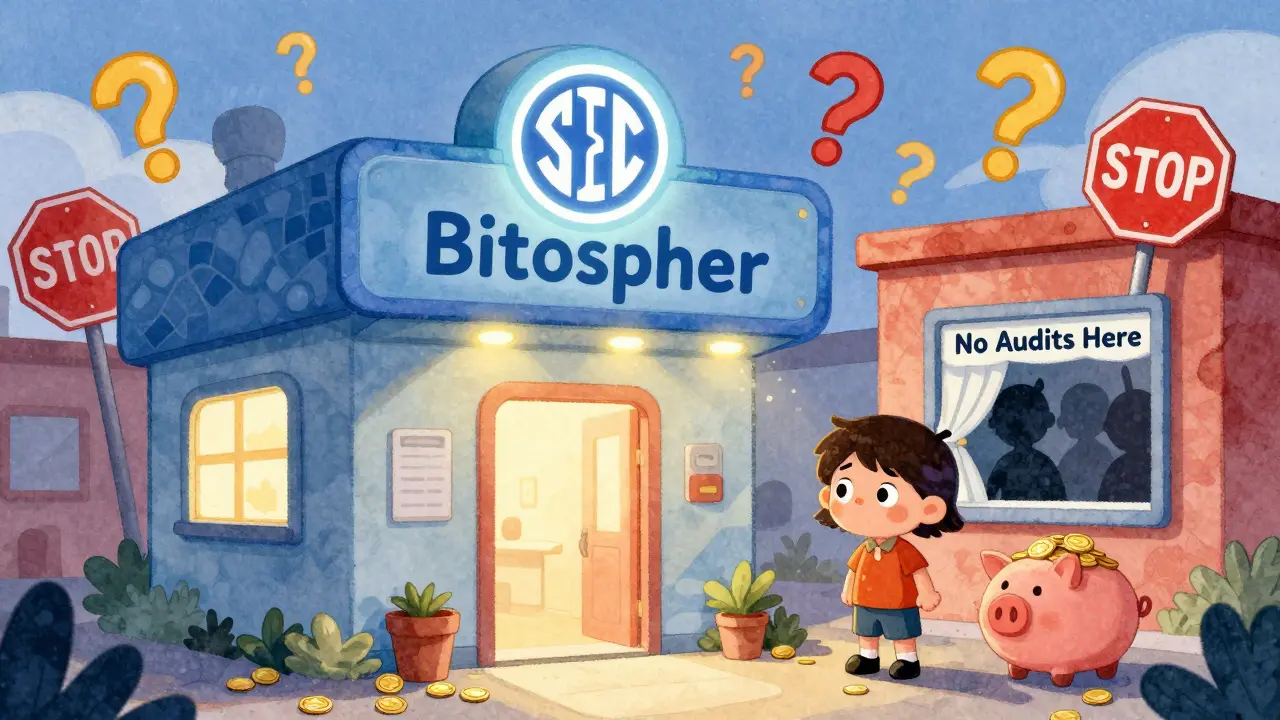
If you're looking at Bitospher as a place to trade crypto, you need to know one thing upfront: Bitospher claims to be SEC-regulated. But here’s the problem - the SEC doesn’t regulate crypto exchanges like it does banks or stock markets. It sues them. In 2023, the SEC took legal action against Coinbase and Binance for operating without proper registration. So when Bitospher says it’s "SEC-regulated," that’s not just misleading - it’s a red flag.
What Bitospher Claims - And What It Doesn’t Prove
Bitospher says it offers a secure, compliant trading platform with low fees and 24/7 support. Sounds good on paper. But look closer. There’s no public record of its founding team, no official website domain history, no press releases, no LinkedIn profiles for its founders, and no regulatory filings you can verify. The only source that mentions it is WikiBit, a review site with no clear editorial standards or transparency policy. That’s not enough to trust your money to.
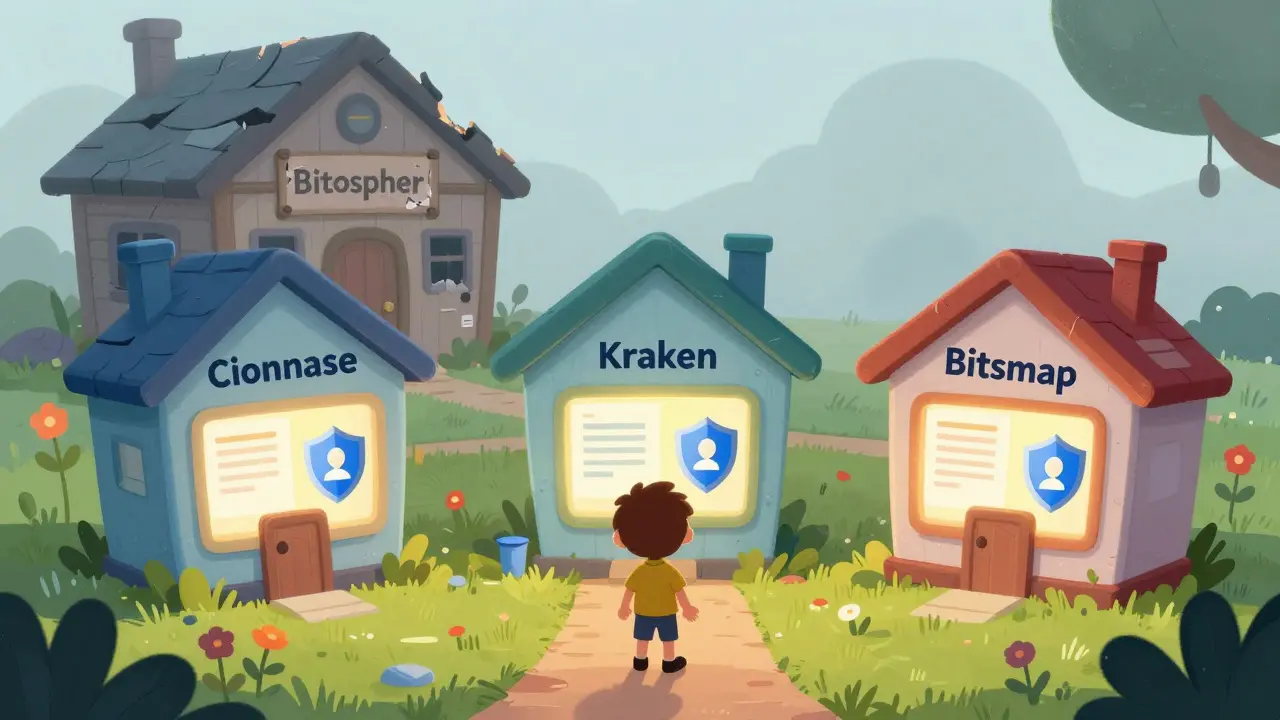
Most legitimate exchanges - even smaller ones like Bitstamp or Kraken - publish their legal entity names, registration numbers, and audit reports. Bitospher doesn’t. That’s not an oversight. It’s a warning sign.
Fees: Low on Paper, But Is It Real?
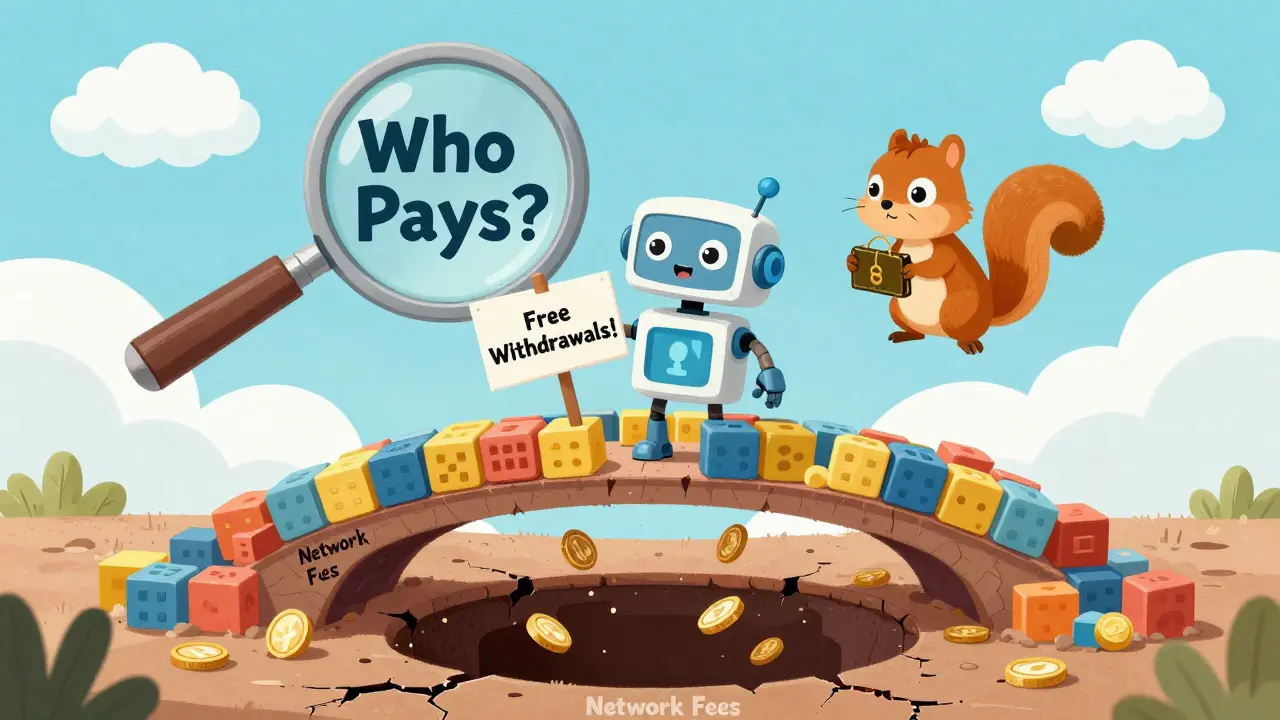
Bitospher advertises a flat 0.25% trading fee for both makers and takers. That’s higher than Binance (0.1% taker, 0.02% maker) and Coinbase Advanced Trade (0.4% taker, 0.05% maker). But here’s the twist: Bitospher says deposits and withdrawals are free. That sounds great - until you realize most major exchanges already do this for crypto deposits. Withdrawals? They usually charge network fees, which are paid to miners, not the exchange. Bitospher claims to absorb those. But if they’re not charging you, who’s paying? And how?
Real exchanges don’t magically make blockchain fees disappear. Bitcoin withdrawal fees average $1.50-$5.00 depending on network congestion. If Bitospher is covering that, they’re either losing money or hiding fees elsewhere. Either way, it’s unsustainable. And if they’re not covering it, then their "free withdrawal" claim is false.
Security: Cold Storage, But No Proof
Bitospher says it stores 95-98% of user funds in cold storage. That’s the industry gold standard. Exchanges that do this have 73% fewer hacks, according to Krayon Digital’s 2024 report. But saying it and proving it are two different things.
Top exchanges like Coinbase and Binance publish monthly proof-of-reserves reports. These are third-party audits that show they hold enough crypto to cover all user balances. Bitospher doesn’t. Zero. No audit reports. No transparency page. No way to verify their cold storage claims. That’s not just risky - it’s dangerous.
Chainalysis found that $2.38 billion was stolen from crypto exchanges in 2023. Many of those were new platforms with flashy claims and zero transparency. Bitospher fits that profile exactly.
Two-Factor Authentication and User Protection
Bitospher mentions "strict user authentication," but doesn’t say what that means. Does it support Google Authenticator? Authy? Biometric login? SMS? If you don’t know, you can’t use it safely.
Alwin.io found that exchanges without mandatory two-factor authentication (2FA) suffer 3.2 times more account takeovers. If Bitospher doesn’t require 2FA, or only offers weak versions like SMS (which can be hijacked), you’re at high risk. And there’s no public info on whether they use email alerts for logins, device locking, or withdrawal whitelisting - all basic protections top exchanges use.
Customer Support and User Experience
Bitospher claims 24/7 customer support. That’s rare for small exchanges, so it sounds promising. But where are the reviews? Check Trustpilot. Check Reddit. Check Twitter. There’s nothing. No user testimonials. No complaints. No praise. Just silence.
Compare that to Coinbase, which has over 18,500 Trustpilot reviews and a 4.7-star rating. Or Binance, with millions of active users posting daily on forums. If Bitospher had real users, you’d see them talking. You’d see people complaining about slow withdrawals. You’d see someone praising the mobile app. You’d see something real. You don’t. That’s not a good sign.
Regulatory Claims: The Biggest Red Flag
The SEC doesn’t "approve" crypto exchanges. It sues them. As of October 2025, only 37 exchanges worldwide hold comprehensive regulatory licenses across multiple jurisdictions. None of them are called Bitospher. The U.S. doesn’t have a single federally licensed crypto exchange. Every claim of "SEC regulation" is either a lie or a misunderstanding.
Some exchanges get state money transmitter licenses - like New York’s BitLicense. Others register as Money Services Businesses (MSBs) with FinCEN. But those aren’t "SEC regulation." They’re basic compliance. Bitospher doesn’t mention any of those. It just says "SEC-regulated." That’s not compliance. It’s marketing spin.
What You Should Do Instead
If you want to trade crypto safely in 2026, don’t gamble on unverified platforms. Stick with exchanges that publish:
- Proof-of-reserves reports (monthly or quarterly)
- Third-party audit results (SOC-2, KPMG, etc.)
- Clear legal entity names and registration numbers
- Publicly available customer support records and user reviews
Here are three safer alternatives:
- Coinbase - Fully regulated in the U.S., publishes monthly audits, 12.7 million active users.
- Kraken - Registered with FinCEN, offers advanced security features, and has been around since 2011.
- Bitstamp - Licensed in Europe, transparent about reserves, and one of the oldest exchanges still operating.
Even if these platforms charge slightly more in fees, they’ve proven they can keep your money safe. Bitospher hasn’t proven anything.
Final Verdict: Avoid Bitospher
Bitospher looks like a classic crypto scam playbook: vague claims, no verifiable data, fake regulatory buzzwords, and zero user feedback. It’s not just unverified - it’s unverifiable. In a space where $2.38 billion vanished in one year, you can’t afford to take chances.
Don’t trust claims. Trust proof. And right now, Bitospher has none.
Is Bitospher a legitimate crypto exchange?
No, Bitospher cannot be considered legitimate based on available evidence. It makes unverifiable claims about SEC regulation, provides no proof of audits, reserves, or team details, and has zero user reviews or public presence. Legitimate exchanges publish transparent, third-party verified data. Bitospher does not.
Does Bitospher really have SEC regulation?
No. The U.S. Securities and Exchange Commission (SEC) does not "regulate" or "approve" crypto exchanges like traditional financial institutions. Instead, the SEC has sued major exchanges like Coinbase and Binance for operating without registration. Any claim of "SEC regulation" by Bitospher is either a misunderstanding or a deliberate misrepresentation.
Are Bitospher’s trading fees really lower than other exchanges?
Bitospher claims a flat 0.25% fee for both makers and takers, which is higher than Binance (0.1% taker) and Coinbase Advanced Trade (0.4% taker). While it says deposits and withdrawals are free, this is misleading - crypto withdrawal fees are network fees paid to miners, not the exchange. If Bitospher is covering those, it’s unsustainable. If not, the "free" claim is false.
Is Bitospher’s cold storage claim trustworthy?
Cold storage is a good security practice, but claiming it isn’t the same as proving it. Top exchanges like Coinbase and Binance publish monthly proof-of-reserves audits. Bitospher provides none. Without third-party verification, there’s no way to know if your funds are actually stored offline - or if they’re sitting in a vulnerable hot wallet.
What should I use instead of Bitospher?
Stick with exchanges that publish audit reports, have real user reviews, and are legally registered. Coinbase, Kraken, and Bitstamp are all well-established, regulated, and transparent. They may charge slightly more in fees, but they’ve proven they can protect your assets - something Bitospher has not.
Can I trust Bitospher’s customer support?
Bitospher claims to offer 24/7 support, but there are zero user testimonials, reviews, or reports to back this up. If it had real users, you’d see complaints about slow responses, locked accounts, or withdrawal delays. The silence speaks louder than any claim.
Has Bitospher ever been hacked or involved in a scam?
There are no public records of Bitospher being hacked - because there’s no public record of it operating at all. That’s the bigger issue. Scam exchanges often disappear after collecting deposits. Without verified users, transaction history, or audit trails, Bitospher could vanish tomorrow with your funds - and you’d have no way to prove you ever used it.
Don Grissett
Bitospher? Bro that’s a sketchy side-hustle website with a fancy logo and zero real info. SEC-regulated? LOL. The SEC doesn’t regulate crypto, it sues it. This is like claiming your garage sale is FDA-approved. 🤡
Rahul Sharma
As someone who has analyzed over 40 crypto platforms, I can confirm with certainty that Bitospher exhibits all classic signs of a pre-launch exit scam. No audit trail, no legal entity disclosure, no user footprint. Legitimate platforms operate with transparency. This does not. Avoid at all costs. 🚩
Mujibur Rahman
Let’s be real here - if you’re seeing ‘SEC-regulated’ on a crypto site you’re already 90% of the way to losing your ETH. The SEC doesn’t bless platforms, it subpoenas them. Bitospher’s whole model screams ‘we need your money before the domain expires’ 🧨
Tre Smith
They claim 95-98% cold storage. That’s a lie unless they publish proof-of-reserves. No audit? No transparency? No accountability? That’s not a trading platform - it’s a honeypot. The fact that they don’t even mention FinCEN or state licenses shows they’re not even trying to be legitimate. This isn’t risky - it’s criminal negligence.
Meenakshi Singh
Free withdrawals? Yeah right. That’s like saying your Airbnb is free because they don’t charge cleaning fees - but the electricity bill is $2000/month. Someone’s paying for those Bitcoin fees. It’s either them (unsustainable) or you (hidden fee). Either way, don’t fall for it. 💸
kris serafin
Zero reviews? No LinkedIn? No domain history? That’s not an oversight - that’s a red flag parade. If you can’t find one real person who’s used it, you shouldn’t be depositing a single satoshi. Stick to Coinbase or Kraken. Your future self will thank you. 🙏
Kip Metcalf
I almost signed up for this thing last week until I checked the domain registration - created 3 months ago. No WHOIS privacy, no content history, no backlinks. It’s a ghost site with a UI. I’d rather lose money on a rug pull I can see coming than get ghosted by a ghost exchange. 🤷♂️
Natalie Kershaw
Hey if you’re new to crypto, just remember: if it sounds too good to be true - free withdrawals, SEC-regulated, 24/7 support with zero reviews - it’s a trap. I’ve been through 3 scams already. Don’t be the next one. Use Coinbase. It’s boring. But boring keeps your money safe. 💪
Jessie X
Why do people still fall for this? The crypto space is full of real innovation - DeFi, staking, DAOs - but we keep getting drawn to these fake shiny objects. Bitospher isn’t just a scam, it’s a distraction from the real progress happening in regulated, transparent platforms. Let’s focus on the good stuff.
Jordan Leon
There’s a philosophical truth here: trust isn’t built on claims. It’s built on evidence. Bitospher offers zero evidence. Every other exchange - even the small ones - publish their legal name, their audit reports, their team. This one doesn’t. And that silence? That’s the loudest answer you’ll ever get.
Paul Johnson
you think this is bad wait till you see the fake 5 star reviews on their site - all from emails like [email protected]. i found one that said "this platform changed my life" but the profile pic was a stock photo of a dog. wtf. this is a joke. dont even open the app
Jacob Clark
Okay but like… if Bitospher is fake, why is it still up? Why aren’t the authorities shutting it down? Maybe it’s just… misunderstood? Maybe the SEC is just slow? Maybe they’re in the process? Maybe… maybe…
Emily Hipps
Look, I used to think this was just another scam site too - until I started digging into the domain registrar’s history. It was registered under a shell company in the Seychelles, with the same admin email as 12 other crypto scams from 2024. This isn’t just a bad exchange - it’s part of a network. Don’t be the next victim. Walk away. You’ve been warned.