
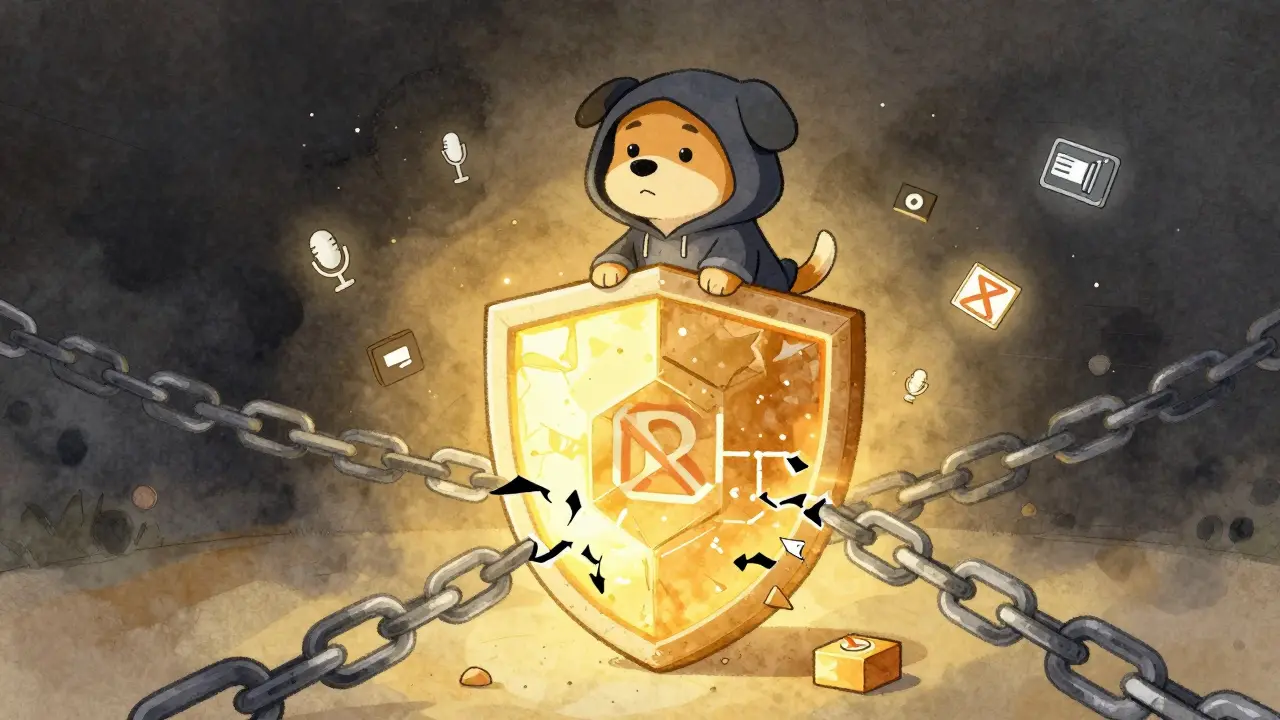
Resistance Dog (REDO) isn’t just another meme coin. While most meme coins ride hype waves and vanish just as fast, REDO carries a message - one that’s tied to real-world struggles over internet freedom. At its core, REDO is a digital symbol of defiance against censorship, built on the TON (The Open Network) a high-performance blockchain developed by Telegram’s founder Pavel Durov, designed for fast, scalable, and decentralized transactions. The token’s image - a hooded dog drawn by hand - isn’t random. It’s a direct reference to the fight for uncensored communication. In 2024, when Pavel Durov was briefly detained in France, the REDO community rallied around the token as a rallying cry. Holding REDO became a quiet act of protest. It’s not just about buying a coin. It’s about standing with those who refuse to let governments control what people see online. The price of REDO fluctuates depending on the platform. As of March 2026, CoinMarketCap lists it at $0.02871, while LiveCoinWatch shows $0.0316. TradingView reports $0.0280, and CryptoRank puts it at $0.02759. These small differences aren’t errors - they’re normal in crypto, where liquidity varies across exchanges. The 24-hour trading volume hovers around $84,000, which is modest compared to giants like Dogecoin or Shiba Inu, but it’s consistent for a project rooted in activism rather than speculation. REDO’s technical backbone is one of its strongest features. Unlike many meme coins built on Ethereum or BSC, REDO runs on the TON blockchain a decentralized network with sharding technology that splits transaction processing across multiple parallel chains, allowing it to handle millions of transactions per second. This isn’t just a technical detail - it’s a philosophical one. TON’s speed and low fees make REDO usable in real life. You can send it instantly, pay for services, or move it across borders without banks or middlemen. That’s exactly what the movement needs. The tokenomics of REDO aren’t fully public. There’s no official whitepaper listing total supply or team allocations. That’s unusual for a project this old, but it’s intentional. The lack of transparency isn’t a flaw - it’s a statement. By not publishing exact numbers, the project avoids centralized control. No single group owns the supply. No whale can dump millions and crash the price. The community holds the power. You can buy REDO on exchanges like MEXC, where you can trade it using credit cards, bank transfers, or PayPal. Spot trading is the most common way to get in - you buy the coin at the current price and hold it. Futures trading is available too, but that’s risky. REDO’s 24-hour volatility is around 16.97%, and over the last 30 days, it had only 47% green days. The Relative Strength Index (RSI) a momentum oscillator that measures the speed and change of price movements, typically used to identify overbought or oversold conditions sits at 35.24, which means the market isn’t oversold or overbought - it’s stuck in neutral. That’s not a sign of weakness. It’s a sign of stability. People aren’t panicking. They’re holding. Price predictions are all over the place. CoinCodex forecasted a drop to $0.02190 by March 20, 2026, which would be a 24.5% decline. But that was based on older data. The Fear & Greed Index for REDO is at 30 - firmly in "fear" territory. That’s not panic. It’s caution. People are waiting. They’re watching. They’re not selling because they believe in the cause. What makes REDO different from Dogecoin or PepeCoin? Those are jokes with no real mission. REDO has one. It’s not just a coin. It’s a tool. Supporters use it to fund anti-censorship projects. Some donate REDO to organizations fighting internet shutdowns in Russia, Iran, or China. Others use it to tip journalists or whistleblowers on decentralized platforms. In DeFi, REDO can be staked for yield on TON-based protocols, earning passive income while supporting digital rights. The social side matters too. REDO’s presence on X (formerly Twitter) is strong. Posts with #REDO or #DigitalResistance get traction among activists, coders, and privacy advocates. It’s not a trend. It’s a network. People who care about free speech don’t just hold REDO - they talk about it, share stories, and connect with others who’ve been silenced. Is REDO a good investment? That depends. If you’re looking for quick flips, it’s not ideal. The volume is low, and the price moves slowly. But if you believe in digital freedom, holding REDO isn’t about profit. It’s about participation. You’re not just buying a token. You’re joining a movement. The project has no corporate structure. No CEO. No marketing team. Just a symbol, a blockchain, and a community. That’s rare. Most crypto projects are built to make money. REDO was built to resist. It’s not perfect. The lack of official documentation is a risk. There’s no audit. No roadmap. But maybe that’s the point. If a centralized team controlled REDO, it could be shut down. By staying decentralized, it stays alive. As of March 2026, REDO trades at under $0.03. That’s cheap. But its value isn’t in the price. It’s in the message. And that message is louder than ever.
How to Buy Resistance Dog (REDO)
Getting REDO is straightforward if you know where to look. Here’s how:- Sign up on MEXC - one of the few exchanges that lists REDO directly.
- Verify your identity (KYC) - required for deposits and withdrawals.
- Deposit funds using credit card, bank transfer, or PayPal.
- Go to the REDO/USDT or REDO/TON trading pair.
- Place a spot order - buy at market price or set a limit order.
- Once purchased, transfer REDO to a TON-compatible wallet like Tonkeeper or Tonfi for secure storage.
Why REDO Isn’t Just Another Meme Coin
Most meme coins are built for fun. REDO was built for fight.- It has a cause - digital freedom, not just memes.
- It’s on TON - not Ethereum or Solana. That means fast, cheap, and scalable transactions.
- No team, no roadmap - which prevents centralization and censorship.
- Real-world impact - donations fund anti-censorship tools and support activists.
- Community-driven - no influencers, no paid promotions. Just people who care.

Where REDO Fits in the Crypto World
REDO sits at the intersection of three things:- Meme coins cryptocurrencies built on humor or viral imagery, often lacking utility but gaining traction through community
- Activist tokens digital assets tied to political or social movements, designed to fund or amplify causes
- Decentralized communication tools blockchain-based systems that enable censorship-resistant messaging and data sharing
What’s Next for Resistance Dog?
No one knows. There’s no official announcement. No press releases. But the community is quietly expanding. Some users are testing REDO as a tipping system on decentralized social networks. Others are building tools that let activists receive donations in REDO without needing a bank account. There’s talk of a decentralized wallet that auto-donates a portion of every transaction to press freedom organizations. It’s not about becoming the next Bitcoin. It’s about staying alive. And so far, it has.
Is Resistance Dog Safe?
Safety here isn’t about price. It’s about resilience. REDO has no smart contract vulnerabilities. It runs on TON, which has been audited and battle-tested. The token itself is simple - no complex yield farming, no locked liquidity pools. That reduces risk. The bigger risk? Government crackdowns. If a country bans crypto, holding REDO could draw attention. But that’s the point. The token was designed to be a target. Use a non-custodial wallet. Never leave REDO on an exchange. And never share your seed phrase.Final Thoughts
Resistance Dog isn’t here to make you rich. It’s here to remind you that the internet isn’t just a tool - it’s a right. And rights need defenders. If you believe in free speech, uncensored access, and digital autonomy, then REDO isn’t a coin. It’s a flag. Hold it. Share it. Talk about it. That’s how movements grow.Is Resistance Dog (REDO) a good investment?
REDO isn’t designed as a financial investment. Its value isn’t in price growth - it’s in symbolic meaning. If you’re looking for quick returns, there are better options. But if you support digital freedom, holding REDO is a way to participate in a global movement. Don’t buy it to get rich. Buy it to stand for something.
Can I use REDO to pay for goods or services?
Not yet widely. REDO isn’t accepted by mainstream merchants. But on decentralized platforms built on TON - like messaging apps, content marketplaces, or donation tools - some users accept REDO as payment. Its real use is in supporting activism, not buying coffee.
Who created Resistance Dog?
The REDO token was inspired by Pavel Durov, founder of Telegram and TON. He hand-drew the hooded dog symbol. While he didn’t launch the token himself, he endorsed it as a symbol of resistance. The token was later developed by community members and collaborators, including creators of the "Spotty" meme character.
Is REDO available on major exchanges like Binance or Coinbase?
No. REDO is not listed on Binance, Coinbase, or Kraken. Your best option is MEXC, which supports TON-based tokens. Always double-check the blockchain - sending REDO to a non-TON wallet will result in permanent loss.
Why does REDO’s price vary so much between platforms?
Because REDO trades on only a few exchanges with low volume. Prices differ because liquidity is thin. MEXC has the most activity, so its price is the most reliable. Other sites pull data from MEXC but may show delays or inaccuracies. Always check the source.
Arlene Miles
This isn't just a coin. It's a declaration. The moment governments start controlling what you can say online, they've already lost. REDO doesn't need a whitepaper because the movement is the document. Every holder is a node in a decentralized resistance network. No CEO. No VC funding. Just people who refuse to be silent. That's more powerful than any blockchain tech ever could be. The price? Irrelevant. The symbol? Eternal.
Jessica Beadle
The TON blockchain's sharding architecture enables sub-second finality with horizontal scalability, which fundamentally decouples transaction throughput from monolithic consensus mechanisms. REDO's tokenomics, while lacking formal documentation, implicitly leverage Byzantine fault tolerance through community-enforced non-centralization - a meta-governance model that circumvents traditional token vesting schedules and team allocations entirely. This is not a meme; it's a cryptographic assertion of sovereignty.
Tony Weaver
Let’s be honest - this reads like a propaganda pamphlet disguised as a crypto whitepaper. ‘A hooded dog’ is not a philosophical statement. It’s a poorly drawn meme. The fact that people are treating this like a civil rights movement is embarrassing. TON is technically impressive, sure, but REDO has zero utility beyond emotional projection. The RSI at 35? That’s not stability - it’s stagnation. And don’t get me started on the ‘no roadmap’ being a feature. That’s not decentralization. That’s negligence.
Patty Atima
I don’t care if it’s a meme or a movement. I bought some because it felt right. And honestly? That’s all that matters.
Lauren J. Walter
So we’re now assigning political meaning to a dog in a hoodie because a guy got detained? Next they’ll coin ‘Censored Cat’ and fund it with NFTs of protest signs. How poetic.
Carol Lueneburg
I love this so much. 🌍✊ The fact that people are using this to support journalists in Iran and Russia? That’s real. That’s the kind of crypto we need. Not another coin to flip. A tool. A voice. A lifeline. Keep holding. Keep sharing. This is bigger than price. This is about humanity.
Henrique Lyma
The entire premise is flawed. You can't build a movement on a token that has no official team no audit no roadmap and no clear legal standing. This is just another case of people romanticizing chaos as rebellion. The TON blockchain is solid yes but REDO is just a ghost in the machine. A digital ghost story. And ghost stories don't pay bills. They don't fund activists. They don't change anything. They just make people feel good while they sleep.
Steph Andrews
I’m from India and I’ve seen internet shutdowns firsthand. When they cut access during protests last year I was terrified. I didn’t have money to donate. But I bought REDO. Not because I thought it would go up. Because I needed to feel like I was doing something. Even if it was small. Even if it was just one token. It meant I wasn’t alone.
Prakash Patel
You all are delusional. This is a pump disguised as a protest. The same people who call this resistance are probably the ones who bought Dogecoin because Elon tweeted it. You’re not resisting. You’re just chasing a narrative. And the price is flat because no one actually uses it. It’s a costume. Not a revolution.
Zachary N
There’s something deeply important here that people are missing. REDO’s real innovation isn’t the token. It’s the absence of structure. Most crypto projects try to centralize control under the guise of ‘efficiency’ - a CEO, a roadmap, a marketing budget. REDO flips that. By refusing to define itself, it becomes unkillable. Governments can shut down websites. They can seize assets. But they can’t shut down a symbol that exists only in the minds of millions who refuse to forget. That’s why it’s still here. Not because of tech. Because of will.
Elizabeth Kurtz
I’ve been holding REDO since 2024. I don’t talk about it much. But I’ve sent it to activists in Belarus. I’ve tipped a journalist in Sudan. I’ve used it to pay for a VPN server hosted on TON. It’s not glamorous. But it’s real. And that’s more than I can say for half the ‘decentralized’ projects out there.
john peter
The romanticization of financial nihilism as moral virtue is a dangerous delusion. One cannot conflate symbolic gesture with substantive change. The very notion that a cryptocurrency can serve as a vehicle for human rights advocacy is not only naive - it is ontologically incoherent. The blockchain is a ledger, not a conscience. To imbue it with moral agency is to commit a category error of the highest order.
Marc Morgan
I live in Australia. We don’t have internet shutdowns here. But I still hold REDO. Not because I think it’ll make me rich. But because if it can help someone in Tehran or Moscow stay connected - then I’m glad I’m part of it. Sometimes the smallest acts are the ones that echo the loudest.