

You’ve probably seen the hype around play-to-earn games. The promise is simple: play a game, earn cryptocurrency, and cash out. But not all projects deliver on that promise. That’s where Continuum World comes in. It markets itself as a free-entry, blockchain-based adventure set on sky islands. You control an avatar called a UMi, collect resources, and earn the native $UM token. Sounds straightforward, right?
But here’s the catch. While the website still claims to be active, data from major tracking platforms tells a different story. Some sources show tiny amounts of trading volume, while others say the coin has been inactive since mid-2025. If you’re wondering whether Continuum World is worth your time or money, you need to look past the marketing and dig into the actual numbers. This guide breaks down what the project is, how it works, and why you should proceed with extreme caution.
How Continuum World Works: The Gameplay Loop
To understand the value of the UM token, you first need to understand the game. Continuum World is built on the concept of resource collection. Instead of fighting monsters or completing complex quests, your primary activity is exploring a virtual world made of floating sky islands. These environments blend natural landscapes with futuristic elements.
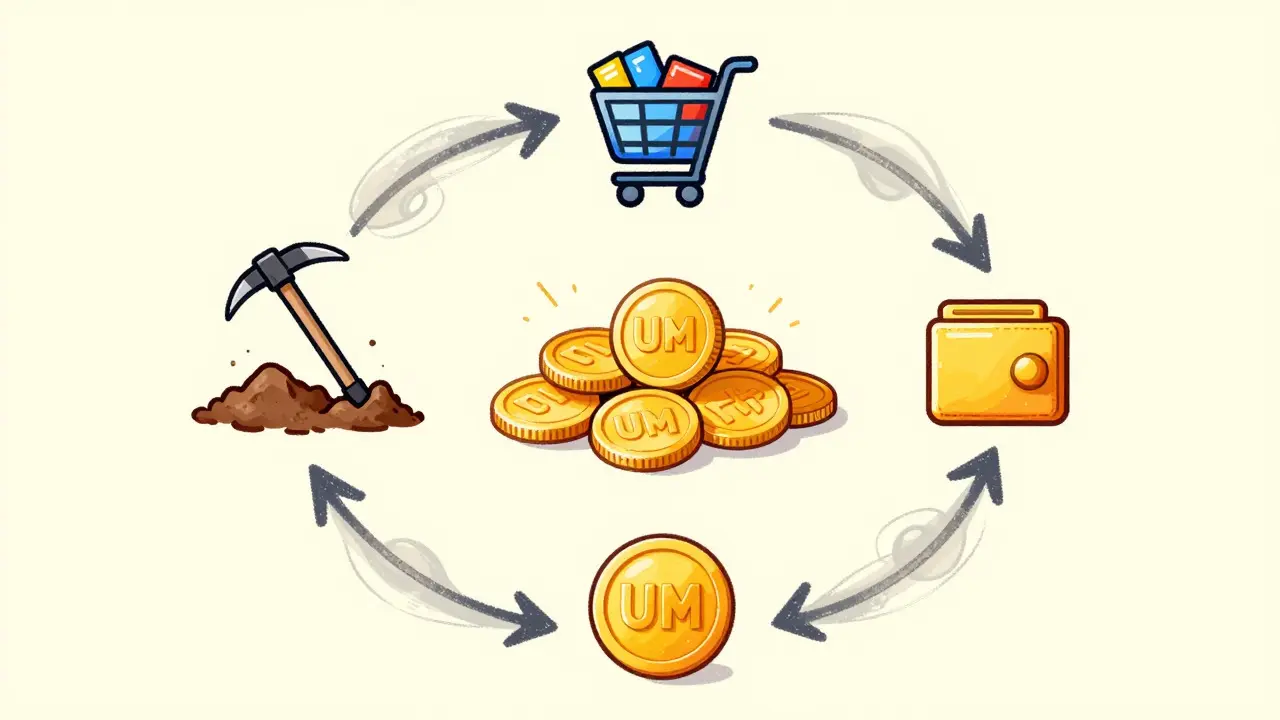
Your character, known as a UMi, moves through these lands to find resources. The more efficiently you search, the more resources you gather. These resources are then converted into $UM tokens. The official documentation states that this process allows players to earn the native token without any upfront cost. This "free-to-play" model is a key selling point, distinguishing it from other blockchain games that require you to buy expensive NFTs just to start playing.
The economic loop is designed to incentivize activity. The idea is that consistent gameplay leads to token accumulation. However, the value of those tokens depends entirely on external market demand. If no one wants to buy $UM outside the game, the rewards have little real-world value. This is a common pitfall in the play-to-earn sector, where internal economies can collapse if player interest wanes.
Tokenomics and Utility of the UM Token
The UM token serves two main functions within the Continuum World ecosystem. First, it acts as a reward for gameplay. Second, it functions as a medium of exchange within the game’s internal marketplace. Players can use UM to buy items, upgrade their avatars, or access new areas. According to the project’s whitepaper, the total supply of UM is capped at 1 billion tokens. A fixed supply cap is generally a positive sign in crypto, as it prevents infinite inflation that dilutes value.
However, utility alone doesn’t create price stability. For a token to hold value, there needs to be a steady flow of new players entering the ecosystem and spending tokens. Without fresh capital coming in, the existing holders end up competing against each other to sell, which drives the price down. Currently, the lack of significant trading volume suggests that the internal economy may not be generating enough demand to support a robust external market.
| Attribute | Details |
|---|---|
| Blockchain Network | Polygon (MATIC) |
| Token Symbol | UM |
| Total Supply | 1,000,000,000 UM |
| Primary Use Case | In-game currency and rewards |
| Entry Cost | Free (No initial NFT required) |
Trading Data and Market Status: The Red Flags
This is where things get tricky. When researching Continuum World, you’ll notice conflicting information across different platforms. As of May 2026, CoinGecko lists the price of UM at approximately $0.00002638. The 24-hour trading volume is reported at a mere $58.50. To put that in perspective, most active cryptocurrencies have daily volumes in the millions or billions. A volume of $58 means that very few people are buying or selling the token. This creates high slippage, meaning if you tried to buy a significant amount, the price would spike dramatically due to thin liquidity.
More concerning is the status report from Coinlore. This platform indicates that the coin appears to be inactive, with no price data received since April 19, 2025. This discrepancy is critical. It suggests that while some decentralized exchanges might still list the token, major aggregators have stopped tracking it due to a lack of reliable data. Coinbase, one of the largest centralized exchanges, shows UM valued at $0.00 USD, effectively treating it as having no tradable value on their platform.
The primary venue for trading UM is Quickswap, a decentralized exchange built on the Polygon network. On Quickswap, the UM/WETH pair shows even lower activity, with about $13.13 in volume over 24 hours. Trading on DEXs like Quickswap requires users to connect Web3 wallets and manage gas fees themselves. For a casual gamer looking to cash out earnings, this adds a layer of technical complexity that many find daunting.
Technological Infrastructure: Polygon and Web3
Continuum World operates on the Polygon blockchain. This is a logical choice for a gaming project. Ethereum mainnet transactions can be slow and expensive, which makes microtransactions for in-game items impractical. Polygon offers faster confirmation times and significantly lower fees, making it suitable for frequent interactions like collecting resources or trading small amounts of UM.
The integration with Web3 technologies means that your assets are technically stored in your digital wallet, not on a central server controlled by the developers. In theory, this gives you ownership of your tokens. However, this also means that if the game servers go offline or the development team abandons the project, your tokens remain in your wallet but may lose their utility within the game. You can still try to trade them on Quickswap, but as the low volume suggests, finding a buyer is difficult.
Risks and Viability Assessment
If you’re considering investing in UM or spending hours playing Continuum World, you need to weigh the risks carefully. The project exhibits several warning signs common to dormant or failing crypto projects:
- Low Liquidity: With daily volumes under $60, exiting a position without losing value is nearly impossible.
- Data Discrepancies: Conflicting reports between active trackers (CoinGecko) and inactive flags (Coinlore) suggest instability in data reporting.
- Lack of News: There is minimal coverage in major crypto news outlets or gaming publications, indicating low community engagement or developer silence.
- Price Stagnation: The token price is fractions of a cent, showing no significant upward momentum despite the passage of time.
On the positive side, the project maintains a functioning website and a defined tokenomic structure. The free-to-play model lowers the barrier to entry, which could theoretically attract new users. However, without active marketing, regular updates, or a growing player base, these features are insufficient to drive value. The absence of a clear development roadmap or recent announcements further fuels speculation that the project may be in maintenance mode or abandoned.

Comparison with Other Play-to-Earn Projects
To put Continuum World in context, it’s helpful to compare it with established players in the space. Projects like Axie Infinity or The Sandbox have massive ecosystems, large communities, and significant trading volumes. While they also face volatility, they have proven track records of sustaining user interest and economic activity.
Continuum World lacks the scale and visibility of these giants. It competes in a crowded market where attention is scarce. Without unique mechanics or strong community building, it struggles to differentiate itself. The free-entry model is attractive, but if the earnings potential is negligible due to low token value, the incentive to play diminishes quickly.
Final Thoughts on Continuum World
Continuum World presents a classic case of a crypto project with a promising concept but questionable execution. The idea of earning tokens through simple gameplay is appealing, especially with a free entry point. However, the reality of the market data paints a bleak picture. Low trading volumes, conflicting activity reports, and a near-zero price suggest that the project has lost significant momentum.
If you’re a curious gamer who wants to explore blockchain technology without financial risk, you can try playing Continuum World. Since there’s no upfront cost, your only investment is time. But if you’re looking for a serious investment opportunity or a reliable source of income, the current indicators advise caution. Always do your own research, check multiple data sources, and never invest more than you can afford to lose in highly speculative assets like UM.
Is Continuum World (UM) a scam?
There is no definitive proof that Continuum World is a scam, as it operates on public blockchains and has a transparent token supply. However, it exhibits signs of abandonment or dormancy, such as extremely low trading volumes and conflicting data from tracking platforms. This makes it a high-risk asset rather than a confirmed fraud.
How do I buy UM tokens?
UM tokens are primarily traded on decentralized exchanges like Quickswap on the Polygon network. You will need a Web3 wallet (such as MetaMask), some MATIC or ETH for gas fees, and another cryptocurrency (like WETH) to swap for UM. Due to low liquidity, expect high slippage.
Can I earn real money from Continuum World?
Technically, yes, by converting earned UM tokens into other cryptocurrencies or fiat via exchanges. However, given the token's price of less than $0.00003 and low trading volume, the actual monetary value earned is likely negligible for most players.
Why is the UM token price so low?
The low price reflects a lack of market demand and liquidity. With few buyers and sellers, the price drops easily. Additionally, concerns about the project's activity level since 2025 have reduced investor confidence.
Is Continuum World still active in 2026?
The status is unclear. While the website remains online and some minor trading occurs on DEXs, major data aggregators like Coinlore flag it as inactive since April 2025. This suggests limited development activity and a small remaining user base.