

Imagine losing access to millions of dollars in Bitcoin because a single line of code was vulnerable. Now imagine that vulnerability being exploited by a future quantum computer before you even knew it existed. This isn't science fiction; it’s the looming reality for anyone managing digital assets without robust Hardware Security Modules (HSMs). As we move deeper into 2026, the role of HSMs in the cryptocurrency industry is shifting from a 'nice-to-have' luxury for big exchanges to an absolute necessity for survival.
The landscape has changed dramatically since the early days of crypto wallets stored on simple USB drives or paper sheets. Today, with regulatory pressures like MiCA in Europe and PCI DSS v4.0 globally demanding tamper-proof key storage, the stakes are higher than ever. But what exactly is changing? Why are experts warning about a 'quantum deadline'? And how should you decide between cloud-based solutions and physical hardware?
What Is an HSM and Why Does Crypto Need It?
To understand the future, we first need to pin down what an HSM actually does. A Hardware Security Module is a dedicated, tamper-resistant cryptographic processor designed to securely manage, generate, and store cryptographic keys throughout their lifecycle. Think of it as a vault within a server. Unlike software-based encryption, which runs on your operating system and can be snooped on by malware, an HSM performs all sensitive operations inside its own secure boundary.
In the context of blockchain, this means private keys never leave the HSM. When a transaction needs signing, the data goes in, the signature comes out, but the key itself stays locked away. If someone tries to physically pry open the device, sensors detect the intrusion and instantly erase the keys-a process called zeroization. For exchanges holding billions in user funds, this isolation is the difference between staying in business and facing catastrophic liability.
Historically, these devices were built by giants like IBM in the 1970s for banking. Today, they are the backbone of institutions like Coinbase and Binance. However, the technology is evolving rapidly to meet new threats that didn’t exist two decades ago.
The Quantum Threat: The 2026 Deadline
The biggest driver of change in the HSM market right now is the rise of quantum computing. Current blockchain security relies heavily on algorithms like RSA and ECC (Elliptic Curve Cryptography). These are hard for classical computers to break, but a sufficiently powerful quantum computer could crack them in hours-or even minutes.
NIST’s Post-Quantum Cryptography Project Manager, Dustin Moody, made it clear in January 2025: HSMs must integrate new standards like CRYSTALS-Kyber and Dilithium by 2026. If they don’t, blockchain keys become vulnerable to decryption. This creates a strict timeline for the industry. You can’t just patch this later; you need hardware that supports these new mathematical structures natively.
Here is where things get tricky. Dr. Lily Chen from NIST warns that 60% of current HSM firmware lacks 'crypto-agility.' In plain English, this means many existing devices cannot easily switch to new algorithms without major, risky firmware upgrades. Vendors like Thales and Utimaco are racing to release updates-Thales’ 'Quantum Shield' firmware aims to add hybrid RSA/Kyber support by late 2025-but the transition period is dangerous. MIT’s Vinod Vaikuntanathan cautions that mixing old and new algorithms during this phase might introduce side-channel vulnerabilities, where attackers exploit power consumption patterns to steal keys.
By 2030, Gartner predicts HSMs will evolve into 'Quantum Root of Trust' appliances. By 2035, traditional RSA/ECC algorithms should be completely phased out in critical infrastructure. If you are deploying an HSM today, ensure it has a clear roadmap for post-quantum cryptography (PQC) support, or you’re buying obsolete tech.
Cloud vs. On-Premises: The Great Divide
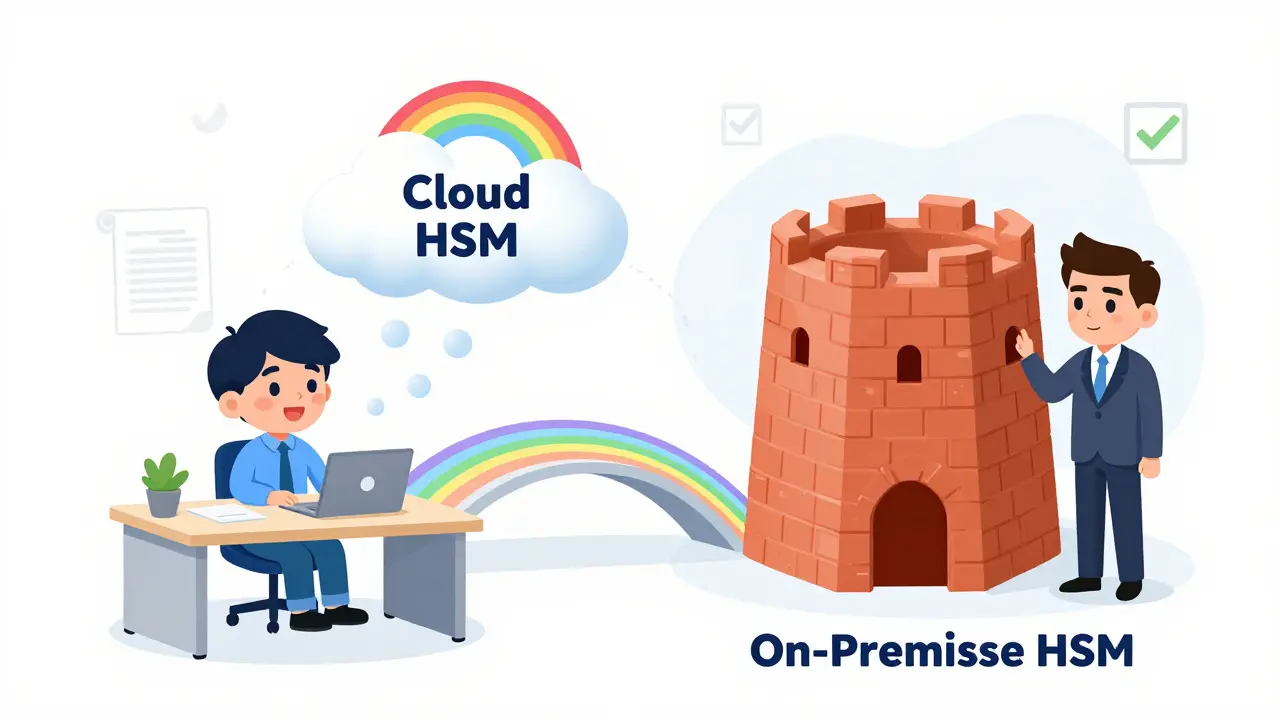
One of the most common questions I hear from engineers is whether to buy physical boxes or rent security from the cloud. The answer depends entirely on your scale and risk tolerance.
| Feature | Cloud HSM (AWS/Azure/GCP) | On-Premises (Thales/Utimaco) |
|---|---|---|
| Market Share (Startups) | 68% | 22% |
| Cost Model | $1,200 - $5,000/month | $15,000 - $50,000+ upfront |
| Customization | Limited (Vendor-managed) | High (Full control) |
| Uptime SLA | 99.99% | Depends on your infrastructure |
| Audit Control | Moderate (Shared responsibility) | Superior (Physical isolation) |
| Best For | DeFi protocols, Startups | Major Exchanges, Custodians |
Cloud HSMs, such as AWS CloudHSM or Azure Dedicated HSM, dominate among startups because they remove the headache of physical security. You don’t need a guarded data center; you just need an API key. Crypto.com’s CISO reported a 92% satisfaction rate after moving to cloud HSMs, citing faster key rotation cycles. However, you trade control for convenience. You rely on the cloud provider’s integrity.
On-premises units, like the Thales CipherTrust or Utimaco General Purpose HSM, remain the choice for heavyweights like Binance. They offer superior audit trails and allow for complex clustering setups that can handle hundreds of thousands of transactions per second. But they come with a steep learning curve. One Coinbase engineer noted that configuring FIPS 140-3 mode alone took three weeks of dedicated effort. Plus, if your building gets flooded, your keys are gone unless you have rigorous backups.

Performance Bottlenecks and Real-World Limits
Let’s talk numbers. Modern HSMs are fast, but they aren’t infinite. Top-tier models perform 20,000 to 50,000 RSA 2048-bit operations per second. That sounds impressive until you realize that quantum-safe algorithms like CRYSTALS-Kyber drop that throughput to 5,000-12,000 operations per second due to larger key sizes.
For high-frequency trading bots or ultra-low-latency DeFi applications, this latency (5-15ms per operation) can be a dealbreaker. Pure software solutions like Libsodium can sign transactions in sub-milliseconds. So why use an HSM? Because speed doesn’t matter if your keys are stolen. HSMs excel in high-value custody scenarios, not necessarily in micro-second arbitrage.
If you need both speed and security, the solution is clustering. Utimaco specs show clusters of up to 32 nodes can support over 500,000 transactions per second through load-aware routing. But scaling introduces complexity. During network congestion, misconfigured HSMs can cause transaction signing delays, leading to failed trades. Futurex’s 2025 best practices guide emphasizes monitoring queue depths closely to prevent bottlenecks.
AI Integration and Smart Defense
Security isn’t just about locking doors; it’s about watching who walks through them. The next frontier for HSMs is AI integration. Vendors are embedding machine learning models directly into the hardware to detect anomalous behavior.
For example, Futurex’s updated payment HSM uses ML to flag unusual transaction patterns with 99.2% accuracy. Thales’ AI Key Manager claims to reduce breach response times by 73%. Imagine an HSM that notices a sudden spike in withdrawal requests from a specific IP range and automatically pauses signing until a human approves it. This proactive defense layer is becoming standard in enterprise contracts.
However, there’s a catch. AI models require training data. If the HSM hasn’t seen a particular type of attack before, it might miss it. Additionally, running ML processes inside the secure boundary consumes resources, potentially impacting performance. It’s a balancing act between intelligence and speed.
Regulatory Pressure and Compliance Costs
You can’t ignore the legal side. Regulations are tightening globally. PCI DSS v4.0, effective March 2025, mandates HSMs for all crypto transaction signing if you handle cardholder data alongside crypto. In the EU, the Markets in Crypto-Assets (MiCA) regulation requires 'tamper-proof key storage' for licensed exchanges.
This forces adoption. Even small players feel the pressure. Adoption rates hit 92% among the top 50 exchanges, while only 38% of DeFi protocols use them due to cost barriers. Small teams complain about the prohibitive expense-$15,000 a month for cloud services is a lot when you’re bootstrapping. Yet, without compliance, you can’t operate legally in many jurisdictions.
FIPS 140-3 certification adds another layer. Validating your setup takes 4-6 months extra. Documentation quality varies wildly; Thales provides over 1,200 pages of guides, while others leave users guessing. Make sure your vendor offers strong support. Average premium support response time is 4.2 hours, but community forums often fill the gaps.
Common Pitfalls and Failure Cases
Even with expensive hardware, mistakes happen. Human error remains the weakest link. The 2023 Ledger incident saw 15,000 user keys exposed not because the HSM broke, but because it was misconfigured. Similarly, the 2024 Wormhole Bridge hack involved insufficient monitoring of HSM transactions, allowing a $320 million theft.
Vendor lock-in is another silent killer. Migrating from Thales to Utimaco can require 200+ hours of re-engineering due to proprietary APIs. Plan your architecture carefully. Use standardized interfaces like PKCS#11 where possible, but know that advanced features often tie you to one ecosystem.
Also, beware of 'soft' alternatives. Open-source tools like SoftHSM achieve only FIPS 140-2 Level 1 compliance and process one-tenth the transactions of hardware units. NCC Group’s 2024 audit deemed them unsuitable for production crypto systems. Don’t cut corners here.
Next Steps for Your Organization
So, what should you do? If you are starting fresh, evaluate your threat model. Are you storing life savings or facilitating low-value micropayments? For custodial services, invest in a hybrid approach: cloud HSMs for agility, backed by on-prem cold storage for maximum security. Ensure your chosen vendor has a published PQC roadmap.
If you are already using HSMs, audit your firmware versions immediately. Check for crypto-agility capabilities. Test your failover procedures. Simulate a tamper event. Train your team-not just on configuration, but on incident response. The technology is powerful, but it’s only as good as the people managing it.
Is an HSM necessary for individual crypto holders?
Generally, no. Individual users benefit more from hardware wallets (like Ledger or Trezor), which are essentially mini-HSMs designed for personal use. Enterprise-grade HSMs are overkill and too complex for personal key management. Stick to reputable hardware wallets for your personal stash.
How much does it cost to implement an HSM for a startup?
Cloud-based HSM services typically range from $1,200 to $5,000 per month depending on transaction volume and region. On-premises solutions require an upfront investment of $15,000 to $50,000 plus ongoing maintenance costs. Startups usually opt for cloud providers like AWS CloudHSM to minimize capital expenditure.
Will quantum computers break my current Bitcoin keys?
Not yet. Current quantum computers are not powerful enough to break ECDSA signatures used in Bitcoin. However, once fault-tolerant quantum computers arrive (estimated mid-to-late 2030s), they could theoretically decrypt past transactions. Migrating to quantum-resistant algorithms via updated HSMs is the long-term solution.
What is the difference between FIPS 140-2 and 140-3?
FIPS 140-3 is the newer, stricter standard. It places greater emphasis on supply chain security, platform diversity, and rigorous testing of cryptographic modules. Many regulators now prefer or mandate 140-3 Level 3 or higher for financial institutions, making older 140-2 certified devices less attractive for new deployments.
Can I use open-source HSM alternatives for production?
It is not recommended for high-value environments. Open-source options like SoftHSM lack the physical tamper-resistance and performance of hardware modules. They may achieve lower-level compliance (Level 1) but do not provide the same level of trust required for exchange-grade custody or large-scale institutional operations.
Sylvia Mossman
Oh please, spare me the fear-mongering about quantum computers breaking everything by 2026. It's always the same hype cycle. You guys act like Shor's algorithm is going to drop out of the sky tomorrow and wipe out all our Bitcoin holdings overnight. The reality is that building a fault-tolerant quantum computer capable of cracking ECDSA is still decades away, not years. This whole 'quantum deadline' narrative is just a sales pitch for expensive hardware upgrades that most people don't need.
Lee Paige
The real threat isn't quantum computing; it's the backdoors these cloud providers are already installing. AWS and Azure have root access to your keys in CloudHSMs. Do you really trust Big Tech with your financial sovereignty? They can freeze your assets or leak your keys to the government on a whim. On-premises HSMs are the only way to go if you value actual privacy and control over your own data. Don't let them sell you convenience at the cost of your freedom.
Dr Lynea LaVoy
I appreciate the detailed breakdown here, but I think we need to look at this from a practical implementation standpoint rather than just theoretical risks. For many mid-sized exchanges, the cost barrier mentioned is real. $5,000 a month for cloud HSMs is significant when margins are tight. However, the regulatory pressure from MiCA is forcing their hand regardless of whether they feel ready. The key takeaway isn't just buying the box, but ensuring the team understands crypto-agility. If you buy an HSM today that can't be updated to support CRYSTALS-Kyber later without a full hardware replacement, you've wasted your money. Look for vendors with clear PQC roadmaps, as the article suggests.
Steven Jacobowitz
Look, I run a small DeFi protocol and this stuff sounds like overkill for us. We use multi-sig wallets and that's been enough so far. But reading about the Ledger incident where misconfiguration led to exposure... that hits home. Maybe we aren't safe either. The part about side-channel vulnerabilities during the transition period is scary though. If mixing old and new algorithms makes us weaker, what's the play? Just wait until 2030?
aaliyah zahid
Sigh. Another day, another panic about tech that doesn't exist yet. Meanwhile, my private key was stolen because I clicked a phishing link on Twitter. Focus on human error first, folks. Quantum computers can break encryption, but they can't guess your password if you reuse 'password123'. Until then, let's stop pretending we're all cryptographers and start using 2FA properly. The HSM debate is fun for engineers, but for 99% of users, it's irrelevant noise.
Alexis Abster
This is such a crucial discussion! 😱 I mean, imagine losing millions because you didn't upgrade your firmware. It’s terrifying but also kind of exciting how fast the industry is moving. I love that Thales is racing to release updates. It shows they care! But seriously, the latency issue with Kyber is a big deal for high-frequency trading. I wonder if anyone has found a middle ground? Maybe hybrid setups are the answer? We need more innovation here!
Brad Ranks
Unbelievable. Absolutely unbelievable. The amount of drama surrounding this is ridiculous. People are acting like the end of the world is coming. Meanwhile, I'm sitting here watching my portfolio dip because of some macroeconomic news. Who cares about quantum computers when inflation is eating your gains? This post is pure FUD designed to scare retail investors into buying enterprise solutions they don't understand. Stay strong, everyone. Ignore the noise.
Yogendra Dwivedi
I find the comparison between cloud and on-premises very interesting. In India, we are seeing a lot of startups adopting cloud solutions due to cost constraints. But the lack of customization is worrying. If the vendor goes down or changes their API, you are stuck. I would love to hear more about how smaller teams in emerging markets are handling this. Is there a middle path? Maybe open-source HSM alternatives could work if configured correctly? I am curious about the community support for tools like SoftHSM.
dan kaffeman
You idiots really think you can secure anything with software? Hardware is the only truth. If you're running crypto on a server managed by someone else, you're already dead. The elites who built these systems know exactly how to exploit your trust. Buy physical HSMs, lock them in a vault, and pray. The rest of you are just pawns in a game you don't understand. Wake up.
Meg Gran
honestly this whole thing feels like a scam to sell expensive boxes to people who dont know better. quantum computing is years away maybe decades. why should i spend thousands now? its just corporate greed disguised as security. also the typing errors in the original post were annoying but whatever. just keep ur keys offline and ignore the hype train.
Alexander DeVries
Let's stay focused on the facts here. The performance bottleneck is real. Dropping from 50k ops/sec to 12k ops/sec for Kyber is significant. For those running high-volume exchanges, clustering is mandatory. Utimaco's 32-node cluster solution seems viable, but the complexity is no joke. You need a dedicated team to manage queue depths and failover. If you don't have the resources, stick to cloud HSMs for now, but ensure your vendor supports hybrid RSA/Kyber soon. Preparation is key.
Karthikeyan S
lol wow another boring tech post. nobody cares about hsm unless they are getting hacked. and even then they blame the user. the real problem is that crypto itself is flawed. why do we need quantum proof security for a system that is basically a digital casino? just burn it all. 🔥🔥🔥
Dinesh Pattigilli
typical western centric view of security. in india we have different challenges. power cuts, internet instability, etc. your fancy hsm does nothing if the server goes down. also the cost is prohibitive for local exchanges. we rely on simpler methods which work fine for now. dont lecture us about compliance when your own regulations are a mess. focus on usability first.
Madhu Menon
The philosophical implication of zeroization is fascinating. When the device detects intrusion and erases keys, it essentially commits suicide to protect the secret. It is a form of digital martyrdom. We are creating machines that value secrecy above their own existence. In a quantum future, will these machines evolve to predict threats before they happen? The AI integration mentioned adds another layer to this existential dilemma. 🤔
Caitlin Donahue
i mean its good info but super dry. like yeah sure buy the box if u can afford it. but for most of us its just noise. the table was helpful tho. thanks for that. hope the prices come down soon. otherwise its gonna be a rich man game.
Erik Kirana
It is absolutely imperative that organizations adhere to FIPS 140-3 standards immediately. There is no room for negligence. Those who continue to utilize outdated Level 2 certifications are demonstrating a profound lack of professional competence. The documentation provided by Thales is exemplary, whereas other vendors are frankly incompetent. One must prioritize supply chain security above all else. Failure to do so is tantamount to inviting disaster. 😡
Mark Corpuz
The distinction between individual hardware wallets and enterprise HSMs is often blurred in public discourse. As noted, individuals should stick to Ledger or Trezor. Enterprise-grade HSMs are indeed overkill for personal use. However, the point about vendor lock-in is critical. Migrating from one proprietary ecosystem to another is a nightmare. Standardizing on PKCS#11 is wise, but as the article points out, advanced features often require proprietary APIs. Plan your exit strategy early.