
Imagine sending money to a friend without leaving a digital paper trail. For years, that was the promise of privacy coins, cryptocurrencies like Monero (XMR) and Zcash (ZEC) designed to keep your financial life private. But in 2026, that promise is under siege. Governments worldwide are tightening the noose around anonymous transactions, driven by fears of money laundering and tax evasion. If you hold these assets or plan to use them, the rules have changed dramatically since 2024.
The landscape isn't just shifting; it's fracturing. While some regions embrace strict oversight, others create sandboxes for innovation. This article breaks down exactly what has happened to Monero and Zcash, why regulators are targeting them, and what this means for your ability to trade and transact privately.
Why Regulators Are Targeting Privacy Coins
To understand the crackdown, you need to look at the threat model from a government’s perspective. Traditional banking leaves a clear audit trail. Bitcoin, while pseudonymous, allows analysts to trace clusters of addresses back to real-world identities using blockchain analytics firms like Chainalysis. Privacy coins break this chain entirely.
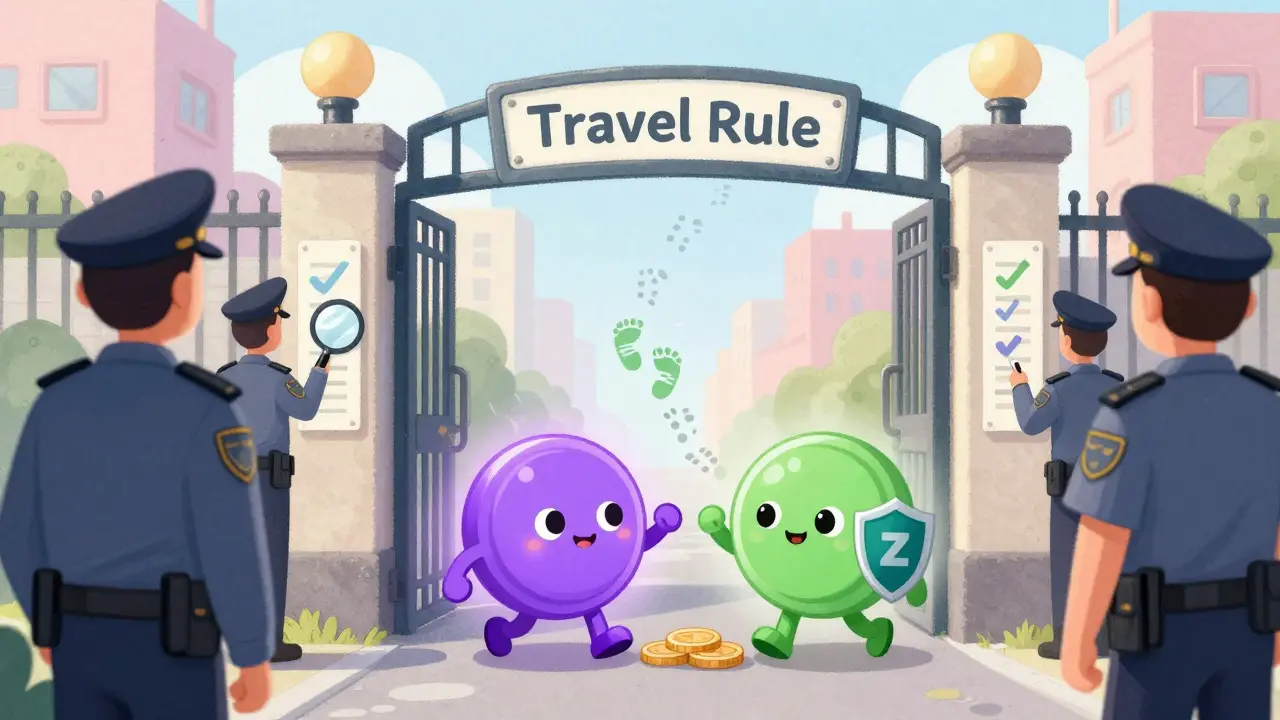
This anonymity is a feature for users but a nightmare for enforcement agencies. The Financial Action Task Force (FATF), the global money laundering watchdog, has been pushing harder than ever. In 2025, they extended the "Travel Rule" to cover more digital asset transfers. This rule requires exchanges to share sender and receiver information for transactions above certain thresholds. For a coin that hides this data by design, compliance is technically impossible without breaking its core promise.
The stakes are high. By 2025, privacy coins accounted for 11.4% of all cryptocurrency transactions globally, with volumes exceeding $250 billion. That’s a lot of untraceable value moving through the system. Regulators worry about illicit flows-drug trafficking on darknet markets, ransomware payments, and terrorist financing. Real-world cases, such as U.S.-based vendors using Monero to sell fentanyl-laced products on platforms like Abacus Market, have provided concrete ammunition for policymakers arguing that these coins facilitate crime.
Monero vs. Zcash: Different Tech, Different Fates
Not all privacy coins are built the same, and their technical architectures dictate how regulators treat them. Understanding the difference between Monero’s mandatory privacy and Zcash’s optional privacy is crucial for navigating the current restrictions.
| Feature | Monero (XMR) | Zcash (ZEC) |
|---|---|---|
| Privacy Model | Mandatory (Ring Signatures, RingCT) | Optional (zk-SNARKs) |
| Regulatory Stance | High Risk / Often Banned | Medium Risk / Conditional Compliance |
| Exchange Listings | Widely Delisted in EU/UK | Retained on Major Exchanges |
| User Adoption Trend | Stable P2P Growth | Declining Shielded Usage (-8% addresses) |
| Compliance Pathway | None (Inherently Private) | Selective Disclosure Possible |
Monero uses ring signatures, stealth addresses, and Ring Confidential Transactions (RingCT) by default. Every transaction looks identical to an outsider. You cannot accidentally send a public transaction. This makes Monero incredibly robust for privacy but virtually incompatible with standard Anti-Money Laundering (AML) requirements. As a result, major exchanges like Binance and Kraken delisted Monero in several jurisdictions in 2025 to avoid regulatory fines.
Zcash, on the other hand, offers a choice. It uses zk-SNARKs (Zero-Knowledge Succinct Non-Interactive Arguments of Knowledge) to allow "shielded" transactions that hide details, but also supports "transparent" transactions that behave like Bitcoin. This flexibility gave Zcash a lifeline. Regulators prefer Zcash because it *can* be made compliant. However, this comes at a cost. Only about 8% of Zcash addresses are currently shielded. When most users opt for transparency, the remaining private users stand out, weakening the overall privacy set. This dynamic has led to a decline in active shielded addresses, showing that regulatory pressure directly influences user behavior.

The Global Crackdown: MiCA and the Travel Rule
The regulatory hammer has fallen hardest in Europe and among FATF-compliant nations. The European Union’s Markets in Crypto-Assets (MiCA) regulation has been a game-changer. MiCA imposes strict transparency requirements on crypto service providers. Since privacy coins fundamentally conflict with these transparency mandates, many exchanges removed them from their platforms. Data shows a 22% reduction in privacy coin offerings across EU-regulated exchanges post-MiCA implementation.
The FATF Travel Rule extension further squeezed liquidity. By requiring enhanced reporting for cross-border transfers, it effectively priced out privacy coins from mainstream exchange infrastructure. The impact was immediate: 57% of privacy coin transactions were affected by new monitoring requirements. For developers, the challenge is immense. A survey revealed that 74% of privacy coin developers cite FATF rules as their biggest hurdle, forcing them to choose between building compliant features that compromise privacy or facing total exclusion from regulated markets.
Where Can You Trade Privacy Coins Now?
If centralized exchanges (CEXs) are closing doors, where do users go? The answer is largely Peer-to-Peer (P2P) platforms and decentralized exchanges (DEXs). Following the 2025 delistings by major players, P2P platform usage grew by 19% in economically unstable regions. These platforms operate outside traditional banking rails, making them harder for regulators to police but riskier for users due to counterparty fraud.
However, not all hope is lost for regulated trading. Some jurisdictions have carved out exceptions. Singapore and Switzerland have introduced "regulated sandboxes" for privacy coin development and trading. These frameworks allow controlled innovation while maintaining oversight. For example, Swiss banks have begun exploring ways to integrate privacy-enhancing technologies (PETs) into their systems, focusing on institutional privacy rather than retail anonymity. This divergence creates a two-tier market: a restricted, high-friction environment for retail users in strict jurisdictions, and a nascent, compliant ecosystem for institutions in friendly hubs.

Technical Innovations Bridging the Gap
The industry isn’t sitting idle. Developers are racing to build solutions that satisfy both privacy advocates and regulators. The holy grail here is "selective disclosure." Imagine a system where your transaction is private by default, but you can generate a cryptographic proof to show a regulator that you paid taxes, without revealing who you sent money to or how much you earned elsewhere.
Zcash is leading this charge with ongoing developments in zk-SNARKs that aim to enable AML compliance without stripping away anonymity. These zero-knowledge proofs allow one party to prove to another that a statement is true without revealing the underlying information. For instance, you could prove your transaction is below a taxable threshold without disclosing the exact amount. While promising, these solutions face significant technical hurdles. They require more computational power and complex key management, which can be a barrier for average users.
Firo (formerly Zcoin) is another player experimenting with hybrid models. Its Lelantus Spark protocol, combined with Dandelion++ to hide IP addresses, focuses on breaking transaction history links. While still facing regulatory headwinds, Firo’s approach highlights the broader trend: pure anonymity is becoming less viable than "auditable privacy."
What This Means for Your Portfolio
If you hold Monero or Zcash, your strategy needs to adapt. The era of buying privacy coins on Coinbase and holding them forever is over. Here’s what you should consider:
- Liquidity Risks: With fewer exchanges listing these coins, slippage increases. Selling large amounts of XMR may now require using multiple P2P platforms, increasing time and risk.
- Tax Reporting: Even if the coin is private, your fiat on-ramp and off-ramp are likely KYC-compliant. Ensure you track your gains meticulously. The IRS and other tax authorities are increasingly using heuristics to flag suspicious patterns, even if they can’t see the blockchain directly.
- Storage Security: As centralization decreases, self-custody becomes paramount. Hardware wallets remain the safest option, but ensure they support the specific privacy protocols of your chosen coin.
- Diversification: Consider whether pure privacy is worth the friction. For many users, mixing services on Bitcoin or Layer-2 solutions on Ethereum offer a balance of privacy and liquidity that privacy coins no longer provide.
The regulatory tide is rising. While technology evolves to meet these challenges, the gap between "private" and "compliant" remains wide. Success in this space will depend on balancing your need for anonymity with the practical realities of a world that demands transparency.
Is Monero illegal in the US or EU?
Monero itself is not illegal to own in the US or EU. However, many regulated exchanges have delisted it to comply with local laws. Trading it may be restricted on centralized platforms, pushing users toward P2P networks or decentralized exchanges. Always check your local jurisdiction’s specific stance on Anonymity-Enhanced Cryptocurrencies (AECs).
Why did Zcash retain listings while Monero was delisted?
Zcash offers optional privacy. Users can choose transparent transactions that allow exchanges to monitor activity for AML compliance. Monero forces privacy on every transaction, making it difficult for exchanges to fulfill "Know Your Customer" (KYC) obligations. This flexibility makes Zcash more palatable to regulators.
How does the FATF Travel Rule affect privacy coins?
The Travel Rule requires exchanges to share sender and receiver data for transfers above a certain threshold. Since privacy coins obscure this data by design, complying with the rule often means delisting the coin or implementing restrictive measures that undermine the coin’s utility.
Are there any safe jurisdictions for trading privacy coins?
Singapore and Switzerland have emerged as relatively friendly jurisdictions. They offer regulated sandboxes that allow for privacy coin innovation under strict oversight. However, "friendly" does not mean "unregulated." Expect rigorous compliance checks even in these hubs.
Will privacy coins survive long-term?
Yes, but their form may change. Pure anonymity is being replaced by "auditable privacy" or selective disclosure mechanisms. Technologies like zero-knowledge proofs will likely become standard, allowing users to prove compliance without revealing full transaction histories. The coins that adapt to this hybrid model will thrive.