

Remember when Portugal was the undisputed king of crypto tax havens? For years, digital asset investors flocked to Lisbon and Porto because selling Bitcoin or Ethereum felt like finding money in your couch cushions-completely free from tax scrutiny. That era ended abruptly in 2023. If you are holding cryptocurrency in Portugal today, you need to understand one number better than any other: 28%. This is the flat tax rate applied to short-term capital gains on digital assets. It is not a suggestion; it is the law enforced by the Autoridade Tributária e Aduaneira (AT), Portugal’s tax authority.
The shift wasn't random. Portugal moved to align with broader European Union directives while trying to keep its doors open for long-term investors. The result is a dual-track system that rewards patience and penalizes speculation. If you sell your crypto after holding it for more than 365 days, you pay nothing. Sell it before that deadline hits, and the state takes 28 cents of every euro you profit. Understanding this split is the difference between keeping your profits and facing a hefty bill during tax season.
The 365-Day Rule: Short-Term vs. Long-Term Holdings
The core mechanism of Portugal’s current crypto tax regime hinges on time. Specifically, the clock starts ticking the moment you acquire an asset and stops when you dispose of it. The critical threshold is exactly 365 days. This rule applies to all cryptocurrencies, including Bitcoin, Ethereum, and stablecoins, as well as certain non-fungible tokens (NFTs) if they are treated as investment assets rather than personal use items.
If you hold an asset for less than 365 days, any profit generated upon sale is classified as a short-term capital gain. This gain is subject to a flat 28% tax rate. Let’s look at a concrete example. You buy €10,000 worth of Solana on January 1st. By June 1st, the price doubles, and you sell for €20,000. Your profit is €10,000. Since you held the asset for only five months, you owe 28% of that profit. That comes to €2,800 in taxes. Simple arithmetic, but painful if you aren’t prepared.
Now, imagine you kept that same Solana until February 1st of the following year. You still have the €10,000 profit. However, because you held the asset for more than 365 days, the gain is exempt from taxation. You pay €0. This binary outcome creates a powerful behavioral incentive for Portuguese residents to adopt a "buy and hold" strategy. Active day traders face a significant disadvantage compared to passive investors under this framework.
| Holding Period | Tax Status | Applicable Rate | Example Profit | Tax Owed |
|---|---|---|---|---|
| Less than 365 days | Short-Term Capital Gain | 28% Flat Rate | €10,000 | €2,800 |
| More than 365 days | Long-Term Capital Gain | Exempt (0%) | €10,000 | €0 |
Calculating Your Liability: Flat Rate vs. Progressive Income Tax
While the 28% flat rate is the default for short-term crypto gains, it is not always mandatory. Portuguese tax law allows taxpayers to choose how they report these gains. You can opt to integrate your cryptocurrency profits into your total annual taxable income. This means your crypto gains are added to your salary, rental income, or other earnings, and taxed according to Portugal’s progressive income tax brackets.
This option might sound complicated, but it can save money depending on your overall financial situation. Portugal’s income tax brackets for 2024 range from 13.25% for the lowest income tier up to 48% for incomes exceeding €81,199. If your total income-including crypto gains-places you in a lower bracket, integrating might be cheaper. For instance, if you are a student with minimal salary and make a small crypto profit, adding it to your income might push you into the 13.25% or 18% bracket, which is significantly lower than 28%.
However, for high earners, integration is usually a trap. If you already earn a high salary, adding crypto gains will likely push your marginal tax rate above 28%. In those cases, sticking to the flat 28% rate protects you from sliding into the 43.5% or 48% brackets. Most tax advisors recommend running both calculations before filing. The choice must be made when submitting your annual declaration, so having accurate records of both your traditional income and crypto transactions is essential.
Passive Income: Staking, Lending, and DeFi Rewards
Cryptocurrency ownership isn’t just about buying low and selling high. Many investors earn passive income through staking, lending, or providing liquidity in decentralized finance (DeFi) protocols. How does Portugal treat these rewards? The answer depends on whether you are considered a casual investor or a professional trader.
For most individual investors, staking rewards and lending yields are treated as passive income. These earnings are subject to the same 28% flat tax rate as short-term capital gains. Crucially, the tax event occurs when you receive the reward, not when you eventually sell it. If you stake Ethereum and receive 2 ETH as a reward, you owe 28% tax on the value of those 2 ETH at the moment of receipt. This creates a cash flow challenge, as you may need to sell some of your holdings to pay the tax immediately.
DeFi activities add another layer of complexity. Swapping tokens within a decentralized exchange is generally considered a taxable disposal event if it involves converting one crypto asset into another. Each swap triggers a calculation of gain or loss based on the holding period of the original asset. Liquidity pool fees are also taxable as income. The key takeaway here is that "passive" doesn’t mean "tax-free." Every transaction, no matter how small, needs to be tracked meticulously.

Professional Traders: A Different Tax Bucket
If you trade frequently, use complex strategies, and rely on crypto profits as your primary source of income, the AT may classify you as a professional trader. This designation changes everything. Professional trading profits are not taxed as capital gains but as business income. This means your profits fall under the progressive income tax system, with rates ranging from 14.5% to 53%, plus social security contributions.
Determining professional status is subjective and relies on several factors:
- Frequency: Do you trade daily or weekly?
- Volume: Is your trading volume substantial relative to your net worth?
- Sophistication: Do you use advanced tools, algorithms, or leverage?
- Primary Source: Is crypto your main job, or a side hobby?
If you are deemed a professional, you lose the benefit of the 28% flat rate and the 365-day exemption. Instead, you must declare your activity using Anexo B, similar to a self-employed business owner. This often results in higher overall tax liabilities due to social security charges, but it also allows you to deduct business expenses like software subscriptions, hardware costs, and home office portions. Casual investors cannot deduct these expenses against their capital gains.
Filing Requirements: Modelo 3 and Annexes
Reporting your crypto activities in Portugal requires navigating the Portal das Finanças, the government’s online tax platform. The main form you will encounter is Modelo 3, the annual personal income tax return. Within this form, specific annexes handle different types of crypto income.
For capital gains, you use Anexo G. This annex separates your assets into two categories: those held for less than 365 days and those held longer. You list each transaction, including purchase date, sale date, amount bought, amount sold, and the resulting gain or loss in euros. The system automatically calculates the 28% tax for short-term gains. Accuracy is vital here. Miscalculating the holding period by even one day can turn a tax-free gain into a taxable one.
For passive income like staking rewards, you use Anexo E. This section covers interest and dividends. You report the gross value of the rewards received during the tax year, and the 28% tax is applied. If you are a professional trader, you use Anexo B, declaring your net profit after allowable business expenses.
The deadline for filing Modelo 3 is typically June 30th of the following year. Missing this deadline results in penalties and interest on unpaid taxes. Given the complexity of crypto transactions, many investors hire local tax consultants or use specialized software to ensure compliance. The cost of professional help is often outweighed by the potential savings from correct classification and deduction optimization.
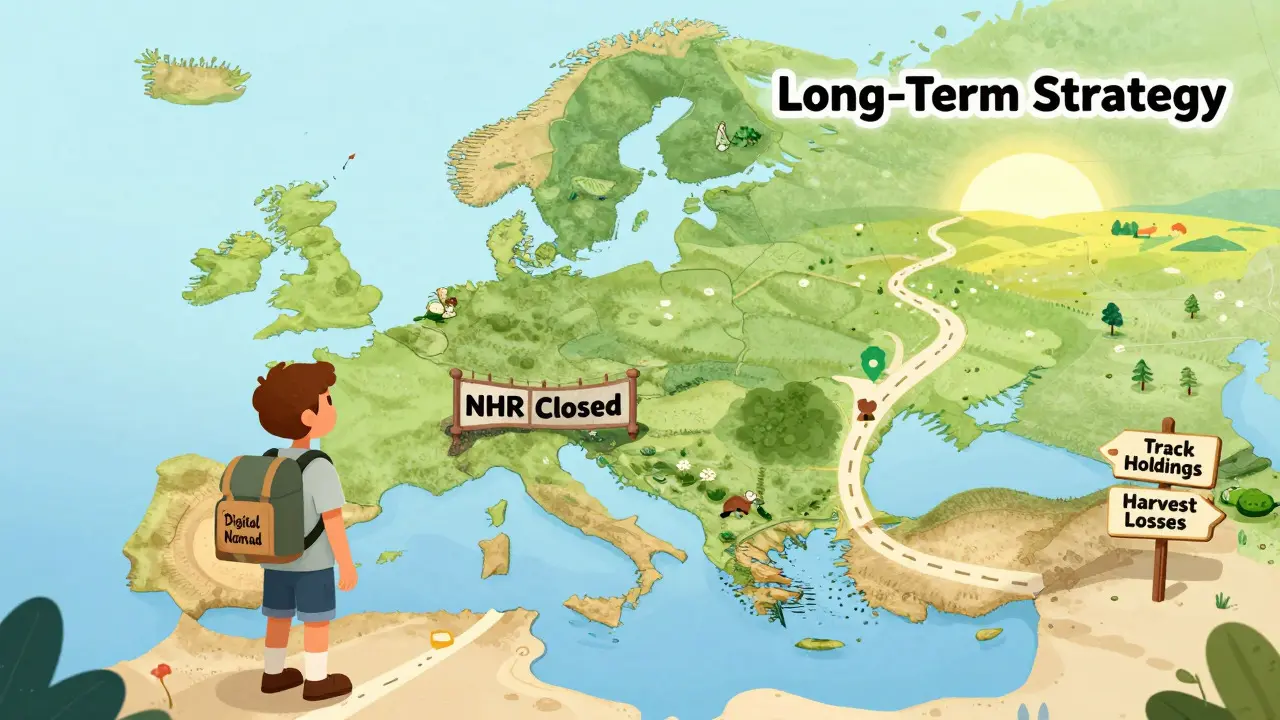
The End of NHR and Its Impact on Crypto Investors
A major topic in Portuguese crypto circles is the Non-Habitual Resident (NHR) program. For years, NHR offered a lucrative tax advantage, allowing eligible individuals to enjoy a flat 20% tax rate on foreign-sourced income, including crypto gains, for ten years. This was significantly lower than the standard 28% rate.
However, the NHR program closed to new applicants in January 2024. New residents moving to Portugal after this date no longer qualify for these benefits. They face the standard tax rules: 28% for short-term gains and 0% for long-term holdings. Existing NHR beneficiaries retain their status for the duration of their ten-year period, creating a stark divide between old and new residents.
This change has shifted the competitive landscape. Countries like Spain and Germany offer different structures, but Portugal’s complete exemption for long-term holdings remains unique in Europe. While the 28% short-term tax is a hit, the ability to pay zero tax on gains after one year keeps Portugal attractive for serious investors. Digital nomads and remote workers need to weigh the loss of NHR against the quality of life and the remaining tax incentives.
Strategic Planning for 2026 and Beyond
As we move through 2026, the regulatory environment continues to evolve. The European Union’s Markets in Crypto-Assets (MiCA) regulation is now fully in effect, bringing stricter reporting requirements for exchanges operating in Portugal. This means your exchange data is more likely to be shared with the AT automatically. Hiding transactions is no longer a viable strategy.
To optimize your tax position, consider these steps:
- Track Holding Periods: Use spreadsheet software or dedicated crypto tax tools to monitor exactly when you acquired each asset. Set reminders 30 days before the 365-day mark to decide whether to hold or sell.
- Harvest Losses: If you have short-term losses, you can offset them against short-term gains. This reduces your taxable base. Ensure you claim these losses in Anexo G.
- Review Integration Options: Before filing, calculate both the 28% flat rate and the integrated income tax scenario. Choose the lower liability.
- Document Everything: Keep records of all transactions, including gas fees, staking rewards, and airdrops. The burden of proof lies with you during an audit.
The 28% tax is not a death knell for crypto investing in Portugal. It is a cost of doing business that encourages discipline and long-term thinking. By understanding the rules, tracking your holdings, and planning your exits around the 365-day threshold, you can minimize your tax burden and keep more of your digital wealth.
Is cryptocurrency tax-free in Portugal in 2026?
Cryptocurrency is not entirely tax-free. Gains from assets held for more than 365 days are exempt from tax. However, short-term gains (held less than 365 days) are taxed at a flat rate of 28%. Passive income like staking rewards is also taxed at 28%.
How do I calculate the 28% crypto tax?
Calculate the profit by subtracting the purchase price from the sale price. Multiply the profit by 0.28. For example, if you made €1,000 profit on a short-term trade, you owe €280 in taxes. You can choose to integrate this gain into your total income instead, which may result in a lower or higher tax depending on your income bracket.
Can new residents still get NHR tax benefits for crypto?
No. The Non-Habitual Resident (NHR) program closed to new applicants in January 2024. New residents must follow the standard tax rules, which include the 28% tax on short-term crypto gains. Existing NHR holders retain their benefits for up to 10 years.
What form do I use to declare crypto taxes in Portugal?
You file Modelo 3 via the Portal das Finanças. Use Anexo G for capital gains, Anexo E for passive income like staking, and Anexo B if you are classified as a professional trader.
Are staking rewards taxable in Portugal?
Yes. Staking rewards are considered passive income and are taxed at a flat rate of 28% at the time they are received. This applies regardless of how long you hold the rewarded tokens afterward.
Nick Darring
Look, I know everyone is panicking about the 28% rate but honestly, if you are just buying and holding for a year or more, it's basically free money compared to what we pay in the US. The real issue here is the staking rewards part because that gets taxed immediately which sucks for cash flow. I mean, who has extra euros lying around to pay taxes on tokens they haven't even sold yet? It feels like a trap for people trying to earn passive income through DeFi. Also, the whole professional trader thing is super vague so you could easily get hit with higher rates if you trade too much. Just be careful with your records.
Alex Di Mango
I think this is actually a pretty fair system compared to other countries. It encourages long-term thinking which is good for the market stability anyway. If you can wait a year, you keep all your profits which is amazing. For those trading daily, well, maybe they should expect to pay their share since they are generating active income. It's not perfect but it's workable if you plan ahead. Plus, Portugal still has a great quality of life so the tax might be worth the lifestyle upgrade.
Carl Michaud
The MiCA regulation is just the beginning of the end for privacy. They want every single swap tracked and reported to the AT automatically. This isn't about fairness, it's about control. The government wants to see every satoshi moving through your wallet. Once they have that data, they can retroactively apply rules whenever they feel like squeezing more revenue from crypto holders. Don't trust the 'exemptions' because the definition of what constitutes a taxable event changes constantly. You are walking into a surveillance state disguised as a tax haven.
Namrata Mapgaonkar
omg this is so complicated :((( i thought portugal was tax free for crypto lol. now i am scared to touch my bitcoin. does this mean if i stake eth i have to sell some to pay tax right away?? that sounds stressful. hope there is a simple way to do this without hiring an expensive accountant. thanks for sharing though! :)
Don Fizy
Hey Namrata, don't worry too much! It's definitely more complex than before but manageable. Yes, staking rewards are taxed when received, so you might need to sell a small portion to cover the 28%. But remember, if you hold the rest for over a year, that growth is tax-free. Many people use software like Koinly or CoinTracker to automate the reporting. It saves a ton of headaches. You got this! (Y)
Eden Tadesse
i read this twice and still confused about the anexos. Anexo G for gains and E for staking right? what if i swap tokens on uniswap? is that a sale? seems like every click is a tax event now. ugh.
Eric Zehr
To clarify Eden, swapping one crypto asset for another is indeed considered a disposal event in Portugal. So yes, swapping ETH for USDC triggers a capital gain calculation based on how long you held the ETH. If you held it less than 365 days, you owe 28% on the profit. If more, it's exempt. Keep detailed records of every swap date and value in EUR at the time of transaction. It's tedious but necessary for compliance.
Rita Dutta
the philosophical implication of taxing digital scarcity is profound. by imposing a 28% levy on short term speculation, the state asserts its dominance over decentralized value transfer. yet, the exemption for long term holdings suggests a tacit acknowledgment of crypto as a store of value rather than mere currency. this dual track system mirrors the ancient dichotomy between merchant and landowner. the transient trader pays tribute while the patient hoarder enjoys sovereignty. interesting how bureaucracy attempts to categorize the uncategorizable blockchain ledger.
Matt Kay
boring. just pay the tax and move on. most guides make it sound harder than it is. buy, hold, forget. done.
Rodmun Tarnowski
It is imperative to note that the integration option for high earners is rarely beneficial; however, for students or low-income individuals, it can significantly reduce the tax burden. One must calculate both scenarios meticulously before filing Modelo 3. The deadline of June 30th is strict, and penalties for late filing are severe. Do not neglect this responsibility.
Candice Cornett
everyone says hold for a year but what if the market crashes? then you are stuck with worthless coins paying no tax but also having no money. the system punishes flexibility. it forces you to gamble on price stability for 365 days. ridiculous.
Lance Jantz
Ah, but Candice, you miss the point entirely. The volatility is the feature, not the bug. By forcing a one-year hold, Portugal filters out the speculators and keeps only the true believers. It is a crucible for the soul of the investor. Those who cannot wait are unworthy of the gains. The 28% tax is merely a toll booth for the impatient masses. We elites understand that time is the ultimate arbitrage.
Dominic Greco
They are tracking everything 🚨👀. The NHR ending was just step one. Next they will ban cold wallets. Stay woke. The 28% is a distraction from the real theft happening via inflation and data harvesting. #CryptoFreedom
Dave Kjendal
Most people fail because they dont track gas fees. Gas fees are deductible expenses if you are a pro trader but for casual investors it's messy. Just use a spreadsheet. Simple is best. Dont overthink it.
Paul Smith
This is super helpful info! 🇵🇹💰 I'm planning to move to Lisbon next year so knowing about the 365-day rule is crucial. I'll definitely set up reminders in my calendar. Thanks for breaking down the Annexes too, that was confusing before. 👍
Prudence Flemming
the jargon here is dense. annex g e b. why cant they just say form 1 2 3. also the distinction between passive and active income is blurry. if i run a node is that work or investment? the law doesnt care about nuance only boxes. fit or die.
Sean Rowland
You are all missing the critical nuance regarding the definition of 'professional trader'. The AT looks at frequency, volume, and sophistication. If you use leverage or algorithms, you are likely a pro. This means progressive tax rates up to 53% plus social security. It is a punitive measure against sophisticated actors. Most retail investors are safe but hedge funds will flee. The regulatory arbitrage window is closing rapidly.
Kat Bennett
I've been living in Porto for two years and I can confirm that the tax office is getting better at checking crypto transactions. They receive data from exchanges automatically now. So hiding gains is risky. I hired a local accountant who knows crypto and it was worth every euro. She helped me offset some losses against gains which saved me a lot. Definitely recommend doing your homework early.
Phil Babb
LISTEN UP EVERYONE!!! The key is LOSS HARVESTING!!! If you have losers, sell them before December 31st to offset your winners!!! It's legal and smart!!! Don't let the government take more than they should!!! Fight back with math!!! 💪💪💪
Sus Sawyer
Phil is right about loss harvesting but be careful with wash sales if you plan to rebuy immediately. Portugal doesn't have a strict wash sale rule like the US but it's good practice to wait a bit. Also, keep screenshots of all trades. The Portal das Finanças can be glitchy so have backups. Good luck guys!
Aryan MISHRA
The tax structure is inefficient. Progressive taxation penalizes success. Flat rate is simpler but regressive. Integration allows optimization. Use Anexo B if you are a business. Use Anexo G if you are an investor. Calculate marginal rates. Optimize. Done.
Ryan Robinson
man i wish i knew this before i sold my btc last month. guess i owe the 28% now. lesson learned. gonna hold my eth till next year atleast. thanks for the heads up everyone. hope the market goes up so i can pay the tax lol.
Amor Jordan
It's really dramatic how quickly things changed from tax-free to 28%. I feel bad for new residents who missed the NHR boat. But hey, at least long-term holders are safe. Just need to be patient. Patience is a virtue after all. Let's support each other through these tax seasons.